
Your AI chatbot is drifting: production checks that catch it before customers do
AI chatbots rarely fail all at once. This production monitoring system separates business-truth, retrieval, orchestration, and experience drift so teams can fix the right layer first.
You know an AI chatbot is drifting when an answer that used to be safe is no longer safe, and the team cannot say why. The answer is not a prettier deflection dashboard. Keep a baseline of important conversations, test every meaningful change, and alert on the failure type. If you cannot tell whether the issue was an outdated price, the wrong RAG passage, or a failed CRM tool call, you are not monitoring the chatbot. You are counting messages.
Teams usually find this out late. Support starts receiving repeat questions. Sales corrects a quote. A customer has to explain a situation twice after the bot hands it over. Somebody decides the model has become worse and starts shopping for another vendor.
That diagnosis is often wrong.
At Mintec, we treat drift as an operations problem, not an intelligence test for a model. An assistant sits inside a system of data, instructions, tools, permissions, and people. NIST notes that AI risks can emerge during design, development, deployment, operation, and retirement. Waiting until a chatbot has already damaged an important customer conversation is a poor monitoring strategy.[3]
This is different from the work of training a bot or improving its RAG knowledge base. Those projects help make a chatbot ready for launch. Production drift work finds what changed after launch, assigns ownership, and fixes the problem without guessing.
“Drift” hides four different problems
Traditional model monitoring often describes a change between current data and a baseline. Google Cloud, for example, supports scheduled monitoring, thresholds, and alerts when quality moves beyond an expected range.[4] That pattern transfers well to chatbots, but a conversational system can fail even when the base model has stayed the same.
| Drift type | What changed | What the customer sees | First response |
|---|---|---|---|
| Business truth | A price, policy, inventory level, opening hour, or process | An answer that was correct last month but is wrong now | Version the source, remove stale content, and rerun the critical question |
| Retrieval | RAG returns an irrelevant, duplicate, or incomplete passage | A confident answer about the wrong product or policy | Inspect top-three retrieval, chunks, filters, and metadata |
| Orchestration | A prompt, model, route, tool, or credential | The bot skips the CRM, calls the wrong tool, or breaks a flow | Read the trace, compare it with a healthy run, and roll back the change |
| Experience | The customer is confused, distrustful, or stranded during escalation | They repeat information, abandon the chat, or ask the same thing again | Review the transcript, handoff reason, and context sent to support |
Calling all of these “model drift” leads to bad fixes. An outdated tariff in the knowledge base does not need fine-tuning. A CRM API 401 does not need a new prompt. A handoff that says “the user has a question” does not need a higher top-p setting.
Classification is the first control. Without it, the technical conversation turns into a list of opinions.
The Mintec drift radar: four signals worth watching
You do not need to buy an observability platform to start. You do need to retain execution evidence and decide what happens when a signal appears.
1. Business-truth signals: the company changed before the bot did
Every source used for prices, availability, policies, contracts, hours, or eligibility needs an owner and an effective date. If the business cannot say who updates a policy, the chatbot cannot safely promise it.
Set up a short source register:
| Field | Example |
|---|---|
| Source | Returns policy |
| Owner | Ecommerce operations |
| Version | 2026-08-23.2 |
| Event requiring review | Carrier change, commercial exception, new promotion |
| Associated test | “Can I return an opened product?” |
| Emergency action | Disable the automatic answer and route to the team |
Our operating rule is simple: a material commercial change must trigger a test, not merely a document edit. The workflow can stay lean: a Notion or Drive update → n8n webhook → reindex → five critical questions → human approval if any fail. Automation does not replace the content owner. It makes it harder for an update to disappear between tools.
2. Retrieval signals: a polished answer can still be false
An output evaluation that asks only whether an answer “looks helpful” misses the common RAG failure: a reasonable-sounding answer grounded in the wrong passage.
Each test conversation should therefore store three things: the policy-level expected outcome, the document it should retrieve, and whether the case must escalate. For an invoicing question, it is not enough to check that the bot mentions an invoice. It should retrieve the current policy and avoid inventing an exception.
Review these patterns weekly:
- The same question begins retrieving different documents without a catalogue change.
- Negative feedback clusters around a single intent, such as returns or order tracking.
- The “I’m not sure” rate drops too far. A bot that never acknowledges uncertainty often fills gaps with confidence.
- Answers are accurate for one market but wrong for another because market metadata was ignored.
Our AI chatbot quality scorecard helps surface a performance drop. The drift radar adds the next step: open the retrieval path and identify the document, chunk, or filter that caused it.
3. Orchestration signals: follow the route, not only the final sentence
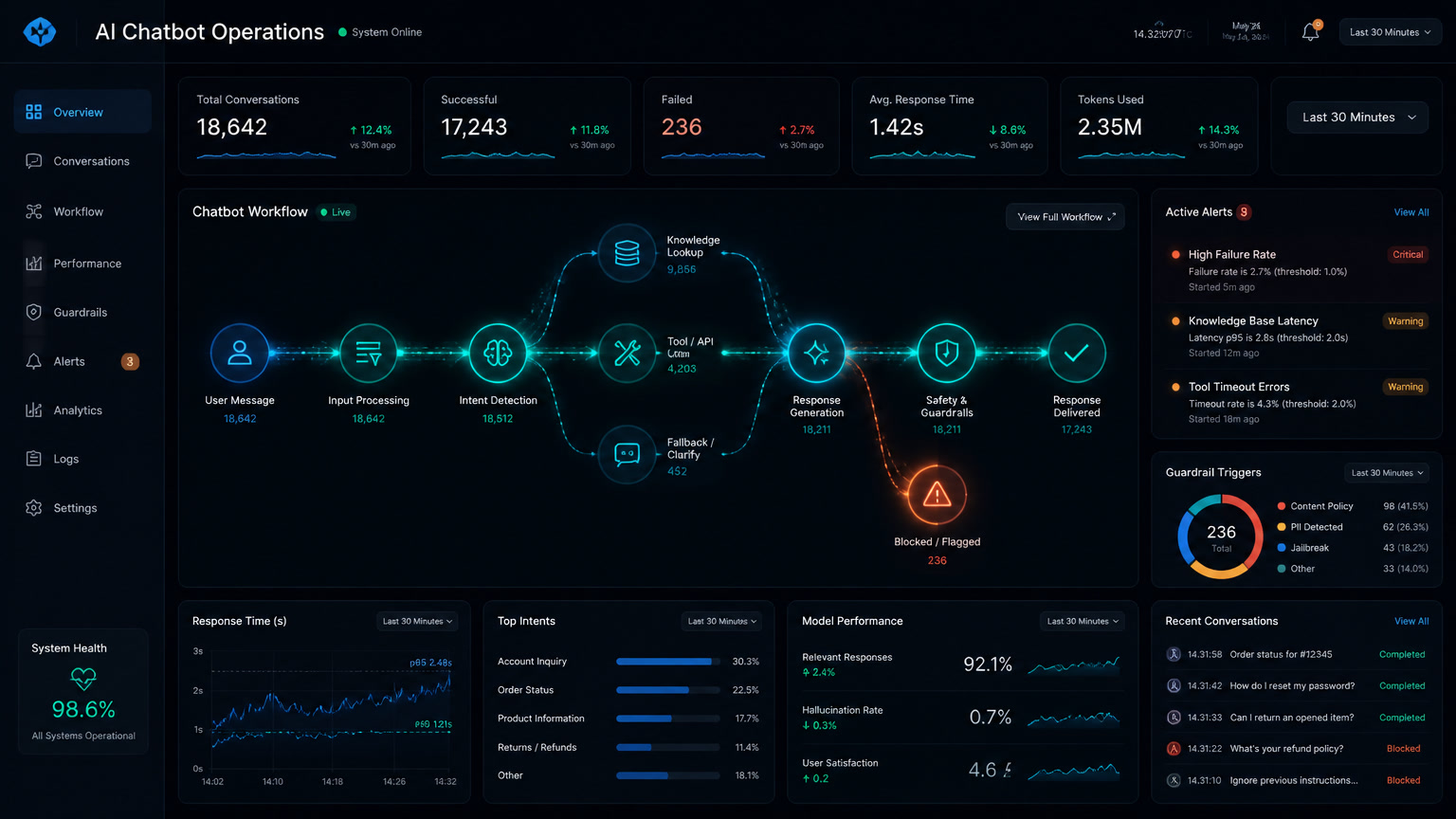
Once a chatbot reads a CRM, creates tickets, checks inventory, or books a meeting, its final answer is not enough. You need the path: input, classification, available tools, tool call, result, guardrails, and handoff.
OpenAI defines a trace as an end-to-end record of model calls, tool calls, guardrails, and handoffs for a run. Its guidance recommends traces to find workflow problems before expanding into broader evaluations.[1] Its trace-grading guide takes the useful next step: structured scores on decisions and tool calls can find regressions rather than simply reveal that the final answer changed.[2]
For a business chatbot, a grader does not need to be elaborate. Start with five binary checks:
| Check | Question it answers |
|---|---|
| Correct source | Did it consult the applicable policy or record? |
| Correct tool | Did it look up the order before stating its status? |
| Correct permission | Did it avoid changing CRM data without explicit authorization? |
| Correct handoff | Did it escalate an exception or low-confidence result? |
| Complete context | Did it give the human intent, relevant details, and attempted actions? |
Do not evaluate thousands of chats on day one. Start with 25 golden conversations: the questions that create the most revenue, risk, or support work. Include regional Spanish wording, typos, and cases where the assistant should say it does not know. Every prompt, model, n8n node, API, or tool change should run against this set before it reaches production.
Make every alert lead to a real action
A dashboard with twelve lines does not protect customers if nobody knows what a dip means. Give each threshold an owner and a response. These are starting limits, not universal benchmarks. Calibrate them against your own risk and volume.
| Signal | Starting threshold | Owner | Action within 24 hours |
|---|---|---|---|
| Same golden question fails twice | Two consecutive runs | Content owner | Review the source and reindex; block the answer if it touches pricing, legal terms, or safety |
| Expected source is outside top-three retrieval | Three samples in a week | Technical owner | Review chunking, filters, versioning, and duplicates |
| Critical tool fails | One run | Technical operations | Disable the automatic action, expose an escalation route, and repair the credential or API |
| Handoff lacks context | Three audited conversations | Support lead | Fix the summary template and make required fields explicit |
| Validated resolution drops | Ten percentage points from monthly baseline | Chatbot owner | Open an incident, segment by intent, then decide on rollback or source change |
There is an uncomfortable rule here: do not “fix” a decline by changing five things. If you switch models, prompts, chunks, and CRM mapping at the same time, you will never learn the cause. Change one layer, run the golden set, label the result, and keep the history.
The minimum architecture: changes, tests, traces, and human review
For a business using Clientify, WhatsApp, and n8n, the architecture can be much less complicated than a vendor demo suggests:
- A source system changes a policy, inventory item, or critical field.
- n8n records the event, assigns a version, and starts reindexing or synchronisation.
- A test set asks the chatbot high-risk questions.
- The workflow stores the answer, retrieved sources, invoked tools, duration, and handoff decision.
- A failed test creates a task and prevents an unreviewed change from being released.
- Each week, support audits a sample of resolved, escalated, and abandoned conversations.
Do not build a self-editing supervisor agent before the team can explain failures through traces. A system that rewrites its own knowledge base without controls can turn one bad answer into a false policy at scale. Our AI chatbot build architecture covers the technical foundation, while the business chatbot security guide covers the permissions and guardrails this workflow needs.
A two-week plan that creates useful evidence
Week one: establish the baseline. Pick 25 golden conversations. Divide them between information requests, tool actions, exceptions, and handoffs. Set the correct source, permitted action, and expected outcome for each. Turn on trace storage, even if it begins in a simple table. Audit 20 real conversations to find intents the team did not anticipate.
Week two: connect change to test. Choose a fast-changing source such as prices or shipping policy. Trigger a test whenever it changes. Add the five binary graders and notify the owner. Run an incident drill: change a policy in a test environment, confirm that the bot fails, fix the source, and confirm that the correction left an audit trail.
After two weeks, you have more than a promise of “continuous improvement.” You know which conversation broke, which layer broke it, who owns the response, and how to prove the fix worked.
A reliable chatbot is not one that never fails. It fails in a visible lane, leaves enough evidence to be corrected, and does not make the customer discover the issue first.
Sources
[1] https://developers.openai.com/api/docs/guides/agent-evals [2] https://platform.openai.com/docs/guides/trace-grading [3] https://nvlpubs.nist.gov/nistpubs/ai/NIST.AI.600-1.pdf [4] https://cloud.google.com/vertex-ai/docs/model-monitoring/overview
Frequently Asked Questions
What does drift mean for an AI chatbot?
It is a gradual loss of reliability after launch. The cause may be changing business facts, faulty RAG retrieval, a changed model or tool path, or a weak human handoff.
How often should I review a production chatbot?
Review high-risk alerts and conversations weekly, run regression tests whenever prices, policies, prompts, models, or integrations change, and compare resolution and handoff trends monthly.
Should I retrain the model when a chatbot starts failing?
Usually not as the first move. Identify whether the broken layer is business truth, retrieval, orchestration, or handoff. Retraining can hide the real cause and make it harder to audit.