

AI CRM for Small Businesses: Complete Guide
Discover how to implement an AI-powered CRM in your small business. Statistics, benefits, tools, and a 4-week implementation plan.
AI CRM for Small Businesses: Complete Guide
Artificial intelligence is reshaping how small businesses manage customer relationships. If you run a small or mid-sized company, you've probably asked yourself whether an AI-powered CRM is worth the investment.
The short answer is yes. But not because AI is trendy — because of what it lets you do: stop drowning in manual tasks and start closing more deals. This guide covers the concrete data, real-world tools, and a step-by-step plan to get you there.
What Is an AI-Powered CRM?
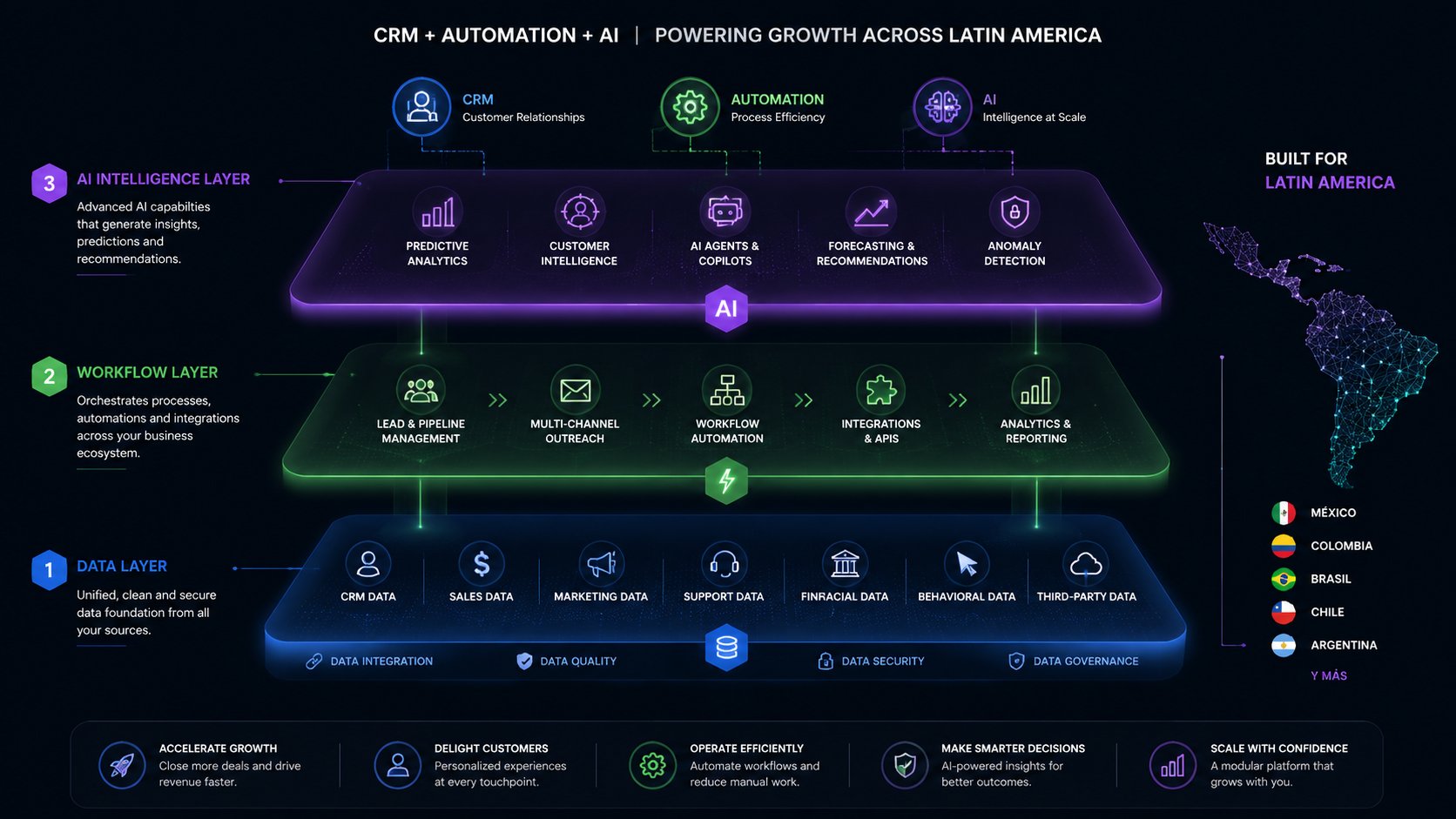
An AI-powered CRM is a customer relationship management system that uses machine learning and automation to predict customer behavior, recommend next actions, and handle routine tasks without human intervention. It's not just a database on steroids. It's a system that learns from every interaction and becomes more valuable the more you use it.
Here's what sets it apart from a traditional CRM:
- Intelligent automation: automatic follow-ups triggered by customer behavior, not manual rules
- Predictive analytics: identifies which customers are most likely to buy — or churn
- Conversational AI: chatbots and voice assistants that qualify leads 24/7
- Automated lead scoring: prioritizes contacts without any manual input
- Natural-language reporting: ask "show me this month's sales compared to last month" and get an instant answer
The Statistics That Justify the Investment
Let's start with the numbers. Data-driven decisions beat gut feelings every time.
Market & Adoption
- The CRM market reached $71 billion in 2025 and is projected to hit $262 billion by 2032 — a compound annual growth rate of 12.6%
- 80% of organizations already use AI to support customer-facing decisions
- 9 out of 10 Fortune 500 companies have a CRM implemented
- Among small businesses, CRM adoption grew 45% in the last two years
Business Results
- 70% of organizations report significant improvement in customer engagement after adding AI to their CRM
- Small businesses that implement AI solutions see an average 30% boost in productivity
- A small company can save up to 30 hours per week by automating repetitive tasks with an intelligent CRM
- 30% of CRM users plan to integrate AI capabilities directly into their workflows, up from 18% in 2022
- 71% of users trust AI-generated real-time insights to make sales decisions
The Realistic Side
- 25% of CRM implementations fail because of poor data quality
- 22% of businesses still resist due to data security concerns
- Only 40% of companies report an internal adoption rate of 90% or higher
What an AI CRM Can Do for Your Small Business
Let's get practical. These are the capabilities that deliver the most value day to day.
1. Automatic Lead Qualification
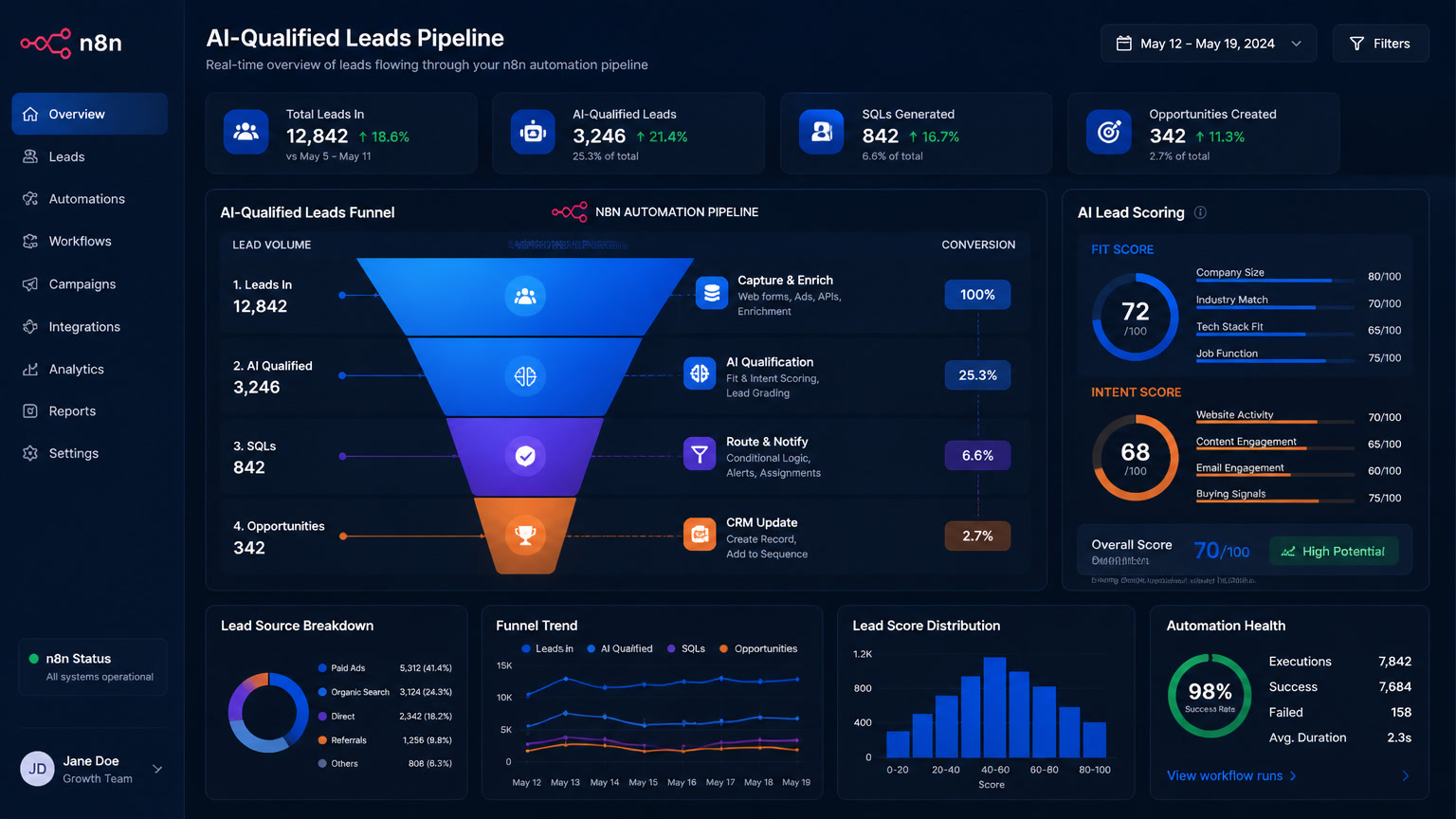
Imagine a visitor lands on your website, downloads a resource, and asks your chatbot about pricing. An AI CRM can:
- Assign a predictive score to that lead in seconds
- Determine whether they're cold, warm, or hot based on historical behavior
- Route them to the correct sales pipeline automatically
- Schedule a personalized follow-up without anyone lifting a finger
2. Churn Prediction
AI analyzes behavioral patterns that signal a customer is about to leave: fewer logins, unresolved support tickets, unopened emails. When it detects these signals, it can trigger an automatic retention campaign — before it's too late. For a deeper look at how AI transforms customer management, check out our guide on AI-Powered CRM.
3. Follow-Up Automation
This is the most immediate win. An AI CRM can:
- Send follow-up emails at the optimal time for each contact
- Personalize the message based on the buyer's stage
- Remember birthdays, anniversaries, and key dates
- Suggest the best next step for every lead
4. Chatbots and Conversational Assistants
A chatbot integrated with your CRM doesn't just answer FAQs. It can identify the visitor, pull up their history, gauge intent, and even book a meeting — all without human involvement. For more on conversational AI, read What Is a Chatbot and How Can It Help Your Business?
5. Reporting and Forecasting
Forget spending hours in spreadsheets. AI generates sales forecasts from real data, spots trends your team would miss, and tells you — in plain English — what's happening with your business. If you're exploring broader automation, our No-Code AI Automation article covers how to build these workflows without a development team.
How to Implement an AI CRM in Your Small Business (4-Week Plan)
Week 1: Diagnosis and Selection
Before choosing a tool, answer these questions:
- How many contacts do you currently manage?
- Which processes consume the most time?
- What integrations do you need (email, web, WhatsApp, social media)?
- Is your team ready to adopt new technology?
Based on your answers, evaluate options like HubSpot, Salesforce Einstein, Zoho CRM with AI, and Pipedrive — all of which offer AI features at different price points suitable for small businesses.
Week 2: Configuration and Migration
- Clean your existing data before migrating (remember: 25% of failures are due to dirty data)
- Configure your sales pipelines and custom fields
- Connect basic integrations (email, calendar, website)
- Define lead scoring criteria
Week 3: Automation and Training
- Set up basic follow-up automations
- Train your team on daily system usage
- Establish clear success metrics (qualified leads, response time, conversion rate)
- Activate chatbots and conversational assistants
Week 4: Optimization and Scaling
- Review the first batch of AI-generated insights
- Adjust predictive models based on real results
- Expand integrations (WhatsApp, social media, advertising)
- Document the process for future iterations
Looking for more on scaling your automation? Read Marketing Automation: The Best Way to Sell on Autopilot for additional strategies.
Common Mistakes to Avoid
1. Implementing Without Cleaning Data First
AI runs on data. If your data is dirty, AI will give you wrong answers delivered with high confidence. Invest time in cleaning your database before activating any predictive features. For a broader framework, see How to Improve Customer Experience with CRM.
2. Expecting Instant Results
An AI CRM needs time to learn. The first 30–60 days are a calibration period. Don't judge the tool by its first-week performance.
3. Ignoring Team Adoption
60% of companies struggle with internal adoption. If your team won't use the system, it doesn't matter how smart it is. Invest in training and show quick wins to build momentum.
4. Buying More Features Than You Need
Start with the basics: follow-up automation, simple lead scoring, and a chatbot. Add advanced features (predictive analytics, sentiment analysis, automated reporting) only after the fundamentals are working well.
Industry Use Cases
E-Commerce
An online business can use AI CRM to:
- Segment customers by purchase behavior and send personalized offers
- Predict high-demand products and adjust inventory
- Identify high-value customers and prioritize their service
- Automate post-sale follow-ups and abandoned cart recovery
For more on scaling an online business, check out E-Commerce in 2026: Scaling Without Breaking.
Professional Services
Consultancies, agencies, and law firms benefit from:
- Automated lead capture from websites and social media
- Intelligent follow-up on sales opportunities
- Automated reminders and deadline management
- Auto-generated performance reports for each client
Retail and Local Business
Physical stores can leverage:
- Unified customer data from point-of-sale, web, and social media
- Automated marketing campaigns based on purchase history
- Intelligent loyalty programs
- Chatbots for after-hours customer service
The Future of AI CRM
By 2028, AI assistants are expected to not just recommend actions but execute them autonomously. That means:
- Sales negotiations partially managed by AI
- Contracts generated and reviewed automatically
- Hyper-personalized real-time experiences
- Full integration with voice assistants and augmented reality
Businesses that start integrating AI into their CRM today will be in a much stronger position when these capabilities become the industry standard. For a glimpse of what's next, read Autonomous AI Agents: The New Digital Workforce.
Related articles
- Complete Guide to AI for Business: Automation, CRM & Growth
- AI Agents vs. Traditional Automation: What Actually Works for Business Processes
- AI-Powered CRM: Beyond Traditional Customer Management
Conclusion
Five years ago, implementing an AI-powered CRM required a large-company budget and a dedicated technical team. Not anymore. The tools are accessible, the success stories are documented, and the real risk isn't implementing poorly — it's not implementing at all.
The 4-week plan above works if you execute it with discipline: diagnose, clean your data, configure the basics, then scale gradually. You don't need the most expensive CRM on the market. You need the one your team will actually use.
Ready to take the next step? At Mintec, we help small businesses implement AI-powered CRM systems — from tool selection to full process automation. Contact us for a free diagnostic consultation and let's build a CRM strategy that grows your business.