
Clientify July 2026 Update: Health Center, Dashboards, and AI Chatbot — What Changes for Agencies and SMBs
Clientify launches Health Center for automated CRM data quality diagnostics, 5 customizable dashboards, and a redesigned AI chatbot. We analyze how these three features change CRM management for agencies and SMBs in Latin America.
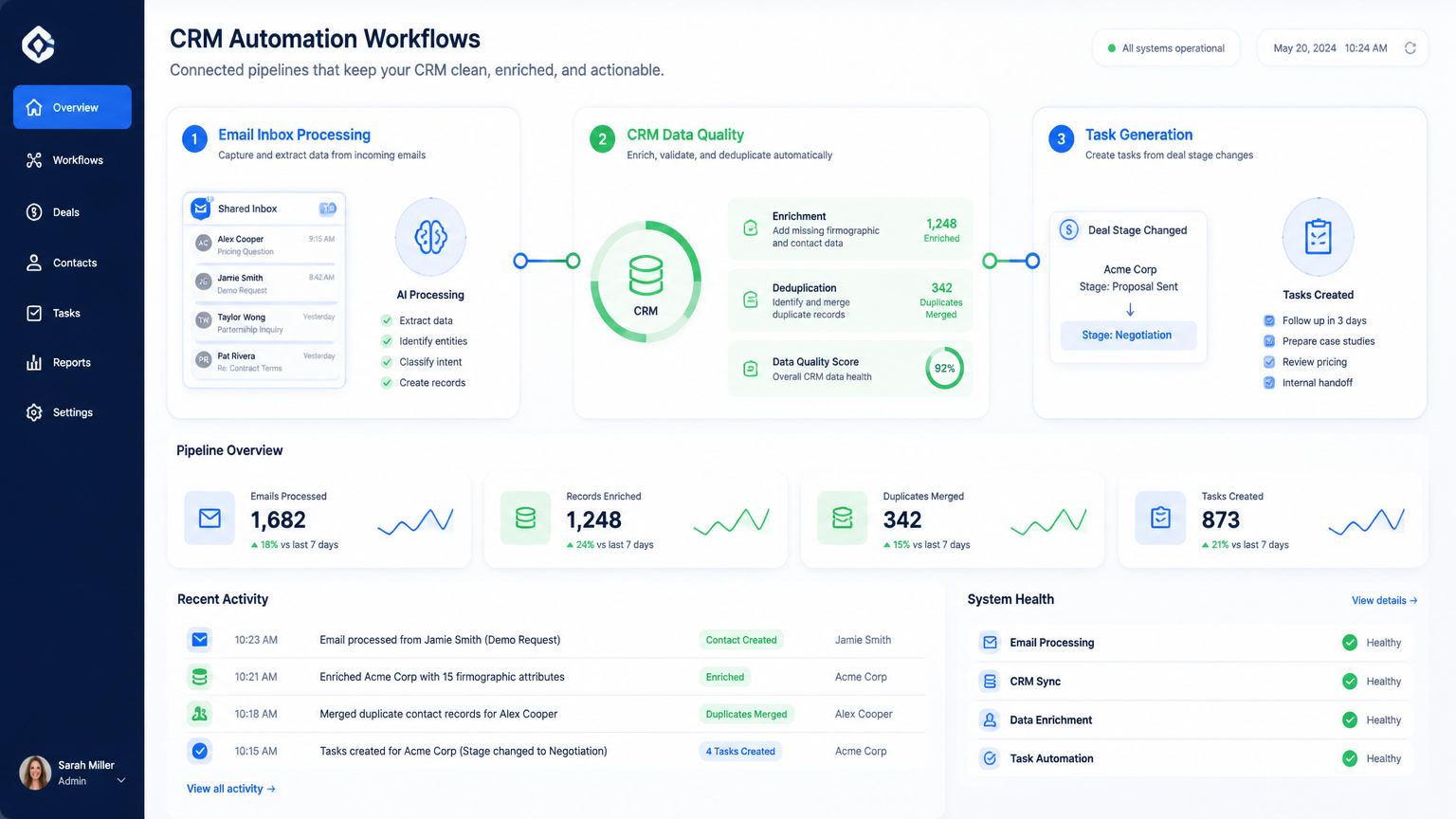
Clientify shipped three features in July 2026 that change how agencies and SMBs manage their CRM: Health Center (automated data quality diagnostics), 5 customizable dashboards, and a redesigned AI chatbot. These aren't isolated updates — they form an integrated monitoring, reporting, and engagement ecosystem that replaces workflows that previously required external tools or manual processes.
Mintec is a Clientify Partner. We implement the platform for clients across Mexico, Colombia, Central America, and Peru. We got early access to these features before the public launch, and we've been testing them with real client deployments. Here's what we found.
Health Center: The End of Blind Data Quality Diagnosis
The most common problem we see in CRM implementations is that teams know their data is bad — but they don't know how bad or where exactly. They feel the friction: cold leads, overdue tasks, stalled pipelines. But they can't point to a single number that says "your CRM has a specific problem in the quotation stage with contacts untouched for 60 days."
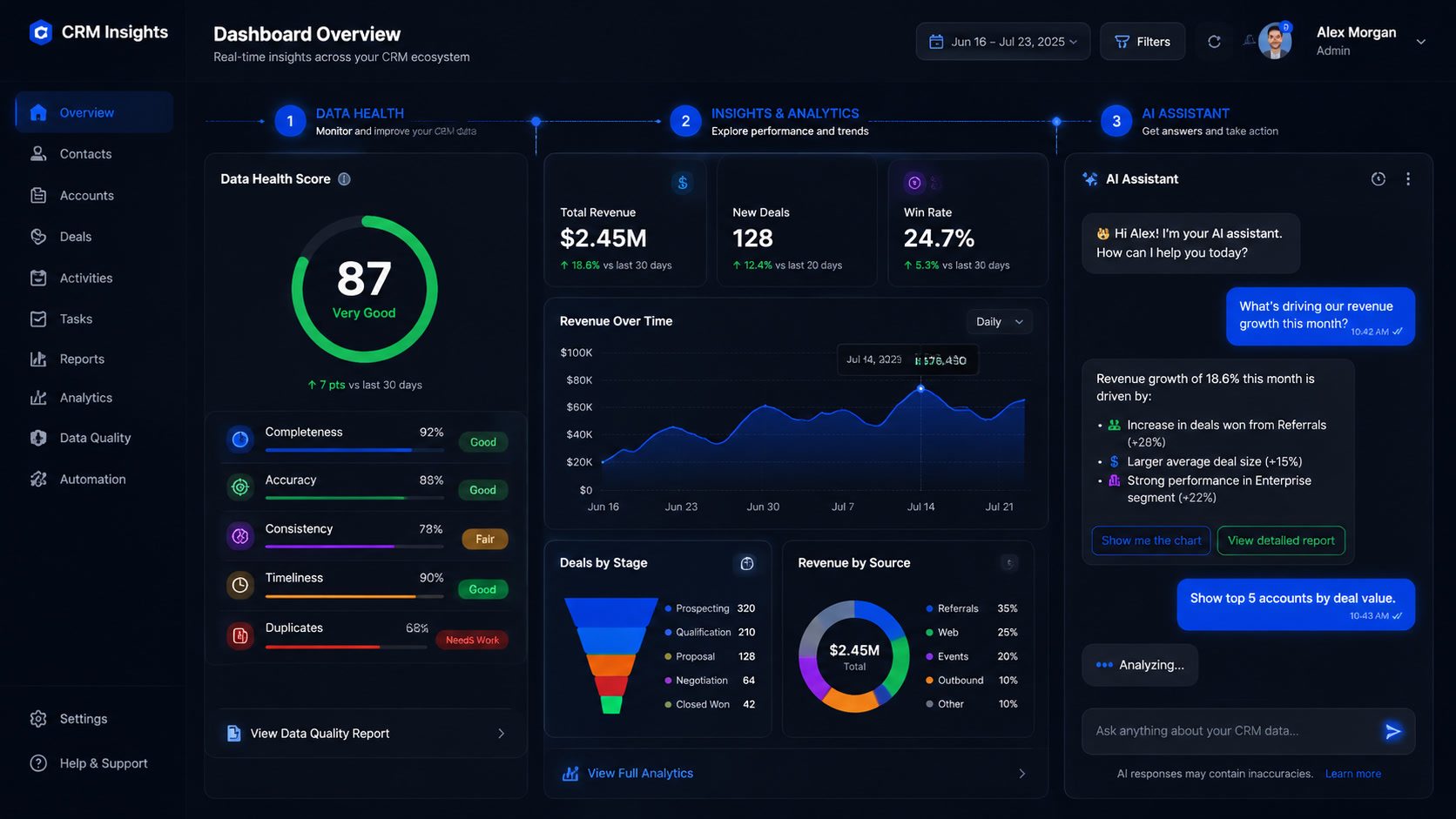
Health Center solves this. It's a diagnostic panel that automatically analyzes:
- Outdated contacts: flags records with bounced emails, wrong phone numbers, or outdated company information.
- Stalled pipeline stages: detects deals stuck in a specific stage for more than a configurable number of days.
- Overdue tasks and irregular activity: shows which tasks are past due and which team members have below-average activity.
- Funnel coverage gaps: alerts when pipeline stages have abnormally few deals compared to historical averages.
Before Health Center, diagnosing CRM health meant exporting to Excel, manually cross-referencing data, and losing half a day each month. Now Clientify generates this diagnostic automatically and sends alerts when something needs attention.
Real case: We implemented Clientify for a marketing agency in Guadalajara managing 4,000+ contacts. Their first Health Center report revealed that 18% of leads had incorrect phone numbers and 12% of follow-up tasks were more than 30 days overdue. In two weeks they cleaned the data and re-engaged leads that were "dead" only because nobody had contacted them.
The 5 New Dashboards: Agency-Grade Reporting Without External Tools
Clientify added five preconfigured yet fully customizable dashboards:
| Dashboard | What It Measures | Who It's For |
|---|---|---|
| Sales | Pipeline, conversion by stage, forecast, close rate by rep | Sales teams and managers |
| Marketing | Campaigns, leads by channel, ROI by campaign, open rates | Marketing managers and agencies |
| Customer Support | Open tickets, response time, satisfaction scores, active chats | Support and customer success teams |
| Productivity | Completed tasks, team activity, goal attainment | Team leads and operations |
| Results | Consolidated view across all areas | CEOs and business owners |
What we value most as an agency is that dashboards can be shared with clients without granting full CRM access. This eliminates the need for Google Data Studio, Power BI, or custom integrations for 80% of agency reporting scenarios.
Previously, showing a client their email campaign performance meant exporting data, building a presentation, or setting up an external integration. Now the client has a live dashboard, updated in real time, with zero manual effort from our team.
Redesigned AI Chatbot: From FAQ Bot to Lead Qualification Engine
Clientify's chatbot isn't new, but the July 2026 version adds AI capabilities that fundamentally change its role in the engagement strategy.
The previous version handled predefined responses with conditional flows. It worked for basic FAQs, but any conversation deviating from the script required manual transfer — and the human agent would have to start the conversation from scratch.
The redesigned chatbot now:
- Qualifies leads automatically using contextual questions based on visitor profile and browsing behavior.
- Schedules meetings directly in the CRM's integrated calendar without human intervention.
- Responds with generative AI to open-ended questions about products, pricing, and availability.
- Transfers to human agents when it detects purchase intent or complex queries, passing the full conversation history.
For a deeper dive on building effective handover flows between bots and humans, see our article on AI customer support automation, where we cover the metrics and architecture patterns that make these transitions seamless instead of frustrating.
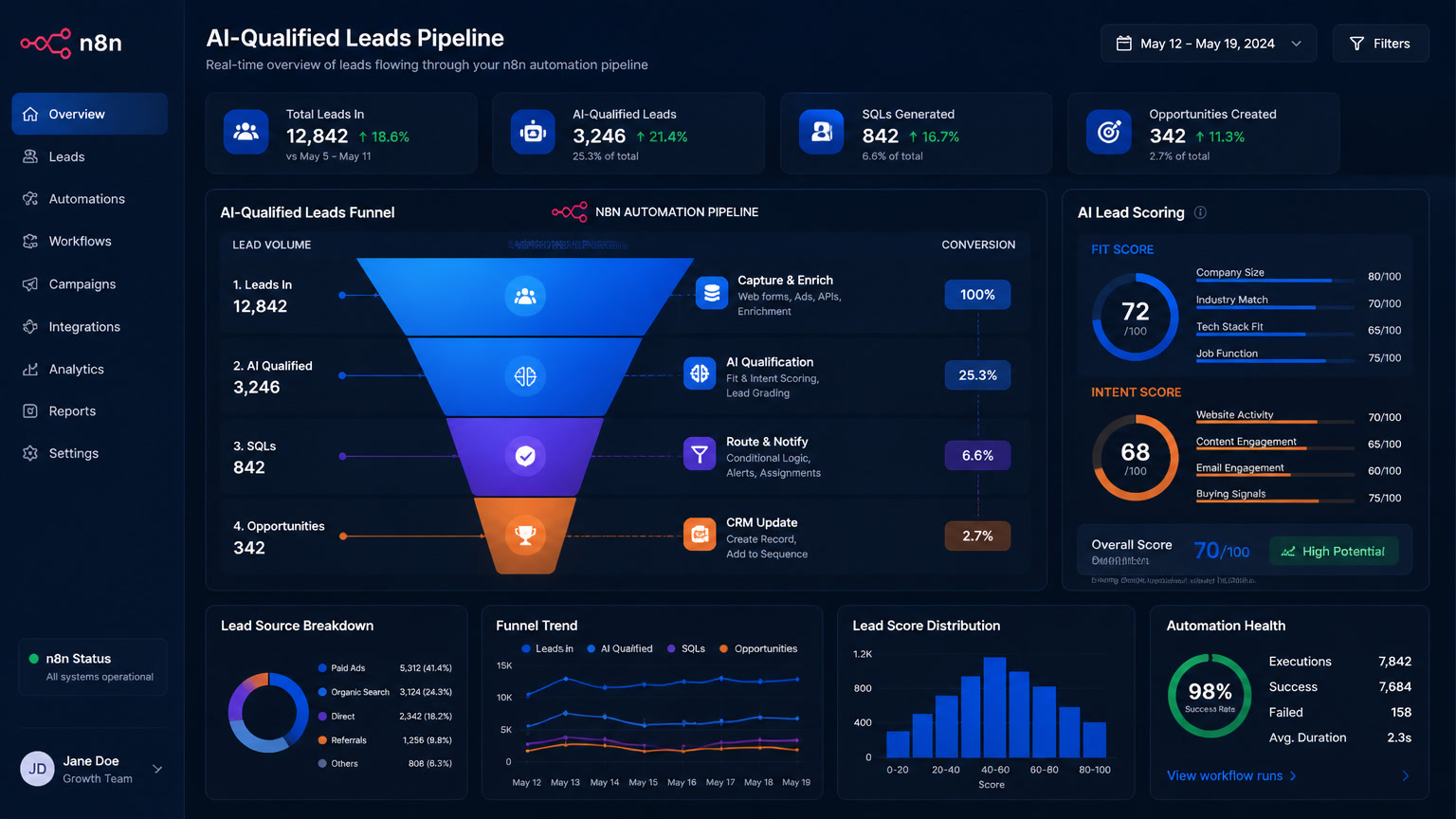
The handover is the key feature: the chatbot doesn't replace the sales rep — it sets the table. When a qualified lead reaches the sales team, they already know which products interest them, what questions they have, and where they are in the buying process.
Practical comparison: In a deployment for a law firm in Mexico City, before the redesigned chatbot they received 30 daily inquiries — 20 were repetitive questions (rates, hours, required documents). An assistant handled 10 calls and replied to 20 emails per day. With the new chatbot, the bot answers all 20 repetitive queries, the assistant handles only 10 high-complexity interactions, and first-response lead time dropped from 4 hours to 2 minutes.
Using the Three Features as an Integrated System
The real value isn't in each feature individually — it's in how they work together. Here's the framework we recommend for agencies:
- Health Center identifies structural CRM problems (bad data, stalled pipelines, low activity).
- Dashboards visualize those problems in real time and enable client sharing without manual intervention.
- The AI chatbot reduces the team's operational load, freeing time for high-value activities that improve Health Center indicators.
This "diagnose → visualize → act" cycle transforms the CRM from a transactional system into a continuous improvement platform. Compare this to the traditional approach of manual CRM audits where data quality checks were monthly batch processes.
When Do You Still Need External Reporting Tools?
For agencies needing live client dashboards, Clientify's new dashboards cover 80% of use cases. You likely don't need Google Data Studio, Power BI, or custom integration for basic reporting anymore.
For cases requiring complex data cross-referencing, multiple external data sources, or highly specific visualizations, external tools are still necessary. But the bar to justify that additional cost is now significantly higher.
Our recommendation: start with Clientify's native dashboards. If within the first 90 days you identify reporting needs they don't cover, then evaluate whether an external layer is worth the investment. Nine out of ten agencies we work with won't need it.
What's Next
Clientify's July 2026 update is substantial, but it's not the end. The roadmap for the remainder of the year includes workflow automation improvements, deeper AI platform integrations, and expanded WhatsApp Business capabilities.
If you manage clients on Clientify — or are evaluating adoption — these three features should be at the top of your priority list. Health Center alone justifies the update if your team suspects data quality issues but lacks real visibility.
For a deeper look at how clean CRM data enables better automation, check our article on behavioral email automation for B2B. Dynamic segmentation only works when your data is accurate — now Clientify gives you the tools to keep it that way with zero friction.
Need help configuring these dashboards or implementing Health Center for your agency? Get in touch. We've tested these features with real clients and know exactly which configurations deliver the best results for different business types.
Frequently Asked Questions
What is Clientify's Health Center?
Health Center is an automated diagnostic module that analyzes CRM data quality in Clientify. It detects outdated contacts, stalled pipeline stages, overdue tasks, and irregular sales activity. It provides proactive alerts and an overall CRM health score.
Does Clientify's new AI chatbot replace human agents?
Not entirely. The redesigned AI chatbot handles FAQs, qualifies leads, and schedules meetings autonomously. Complex or high-value conversations are transferred to the human team through automatic handover, with the full conversation history included. The chatbot + human combination consistently outperforms either approach alone.
Do the new dashboards eliminate the need for external reporting tools like Data Studio or Power BI?
For 80% of agency reporting use cases, yes. The five preconfigured dashboards cover sales, marketing, customer support, productivity, and consolidated results. They can be shared with clients without granting full CRM access, eliminating the need for external BI tools in most cases. Complex multi-source reporting still requires dedicated tools.