
Your own brand query is split across two homepages
Your brand query is the cheapest demand you own. On a bilingual site Google splits it across two homepages. Here are four checks that fix it.
The cheapest demand a company owns is the search for its own name. Nobody rivals you on it, nobody outbids you on it, and the person typing it has already decided to find you. On a clean site that query lands on one URL and converts. On our own bilingual site it did not, and the way it broke is measurable enough to publish.
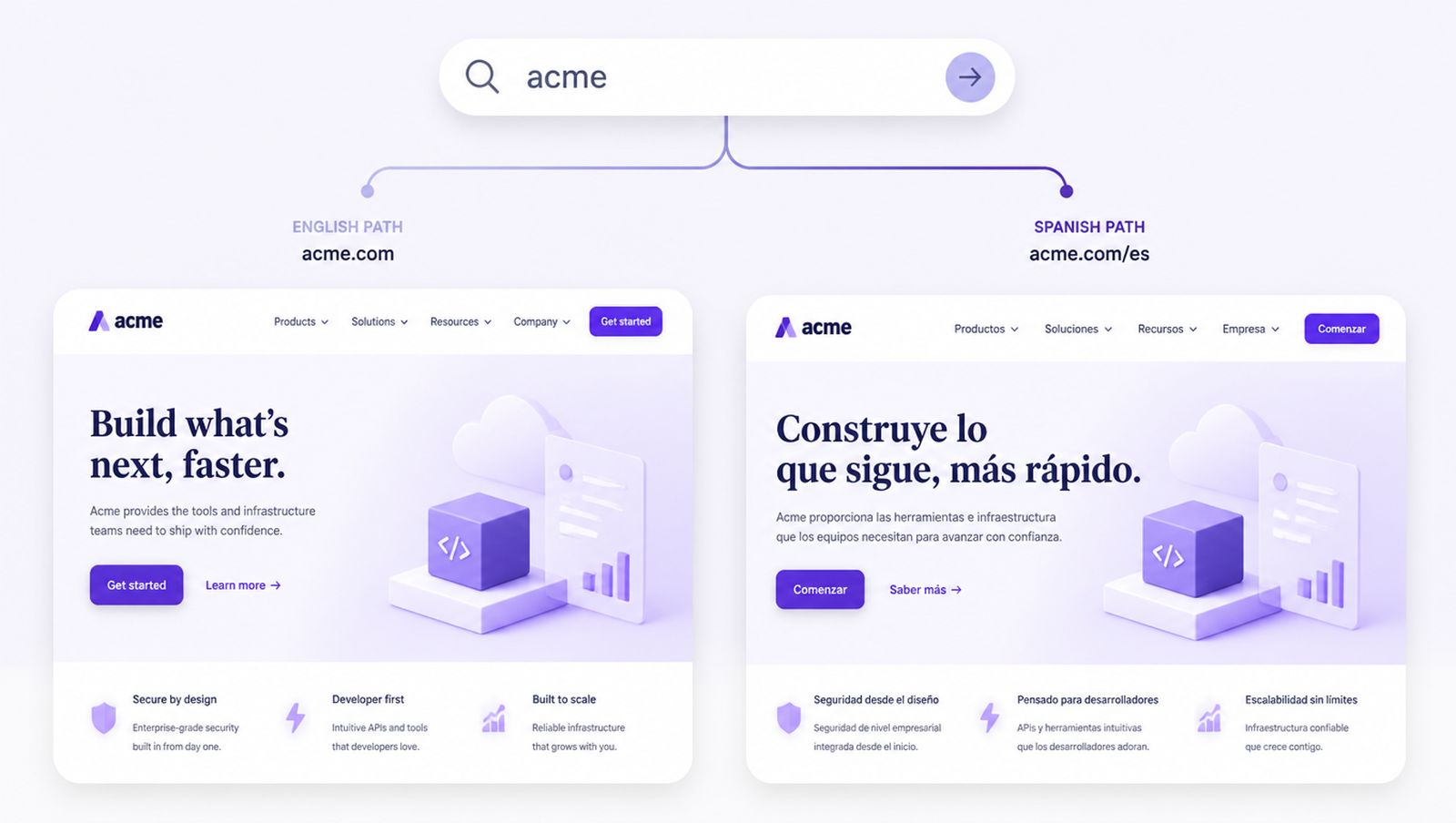
Over the 28 days from September 23 to October 20, our Search Console property recorded the query "mintec" 811 times with 25 clicks, a 3.1% click-through rate from position 7.9. Read alone, that is unremarkable. Group the same query by page and a second story appears, because the impressions are not going to one homepage. They are going to two, and the two behave nothing alike.
| Query | Landing URL | Impressions | Clicks | CTR | Position |
|---|---|---|---|---|---|
| mintec | https://mintec.co/es/ | 285 | 22 | 7.7% | 4.8 |
| mintec | https://mintec.co/ | 547 | 2 | 0.4% | 7.2 |
| mintec (all URLs) | — | 811 | 25 | 3.1% | 7.9 |
One clarification before anyone tries to reconcile the arithmetic: the two page rows sum to 832 impressions and 24 clicks, while the query-only row reports 811 and 25. That gap is not an error on your end or ours. Search Console computes the query dimension and the page dimension on separate samples, so the rows do not always add up to the total. The direction is what matters, and the direction is unambiguous.
What the split actually costs
The Spanish homepage takes the smaller share of impressions and converts them at 7.7% from position 4.8. The English homepage takes the larger share and converts at 0.4% from position 7.2. This is a bilingual company whose English page is the one losing its own name.
The tempting read is that the CTR gap is purely a position gap, and there is truth in that: 4.8 outranks 7.2, and position drives clicks. But that framing lets the real problem off the hook. The question is not why position 7.2 gets fewer clicks than position 4.8. The question is why the company's primary homepage is at position 7.2 for the company's own name at all. A brand query where the official domain does not hold one of the top three spots on its primary URL is not a CTR problem. It is an entity problem wearing a CTR costume.
When the query splits across two URLs, neither one becomes the definitive answer. Google is not confident enough in a single page to put it at the top, so it distributes the query across the candidates it considers plausible, and the searcher gets a weaker set of results for a query that should be trivial. You end up paying for impressions on two pages and getting almost nothing back on the one that carries most of them.
Why a bilingual site invites this
A second language does more than translate. To a crawler it is a second candidate for the same brand, and if the signals around those two candidates are not disciplined, the engine has no reason to treat one as primary. Four things decide whether it does. All four are visible on our own site today, and we ran every check against production while writing this.
Check 1: one canonical brand page
Each of our homepages declares its own canonical, and the pair is correct: https://mintec.co/ is self-canonical, and https://mintec.co/es/ is self-canonical. The x-default on both points to the English root, which is the right default for a company whose primary market is English-first. This part is clean. The point of the check is that you must be able to say which URL you want to own the brand query and then confirm the canonicals and x-default agree with that intention. If your localized page is self-canonical and your root is too, you have told the engine both are equally valid answers, and it will treat them that way.
Check 2: Organization and sameAs consistency
Both of our homepages serve an identical Organization block, quoted as served:
name:  Mintec
url:   https://mintec.co
logo:  https://mintec.co/images/logo.png
sameAs:
  - https://www.facebook.com/mintecdigital/
  - https://www.instagram.com/mintecdigital/
  - https://www.linkedin.com/company/mintecdigital
  - https://github.com/minteclabs
We confirmed all four sameAs profiles return 200. Consistency here is the baseline, not the fix. Two details are worth noting anyway. The block declares url: https://mintec.co without a trailing slash, while the canonical is https://mintec.co/ with one. And there is no @id. Neither is catastrophic, but entity consolidation is unforgiving of small disagreements, and a structured-data consumer comparing your Organization url against your canonical sees two strings that are not identical.
Check 3: reciprocal hreflang, in one URL form
This is where our own site had a real defect, and it is the check most bilingual sites fail silently. Both homepages declare hreflang for each other and for x-default. But the two pages do not use the same form of the Spanish URL.
The English page declares, as served:
hreflang="es" href="https://mintec.co/es"
The Spanish page's own canonical, and its self-referencing hreflang, use:
https://mintec.co/es/
So the English page tells Google the Spanish version lives at /es, and that URL 308-redirects to /es/. The link is reciprocal in spirit but not in string. hreflang is a machine signal, and machines compare strings before they follow redirects. Every hop you add between the declared href and the real canonical is a small bet that the crawler resolves it correctly. Ours does resolve, which is why this has not been a crisis, but the fix is free: make every hreflang href byte-identical to the canonical of the page it points to.
Check 4: third-party profile agreement
The Organization block names one company, one URL, and four profiles. The check is that those profiles describe you the same way the schema does: same name, same category, same location, no stale rebrand, no second account under an old name. This is the half of entity work that lives off your domain, and it is the half most teams never audit because nothing on their own site surfaces the disagreement. An answer engine cross-checks your self-description against what independent sources say about you. When they conflict, it hedges, and a hedged brand query is a split brand query.
Consolidating is not a redesign
Nothing above requires a new site, a new domain, or a migration. It requires deciding which URL owns your name, making every signal point at that decision in the same string form, and removing the small disagreements that let an engine treat two pages as equally plausible. Then you re-pull the same grouped report a few weeks later and check whether one URL is now absorbing both the impressions and the clicks.
The measurement caveat we hold ourselves to: click-through and position are measurable in Search Console today, and everything in this article is drawn from a pull you can reproduce. Whether any of it moves qualified actions is not measurable on our property yet, because GA4 key events are not firing. We are not going to claim a conversion lift we cannot see. What we can claim is that the split existed, that the checks are real, and that the hreflang defect is now on record.
If a brand query is splitting across your own URLs, the diagnosis is the same one we ran on ourselves, and it is the kind of work we do in SEO & GEO. The brand query is where entity clarity stops being a theory and starts being money. For the broader argument on why branded search behaves differently in an answer-engine world, see AI Overviews and branded searches, and for what third-party citation share looks like when it works, see how earned media wins IA citations.
Frequently Asked Questions
Why can a branded query rank below position 5 and still lose clicks?
Because the click-through curve is brutal below the top few results, and a split entity makes it worse. In our own 28-day window the brand query sat at position 7.9 overall, and the URL carrying the larger share of impressions converted at 0.4%. Below about position 5 a searcher often cannot tell which result is the company's official page, so they either click a directory, a social profile, or a competitor bidding on the name. A brand query that does not resolve to one dominant URL is a brand query that leaks.
How do you tell which URL Google has picked for your brand?
Open Search Console, set the window to 28 days, and run the performance report twice: once grouped by query alone, and once grouped by query and page. Filter the first report to your brand name. Then match that query against the second report to see which specific URL is absorbing the impressions and which is absorbing the clicks. If two different URLs of your own domain both appear for the same brand query, that is the split. There is no setting that reports this directly; you have to group by both dimensions and read the rows against each other.