The 84% AI earned media citation stat is misleading — what each engine actually cites
84% of AI citations come from earned media, per Muck Rack. But that number hides more than it reveals. Here's what each LLM actually cites, why the stat is misleading, and how to measure GEO properly.
The 84% number is the most repeated statistic in GEO this year. Muck Rack published it in May 2026, and it has since appeared in nearly every pitch deck that talks about generative engine optimization. The number is correct. But it is doing heavy lifting that does not survive much scrutiny.
What the 84% actually measures
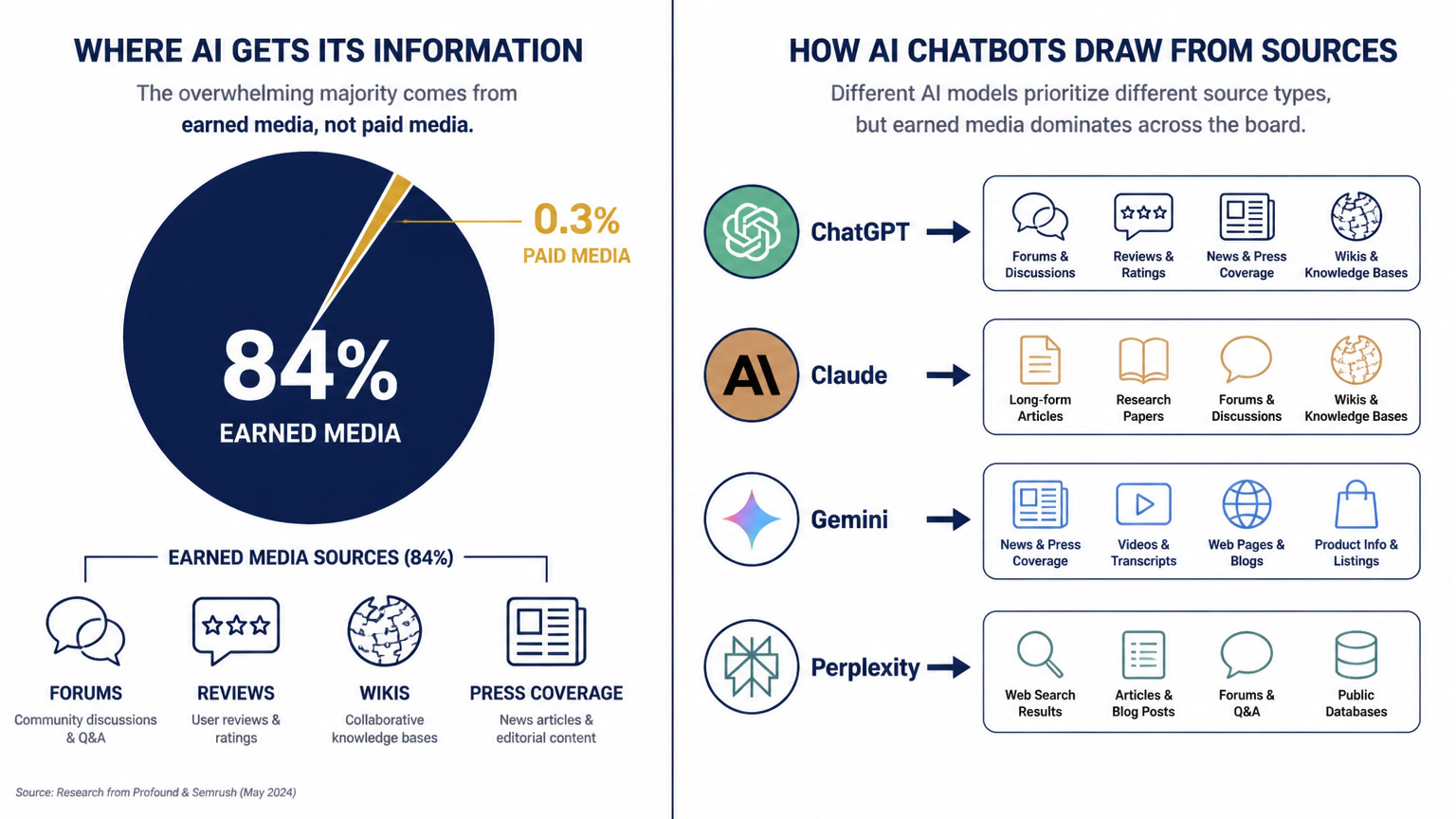
When Muck Rack says 84% of AI citations come from earned media, the word doing the work is "earned". It does not mean press coverage alone. The category includes anything that is not brand-owned and was not paid for: forums like Reddit, user reviews, directories, community wikis, comparison pages, academic content, and government sources.
If what you are being sold is a PR service, the number that matters to you is not 84%. It is 27%, which is the share that corresponds to editorial journalism. Press releases account for just 1.1% of citations, and paid or advertorial content represents only 0.3%.
One number now supports two figures in active circulation: 84% and 27%. Both come from Muck Rack. Neither is wrong. They answer different questions, and which one you encounter depends on who is selling to you.
ZionLabs dissected this in August and Machine Relations published that the effective PR influence on AI citations is closer to 14-17%. PR Daily called it "the 84% myth" and pointed out that the number props up a dangerous narrative: that brands can buy AI visibility with a traditional PR budget.
They cannot. At least not with that number as the foundation.
Every engine cites different sources
What the 84% does not tell you is that each AI engine has its own citation preferences and those preferences barely overlap. A Major Labs study analyzed 30 queries across four engines and found only 16% of cited domains appear on more than one engine. The other 84% is exclusive to each platform.
The data from Muck Rack, Profound, Ahrefs, and QuickSEO paints this picture:
ChatGPT runs on Bing's index and cites in 96% of responses, averaging 5 sources. Its most cited domain is Wikipedia at 16.3% of total citations. Brand homepages follow at 23.8%, and app store listings at 6.6%. Overlap with Google's top 10 is only 6.5%. If your brand has Bing presence and strong referring domains, ChatGPT will find you. If not, it almost certainly will not.
Claude uses Brave Search and is the most selective: it cites in only 55% of responses, but when it does it averages 13 sources, more than double ChatGPT's count. Its top source is PubMed Central. Premium journalism outlets like The New York Times, The Atlantic, and The Economist are its anchors. Claude also has the widest freshness window: it is roughly 3 times more likely than ChatGPT to cite content that is 2-4 weeks old. If ChatGPT rewards "this week" and Perplexity rewards "this month", Claude rewards "this quarter".
Gemini relies on Google's index, Knowledge Graph, and Maps. It cites in 82% of responses averaging 8 sources. Its most cited domain is Reddit. But the most revealing number comes from Yext: 52.15% of Gemini's citations come from brand-owned websites. That is significantly higher than any other engine. If your website is good, Gemini will find it. Google AI Overviews, on the other hand, shares only 13.7% of its citations with Gemini on the same queries.
Perplexity is the maximalist: it averages 21.87 citations per response, nearly 4 times ChatGPT. Its Sonar pipeline runs live retrieval on every query. Its top source is YouTube (54 citations across 30 queries). It has 82% overlap with Google's top 10, the highest of any engine. Perplexity rewards content with video and extractable structure.
The pattern that holds across every study: structured content with tables, lists, and comparisons gets cited at roughly a 25% rate versus 11% for opinion pieces. Direct quotations boost visibility by 41% and original statistics by 37%, per the Princeton GEO benchmark. Keyword stuffing produces essentially zero lift.
Why the 84% number misleads your strategy
The problem is not that 84% is false. It is that it creates the wrong expectation: that getting media mentions will give you uniform visibility across AI. It does not work that way.
If your strategy is built around securing press coverage because "84% of citations are earned", you are optimizing for 27% of 84%. And that 27% distributes unevenly across engines. ChatGPT rewards Bing presence and referring domains. Claude rewards academic sources and premium journalism. Gemini rewards the quality of your own website. Perplexity rewards video and structure.
A single PR channel will not give you visibility across all four engines simultaneously. You need a strategy that combines technical structure, original data-driven content, third-party presence relevant to each engine, and constant freshness.
Measurement framework: what to track and how often
If 84% does not tell you enough, what number actually matters? Four metrics, in this order:
Citation rate by engine. In how many responses from each LLM does your brand or content appear? Measure this weekly with the 20-30 queries that represent your business. A citation in ChatGPT is not the same as a citation in Gemini.
AI share of voice. What percentage of total citations for your target keywords do you represent versus competitors? This is a monthly exercise. You compare your presence against 3-5 key competitors on each engine.
AI referral traffic. Sessions arriving from AI responses, segmented by engine. GA4 records this as traffic from domains like chatgpt.com, claude.ai, or perplexity.ai. Measure monthly.
Conversion impact. Of those sessions, how many generate key events (forms, demos, sales)? This is quarterly. It makes no sense to obsess over citations if they do not translate to business results.
The ideal rhythm: quick weekly looks at AI referral traffic, monthly citation audits across prompts, and quarterly deep dives on trends and gaps.
The reality
The 84% number is not a lie. But it is not the strategic advice that many present it as. What actually matters is understanding that each AI engine has its own source ecosystem, those ecosystems overlap very little, and GEO measurement requires a granular per-engine view, not an aggregate number.
The 84% is a sales number. What you need is a measurement system that tells you where you are being cited, on which engines, through which sources, and whether that translates to anything that matters for your business. Everything else is noise.
Frequently Asked Questions
What does it mean that 84% of AI citations are earned media?
It means 84 out of every 100 links that AI engines cite in their answers come from content that was not paid for and is not owned by the brand. But that category includes forums, reviews, directories, wikis, and comparison pages, not just press coverage.
How much of the 84% is actual journalism?
According to Muck Rack, journalism accounts for 27% of all cited sources. Press releases are 1.1%. Paid and advertorial content represents just 0.3%. The rest are non-journalistic sources in the broad earned category.
How do citation patterns differ between ChatGPT, Claude, and Gemini?
ChatGPT cites in 96% of responses averaging 5 sources, with Wikipedia as its top source. Claude cites in only 55% of responses but averages 13 sources when it does, with PubMed Central as its top source. Gemini cites in 82% with 8 sources on average, and Reddit is its most cited domain.