
Ranking #1 on Google Does Not Mean AI Will Cite You. Here Is How to Actually Measure GEO.
Your SEO dashboard says you rank first. ChatGPT has never heard of you. Here is the measurement gap between traditional search and AI search, and a 4-layer framework to close it.
Ranking #1 on Google Does Not Mean AI Will Cite You. Here Is How to Actually Measure GEO.
You rank first for your main keyword. Your SEO dashboard shows green arrows everywhere. Then someone asks ChatGPT about your category and your brand does not come up. At all.
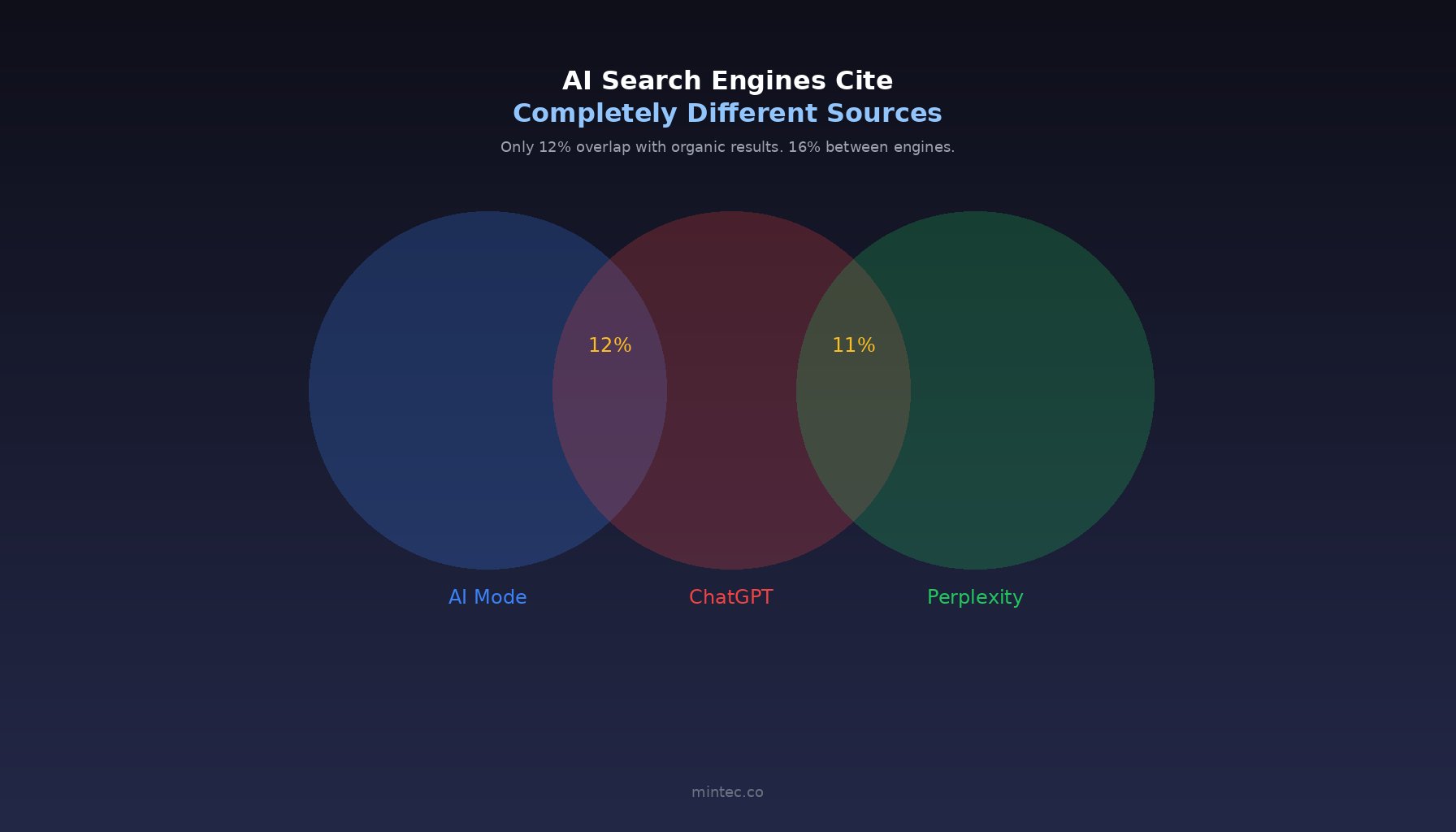
This is not a hypothetical. Geolix.ai, a GEO firm based in Singapore, presented data at an Airwallex event on September 11 showing that the majority of brand audits they run find exactly this pattern: strong traditional search presence, near-total absence from AI-generated answers. The overlap between top Google rankings and AI-cited sources has collapsed from around 70% to under 20% in the last two years.
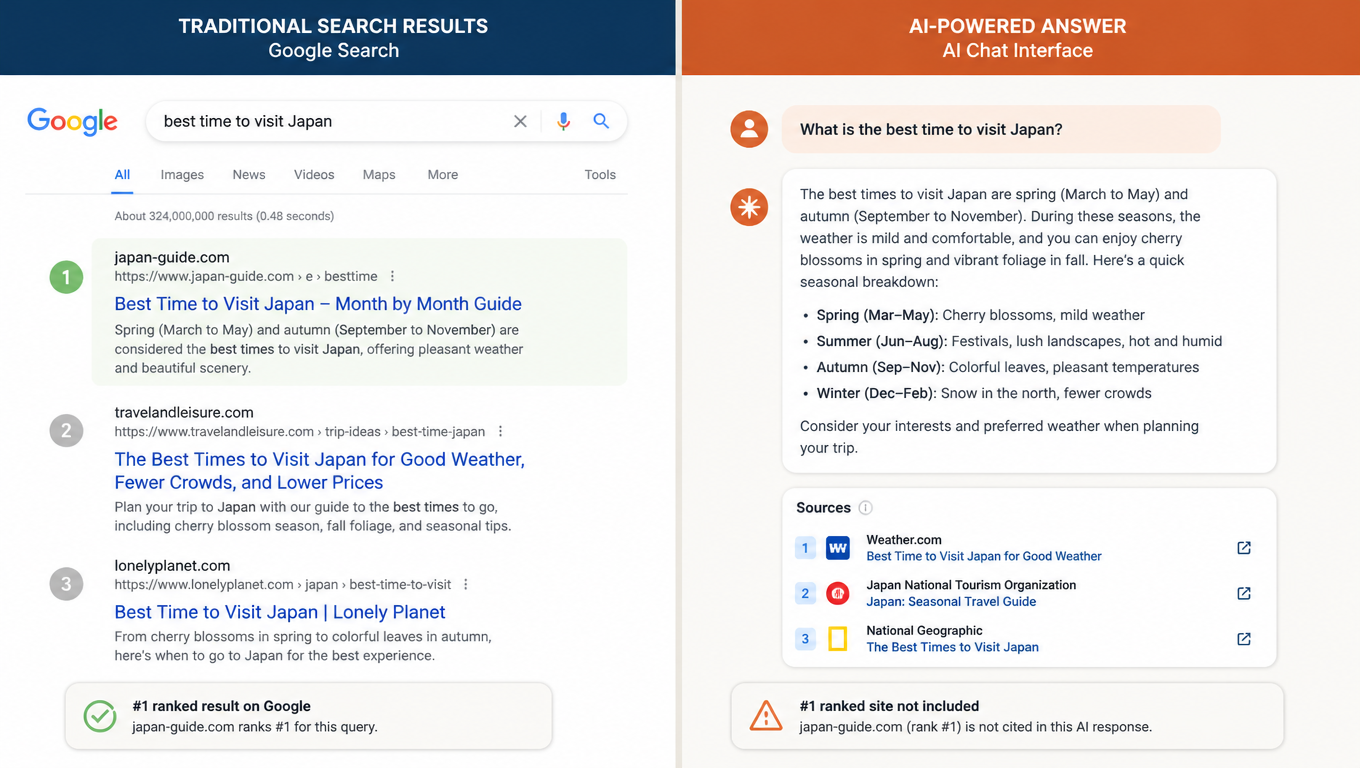
The reason is simple. Google ranks pages. AI engines choose sources to build an answer. Those are different systems, optimized for different things, and your SEO metrics are not built to measure the second one.
What your SEO dashboard cannot see
Traditional SEO measures position in a list. Click-through rate assumes the user sees a list and chooses. Impressions count how often your URL appeared on a results page. None of these capture what happens when there is no list and an AI model writes a paragraph instead.
Google's own guidance, published in May 2026, acknowledges this: "generative AI features on Google Search are rooted in core ranking and quality systems." That is true. But it is also incomplete. Being eligible for AI features is not the same as being selected. And being selected for one AI answer does not mean you will be selected for the next one, for a different user, or on a different platform.
Here is what your current metrics miss:
Who gets cited, not just ranked. A page can rank third on Google and be the only source an AI engine cites. Or it can rank first and be ignored entirely. The citation decision is based on source authority, claim specificity, and retrieval patterns that are different from the ranked-list algorithm.
How many sources the AI uses. Most AI answers cite between 3 and 7 sources. The top 5 domains capture 38% of all AI Overview citations, and the top 10 capture 54%. That is a winner-takes-most distribution, not a long tail. If you are not in that small set, you do not exist in the answer.
What the AI says about you. Search Console shows impressions but not content. An AI engine can cite your page and misrepresent your product, your market, or your pricing. That is worse than not being cited at all.
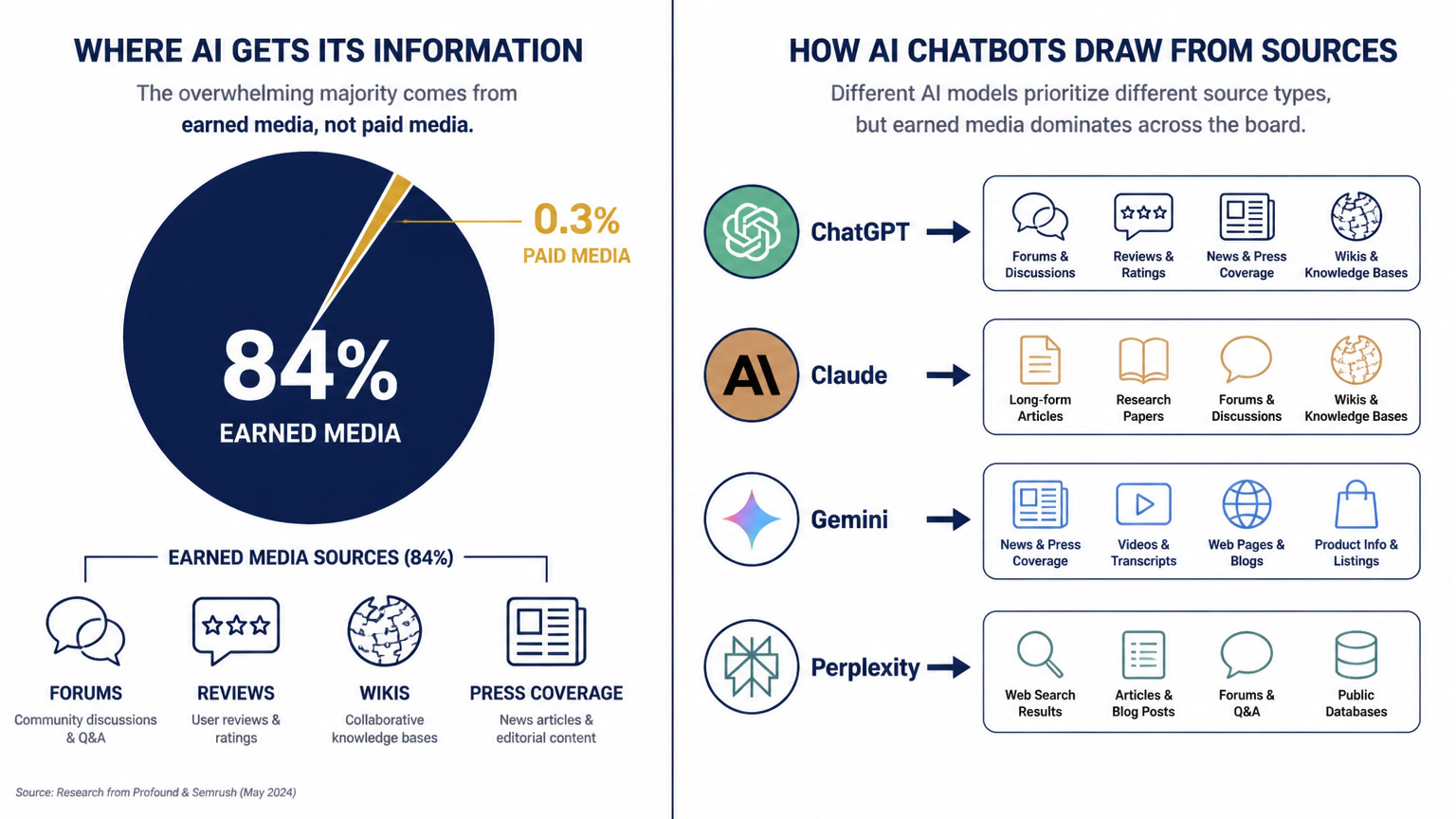
Which platforms matter. ChatGPT's share of AI web traffic dropped from 76% to 53% between June 2025 and May 2026. Gemini grew to 28%. Claude tripled to 9%. Measuring your presence on one platform is like measuring your SEO on one search engine in 2010.
The Geolix case: what measurement-led GEO actually produces
Andy Guo, Geolix.ai's founder, shared a controlled test at the Airwallex session. The client had four identified intent gaps, specific questions their buyers asked that the brand was not appearing for. Geolix published four pieces of content targeted at those gaps.
The result: ChatGPT's citation rate for the client's website went from 9.7% to 26.7%. Brand mention rate went from 2.2% to 8.3%.
Four articles. Not forty. Not a content mill. Four pieces, each built to close a specific gap identified through measurement.
Guo's point was direct: "Every action has to know which gap it is closing." Volume does not move AI citation rates. Relevance, consistency across sources, and evidence density do.
This is the opposite of how most SEO campaigns work, where you publish broadly and hope the algorithm picks you up. In GEO, you measure first, identify the specific gaps, then build only what closes them.
A 4-layer measurement framework for GEO
You need four separate metrics, tracked independently, because they move for different reasons.
Layer 1: Visibility
How often does an AI engine mention your brand when asked about your category?
Pick a fixed panel of 20 to 40 questions your buyers actually ask. Run them across ChatGPT, Gemini, and Perplexity. Record whether your brand is named in the answer. That percentage is your mention rate.
Do not change more than 10% of your panel in a quarter, or your trend line becomes meaningless.
Layer 2: Citation
How often does an engine link to your URL, not just mention your name?
A mention without a link is brand awareness. A citation with a URL is a traffic opportunity. Track both, but report them separately. Your citation share is your citations divided by all citations across you and your competitors. That number tells you whether you are gaining ground relative to the people you actually compete with.
Layer 3: Traffic
How many sessions come from AI-referred sources?
In GA4, build an exploration with a source filter matching chatgpt.com, perplexity.ai, gemini.google.com, copilot.microsoft.com, and claude.ai. The numbers will be smaller than your organic search traffic. That is expected. The value per session tends to be higher because AI-referred visitors arrive with more context and intent.
Layer 4: Conversion
What do those sessions produce?
Track leads, signups, or revenue from AI-referred sessions. This is where the business case lives. A page that gets 50 visits from ChatGPT but converts at 8% is more valuable than a page that gets 5,000 organic visits and converts at 0.3%.
What Search Console actually gives you (and what it does not)
On August 31, 2026, Google rolled out its Generative AI performance reports worldwide. You can now see:
- Impressions in AI Overviews and AI Mode, broken down by page, country, device, and date
- Which URLs were cited within AI features
- Clicks when users click links inside the generative response
What you cannot see:
- Which queries triggered the AI answer
- What the AI answer actually said
- How your brand was described
- Data from other AI platforms
The report is useful for tracking trends over time. It is not a complete GEO measurement tool. Pair it with your prompt panel and GA4 data to get a full picture.
Bing Webmaster Tools has offered AI performance reporting since February 2026, and it does expose the queries Copilot uses. Google is six months behind on that specific feature.
Run your first GEO audit this week
You do not need expensive tools to start. You need three things:
A prompt panel. Write 20 questions your buyers would ask an AI assistant about your category. Be specific. "What is the best CRM for a 20-person sales team in Mexico that uses WhatsApp?" beats "best CRM."
Cross-engine testing. Run those questions through ChatGPT, Gemini, and Perplexity. Record which brands appear, which URLs are cited, and whether the brand description is accurate. Do this weekly.
GA4 source tracking. Set up an exploration filtered to AI-referred sources. Check it monthly. The numbers will be small at first. Watch the trend, not the absolute value.
If you do nothing else, do the prompt panel. It takes an afternoon and tells you more about your AI search presence than any dashboard.
What changes when you measure the right thing
Most marketing teams measure what their tools make easy. SEO tools make rankings easy to measure. Analytics makes traffic easy to measure. So those are the numbers in the report.
But the question that matters is not "where do we rank?" It is "when a buyer asks an AI about our category, does it mention us, cite us accurately, and send people our way?"
That is a different question. It needs different metrics. And until you measure it, you are optimizing for a system that is losing relevance while ignoring the one that is gaining it.
The good news: the measurement tools exist now. Search Console has the data. GA4 can track the traffic. A prompt panel takes an afternoon. The gap is not in the tools. It is in whether you bother to look.
Related reading:
Frequently Asked Questions
Why does ranking #1 on Google not guarantee AI citations?
Google rankings and AI citations use different retrieval systems. Google ranks pages by relevance signals for a list of results. AI engines synthesize answers by pulling from a small set of sources (usually 3 to 7) that they judge most authoritative for a specific question. The overlap between top-10 Google rankings and AI-cited sources dropped from around 70% to under 20% in 2025-2026 as AI search grew.
How do you measure GEO performance?
Use a 4-layer framework: visibility (how often AI engines mention your brand in a fixed prompt panel), citation (how often they link to your URL), traffic (AI-referred sessions isolated in GA4), and conversion (leads or revenue from those sessions). Track each layer separately because they move independently.
What does the Search Console AI report actually show?
As of August 31, 2026, Search Console shows impressions and cited pages for AI Overviews and AI Mode worldwide. It does not show which queries triggered the AI answer, what the answer said, or how your brand was described. It is useful for trend tracking, but it is not a complete GEO measurement tool.
How often should you run a GEO measurement panel?
Weekly for citation and visibility tracking. Monthly for traffic and conversion analysis. Never change more than 10% of your prompt panel in a single quarter, or your trend data becomes unreliable.