
Veterinary Clinic Automation: The Preventive Calendar as a Recurring-Revenue Engine
The average vet clinic silently loses 18-20% of its active client base every year. The calendar-first WhatsApp architecture that wins that revenue back.
The average veterinary practice loses between 18% and 20% of its active client base every year — and it loses it silently: no cancellation calls, no complaints, no exit. This is not a pricing problem and not a competition problem; it is a calendar problem. In veterinary care, "churn" is literally a date that passed: the lapsed vaccine, the checkup that never got booked, the deworming the owner postponed because the pet "looks fine". The fix is not more marketing — it is a calendar-first automation architecture, where each patient's preventive table (species, age, weight) is the single source of truth that fires reminders, confirmations and reactivation sequences over WhatsApp. For an 800-client clinic, that gap is worth roughly $137,000 USD in lost annual revenue — at the $950 average annual spend per client reported by VetSuccess (2026) — and automated win-back sequences recover between 22% and 30% of inactive clients (Petvisor, 2025).
Veterinary churn is invisible because nobody announces they're leaving
There is an odd structure at the heart of this business: the owner makes the decision, but the pet has the need. That gap is why abandonment never announces itself: when a patient stops coming there is no cancellation form, just a growing hole in the schedule someone attributes to "the season".
Industry numbers confirm the silence. According to the AAHA 2025 Practice Benchmarking Report (cited by US Tech Automations, 2026), the average companion-animal practice loses 18% of its active base each year. Bayer's Veterinary Care Usage Study (2024) documents the underlying cause: the average veterinary client receives just 2 to 4 communications per year from their practice — against 15-25 from their dentist, 12-18 from their physician, and 150+ from Amazon. At that contact level, the annual reminder arrives in an inbox that already chose another provider. The same source reports that lifting annual touchpoints from 4 to 20 cuts churn by 8 to 10 percentage points — without promotional content, just presence.
Two industry-specific frictions stack on top: about 11% of veterinary appointments end in no-shows (AAHA-cited data via Staffingly, 2026), and 40% of booking attempts happen outside clinic hours (SMB Automation, 2026), when the front desk is closed. In our own reminder implementations for human-health clinics and gyms we saw the exact same pattern: automated 24-hour and 2-hour WhatsApp reminders took no-shows from 18% down to 6% within the first quarter. The difference is that veterinary calendars are even more predictable — there are no diagnoses shifting dates, only preventive tables computing them.
The benchmarks disagree: measure your own gap first
Be careful about quoting a single number. Industry sources do not agree, and the disagreement is information:
- Annual active-base loss: 18% (AAHA 2025) vs. ~20% (SMB Automation 2026). Realistic range: 15-20%.
- Inactive-client recovery via win-back: 22-30% (Petvisor 2025) vs. 12-18% (SMB Automation 2026). Depends on channel and how long the client has been away.
- Preventive compliance with multi-channel reminders: 78% when the message includes the pet's name and the specific service, vs. 42% for manual phone calls (IDEXX, cited 2026).
- Additional preventive visits with structured recall: 28-35% more than relying on client-initiated scheduling (AAHA, 2024).
The metric to audit first is the active client ratio: patients seen in the past 12 months divided by total records in the system. Above 60% is healthy; below 50% means a volume of dormant clients that a reactivation campaign can attack immediately (SMB Automation, 2026). Before buying any tool, pull a random 100-file report and calculate your own rate. It takes an hour, and it defines everything that follows.
The calendar-first architecture: one table that governs everything
The most common failure we see in clinics that "already have a system" is buying reminders in one tool, a chatbot in another, and a review generator in a third — all on islands. The alternative is a four-layer architecture where the preventive calendar is the single source of truth:
| Layer | What it computes | Typical tool | Monthly cost |
|---|---|---|---|
| 1. Schedule engine | Species + age + weight → preventive table → exact per-patient dates | Self-hosted n8n | $6-20 |
| 2. CRM | Pet and owner record, preventive status, opt-outs, history | Clientify | $0-99 |
| 3. Channel | Proactive utility templates + 24-hour window replies | WhatsApp Business API | $3-15 |
| 4. Intelligence (optional) | Reply classification, inbound triage, message drafting | OpenAI API | $10-30 |
Layer 1 gets built once: a vaccine and checkup table by species and age, from which every later action is a date subtraction. Lapsed-vaccine reminder, annual checkup, quarterly deworming, 10-day post-surgical follow-up — all of it exits the same engine. When an owner confirms an appointment, the CRM updates status and the engine recomputes the next delta. No islands, no parallel spreadsheets, no dependence on who happens to be at the front desk — and that matters: front-desk turnover in this sector runs around 23% annually (BLS, cited 2026). The calendar never resigns.
Our stance: rules own the calendar, AI only where language lives
In veterinary care, a "lost client" is a deterministic event: it is a due date that never got rescheduled. A rules filter — patient with a service overdue by more than 30, 60 or 90 days — catches 100% of those cases with zero error. Rules beat any model here, and we say it plainly: do not pay an LLM to do date arithmetic.
Yes, Petvisor (2025) reports that multi-signal churn scoring predicts departures with 78% accuracy vs. 45% for single-signal systems. But that is the game for chains with thousands of patients, where aggregate behavioral patterns carry real signal. In a two- or three-vet clinic, the "overdue +30/60/90 days" flag is the 80% solution and costs once. AI earns its place exactly where language lives: classifying the owner's reply ("confirmed", "any chance of next week?", "my dog is limping", "not interested"), triaging the photos and questions that land on WhatsApp at 9 PM, and drafting the message with the pet's name in it. Rules for the calendar; AI for the conversation. That is where our when-NOT-to-use-AI framework and the real-world agents we have built for appointment scheduling with automatic reminders converge.
WhatsApp after October 1: still the cheap channel — if you design the cadence around billing
In Latin America you are not going to install a reminder app: your clients already live in WhatsApp. Which is why the cadence must be designed around the billing model in force since October 1, 2026. Two rules govern the cost:
- Replies inside the 24-hour window are service messages: 1,000 free per business number per month. For a clinic, that allowance is consumed by exactly the highest-value traffic — the post-visit questions ("can he eat normally?", "is it normal that she's sleeping so much?") that today die on voicemail.
- Proactive reminders are utility templates: they carry no free tier and are billed per conversation, in the cheapest category of all. At October 2026 rates (service: MX ~$0.0085, BR $0.0068, CO $0.0008 per message), an 800-client clinic sending 8 proactive reminders per year — about 533 templates per month — spends between $1 and $6 USD monthly depending on the country. The full model is covered in what a WhatsApp reply costs since October.
The correct design, then: inbound questions → 24-hour window with assisted replies (free); reminders and reactivation → utility templates (cheap). One mistake we see constantly: sending a proactive reminder inside an open window thinking "it's free because the customer messaged first". Wrong category, wrong invoice.
Reactivation: the three-barrier sequence
Inactive clients don't return for three distinct reasons, and each needs a different message: they forgot about the practice (a reminder fixes it), they don't feel urgency (educational content about their pet's health risks fixes it), they don't see an incentive (a targeted offer fixes it). That logic is what sits behind the 22-30% recovery rate Petvisor reports.
The LatAm version differs from the US playbook in one detail: skip the postcard. Here the sequence wins with a photo of the pet, the owner's name, and a suggested date with two concrete time slots. Four touches over 21 days: (1) preventive reminder with name and reason, (2) short educational content on the overdue condition, (3) a commercial-layer offer — the food or boarding they always buy, (4) a close with automatic suppression if there was no response. That fourth touch exists to protect your list: two unanswered attempts and the client moves to suppressed, not to spam.
And there is one last lever almost nobody uses: a veterinary practice has three revenue layers, and reactivation can target any of them. The clinical visit is the high goal (highest friction, highest value); boarding or grooming booking is medium friction; food or flea-product replenishment is minimal friction — and it is the easiest re-entry door when the owner resists booking a consultation. A sequence that offers the low layer when the high one fails turns a dormant client into a repeat buyer before they ever sit in the waiting room again.
Implementation order (and three mistakes to avoid)
- Audit the active client ratio (one hour, 100-file report). If it's under 50%, reactivation is priority #1.
- Build the schedule engine in n8n with your preventive table by species and age. Once, done right.
- Connect the CRM and the channel: pet + owner record in Clientify, approved utility templates on the WhatsApp API.
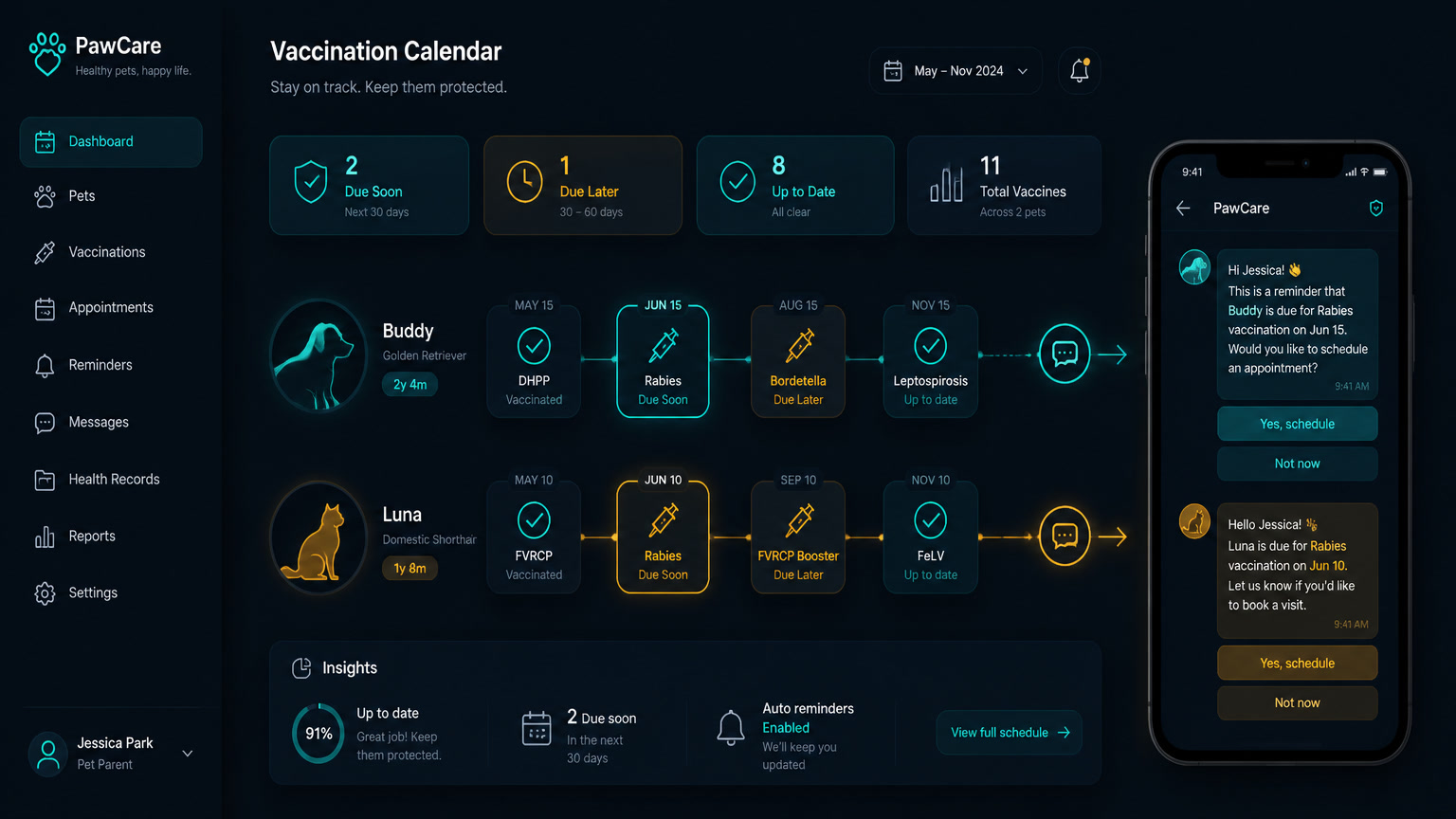
- Turn on reminders and confirmations (the three deltas: 14 days, 3 days, day before), with one-tap confirm or reschedule.
- Enable the win-back sequence only after four weeks of clean cadence, with auto-suppression active from day one.
The three most damaging mistakes: automating before standardizing the preventive table (if every vet computes dates differently, no system fixes it); buying the chatbot before the calendar (a bot that doesn't know which service is due answers beautifully and sells nothing); and reactivating without suppression (a clinic that pushes three times at an owner who never replied isn't gaining clients — it's burning its sender rating, the hardest asset to rebuild on WhatsApp).
Automating a veterinary clinic is not installing a reception chatbot. It is turning the preventive calendar — today living in the vet's head and a notebook — into the operating system of the business. The revenue that conversion recovers is not incremental: it was already yours, just waiting on the right date.
Before choosing a platform, our WhatsApp CRM comparison for LatAm covers Clientify, HubSpot and the native API case by case; and the 24h/2h reminder clinic case shows measured impact on this problem's most visible symptom: no-shows.
Frequently Asked Questions
How much does automation cost for a veterinary clinic?
A small clinic can run on a $26-150 USD/month stack: self-hosted n8n ($6-20), a CRM like Clientify ($0-99), and the WhatsApp Business API (utility template rates, typically $3-15/month at clinic volume). The preventive schedule engine is built once and doesn't charge per patient.
What should a veterinary clinic automate first?
The preventive calendar: the species + age + weight table that computes vaccines, deworming and checkups, with WhatsApp reminders and confirmations derived from it. Client reactivation comes next — that's where the largest recoverable revenue sits.
Do WhatsApp reminders still work after the October 1, 2026 billing change?
Yes. Replies inside the 24-hour window are still service messages with 1,000 free per number per month, and proactive reminders go out as utility templates, the cheapest billing category. For an 800-client clinic, a full annual cadence costs between $1 and $6 USD per month depending on the country.