Salon and Barbershop Automation: Why the Reminder Isn't the First Thing You Should Automate
Salons average a 10% rebooking rate against a 60% target. The five revenue clocks worth automating, and what the cadence actually costs on WhatsApp.
Salon and Barbershop Automation: Why the Reminder Isn't the First Thing You Should Automate
The automation that moves the most money in a salon is not the one that prevents no-shows — it is the one that gets the client to book again. The industry averages a rebooking rate near 10% against a target of 60% or more, and that gap is worth more than any no-show. The 24-hour reminder is bought first because it is the easiest thing to sell, not because it is the most valuable.
That is the ordering mistake we see over and over: the visible symptom gets automated and the hole that decides the business gets ignored.
Two holes bigger than the no-show
There is no agreement on no-shows. Zenoti, from anonymized data across more than 30,000 salons, reports an average no-show rate of 3% and 8% cancellations. BookrHub's 2026 report puts it at 15-25% for businesses without a deposit system; SchedulingKit puts salons without automated reminders at 20%. Three sources, three orders of magnitude. Do not pick one — audit your own 30 days before buying anything.
Now the two holes almost nobody measures:
- Bookings that never come into existence. Between 46% and 50% of salon and barbershop appointments are made outside business hours (Blismo, 2026), and during peak hours 35-40% of calls are lost because everyone's hands are busy (Aira). Only 24% of callers who reach voicemail leave a message, and 71% of regular clients have skipped booking at some point because they could not reach anyone in time (Zenoti, 2026).
- Visits that never repeat. The average rebooking rate runs near 10%, according to Millennium's analysis of tens of thousands of salons published through American Salon; salons that do it well reach 75%. New-client retention averages 35%: only one in ten makes it to a sixth visit. Zenoti puts it bluntly — closing the gap from 10% to 20% at an average-revenue salon is worth roughly $45,000 a year per location (an illustrative estimate built on their benchmarks, not a published figure).
The rebooking gap is 55 points. The worst no-show gap is 17. And yet almost every salon that buys automation starts with the reminder.
The order that works: five revenue clocks
We have built scheduling engines for clinics, firms and aesthetic centers: the bottleneck is never a lack of clients, it is the gap between what the client wants and what ends up on the calendar. In AI agents for appointment scheduling we published that engine's production results — 24-hour and 2-hour WhatsApp reminders that cut no-shows from 18% to 6% at 98% delivery.
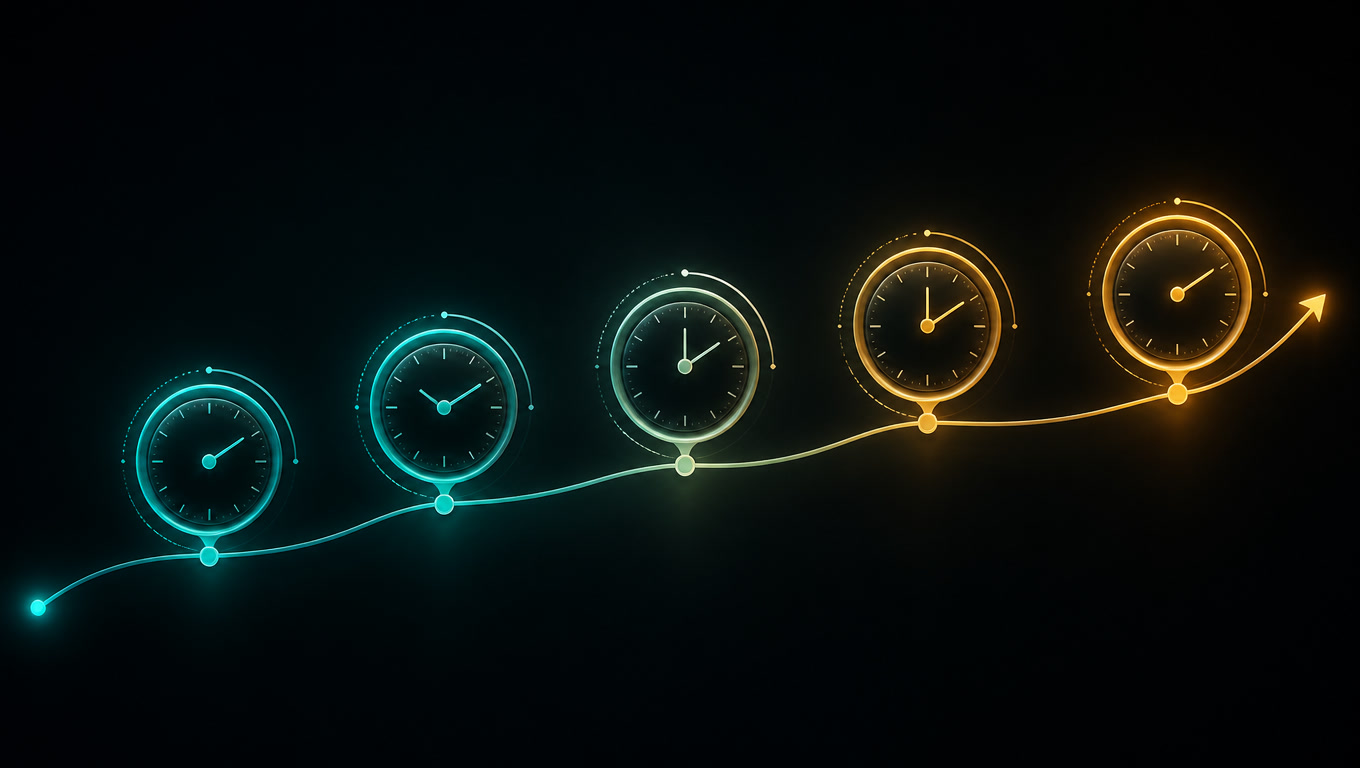
That engine works in a salon, but the steering wheel is different: not a no-show pipeline, but five clocks that run on their own.
| Clock | Fires when | Channel and message | Metric you watch |
|---|---|---|---|
| Booking | A message at 22:40, a missed call, an Instagram DM | Immediate WhatsApp reply with three real openings and a booking link | % of appointments booked outside hours |
| Confirmation | 48 h and 24 h before the appointment | Two-way template: "Confirm / Move / Cancel" — a reply, not a read | % of active confirmations |
| Rebooking | The client leaves without a next appointment, or 24 h pass without booking | Message with the window their service is due and three concrete openings | Rebooking at 24 h and at 12 weeks |
| Cycle | Overdue for their service cadence with no future appointment | Maintenance reminder with a booking link | % of the active base overdue |
| Rescue | 12 weeks without a visit, the point where the client stops being a client | A two-message sequence and an offer of openings | Appointments recovered over rescued base |
The distinction matters: confirmation protects the appointment that already exists; rebooking, cycle and rescue create the next one. The first is maintenance. The other three are growth.
Service cadence decides whether rebooking happens on its own
"I'll be back in a month" does not mean the same thing in every chair. Retention data by service type makes it clear: color clients retain at 75-85%, while massage retention falls to 40-50% (spa and salon retention benchmark, 2026). The same reminder for every service treats someone who comes every three weeks and someone who comes once a trimester identically.
These are the starting windows we recommend configuring — not law, they are the baseline you then measure against:
| Service | Starting window | Automatic trigger |
|---|---|---|
| Color or root touch-up | 4-6 weeks | Overdue at 6 weeks with no booking |
| Balayage or highlights | 8-12 weeks | Overdue at 12 weeks |
| Cut | 4-6 weeks | Overdue at 6 weeks |
| Barbering | 3-4 weeks | Overdue at 4 weeks |
| Nails or waxing | 2-6 weeks | Overdue by service |
| Massage or recurring treatment | Irregular | The cycle is not enough: it needs a reason |
Simple Salon reinforces this with its own standard: 12 weeks is the longest reasonable gap between visits, and below 40% rebooking the salon needs to work the process, not the team. That is why the cycle clock is not an extra — it is what turns a color client into a client for life.
Cash deposits: a US playbook, a brake in Latin America
In the United States the recipe against no-shows is the deposit, and it works: 2026 reports attribute a 60-80% reduction to automated deposit collection.
Our position: across most of Latin America, the automated deposit is the weakest lever on the list, and it is worth saying out loud. Cash is still around 25% of in-person sales volume in the region (PCMI, 2025), and storing a client's card in a small salon's system is the exception rather than the rule. Automating payments that are not going to happen does not reduce no-shows — it adds friction to the act of booking.
The compensating control is two things, not one:
- Active confirmation, not a passive reminder. Clients who explicitly reply show attendance rates more than 20 points above those who only receive a notice (Software Advice research on scheduling tools, across several service sectors) — the difference is not in the wording, it is that the system knows in advance which appointment is at risk.
- An active waitlist. Automated slot recovery runs around $370 per location per month in Zenoti's benchmarks. A last-minute cancellation with no waitlist is money that was already earned and silently lost.
When the salon already takes cards or Mercado Pago as a matter of course, the deposit regains its value. Start with confirmation and waitlist; move up a level when the payment medium allows it.
What the cadence actually costs since October 1, 2026
On October 1, 2026 Meta began charging per message for WhatsApp service messages. Two rules govern a salon's bill:
- The first 1,000 service messages per month per business number are free. They reset monthly, they are not pooled across numbers and there is no rollover: billing starts at message 1,001.
- Proactive reminders go out as utility templates, which have no free tier. They are billed per message by the recipient's country (rates as of October 1, 2026 in USD): Colombia 0.0008, United States 0.0034, Brazil 0.0068, Mexico 0.0085, Chile 0.02, Argentina 0.026.
The arithmetic is simple. A salon running 400 appointments a month sends roughly 400 confirmations at 24 hours, 400 rebooking invitations and 200 cycle messages: about 1,000 proactive messages, around $8.50 in Mexico and under a dollar in Colombia. Client replies ("confirmed", "move me to Thursday") fall inside the 24-hour window, are service messages, and the first 1,000 each month are not billed.
In other words: at this scale cost was never the brake. The brake is having never designed the five clocks.
Which tool fits which size
| Profile | What to use | Typical cost | Where it falls short |
|---|---|---|---|
| A single chair or one-person barbershop | WhatsApp Business with a catalog and an out-of-hours message | $0 | More than one stylist, or stacked services |
| 2 to 5 stylists | Vertical booking software with WhatsApp reminders (Happoin, AgenditApp, Fresha or Booksy) | Tens of USD a month, no booking commission | When you want rebooking segmented by service, not just reminders |
| 6+ stylists or several locations | Clientify + self-hosted n8n + WhatsApp Business API | Around $60-200 a month | Almost never: it scales by location and by stylist |
If you are comparing channels and CRMs first, the WhatsApp and CRM comparison for Latin America covers that ground, and the chatbot cost framework for local businesses says when a well-connected booking flow is enough.
Three mistakes we see in salons that already bought software
- Buying reminders and never looking at rebooking. The software shows avoided no-shows because that is the metric that sells. If you do not watch the share who book their next appointment before leaving, you are measuring the symptom, not the business.
- Leaving rebooking to each stylist's personality. Zenoti's data is blunt: top-earning salons rebook 30% of their clients within 24 hours against a 10% average, and the difference is that the rebooking prompt lives inside the checkout flow, not in whoever is working that day. Automating that step is what turns 10% into 60%.
- Treating every service with the same cadence. An identical reminder for color every four weeks and for an irregular massage shortchanges one and over-serves the other. Service-level cadence is the part of the system almost nobody configures.
What not to automate: the conversation in the chair, where rebooking is actually decided, and cold promotional blasts to the whole base — a marketing message is not a service message and is billed separately.
Start where it hurts
If you automate one thing this month, make it the rebooking clock: find the clients who left without a next appointment, apply their service window, and message them on WhatsApp with three concrete openings. It is the highest return-per-effort lever in a salon.
Once that is running, move up to the other four clocks. The detail on building the scheduling engine and the mistakes to avoid is in AI agents for appointment scheduling; the evidence on when to send each reminder is in clinic automation.
At Mintec we build these five clocks on top of our automation and chatbot services. If you would rather see first where the revenue is leaking, we start there.
Frequently Asked Questions
What is a good rebooking rate for a salon?
Above 60% is considered strong and above 80% excellent: it is the share of clients who book their next appointment before leaving or within 24 hours. The industry average sits near 10%, while top-performing salons exceed 65-70%.
What should a salon automate first?
Out-of-hours capture and two-way confirmation 24 hours before the appointment, because that is where bookings that would otherwise never exist get lost. Second comes automated rebooking driven by service cadence, which holds the largest gap in the business.
How much does WhatsApp appointment automation cost a salon?
Since October 1, 2026 Meta charges per message, but the first 1,000 service messages per month per business number are free. A salon running 400 appointments a month sends roughly 1,000 proactive messages: about $8.50 in Mexico and under a dollar in Colombia.