

The Admin Tax: How Consulting Firms Waste 30% of Billable Capacity (and AI Automation Fixes It)
Consulting firms in Latin America waste up to 30% of their billable capacity on repetitive admin work. Here's how AI automation, smart CRMs, and no-code workflows are recovering hundreds of hours per year for mid-size firms. Backed by data from McKinsey, IDC, the CFO Alliance, and our hands-on implementation experience.
The problem no one in consulting wants to admit
You run a consulting firm. Your team bills by the hour. But if you add up the time spent on proposals, manual reports, invoicing, lead follow-ups, and internal emails... how many billable hours are actually left?
The answer — backed by McKinsey and industry data — is that growing consulting firms lose, on average, 30% of their capacity to non-billable admin work. In concrete terms: out of every 10 hours a client pays for, 3 are lost to things that shouldn't require a consultant's time.
This isn't a theory piece. We're breaking down the 4-pillar framework we're using with consulting firms to recover hundreds of hours per year: CRM → Proposals → Projects → Billing. And we're backing it with real data, not vendor slogans.
The hidden cost of manual operations
Consulting lives and dies by its expertise. But expertise doesn't bill if your team is trapped in spreadsheets, Word templates, and follow-up emails.
A 2026 study by US Tech Automations found that top consulting firms have already automated 35-45% of their internal admin processes. The other 55-65% — the majority — is still stuck in manual workflows that drain productivity.
The numbers tell the story:
| Process | Manual Time | Automated Time | Savings |
|---|---|---|---|
| Proposal generation | 4-8 hours | 45-90 minutes | 80-85% |
| Lead follow-up | 6+ hours/week | Fully automated | 100% manual effort eliminated |
| Billing and collections | 45-65 days DSO | 25-35 days DSO | 40-60% |
| Client reporting | 3-5 hours/week | Auto-generated | 70-80% |
| New consultant onboarding | 2-3 days | 4-6 hours | 75% |
IDC's numbers back this up: firms implementing admin process automation recover 800-1,200 hours per year per 10 employees. At average consulting rates in Latin America ($40-$80/hour), that's between $35,000 and $55,000 per year in recovered capacity.
The 4-pillar framework for consulting firm automation
After implementing automation solutions for consulting and professional services firms, we've identified four areas that deliver 80% of the impact. They're not independent — they work as a system. When you connect all four pillars, the effect is multiplicative, not additive.
Pillar 1: CRM with intelligent scoring and automated follow-up
The first pillar is a CRM that isn't just a digital contact book. You need:
- Automated lead scoring: not all leads deserve the same attention. Set scoring rules based on industry, company size, and behavior (downloaded a whitepaper vs. requested a demo).
- Automated follow-up sequences: 50% of leads never receive follow-up because consultants are busy with existing clients. A CRM with workflow automation can nurture leads with relevant content until they're ready for a call.
- Automatic contact enrichment: 30-50% of CRM data decays annually. Tools like Make connected to enrichment APIs keep your database clean without manual intervention.
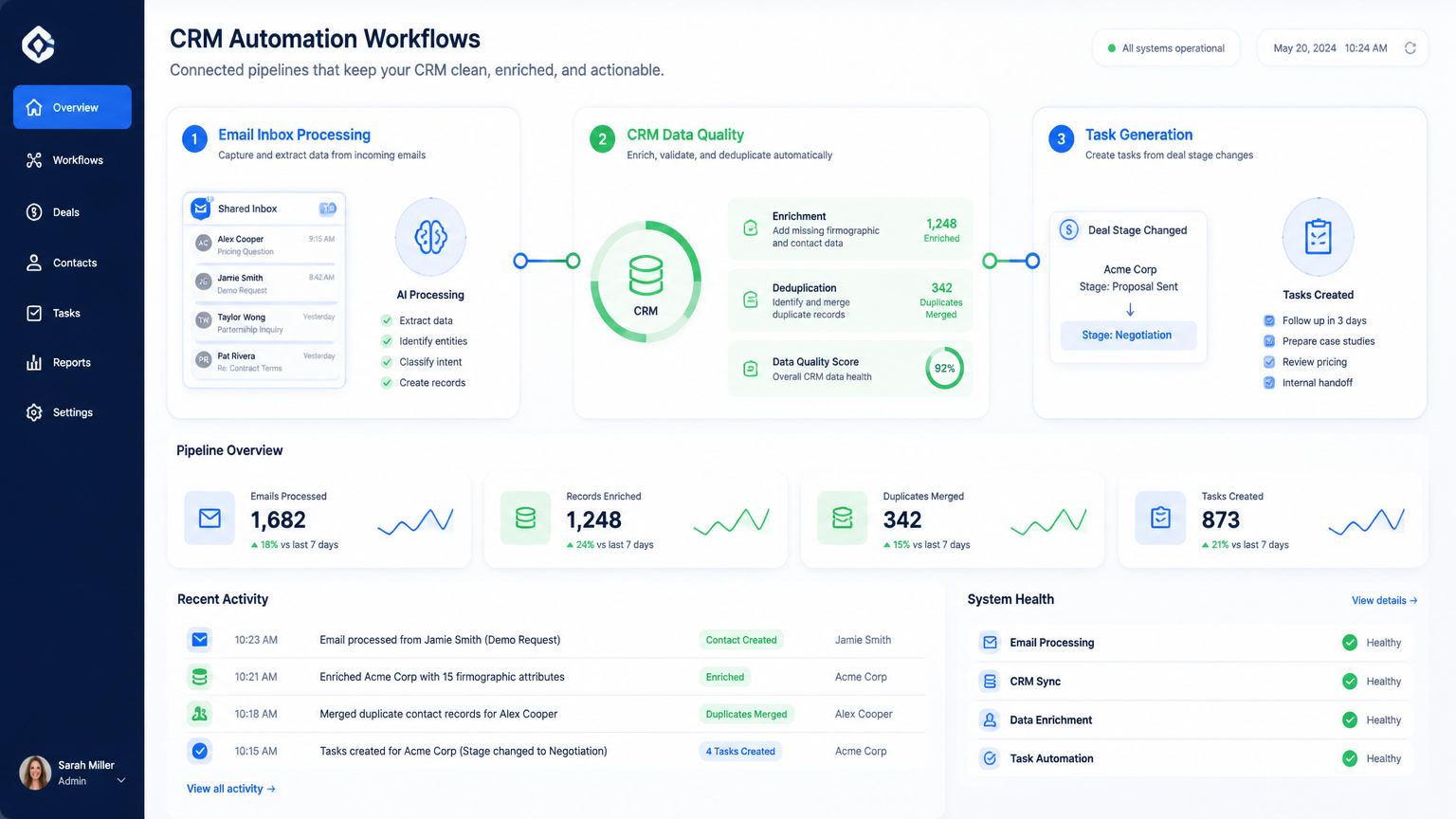
In our experience, implementing CRM automation — Clientify is a strong option for LatAm firms — for a 15-person consulting firm recovers 8-12 hours per week on lead follow-up and data updates alone.
We cover this in detail in our article on AI lead scoring for CRM.
Pillar 2: Automated proposal generation
This is the pillar with the most immediate, visible ROI. A good consulting proposal takes 4-8 hours. With automation:
- Smart templates: connected to the CRM, pre-filling client data, history, and relevant case studies.
- Content library: reusable modules (methodology, team bios, pricing, terms) that assemble dynamically based on prospect profile.
- AI-assisted drafting: using LLMs + RAG over your content library, you generate a first draft in minutes. The consultant only reviews and adjusts. According to Responsive.io data, this cuts proposal time from 4-8 hours to 45-90 minutes.
The impact isn't just time. A firm that delivers proposals in 90 minutes closes more deals because they're faster and their proposals are more consistent.
Pillar 3: Automated project management and tracking
Once the client says yes, the real challenge begins: execute without losing quality or margin.
- Recurring task automation: onboarding checklists, brief delivery, weekly meeting scheduling.
- Real-time dashboards: the client sees progress without the consultant preparing manual reports.
- Automatic alerts: when a project deviates from the budgeted hours or when a key milestone approaches.
Tools like Make or n8n connect your CRM to your project management and billing systems. When a deal closes in the CRM, it automatically creates the project, assigns the team, schedules the kickoff, and generates the first report.
Pillar 4: Automated billing and collections
The pillar that hurts the most. Consulting firms in Latin America average 45-65 day collection cycles. Automation can cut that to 25-35 days.
- Automatic month-end invoicing: no waiting for someone to generate invoices manually.
- Smart payment reminders: staggered sequences that escalate gradually, without consultant intervention.
- Automated bank reconciliation: connect your billing system to your bank account via APIs.
The CFO Alliance reports that firms automating their billing cycle see a 40-60% DSO reduction. For a firm billing $500,000/year, that means having $200,000-$300,000 available 20-30 days earlier.
Our article on AI-powered CRM explores how these capabilities integrate into a single ecosystem.
Why most implementations fail
We've seen dozens of automation attempts at consulting firms. Most fail for three reasons:
1. Automating before defining the process. They want to connect tools without mapping the real workflow. Result: automation that accelerates a broken process.
2. Chasing the perfect tool instead of starting with what's available. Make, n8n, Clientify, HubSpot — any of these can solve 80% of the problem. Perfection is the enemy of progress.
3. Not measuring before and after. Without baseline metrics (time per proposal, DSO, leads without follow-up), there's no way to prove ROI. And without ROI, the initiative dies at the next budget review.
Our recommendation: start with pillar 2 (proposals) because it has the fastest, most visible return. The credibility from that first success makes the other pillars easier to sell internally.
We dive deeper into AI agents in CRM and ERP in our article on advanced automation.
The 90-day decision
The approach we recommend has a 90-day horizon:
- Day 1-30: Diagnosis and process mapping. Measure baseline: admin hours per consultant, current DSO, proposal generation time, leads lost to follow-up gaps.
- Day 31-60: First pillar implementation. We recommend starting with automated proposals (Pillar 2) or CRM with scoring (Pillar 1), depending on where the pain is sharpest.
- Day 61-90: Connect pillars and automate cross-system workflows. This is where Make or n8n create real value: when a qualified lead in the CRM automatically generates a proposal, which on closing creates a project, which on completion generates the invoice.
At Mintec, we help consulting firms across Latin America implement this framework. Every firm is different, but the 4-pillar pattern holds. The key is executing in the right order and measuring every step.
For more on multi-agent CRM implementation and how AI agents are changing the CRM game, check out our full analysis.
The competitive advantage of the automated firm
In a market where clients demand faster responses and tighter budgets, the consulting firm that automates its admin processes doesn't just improve margins — it differentiates. It can respond to RFPs in hours, not days. It can invoice in minutes, not weeks. It can scale without doubling the admin team.
The data from McKinsey, IDC, and the CFO Alliance confirms what we're seeing in practice: firms that automate at least two of these four pillars see 15-25% improvements in proposal-to-close rates and 40-60% reductions in collection cycles.
The question isn't whether your consulting firm should automate. The question is how much longer you can afford not to.
Frequently Asked Questions
What is professional services automation (PSA)?
It's the use of CRM tools, no-code platforms like Make or n8n, and AI to automate repetitive administrative tasks in professional services firms: billing, proposals, client follow-ups, and reporting. It doesn't replace the consultant's judgment — it eliminates work that doesn't require it.
How much time can a consulting firm recover with automation?
According to IDC data, firms implementing admin process automation recover between 800 and 1,200 hours per year per 10 employees, equivalent to $35,000-$55,000 in recovered capacity at average consulting rates.
Which processes should a consulting firm automate first?
The highest-impact processes are: proposal generation (reduces 4-8 hours to 45-90 minutes), billing and collections (reduces DSO by 40-60%), and automated client reporting. These three account for over 50% of admin time in mid-size firms.