
Virtual Assistant or AI Automation: The Decision Matrix for SMBs
Hire a virtual assistant or automate with AI? Neither — every task has a route. Real costs, a routing matrix, and the hybrid model that works.
Virtual Assistant or AI Automation: The Decision Matrix for SMBs
Short answer: you don't have to choose between a virtual assistant and AI automation — you have to route every task to the right lane. Hiring "someone" is not the decision; designing who does what is.
The "should I hire a virtual assistant or automate with AI?" question became unavoidable in 2026, and for an uncomfortable reason: the market is selling a war that doesn't exist. A thread on r/Entrepreneur in August 2026 ("Where are you guys actually hiring good virtual assistants these days?", 68 upvotes, 209 comments) shows business owners still hunting for human assistants while their ad feeds scream that a $29 bot replaces a $2,000 employee. The VA agencies fire back with the opposite pitch: "AI didn't replace assistants, it upgraded them."
Both sides are selling something. We've implemented automation for over a dozen clients across Latin America, and we run our own agency on a hybrid model — agents, automations, and humans. This is the matrix we actually use, with real 2026 numbers.
The price war that clouds the decision
Before any discussion: the numbers. They're public and consistent across multiple 2026 sources:
| Route | Cost per hour | Typical monthly cost | What it covers |
|---|---|---|---|
| General VA (Latin America) | $6-14 | $960-2,240 (full-time) | Salary, no benefits if freelance |
| Specialized/executive VA (LATAM) | $15-22 | $2,400-3,500 (full-time) | C-suite support, bilingual, operations |
| Virtual assistant (US) | $25-45 | $4,000-7,000 (full-time) | Same profile, local market rates |
| Rule-based automation (Make/n8n/Zapier) | $0 per run | $9-99 + setup | Integrations, deterministic tasks |
| AI agent (n8n + API + CRM) | $1-3 effective | $26-209 | Classification, replies, orchestration |
| Hybrid (part-time VA + stack) | variable | $500-1,200 + $30-200 in tools | 24/7 coverage with human escalation |
Three nuances that "AI vs human" comparison tables systematically omit. First, if you hire formally, the SBA puts the true cost of an employee at 1.25-1.4x base salary, and a single admin role can eat 15-20% of the operating budget of a 5-to-15-person SMB. Second, a new assistant takes one to three months to become fully productive. Third, a LATAM assistant at $9-14/hour is still 10x more expensive than an AI agent at $1-3/hour effective — but can do things the agent can't: negotiate, add nuance, carry accountability.
So cost-per-hour analysis is a trap. The right question is which tasks justify which route.
The six-question router
We use this filter task by task. If a task says "yes" to the first two questions, there's almost always an automated route; if it says "yes" to questions four or five, there's almost always a human in the loop:
- Volume — Does it happen 10+ times per week? If not, no route justifies it: either the owner does it or the process gets redesigned.
- Variability — Is the input structured and predictable (forms, fields, templates)? Then rules. Is it free text, voice, or ambiguous cases? Then AI or human.
- Error cost — Does a mistake cost money, a client, or legal trouble? If yes, the route needs human review no matter how cheap it is.
- Judgment and nuance — Does the task require reading context, negotiating, or deciding with incomplete information? That's human territory.
- Relationship — Does the client hear a brand voice and expect a person? An agent can open the door, but relationships are built by humans.
- Maintenance — Who updates the automation when the process changes? If nobody, every "yes" on questions 1-2 loses value.
This is the same spirit as our framework on when NOT to use AI in automation, applied to staffing: technology gets chosen by task characteristics, not by trend.
The routing matrix: eight typical SMB tasks
| Task | Volume | Variability | Error cost | Recommended route |
|---|---|---|---|---|
| Answer FAQs on WhatsApp | high | medium | low | AI agent (chatbot) with the cost tiers from our chatbot framework |
| Classify and assign leads | high | medium | medium | Rules + AI, human review on hot leads |
| Book appointments | medium | medium | medium | Agent self-service + human confirmation on complex cases |
| Draft proposals | low | high | high | Virtual assistant with templates and AI support |
| Reconcile invoices | medium | low | high | Automation with mandatory human review |
| Collections follow-up | high | low | medium | Automated reminders + VA for exceptions |
| Weekly reporting | high | low | low | Pure rules (n8n/Make + Looker Studio) |
| Negotiate discounts, resolve complaints | low | high | high | Virtual assistant / manager — never a fully autonomous bot |
The pattern jumps out: of eight typical tasks, only one is fully human and two are pure rules; the rest live in hybrid mode. That's why binary "VA vs AI" comparisons fail — they answer a question real operations never ask.
The hybrid model that works: the escalation ladder
When we design operations for clients, we build a four-step ladder:
- The agent answers first — 24/7, no waiting, no business hours. It handles the standard: FAQs, classification, booking. In a Mexico City dental clinic we work with, the WhatsApp agent went from resolving 28% to 44% of conversations in one week (by improving its knowledge base, not the model); everything else escalates.
- Rules execute — all deterministic work: assignment, reminders, reports, CRM updates. It's the backbone we documented in no-code automation for LATAM SMBs and AI agents for back-office operations.
- The virtual assistant handles exceptions — what the agent can't do and rules don't cover: complex scheduling, upset clients, quotes with discounts. At the clinic, the admin assistant went from transcribing and replying to the same thing 30 times a day to handling only the cases that need judgment.
- The owner decides — the final layer, and the cheapest to maintain: only decisions arrive here.
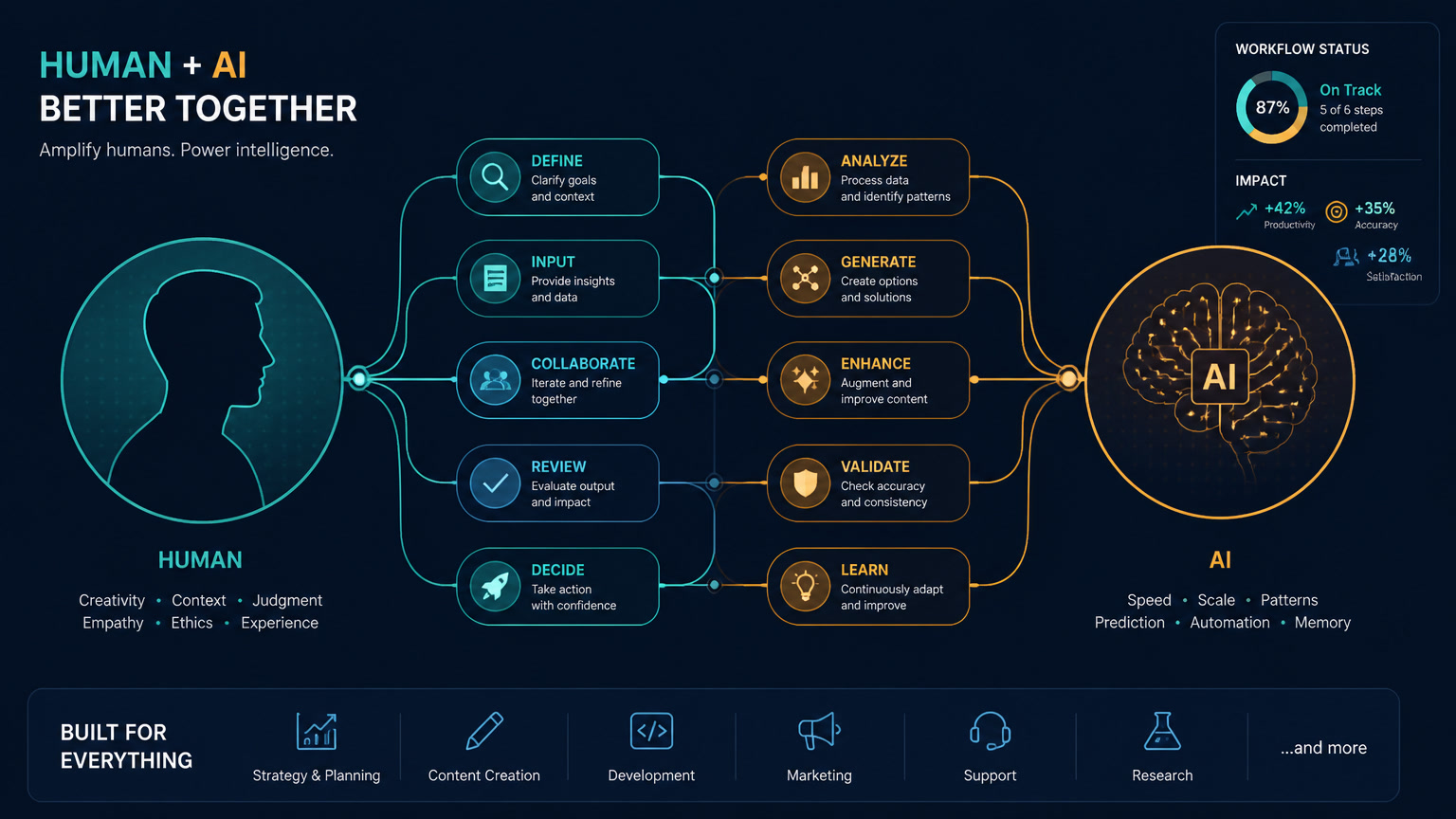
Every step reduces the hours of the next one. The metric isn't "how many conversations the bot resolves" — it's how many hours of human judgment were freed. If the agent resolves 44% and rules absorb another 30%, the human assistant concentrates their day on the 26% that genuinely needs it — and you don't need to hire a second assistant.
This requires measuring operations before touching anything: the operational bottleneck diagnosis we run as step zero on every project.
The reverse trap: what we see in failing implementations
Here's our unfiltered take: most SMBs route backwards. They automate the deterministic work — which a cheap assistant could handle without drama — and leave judgment tasks with no owner, which is exactly where unsupervised automation breaks.
The "$29 bot replaces the $2,000 employee" pitch is the culprit. AI implementation consultant Lilach Bullock put it better than anyone: "every AI vendor sells you the same story: replace a £2,000-a-month employee with a £29-a-month bot. I fell for it too." Her conclusion after actually building it: the agent handled 80% of lead classification, but the remaining 20% — the weird leads, the ambiguous ones, the ones needing tact — still required a human, and nobody had budgeted for that.
The data backs her up. Gartner predicts over 40% of agentic AI projects will be canceled by 2027, and the pattern we documented in why automation projects fail repeats itself: projects that promised to replace an entire role, not to solve a task. An agent is not an employee; it's a piece of a system that someone has to design, supervise, and maintain. If there's no system owner, failure is budgeted from day one.
The rule we apply with clients: one task per automation, one responsible human per agent. If you can't name the person who reviews the bot's answers, don't deploy the bot.
The 30-day plan for routing your operation
- Week 1 — Inventory: list the 15 admin tasks that consume the most hours and run them through the six-question router. Mark a probable route for each.
- Week 2 — Baseline: measure real hours per task. No baseline, no ROI — the lesson we repeat in every automation implementation article.
- Week 3 — First automation and first agent: automate one deterministic task (reporting, assignment) and train an agent for your highest-volume conversational task using the SMB chatbot cost framework.
- Week 4 — Staffing decision: review which judgment tasks ended up with no owner. If they add up to 5+ weekly hours, hire a part-time virtual assistant focused on exceptions and relationships. If less, don't hire yet — the system doesn't justify it.
The sequence matters: automate and deploy the agent before hiring, not after. That way the assistant arrives to do work that genuinely needs judgment, instead of arriving to do what a bot could already be doing.
Our conclusion: in 2026, your first assistant shouldn't be a human or a bot — it should be a routing criterion. Virtual assistants aren't dead and AI agents aren't a scam; what's dead is the binary question. The SMBs that win don't decide "hire or automate": they decide task by task, measure weekly, and build the ladder where humans do what only humans can do. If you want help designing that ladder for your operation, let's talk.
Frequently Asked Questions
Should I hire a virtual assistant or automate with AI?
It depends on the task, not the trend. A virtual assistant wins on tasks that need judgment, nuance, or client relationships; automation and AI agents win on repetitive, high-volume, predictable work. The recommended practice is to route each task separately and run a hybrid model: the agent answers standard requests 24/7, rules execute deterministic work, and the human assistant handles exceptions.
How much does a virtual assistant cost in Latin America in 2026?
A general virtual assistant in Latin America charges between $6 and $14 per hour depending on country and experience ($960-2,200 USD per month full-time), and $15-22 per hour for specialized or executive support. The same role costs $25-45 per hour in the US. For comparison, an AI agent running on n8n and APIs costs $26-209 per month — an effective $1-3 per hour of work.
Can an AI agent replace a virtual assistant?
Yes, on the tasks where agents win: high volume, 24/7 coverage, bounded variability, and low error cost. No, where humans win: negotiation, judgment on ambiguous cases, and trust-based relationships. Projects that try to replace the whole role rather than individual tasks are the ones that get canceled — Gartner predicts over 40% of agentic AI projects will be canceled by 2027.