

AI Mode accepts the answer, AI Overviews compare it: 846,000 sessions of user behavior
Clickstream data from 846,000 US Google sessions shows opposite behavior on the two AI surfaces: in AI Mode 88% of tasks take the shortlist as given and 64% click nothing, while SERPs with an AI Overview get 47.5% of scrolling going backward. What that changes for title tags, meta descriptions and intent-based playbooks.
AI Mode accepts the answer, AI Overviews compare it: 846,000 sessions of user behavior
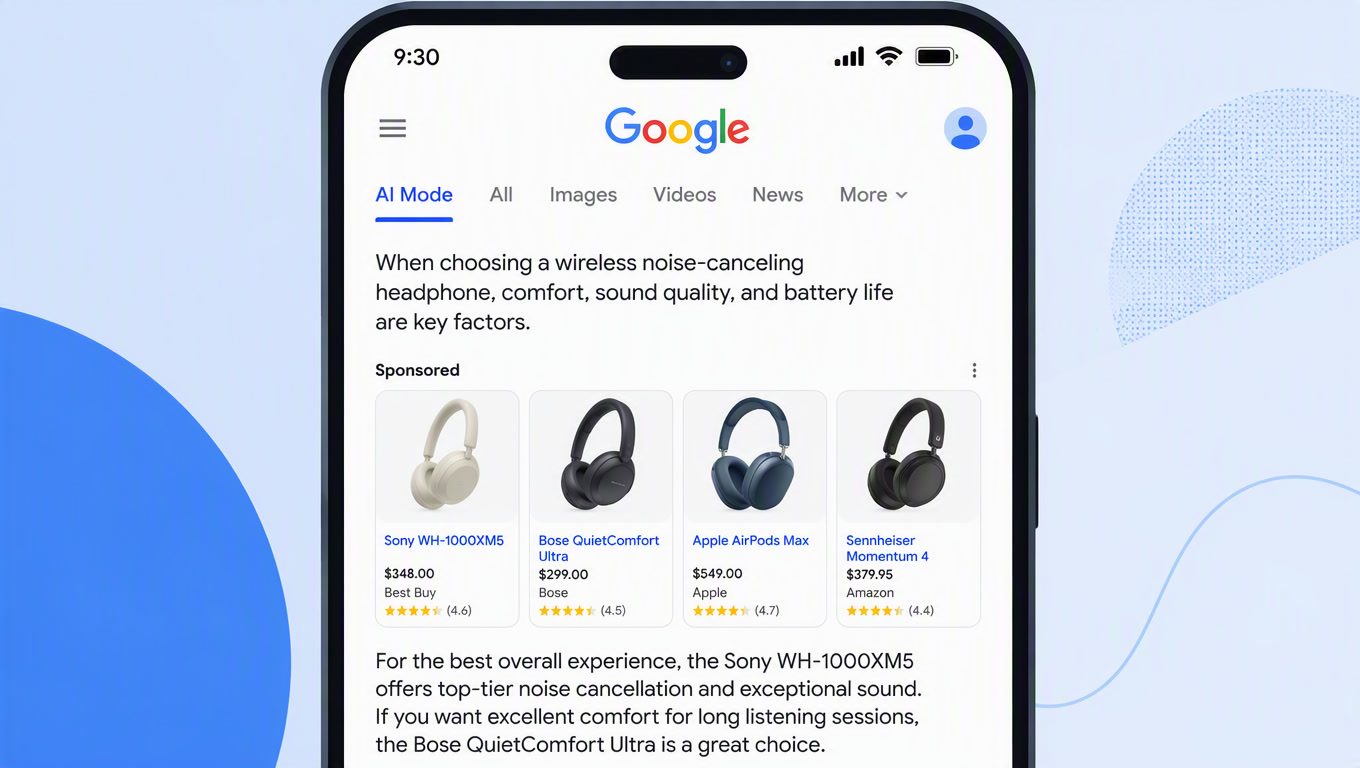
Clickstream data from 846,000 US Google sessions shows the two AI surfaces producing opposite behavior. Inside AI Mode the user takes the answer as given: 88% of tasks used the AI's shortlist as-is, 74% picked the first item, 64% clicked nothing. On a SERP with an AI Overview the user keeps weighing: cursor movement spreads across 83% of the viewport instead of 66%, and 47.5% of all scrolling goes back up the page instead of 27%. Optimizing for one surface and optimizing for the other are two different jobs, and most title tags are still written for a reader who stopped existing.
What was measured
Eric Van Buskirk of Clickstream Solutions analyzed anonymized clickstream data supplied by Surfer SEO: roughly 846,000 US Google search sessions from February and March 2026, tracking cursor position per second, cursor path, scroll depth in both directions, and whether an AI Overview was present. It is the fifth user-behavior study on Google's AI features in twelve months and by far the largest. Earlier public mouse-tracking work measured dozens of people, with the biggest reaching a few thousand tasks; this one compares sessions by the thousand.
The AI Mode comparison figures come from a separate piece of research, GrowthMemo's April 2026 study of 185 high-stakes purchases, cited next to the clickstream work in Search Engine Land's writeup. Worth keeping the two datasets apart, because they were built differently and one of them watches hands while the other watches choices.
Two surfaces, two jobs
| AI Mode | SERP with an AI Overview | |
|---|---|---|
| What the user does | Reads the answer, picks inside it | Reads, pauses, scrolls back, reconsiders |
| Shortlist taken as given | 88% of tasks | not applicable, there is no shortlist |
| First item picked | 74% | cursor spread across 83% of the viewport vs 66% without a panel |
| Clicked nothing | 64% | cursor still 44% of the time vs 29% without a panel |
| Reverse scrolling | not measured | 47.5% of total scroll vs 27% without a panel |
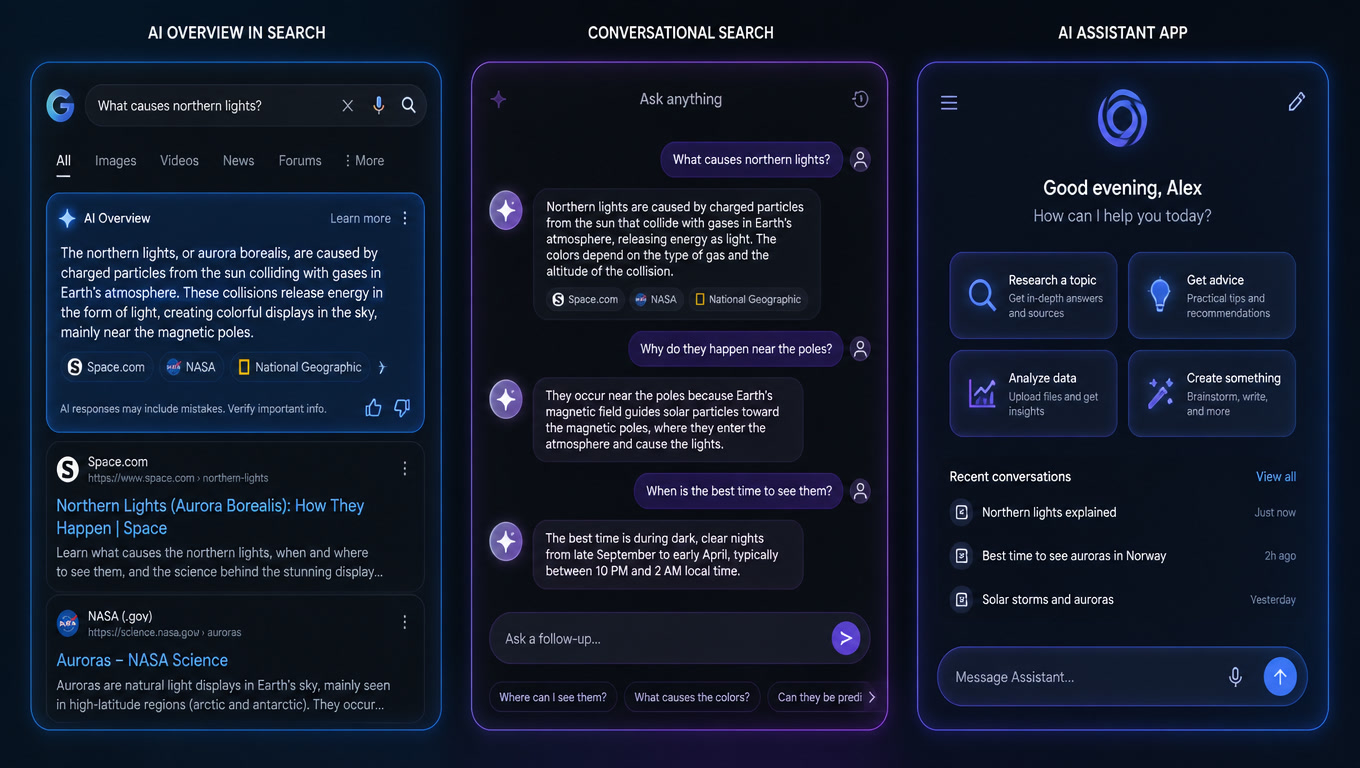
Showing up in AI Mode is a visibility problem at the model layer: either the shortlist contains you or the session ends without you. Showing up in an AI Overview is a comparison problem on the results page: the panel lists you, and the user then keeps moving and decides later. We separated those two jobs earlier in AI Mode and AI Overviews are not the same thing; what is new here is the measurement of what the hand does while the decision forms.
Half the scrolling goes backward
Among users who reverse direction on a SERP with an AI Overview, the median user spends 47.5% of total scrolling going back up the page. Without a panel, 27%. On those pages scrolling splits close to 50/50 between going down and coming back up, which is the signature of someone re-reading rather than scanning.
The May 2025 UX study of 70 users, built on think-aloud sessions and screen recordings, had found this pattern in small: 38% of AI Overview sessions included reassurance-seeking clicks, where the person opened a second link just to be sure. The clickstream data shows that the validation work has moved onto the results page itself. People used to leave Google to check a result. Now they scroll up on Google to check it.
For anything with real stakes behind the purchase, this is the most consequential number in the study. Your listing under an AI Overview is not getting one impression anymore. It is getting two or three, and the later ones are the ones where somebody compares you against what sits above and below you.
Intent stops predicting how long people stay
Without an AI Overview, dwell time follows intent exactly the way the playbooks say. Twenty-one seconds into a session, 12% of navigational searchers are still on the page and 32% of local searchers are, a 20-point spread that has held for twenty years. With an AI Overview present, all five intent types (informational, local, navigational, transactional, video) sit between 41.9% and 48.5% at the same 21-second mark. The spread compresses to roughly six points.
Search Engine Land calls this the most novel finding in the study, and the scoping matters: it is a time-on-page finding, not a general behavior finding. Scroll depth still varies by intent under an AI Overview, and it reshuffles. Local jumps from third deepest to first, video falls from first to third. Intent still tells you what content to write. It no longer tells you how long someone will linger on the results page once the panel is there.
Our reading: for two decades the useful segmentation question was "what kind of query is this?" The question that now moves the number is "does this query bring a panel, and what does the panel say?" Same keyword list, different column to sort by.
The brand shortcut is gone
Cursor activity on navigational queries rose 40% when an AI Overview was on the page. Those searchers scored 19.7 on the cursor scatter measure without a panel, the most focused group in the study, and 27.5 with one. At 21 seconds, 45.8% of them were still active on the page against 12% without it. Someone who typed your brand name is now sweeping the page before reaching you.
That matters more than it did in September, when Ahrefs recorded AI Overviews on 83% of tracked branded queries, up from 61.3% in July: the panel is usually there, and the authority check fires before the click, even when there is nothing to gate against. We unpacked the citation side of that in AI Overviews answer 83% of branded searches; the behavior data says the user reads the panel first and you second.
What to rewrite this week
- Write the title tag for the second read. The user comes back to it after scrolling up. Front-load the entity and the differentiator that settles a comparison: price, version, date, the "vs" the query implies. A title that only names the topic has nothing to offer on the second pass.
- Make the meta description carry comparison criteria. When your result sits next to three others under a panel, the description is the only field where you say why to pick you. Numbers and specifics beat adjectives here.
- Put the answer in the first 40 to 70 words. In AI Mode 64% of sessions click nothing, so the extracted passage is the deliverable, not an invitation to a click. Same reason we argued for answer-first structure in the first citation takes 47% of the clicks.
- Check what the panel says about you on your own brand queries. If a third of branded queries now carry an AI Overview, the panel is part of your SERP and you should read it like one, month over month.
- Sort your query list by panel presence, not by intent. Intent still drives content format. Dwell, CTR and expected loss now track whether a panel appears, and that column is the one to prioritize against.
What this study does not claim
Clickstream Solutions says it plainly: the study does not claim that lower-ranked results get more clicks. What it shows is that with an AI Overview present, the results page receives more on-page evaluation before the click. The analysis leaned on nonparametric tests (Kruskal-Wallis, Mann-Whitney U, chi-square with Cramér's V) and reports effect sizes and directional consistency instead of p-values, because with this sample size tiny differences go significant.
Limits worth keeping in view: US sessions only, February and March 2026, an opt-in panel that agreed to share browsing behavior, and cursor paths published as aggregate illustrations rather than individual recordings. A five-month-old dataset of US desktop-heavy sessions is a strong read on direction, not a promise about next quarter.
How it looks on our own site
We pulled Search Console for our own domain (sc-domain:mintec.co) for September 15 to October 12, 2026, filtered to /blog/ pages. Two examples: /blog/ai-automation-small-business-revenue/ drew 4,546 impressions at position 7.4 with a 0.20% CTR, and /blog/turn-off-ai-overviews/ drew 2,041 impressions at position 9.3 with a 0.73% CTR.
Search Console does not hand us clicks split by AI Overview presence, so connecting those CTRs to the panel is correlation at best and we won't pretend otherwise. What the numbers do support is the shape of the problem: mid-first-page positions with thousands of impressions and sub-1% CTR are exactly the listings that get looked at during the scroll-back and not necessarily chosen on the first pass. Fixing them is a title and description job before it is a ranking job.
What does not change
That the two surfaces keep diverging, and that one strategy keeps failing on both. The mechanics of getting extracted and cited are covered in how to write for GEO, and the accounting for clicks that never happen lives in the click and citation framework for searches without clicks. What this study adds is the layer underneath all of it: the hand on the mouse stopped moving in a straight line, and the playbook has not caught up.
Frequently Asked Questions
What did the 846,000-session user behavior study measure?
Clickstream Solutions analyzed anonymized clickstream data provided by Surfer SEO across about 846,000 US Google search sessions collected in February and March 2026. The tracked signals were per-second cursor position, cursor path, vertical scroll depth in both directions, and whether an AI Overview was present on the results page. Analysis used nonparametric tests and reports effect sizes rather than p-values.
How does user behavior in AI Mode differ from user behavior in an AI Overview SERP?
In AI Mode users tend to accept the answer: 88% of tasks took the AI shortlist as-is, 74% picked the first item and 64% clicked nothing, according to GrowthMemo's April 2026 study of 185 high-stakes purchases. On a SERP with an AI Overview users keep evaluating: cursor movement spreads across 83% of the viewport instead of 66%, cursors stay still 44% of the time instead of 29%, and 47.5% of scrolling goes back up the page instead of 27%.
Does search intent still predict how long users stay on the results page?
Not when an AI Overview is present. Without a panel, 21 seconds into a session only 12% of navigational searchers are still on the page against 32% of local searchers, a 20-point spread. With an AI Overview all five intent types cluster between 41.9% and 48.5% at the same mark, compressing the spread to about 6 points. Intent still shapes what content to write, but it no longer predicts dwell time on the SERP itself.