
YouTube SEO: How AI Search Is Changing Video Discovery Forever
YouTube rebuilt its algorithm with Gemini AI in January 2026. Semantic IDs replaced keywords. Session duration matters more than CTR. Here's what actually works for YouTube SEO now.
YouTube SEO: How AI Search Is Changing Video Discovery Forever
On January 14, 2026, Google did something they internally called a "core AI reconfiguration" for YouTube. This was not a minor algorithm tweak — it was a complete rebuild of the recommendation engine using Gemini AI.
If your YouTube SEO strategy still relies on what worked in 2024, I have bad news: you are playing by rules that no longer exist.
According to OverTheTopSEO, the most underappreciated change in YouTube's 2026 ecosystem is how deeply AI now governs discovery. Understanding this system unlocks growth that keyword-based optimization alone cannot achieve.
What changed with Gemini AI on YouTube
To understand what happened, you first need to know how YouTube worked before. The traditional algorithm prioritized CTR (click-through rate) on thumbnails and watch time on individual videos. Your strategy was simple: catchy thumbnail + keyword-rich title + good retention rate.
That no longer works.
The January 2026 update integrated Gemini AI directly into the core recommendation architecture. It introduced three fundamental changes:
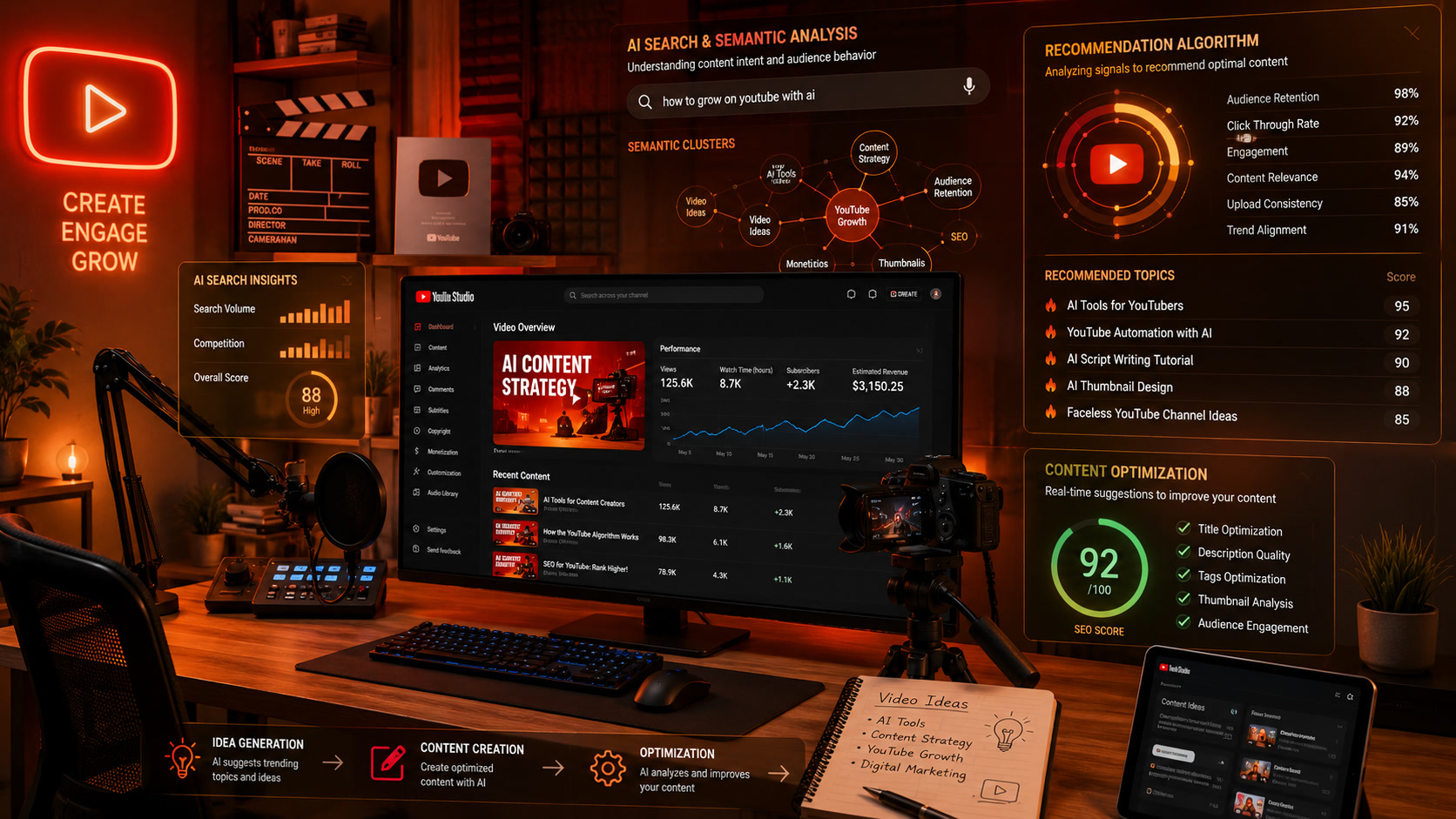
Semantic IDs instead of keywords. YouTube now understands the meaning of your video, not just the words in your title and description. If you make a video about "how to configure Node.js for production," the algorithm understands it relates to "server deployment," "backend engineering," and "DevOps" — even if you never use those exact words. YTSHARK explains that the 2026 algorithm uses natural language processing to understand the semantic meaning of content.
Session duration over individual video metrics. YouTube now optimizes for the user's entire experience on the platform, not the performance of a single video. According to SocialBee, the platform focuses on session time and depth — tracking whether viewers watch more than one video, move to related content, and come back later.
Good Abandonment as a positive signal. This is my favorite change. YouTube now recognizes when a user found exactly what they were looking for, even if they only watched 30 seconds. Someone searches "how to restart my router" and finds the answer in the first 15 seconds — that is "good abandonment." The user is satisfied even though they did not finish the video.
How to optimize your content for YouTube in 2026
The tactics that actually work now are very different from two years ago.
Forget CTR as your north star. Vizmo's analysis confirms that the January update penalizes misleading thumbnails. If you promise something in the thumbnail that the video does not deliver, the AI detects it and penalizes your content. Instead of optimizing for the click, optimize for the promise you make and how well you deliver on it.
Create content that generates sessions, not single views. The best success indicator in 2026 is how many videos a user watches after yours. This means your video endings matter more than your beginnings. End screens, well-organized playlists, and content series are strategically more valuable than ever.
Structure for conversational search. YouTube announced Gemini Omni at Google I/O 2026, which lets users ask natural language questions and get answers extracted from specific videos. Your content needs clear sections, specific points, and direct answers to common questions.
Quality over quantity applies harder than ever. With Gemini's semantic understanding, YouTube no longer needs to rely on surface-level signals to rank content. One well-researched, well-edited video will consistently outperform five quick, generic ones.
What creators and brands are reporting
The data is mixed but tells a clear story. Creators who relied on volume strategies (publishing 5-7 short videos per day to maximize reach) are seeing dramatic view drops since January. Those investing in deeper, well-researched content are seeing improvements.
A fascinating data point from PostIgniter's analysis is that Shorts no longer work as a discovery hack to drive traffic to long-form content. YouTube now treats Shorts and long-form as separate experiences, and aggressive cross-promotion is penalized.
For brands, the shift is broadly positive. High-quality educational and explanatory content performs better than ever because Gemini understands the real value of the content, not just surface metrics.
The data behind the shift
The numbers coming out of the creator economy confirm this is not theoretical. According to Likes.io, the algorithm changes that went into effect in early 2026 are punishing the playbook most creators were running through 2024 — chasing thumbnail-CTR alone, padding videos to game watch time, and posting Shorts as a discovery hack.
Data from vidIQ shows that channels that pivoted to session-optimized content (series, structured playlists, end-screen funnels) saw 40-60% increases in channel-level watch time between February and May 2026, even when individual video metrics stayed flat. The algorithm is rewarding ecosystem builders, not video-by-video optimizers.
The YouTube Shorts question
One of the most debated changes in 2026 is what happened to Shorts. The short-form video format that exploded in 2023-2024 has been a mixed bag for creators. The January update made it clear: YouTube now treats Shorts and long-form as fundamentally different content types with separate recommendation systems.
The old strategy of using Shorts as a funnel to long-form content is dead. YouTube's Gemini system analyzes the content format itself and categorizes it independently. If you post a Short that is essentially a trailer for a long-form video, the algorithm treats the Short on its own merits and does not give the long-form version any boost.
But Shorts themselves still work well — for short-form content. Brands seeing the best results on Shorts in 2026 are the ones creating standalone, self-contained content designed specifically for the format, not repurposed long-form clips.
Measuring success differently
The metrics that matter have changed. If your YouTube dashboard still focuses on views, watch time, and subscriber count, you are measuring the wrong things.
The key metrics for 2026 are:
- Session duration. How much total time does a viewer spend on YouTube after watching your video? This is the single most important signal.
- Channel-level retention. Do viewers who watch one of your videos come back to watch another one within the same session? This is what Gemini tracks.
- Good abandonment rate. Are viewers finding what they need quickly? Low session duration on your video combined with high satisfaction is a positive signal if the search intent was specific.
- Returning viewer ratio. Are people coming back to your channel? This signals that you are building an audience, not just generating one-off views.
Practical strategy for 2026
If you are running a YouTube content strategy, here is what I recommend based on what is actually working:
- Research intent, not keywords. Use YouTube Search to understand what questions your audience is asking. Then structure each video to answer one specific question completely.
- Design for the session. Group your videos into thematic playlists and use cards and end screens to guide viewers to the next logical video. Your goal is 3+ videos per session.
- Measure what matters. Ignore CTR and raw views. Monitor session duration, good abandonment rate, and returning visits.
- Invest in audio production. Gemini analyzes audio content with much more precision than before. Clean, well-edited audio with clear speech helps the algorithm understand your content.
- Create evergreen content. Content that ages well has a huge advantage in 2026 because YouTube understands it better and can recommend it contextually long after publication.
Related articles
- GEO for Local Businesses: How to Dominate AI Search Results in Your City
- Predictive SEO: How AI is Changing Search
- SEO (Search Engine Optimization) Is it that important for your business?
The bottom line
The Gemini update on YouTube is not a crisis — it is a correction. The algorithm is finally rewarding content that actually helps users, not content that games the system best. For creators and brands that put quality first, this is the best time to be on YouTube.
Want to go deeper on video marketing strategy? Check out our digital strategy service. You can also read about AI video marketing and community-led growth to understand how brands are building audiences in 2026. And if you need help with positioning, our SEO and GEO service is built for the current landscape.
The platform changed. The rules changed. But the opportunity is still enormous for those who adapt fast.