How to Start a Video Production Business When AI Moves the Cost Structure
Starting a video studio costs less in cameras and more in pipeline. Real cost per finished minute, three startup models, and what clients actually pay in 2026.
Short answer: you can start a video production business today for far less money than five years ago — but the money no longer goes where it used to. The camera stopped being the barrier. The real cost moved to three places: the post-production pipeline, creative judgment, and compliant delivery. If your business plan still budgets 60% for the shoot and 25% for post, your numbers are wrong on day one.
That mismatch is exactly what we see in the projects we produce for clients. Below are the real market rates, our own production numbers, and a three-model framework so you can pick your entry point.
First: the cost structure inverted
Market data still describes the old world. According to Vidico's video production cost guide, backed by Clutch rate data, a corporate project splits like this: pre-production 15-25%, production 40-55%, post-production 25-35%. Colossyan reports the same split from the same source.
That worked when the shoot was the bottleneck. For an AI-first studio the curve flips: generation becomes cheap and fast, and the money concentrates in three things AI does not solve on its own:
- Briefing and judgment. Deciding which model generates which shot, and rejecting 80% of what comes out.
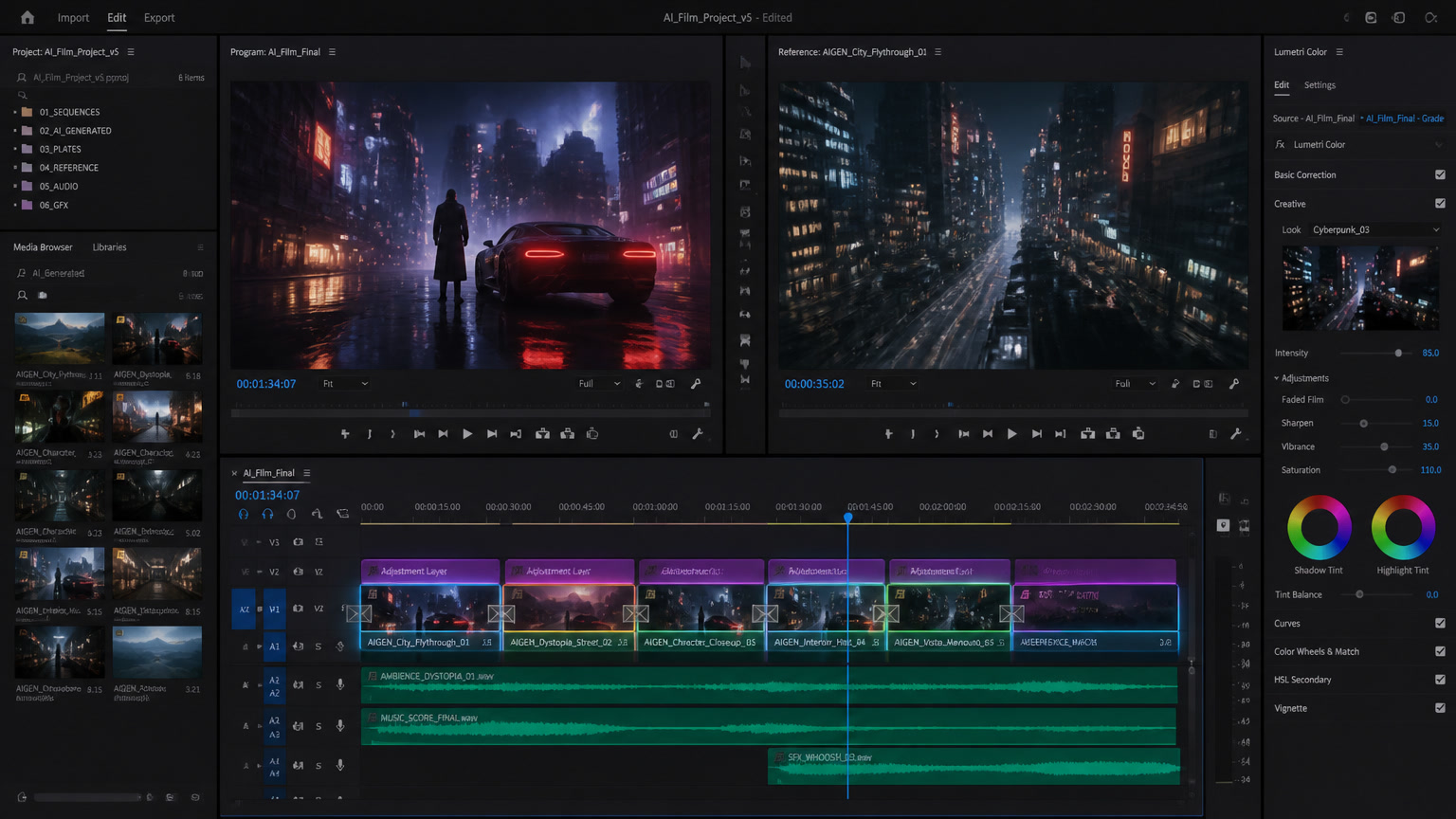
- Real post-production. Transcoding, color, mix, per-channel variants.
- Delivery. Captions, transcripts, provenance marking, and file weights that don't destroy web performance.
If you're starting out, that relocation of cost is your advantage: you can compete against studios with more crew than you, because their cost structure is anchored to a model clients no longer buy.
What clients pay (2026 market ranges)
These are the published ranges we use to quote and to audit proposals:
| Type of work | Market range | Source |
|---|---|---|
| Corporate video per finished minute | $1,000 – $10,000 | Vidico / Colossyan |
| Standard business project | $3,000 – $25,000 | Vidico |
| Explainer, 60-90 seconds | $5,000 – $12,000 | EVEN Media |
| Professional videographer, full day | $1,000 – $2,500 | D-MAK (2026 rates) |
| Freelance shoot day | $600 – $1,200 | Vidico |
| Typical agency entry per project | from $5,000 | Vidico |
Two readings. First: project spend has not collapsed despite AI — buyers still pay for outcomes, not for camera days. Second: the margin is no longer in billing crew days; it's in delivering finished minutes that cost you less to produce than they cost your competition.
What it costs you to produce it (the side nobody publishes)
This is where we do have our own numbers, from real client projects over the last two years:
| Item | Real cost | Note |
|---|---|---|
| One minute generated with a single premium model (Sora 2) | $96 – $216 per 60s video | Includes failed attempts |
| Same video with multi-model routing | $15 – $50 per 60s video | Routing by shot type |
| API cost per minute (Veo 3 / Sora 2 / Runway / Kling) | $3 – $18 per minute | Depends on the model |
| AV1 transcoding | cuts weight 62-68% | Post-production pipeline |
| Provenance marking (C2PA + watermark) | ~$0.01 per minute | Mandatory if you distribute in the EU |
| Accessibility pass (captions + transcript) | +10 to 30 min per 30s clip | AI tools ship none of this metadata |
One detail that changes how you quote: the model's per-minute cost is the cheapest line on the list. Per-second pricing for AI video tools is public and races downward. What doesn't get cheaper is the hand that fixes the take, the pipeline that delivers, and the legal responsibility for the output.
Three models for entering the market
After years producing for clients and watching new studios come and go, almost every case falls into one of three:
| Model | Typical investment | What you sell | Ceiling | Main risk |
|---|---|---|---|---|
| 1. Freelance with AI | Low (own gear + credits) | Editing, cuts, social clips | Your time | You become an hourly factory |
| 2. AI-first studio (2-3 people) | Medium (workstation, licenses, pipeline) | Finished minutes sold in packages | Recurring contracts | Pipeline never gets standardized |
| 3. Full-service production company | High (crew, producers, sales) | $10k–$50k+ projects | Scales with headcount | You rebuild the old cost structure |
Model 1 is the legitimate entry point: you sell by day or project, charge $600-$1,200 for a shoot, and use AI to compress the edit. It's good for proving you can deliver. It's not a destination: low ceiling, low margin.
Model 2 is where the margin lives in 2026. A 60-second video that costs you $15-$50 in API spend sells in a market range that starts in the thousands of dollars. That isn't magic: it's a standardized pipeline (the four steps in AI video post-production) and a routing discipline that stops you from paying ten attempts to the most expensive model.
Model 3 is the classic path and still works when sales are steady — but it reintroduces exactly what AI was removing: people, shoot days, logistics.
The framework we use to decide
Three questions, in this order:
- Does your client need real people on camera? Testimonials, product with actors, executive video → you need shoot capacity (hybrid model 2 or full model 3). Conceptual content, motion, b-roll, demos → model 2 alone gives you a full advantage.
- Can you sell recurring contracts? If not, start in model 1 even if model 2 is the goal: without recurring revenue, fixed structure kills you in month three.
- Do you have pipeline discipline? Captions, transcripts, format variants, optimized weights and provenance marking are real work that must be budgeted per deliverable. If you don't quote it, you give it away.
The third question is the one most often skipped. Since August 2, 2026, Article 50 of the EU AI Act requires machine-readable marking on AI-generated content circulating in the EU, with fines up to 3% of global turnover. That isn't a legal footnote: it's a per-minute line item that belongs in your proposal.
What AI did not change
Closing with what stays true through all of this:
- Taste is still the product. Conversational editing tools speed up the work, but they don't decide what gets cut.
- Revision rounds cost money. The client approval cycle is the real bottleneck on small projects. Capping it contractually is the cheapest margin lever that exists.
- Demand grows faster than supply. Wistia's State of Video Report found 91% of teams produce more videos since adopting AI tools and 37% report double the output or more; a third of teams already use AI routinely, mostly in pre-production. The market won't reward the cheapest studio — it will reward the one that ships volume without losing quality.
- Delivery decides your reputation. A heavy video destroys the performance of the site hosting it, and a piece without captions fails a large share of the audience. That's the studio's responsibility, not the client's.
If you're starting a video production business today, the right question isn't "how much gear do I buy?" It's: what cost per finished minute can I sustain, and what delivery structure lets me charge for outcomes instead of camera days?
Answer that and the rest of the business plan writes itself.
Frequently Asked Questions
How much does it cost to start a video production business?
The entry cost is no longer the camera gear: an AI-first studio can run on one workstation, editing licenses and video-model credits (roughly $3 to $18 per generated minute). What decides survival is cost per finished minute against what clients pay — $1,000 to $10,000 per finished corporate minute in today's market.
How much do video production companies charge?
In 2026, corporate video runs $1,000 to $10,000 per finished minute, a standard business project lands between $3,000 and $25,000, and a professional videographer charges $1,000 to $2,500 per shoot day.
Do I need expensive equipment to start a video production company?
No. Equipment stopped being the barrier: the barrier is now the pipeline (post-production, AV1 encoding, captions and provenance marking) plus the judgment to pick which model generates which shot.