Search Console Platform Properties Are Here: Your Social Content Finally Shows Up in Google's Data
Google rolled out Search Console platform properties for Instagram, TikTok, X, and YouTube to everyone in early August 2026. Here's how to connect them, what data they actually give you, and why they matter for AI search visibility.
Search Console Platform Properties Are Here: Your Social Content Finally Shows Up in Google's Data
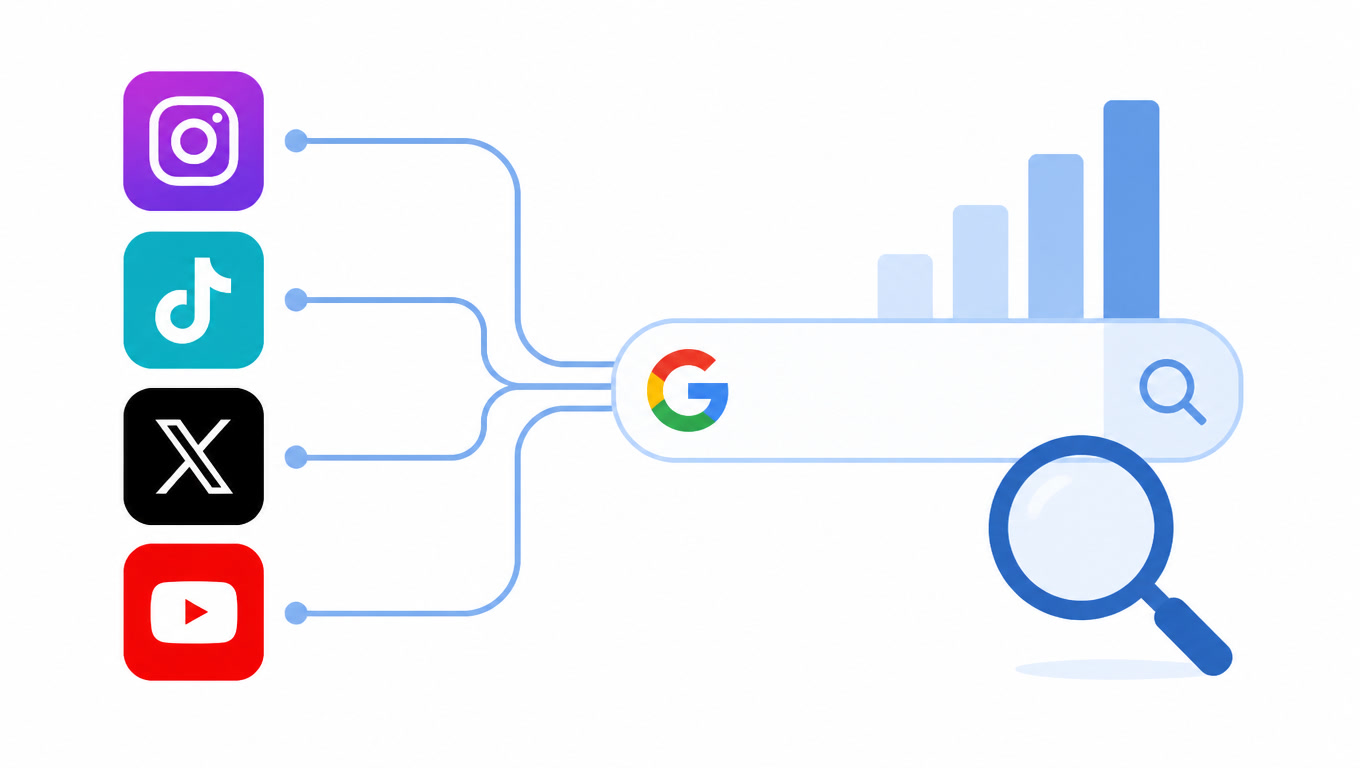
As of August 2026, Search Console can measure your Instagram, TikTok, X, and YouTube content. Google calls them platform properties: you connect your account, authorize the connection, and the performance report starts showing clicks, impressions, and queries for your posts in Google Search and Discover. The rollout announced in July reached everyone in early August. For anyone working on visibility in AI search, this closes a hole we've been pointing at for two years.
Google announced platform properties in its Search Central blog at the end of July 2026, and the news barely registered. A few weeks later, in Search Engine Roundtable's monthly report, the line was different: Instagram, TikTok, X, and YouTube content now has data in Search Console for everyone. Between those two dates, something changed in how brand visibility can be measured. Most agencies haven't connected it to the bigger picture yet.
Google finally measures what happens outside your domain
Until now, Search Console had one view: your domain. If you published on Instagram, TikTok, or YouTube, that content was invisible to the tool. You could see how many people landed on your site from Google, but not how many people found your reel or your X thread on Google.
That's over. Platform properties are standalone Search Console properties, one per platform, connected to your social account through authorization. Google pulls that profile's performance data from Google Search and Discover and shows it inside Search Console with the same logic you use for your website.
This doesn't replace each platform's native analytics. It's an extra layer, and it's the only one that answers this question: when someone searches Google for something related to your brand, does your social content show up?
How to set it up (five minutes, literally)
The process is documented in the Search Central blog and it's simpler than verifying a domain:
- Open Search Console and go to the property selector or the verification page.
- Click "Add property".
- Pick the platform: Instagram, TikTok, X, or YouTube.
- Authorize the connection with your account when Google prompts you.
That's it. If you run more than one profile on the same platform, repeat the process for each one. Google recommended connecting accounts one by one, and the rollout is gradual: if the option isn't in your account yet, it shows up in the coming weeks.
Setup costs nothing. The real cost is deciding which accounts to connect, because each new property shows you an uncomfortable truth: how much of your social content has real visibility on Google, and how much only lives inside the platform's bubble.
What data you get (and what you don't)
Each platform property has three views:
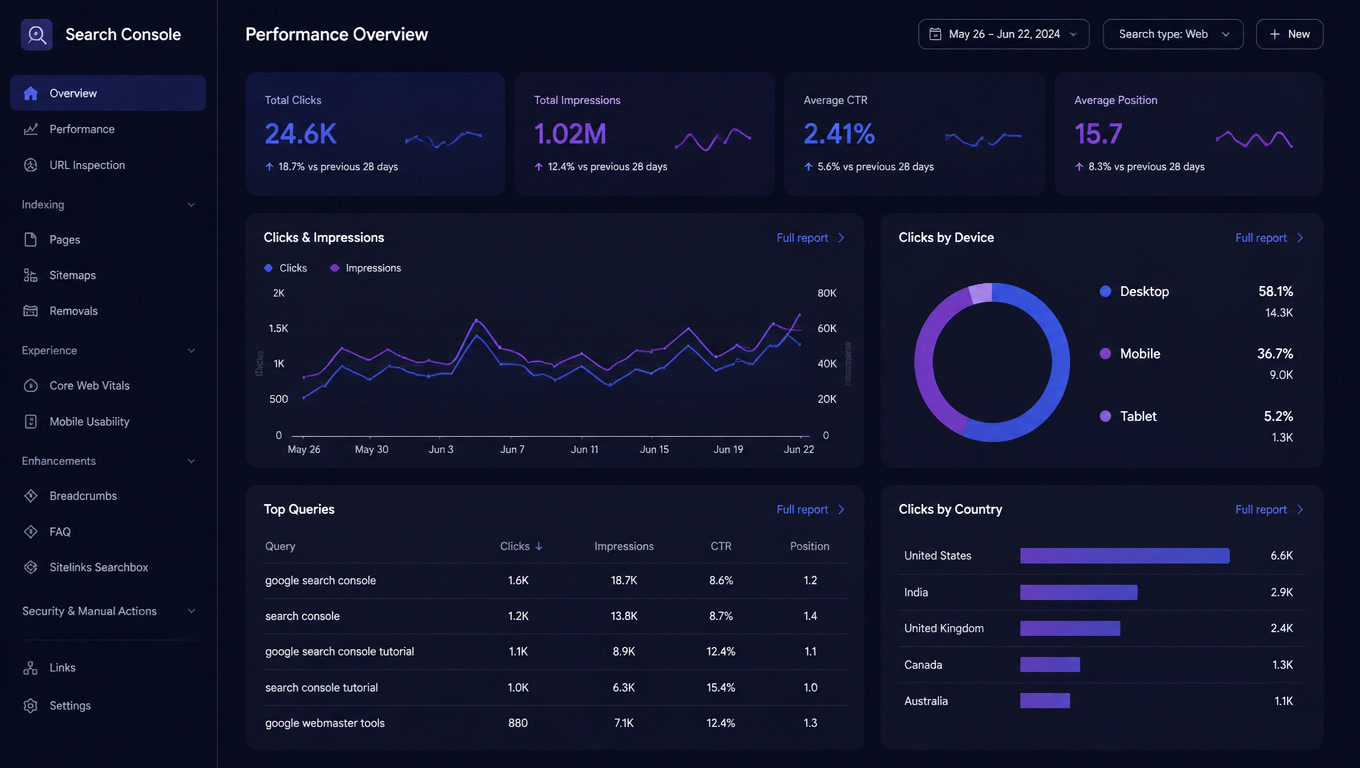
The performance report. Clicks, impressions, average CTR, and average position for your social content in Google Search. It includes the queries that triggered those impressions and filters by search type: Web, Image, Video, and News. This is where you see which specific posts are showing up and under which terms.
The Insights report. A more aggregated read: trends, top posts, and how people find your account. Good for the executive summary, not for operating.
Achievements. Google hands out badges for performance milestones. Treat it as a gamification layer you can ignore without losing anything.
What it doesn't give you: AI Overviews or AI Mode data. Generative AI impressions for your own site still live in the generative AI report Google launched in June 2026, and AI Mode queries still appear in your domain's regular performance report, as we documented when Google confirmed where to find AI Mode queries. Platform properties measure social content in classic search and Discover. Full stop.
Why this matters for AI search
Here's the part almost nobody is connecting. AI search cites social content constantly. ChatGPT, Gemini, and Perplexity answer with X threads, Instagram reels, and YouTube videos as sources, the same way they cite blog posts. We've already covered how AI engines run on three separate citation rulebooks depending on the platform.
The problem was measurement. You knew your social content could end up cited by an AI engine, but you had no way to measure its performance off-platform. Now Google hands you half of that answer: how much of your social content appears in its search engine, under which queries, and at which position.
The other half you have to build yourself, because the Search Console generative AI report only shows aggregated impressions. At Mintec we cross that report with our LLM traffic reporting to see what ChatGPT, Gemini, and Perplexity actually cite, and the picture rarely matches traditional rankings.
The three-layer visibility map
With platform properties, brand visibility can be measured in three layers that never crossed before:
Layer 1: your website. The classic Search Console property, plus the generative AI report. It measures how your domain appears in Google, including AI Overviews and AI Mode.
Layer 2: your social content. The platform properties. They measure how your posts appear in Google Search and Discover.
Layer 3: your AI engine citations. What ChatGPT, Gemini, and Perplexity cite from you, measured with LLM traffic reports or citation monitoring.
The intersections are where the value lives. An Instagram post that shows up in layer 2 with real queries and also gets cited by an AI engine in layer 3 is a dual-surface asset: it deserves more budget and more variations. A post with thousands of likes but zero presence in layers 2 and 3 is entertainment, not a search asset. Harsh, but now it's measurable.
What to do this week
- Connect your main accounts. Instagram first, because it usually has the biggest gap between native performance and Google visibility. TikTok, X, and YouTube after.
- Export the first 28 days of each property's performance report and look at the queries. The surprises will show up: terms you didn't associate with your brand, and posts nobody on the team expected.
- Cross it with your generative AI report. If a page on your site has high impressions in the AI report and your social content shows up for similar queries, you have a topic that deserves a dedicated page.
- Feed the content loop. Formats that appear on Google deserve more variations. The ones that don't deserve an honest conversation about whether they're doing anything beyond vanity metrics.
What Google didn't say
Google pitched this as a feature to see "how content from social and video platforms performs." The reading nobody says out loud: AI search is making social content part of the answer system, and Google needs brands to treat it with the seriousness of a search asset. It wasn't built for social media managers. It was built so social content enters the same optimization loop as websites.
That has an uncomfortable consequence: now that it can be measured, social content that doesn't show up on Google has no excuse left. And the content that does show up, for the first time, has a business case that doesn't depend on the platform's algorithm.
If you want to see where your brand stands across those three layers, talk to us. We build the full map: website, social, and AI citations, using the data you already have in Search Console.
Frequently Asked Questions
What are platform properties in Search Console?
They are a new property type Google introduced in July 2026 that lets you connect Instagram, TikTok, X, and YouTube accounts to Search Console. Once connected, they show how your social content performs in Google Search and Discover: clicks, impressions, CTR, position, and queries.
How do I set up a platform property?
Open the property selector in Search Console, click 'Add property', pick the platform (Instagram, TikTok, X, or YouTube), and authorize the connection with your account. Repeat for each account or profile you want to measure. The rollout is gradual, so if you don't see the option yet, it arrives in the coming weeks.
Do platform properties include AI Overviews or AI Mode data?
No. The platform property performance report measures your social content in Google Search and Discover, with filters for search type (Web, Image, Video, News). Generative AI impressions for your own site still live in the generative AI report launched in June 2026.