
How We Systematized AI Automation Delivery: The Operating System Your Agency Needs
Agencies lose 60% of clients in year two from delivery breakdowns. The 5-phase framework we use at Mintec to deliver AI automation consistently at scale.
How We Systematized AI Automation Delivery: The Operating System Your Agency Needs
Most AI automation agencies fail not from bad sales or bad technology — from having no delivery system. After 15 years running an agency that now lives off automating processes for businesses across Mexico, Central America, and the US, we learned that the difference between an agency that retains clients and one that loses them isn't the tech stack — it's the operating system behind every delivery.
60% of clients leave in year two when delivery runs on founder effort alone. With a standardized system, that number drops to 18%. This article is the 5-phase operational framework we use to make that happen, backed by real 2026 market data.
The problem the industry doesn't want to talk about
Gartner predicted in June 2025 that more than 40% of agentic AI projects will be canceled before the end of 2027. Not because of bad models — because of escalating costs, unclear business value, and inadequate risk controls. A March 2026 Digital Applied survey found that 78% of enterprises have AI agent pilots running, but fewer than 15% reach production. The average sunk cost per abandoned initiative: $7.2 million in 2025.
At the agency level, the numbers are equally brutal. Focus Digital reported in 2026 that project-based agencies lose 42% of clients annually, while retainer-model agencies lose only 18%. For an agency billing $5.5 million annually, that's $1.2 million in lost recurring revenue per year from churn.
The real problem isn't that AI automation doesn't work. It's that agencies are scaling like service businesses when they should be building product operations.
The 5-phase framework: from controlled chaos to consistent delivery
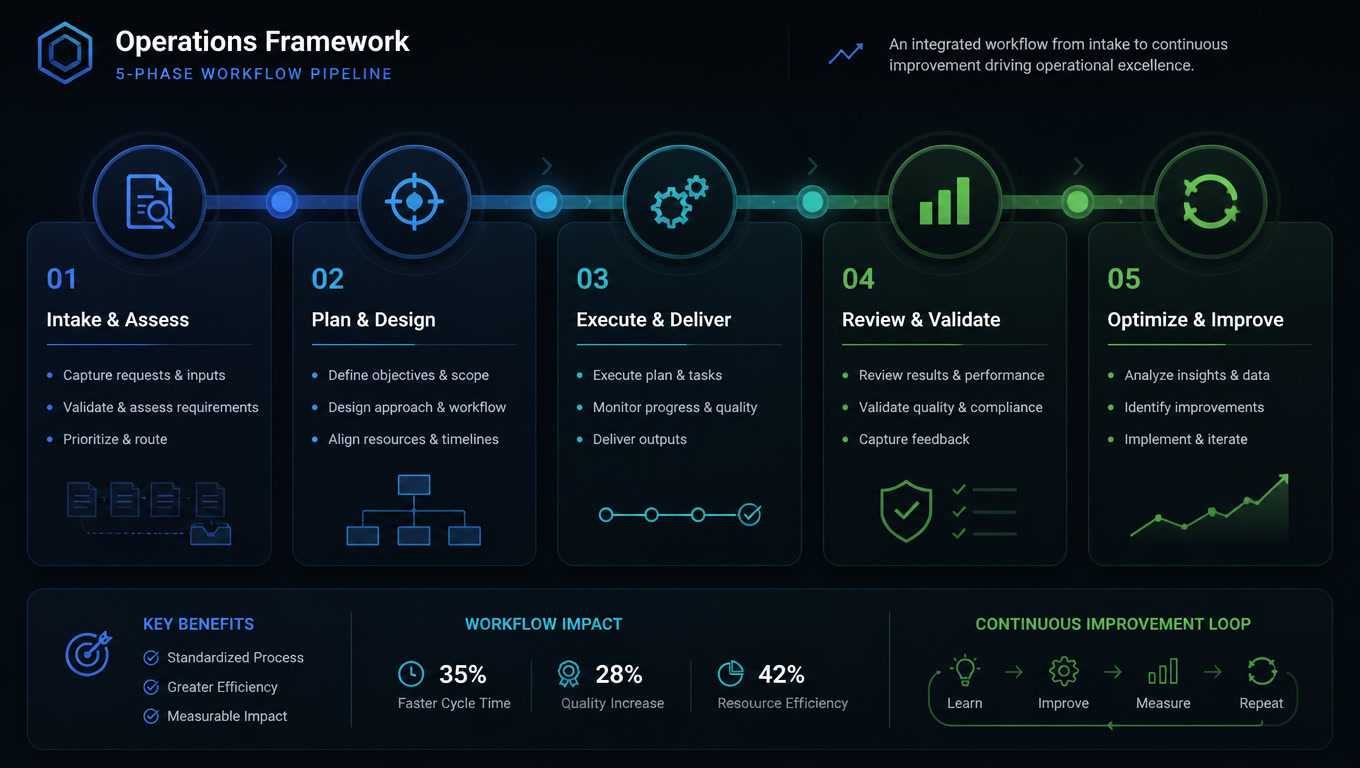
After too many projects delivered at 2am and too many clients who left after month 3, we built a delivery system in 5 phases. Each phase has a clear input, a verifiable output, and a decision point. It's not theory — it's what we use every week.
Phase 1: Structured diagnosis
Intake isn't a sales call. It's a diagnosis with a standardized questionnaire capturing: pain level (1-5), current tools, process volume, integration needs, and error tolerance. If the client doesn't fill out the form, they don't advance. This qualifies before anyone touches n8n or Make.
Phase 2: Surgical scoping
This is where most agencies fail: they try to automate everything at once. We scope exactly one workflow. One. We define the metric that matters (time saved, qualified leads, reduced errors), agree on scope and timeline boundaries, and document the expected outcome. If the client wants more, it's a separate phase with separate cost. No exceptions.
Phase 3: Modular building
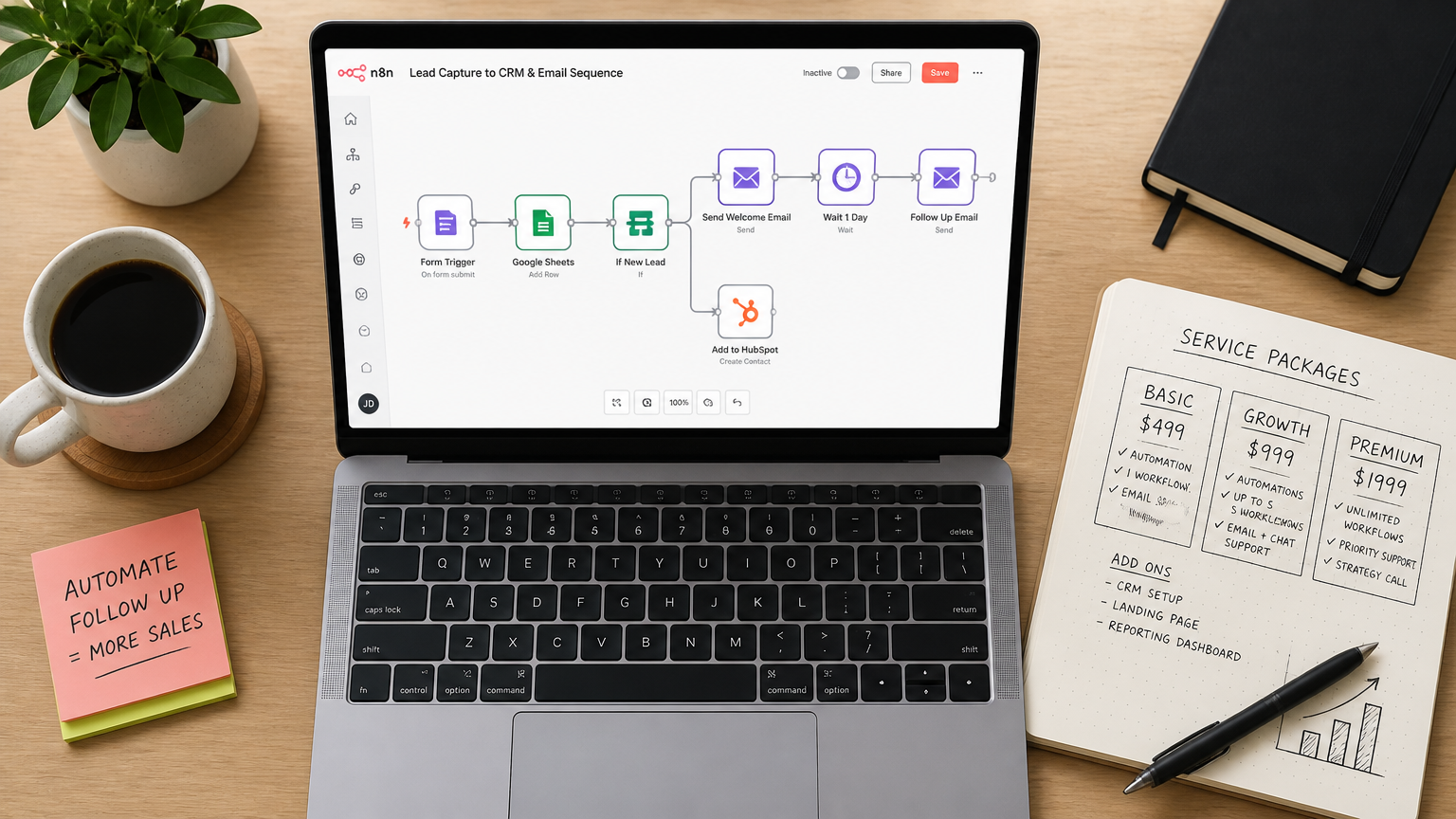
We build like software, not like service. Modular components in n8n or Make, versioned in our internal repo. Every workflow has automated tests in staging before touching production. The difference: when something breaks (and it will), we know exactly where to look because each module has a defined responsibility.
Phase 4: Deployment with monitoring
Launch in three risk tiers:
- Low risk (reports, data, alerts): direct deploy with 7-day monitoring
- Medium risk (email automation, follow-ups): 1 week of shadow mode before the switch
- High risk (financial actions, CRM writes, payments): human approval gates at every step
We never launch high risk without a human reviewing the first 50 executions.
Phase 5: Continuous monitoring and scaling
This is where most agencies abandon the client. We run a 30-day post-launch sprint: daily monitoring in the first week, weekly reviews with data reports, audit logs, and automatic anomaly alerts. If the chatbot answers wrong, we know within hours, not weeks.
Scaling comes from packaging successful workflows as reusable templates. A lead qualification workflow that works for a dental client adapts for logistics. The second delivery takes 40% less time.
The equation that changes everything: from founder to system
| Factor | Founder-led delivery | Standardized system |
|---|---|---|
| Clients per team | 5-8 (total dependency) | 20-30 (with SOPs) |
| Consistent quality | Variable, depends on the day | High, documented processes |
| Delivery time | 2-6 weeks (unpredictable) | 1-3 weeks (predictable) |
| Pricing | Hourly ($25-75/h) | Fixed project ($2K-$5K) + retainer ($500-$3K/mo) |
| Annual retention | ~58% (42% churn) | ~82% (18% churn) |
| Gross margin | 40-55% | 65-75% |
The left column describes most AI automation agencies in 2026. The right column describes the ones that survive.
The change isn't technical. It's operational. The difference is having documented every phase of delivery: from the intake form to the post-launch checklist. When your delivery is consistent, your churn drops, your pricing stabilizes, and your team can grow without every new client being an emergency.
The LatAm advantage most agencies ignore
In Latin America, AI automation has an additional edge: 24/7 agent delivery vs. human working hours. For a restaurant in Mexico City receiving WhatsApp orders at 11pm, or a dental clinic in Guadalajara losing patients because nobody answers on weekends, automation isn't a luxury — it's operational infrastructure.
Our typical LatAm stack: Clientify ($0-99/mo), n8n self-hosted ($6-20/mo), OpenAI API ($20-50/mo), WhatsApp Business API ($0.01-0.05/message). Total: $26-200/mo. Compared to $1,200+ for HubSpot Enterprise, that's 6-47x cheaper for the same operational result.
The key for agencies in the region: automate what hurts most first (response time, lead loss, repetitive manual tasks), then scale with templates afterward.
The 90-day checklist to systematize your agency
Days 1-30:
- Document the intake form (standardized questions, eligibility scoring)
- Create 3 workflow templates for the most common cases (lead capture, chatbot FAQ, automated reporting)
- Define the post-sale handoff process with a verifiable checklist
Days 31-60:
- Build a monitoring dashboard with key metrics (response time, error rate, satisfaction)
- Create the weekly review process with a report template
- Establish the 3 deployment risk tiers with clear criteria
Days 61-90:
- Package the 3 most successful workflows as reusable templates
- Define value-based pricing (fixed project + retainer), not hourly
- Launch the retention program: check-ins at 7, 30, and 90 days post-launch
Validation: If after 90 days you have intake-to-value in <48h, scope creep <10%, and autonomous resolution >50%, the system works.
The delivery gap is where the margin lives
AI automation for agencies isn't a technology game — it's an operations game. The tech stack is commodity: n8n, Make, OpenAI, Clientify are available to anyone. What isn't commodity is the delivery system that turns that stack into consistent results for 20+ clients without the founder being the bottleneck.
As the research shows: 78% of enterprises have pilots but fewer than 15% reach production. The difference isn't the model — it's the system behind the model. The agencies making real money aren't the ones selling better — they're the ones delivering better.
Agencies that build their delivery operating system now will capture a disproportionate share of the market. The ones still operating like it's 2024 will fight over the same 5-8 clients until the market leaves them behind.
Frequently asked questions
How many clients can an AI automation agency handle with a structured operating system?
Depends on the team. A solo founder manages 5-8 clients before quality drops. A team of 3-4 with standardized SOPs can consistently deliver to 20-30 clients while maintaining 65-75% gross margins.
What metrics should an AI automation agency track?
The five essential metrics: (1) intake-to-first-value time (<48h ideal), (2) scope creep rate (<10%), (3) post-launch error rate (<5%), (4) chatbot autonomous resolution (>50%), and (5) client retention rate (>80% annually).
When should an agency move from founder-led delivery to a standardized system?
When you exceed 5-8 active clients or bill more than $15K/mo. The symptoms: missed SLAs, human errors in configurations, and the founder spending more time firefighting than building.
Frequently Asked Questions
How many clients can an AI automation agency handle with a structured operating system?
Depends on the team. A solo founder manages 5-8 clients before quality drops. A team of 3-4 with standardized SOPs can consistently deliver to 20-30 clients while maintaining 65-75% gross margins.
What metrics should an AI automation agency track?
The five essential metrics: (1) intake-to-first-value time (<48h ideal), (2) scope creep rate (<10%), (3) post-launch error rate (<5%), (4) chatbot autonomous resolution (>50%), and (5) client retention rate (>80% annually).
When should an agency move from founder-led delivery to a standardized system?
When you exceed 5-8 active clients or bill more than $15K/mo. The symptoms: missed SLAs, human errors in configurations, and the founder spending more time firefighting than building.