Meta Overtakes Google in Ad Revenue: What Changes for Your Paid Media Budget
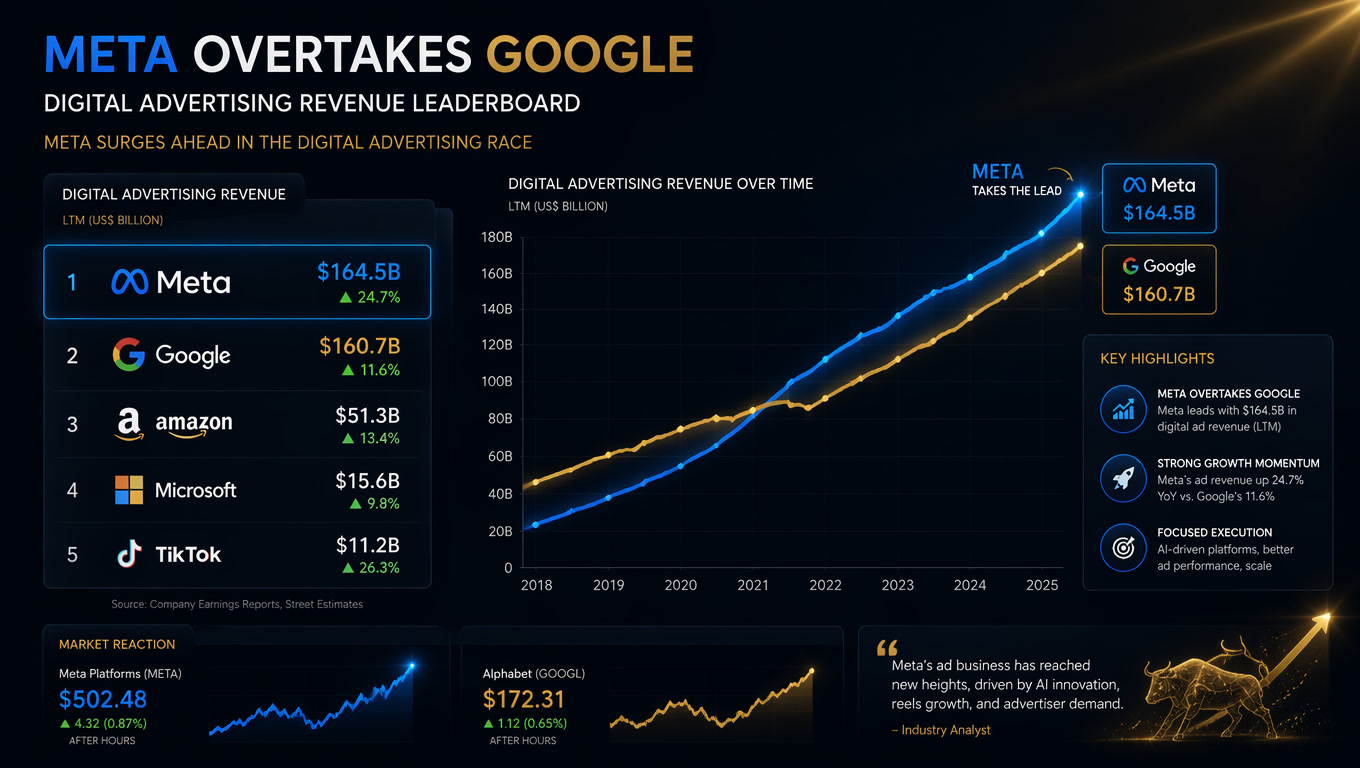
EMARKETER forecasts Meta will reach $243.5B in ad revenue in 2026, surpassing Google's $239.5B for the first time. Meta's growth rate (24.1%) is double Google's (11.9%). This isn't just a milestone — it signals a structural shift in where ad performance lives and how budgets should be allocated across platforms. We break down what's driving it and what we're doing differently in client accounts.
Meta Overtakes Google in Ad Revenue: What Changes for Your Paid Media Budget
Meta will surpass Google in global digital ad revenue for the first time in 2026. EMARKETER forecasts Meta at $243.46 billion versus Google's $239.54 billion. Meta's growth rate (24.1%) is more than double Google's (11.9%). This isn't a trivia stat. It's a signal about where ad performance is concentrating — and most brands haven't adjusted their budget allocation to match.
At Mintec we allocate paid media budgets across Meta, Google, LinkedIn, TikTok, and programmatic for clients in LATAM, the US, and Europe. The EMARKETER forecast confirms what we've seen in account performance data over the past 18 months: Meta's ad ecosystem is delivering better returns for a wider range of objectives, and the market is voting with spend.
Here's what's driving the shift, what it means for your campaigns, and how we're rebalancing budgets accordingly.
The numbers behind the milestone
EMARKETER's April 2026 forecast shows a structural change in the advertising landscape, not a temporary blip:
| Metric | 2025 | 2026 (forecast) | Change |
|---|---|---|---|
| Meta ad revenue | $196.17B | $243.46B | +24.1% |
| Google ad revenue | $214.06B | $239.54B | +11.9% |
| Amazon ad revenue | $68.64B | $82.07B | +19.6% |
| Triopoly share | ~58% | 62.3% | +4.3pp |
| Meta market share | ~22% | 26.8% | +4.8pp |
Source: EMARKETER forecast, April 2026.
The gap isn't small. Meta is adding nearly $50 billion in incremental revenue this year — roughly the entire ad business of Amazon. Google's growth, while still healthy in absolute terms, is decelerating. And as EMARKETER analyst Drew Spink put it: "Smaller platforms and traditional media can't replicate these capabilities in comparable cost or speed, and incremental budgets continue to flow in that direction."
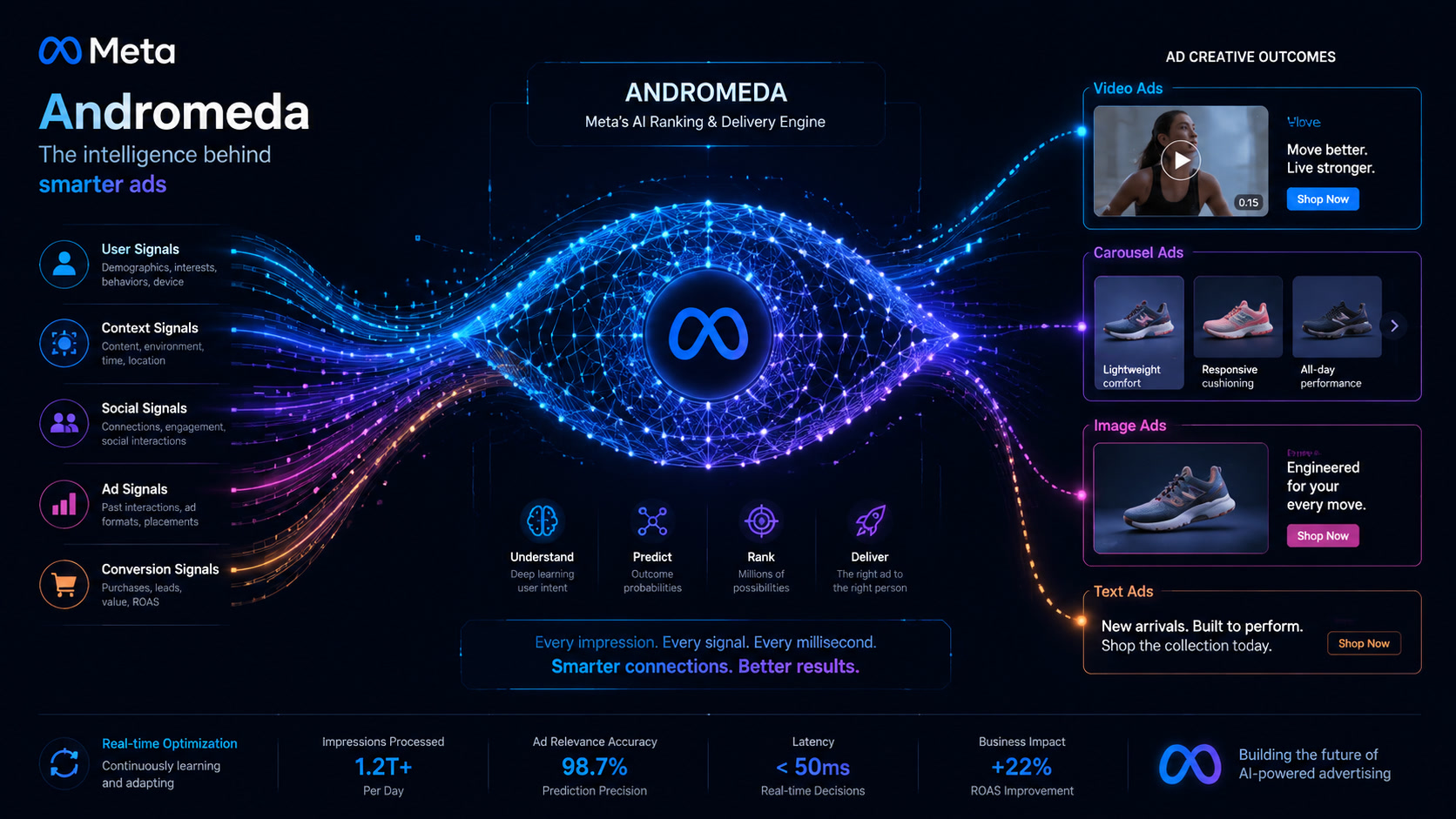
We've written before about how Advantage+ creative enhancements are now default and how Andromeda shifted from audience targeting to creative-based delivery. Those individual changes are compounding into this macro result.
Why Meta is winning: three structural advantages
The EMARKETER analysts point to specific drivers. Zach Goldner, senior forecasting analyst: "Tools like its Advantage+, AI-generated ad creatives, and its broader automation stack are improving performance across both Facebook and Instagram, with Reels being a big beneficiary. Advertisers are getting better bang for their buck, and that's pulling more ad dollars onto the platform."
From our experience managing campaigns, three advantages stand out:
Better ROAS for more verticals. Meta's AI-driven delivery keeps improving conversion quality for industries that historically underperformed on social — B2B services, insurance, professional education. What used to be Google's exclusive territory now competes directly on Meta. We've seen B2B lead campaigns on Meta match Google Search CPA within 4-6 weeks of proper creative velocity.
Lower barrier to entry for advertisers. Advantage+ campaigns let newer advertisers launch and see results without deep platform expertise. That expands the advertiser base — and more advertisers means more auction pressure, which drives Meta's revenue up. It's a self-reinforcing cycle: better tools → more advertisers → higher CPMs → more revenue → better tools.
Reels monetization hit its stride. Meta spent years pushing Reels as a TikTok competitor. In 2026 that bet is paying off. Reels ad load is now comparable to Feed, and engagement rates on Reels ads outperform static formats in most verticals we manage. The shift to video-first creative is expanding Meta's total addressable ad inventory significantly.
What this means for your paid media strategy
Most brands still allocate budget based on historical splits or personal preference, not on where marginal returns are actually growing. Here's what changes:
The triopoly squeeze is real
Meta, Google, and Amazon now control 62.3% of global digital ad spend. That concentration means CPMs will keep rising across all three platforms — there's no competing platform absorbing demand. For brands, this means efficiency gains have to come from creative performance and conversion optimization, not from finding cheaper inventory elsewhere.
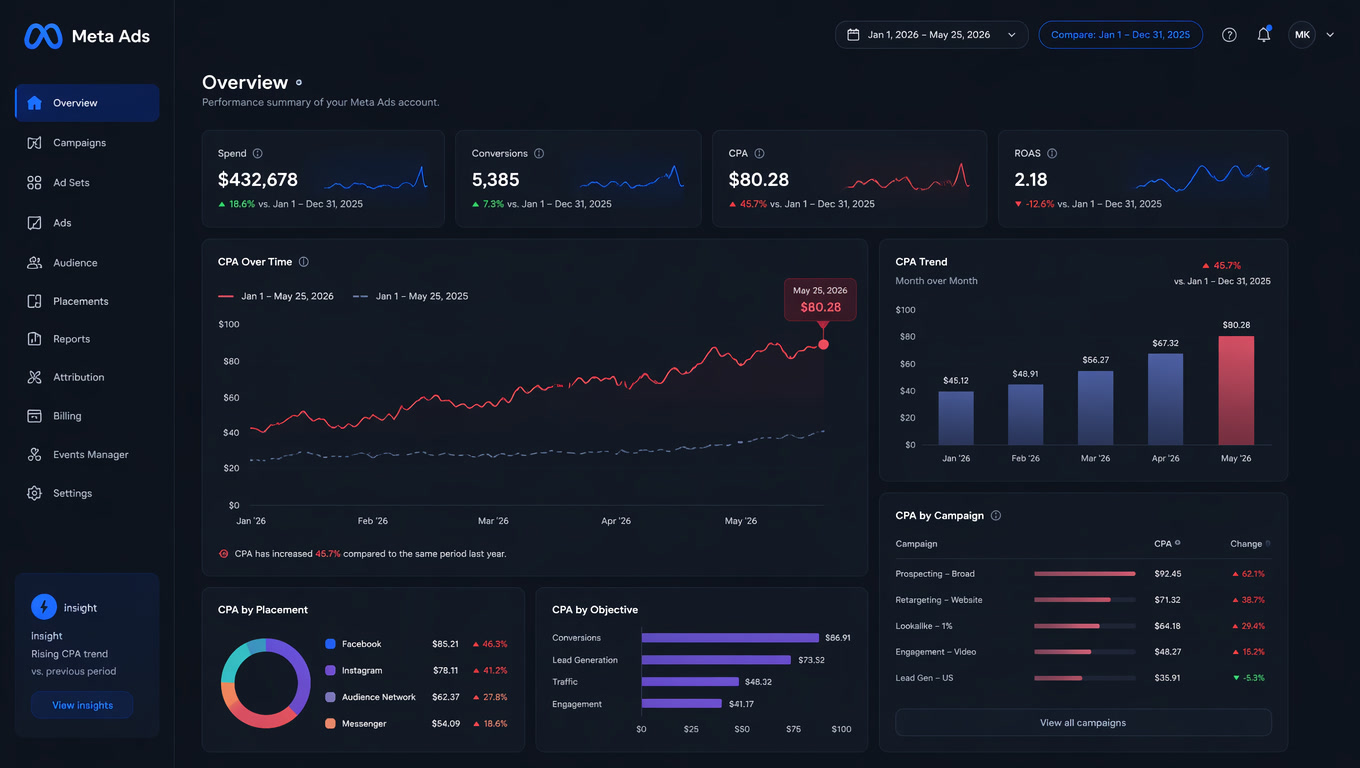
We covered the CPA impact in detail in our recent piece on Meta Ads cost inflation: average CPA jumped 38% year-over-year. Meta's revenue growth and CPM inflation are two sides of the same coin.
Google's display weakness is Meta's opportunity
EMARKETER data shows Google's display network actually shrank in early 2026. Non-branded Google Search CPCs jumped 29% while CTRs fell 26%. AI Overviews are compressing traditional search ad real estate, and display is losing ground to social formats. The brands winning in 2026 are the ones shifting consideration-stage budget from Google Display toward Meta and TikTok.
We compared the two AI-native ad platforms in our Smart+ vs Advantage+ analysis — the key insight is that both platforms reward creative variety over targeting precision, but Meta is farther along in making it work at scale.
Budget rebalancing: the 60-30-10 framework
Based on what we're seeing across managed accounts, here's how we're structuring paid media budgets for H2 2026:
60% on creative-diverse platforms (Meta + TikTok). These are the engines. Meta for full-funnel, TikTok for top-of-funnel and viral potential. Both require 15-20 active creatives per campaign to perform under AI-driven delivery.
30% on intent-capture platforms (Google Search + LinkedIn). Google for bottom-funnel, LinkedIn for B2B consideration. These channels still deliver the highest intent traffic, but their relative efficiency is declining as AI Overviews and automation reshape them.
10% on emerging and testing (Amazon Ads, Reddit, CTV, retail media networks). This is where the next growth wave will come from, but the performance isn't reliable enough yet to scale beyond testing budgets.
This framework assumes a minimum of 20 creative assets per week across the portfolio — a creative velocity that most in-house teams struggle to maintain. That's the real binding constraint in 2026: not budget, but creative production capacity.
The bottom line
Meta overtaking Google in ad revenue is a symptom, not the story itself. The real shift is that AI-driven platforms with diverse creative formats are outperforming intent-based search in more and more verticals. Brands that adjust their budget structure, creative velocity, and measurement framework will capture the delta. Those that keep allocating based on 2024 conventions will pay more for less.
The triopoly isn't going anywhere. But within it, Meta has taken the lead — and the brands we work with that have already shifted budget toward Reels, Advantage+, and diverse creative libraries are seeing the results in their ROAS. The question isn't whether to follow. It's how fast.
Need help rethinking your paid media allocation for H2 2026? We run full-funnel audits that include competitive creative benchmarking, platform-level ROAS analysis, and a rebalanced budget proposal. Contact Mintec's paid media team.
Frequently Asked Questions
Has Meta actually overtaken Google in ad revenue?
EMARKETER forecasts Meta will reach $243.46 billion in net worldwide ad revenue in 2026, surpassing Google's $239.54 billion. Meta's growth rate is 24.1% — double Google's 11.9%. In 2025, Google still led with $214.06 billion to Meta's $196.17 billion.
Why is Meta growing faster than Google in ad revenue?
Three drivers: 1) Advantage+ and AI creative tools improved ROAS, drawing more ad dollars onto Facebook and Instagram, with Reels as a major beneficiary. 2) Meta's Q1 2026 ad revenue grew 33% YoY versus Google's ~16%, and Google's display network actually shrank. 3) AI-generated ad creatives and automation reduced friction for advertisers, lowering the skill barrier to effective campaigns.
What does Meta overtaking Google mean for advertisers?
It means the triopoly (Meta, Google, Amazon) now controls 62.3% of global digital ad spending. For advertisers, this concentration means rising CPMs as competition intensifies, but also better AI-driven performance on Meta when you feed the system enough creative variety. The key implication: brands that relied heavily on Google Search may need to rebalance toward Meta's visual and social inventory, especially for top-of-funnel and consideration stages.