Andromeda: Meta's Algorithm That Killed Audience Targeting (and How We Restructured)
Meta replaced a decade of audience targeting with Andromeda — creative now defines the audience, not the other way around. Here's how we rebuilt our clients' campaign structures: what we stopped doing, what we doubled down on, and why creative velocity is the most important performance metric in 2026.
Andromeda: Meta's Algorithm That Killed Audience Targeting (and How We Restructured)
Between late 2025 and early 2026, Meta completed the global rollout of Project Andromeda, its new AI-driven ad retrieval and delivery system. Most advertisers never saw the change happen. They only felt the symptoms: unstable performance, targeting levers that stopped responding, and creative volatility that seemed to defy everything that used to work.
Andromeda is not a minor adjustment. It's the replacement of a targeting model advertisers relied on for a decade. The philosophical shift is this: Meta is no longer optimizing ads around who the advertiser thinks the audience is. It's optimizing around what the system can predict people will do.
At Mintec, we've been restructuring client accounts under this new system since its initial rollout. Here's what actually changed — not the keynote theory, but the Monday-through-Friday decisions that make or break performance.
How Andromeda Works (and Why It's Different)
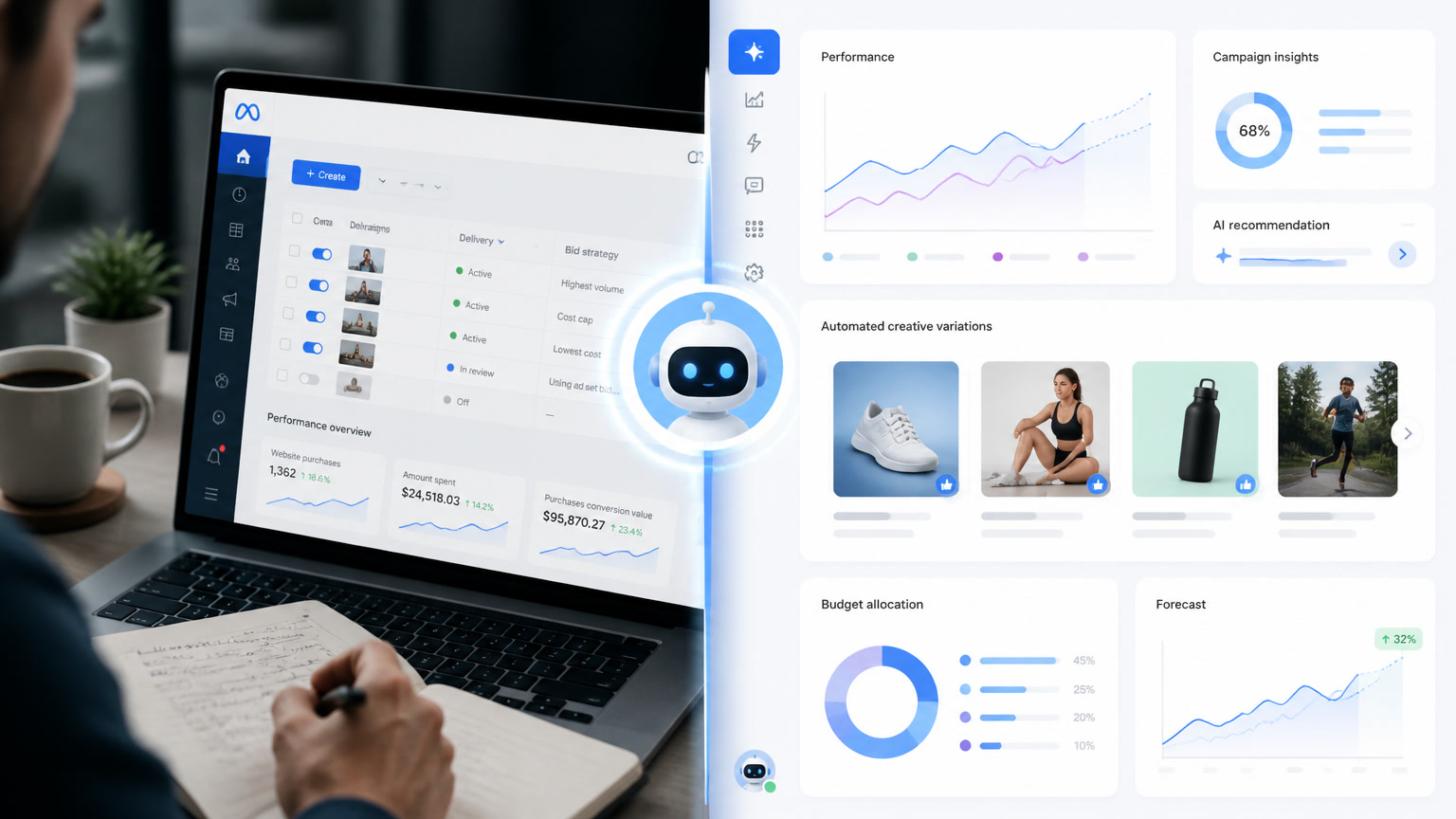
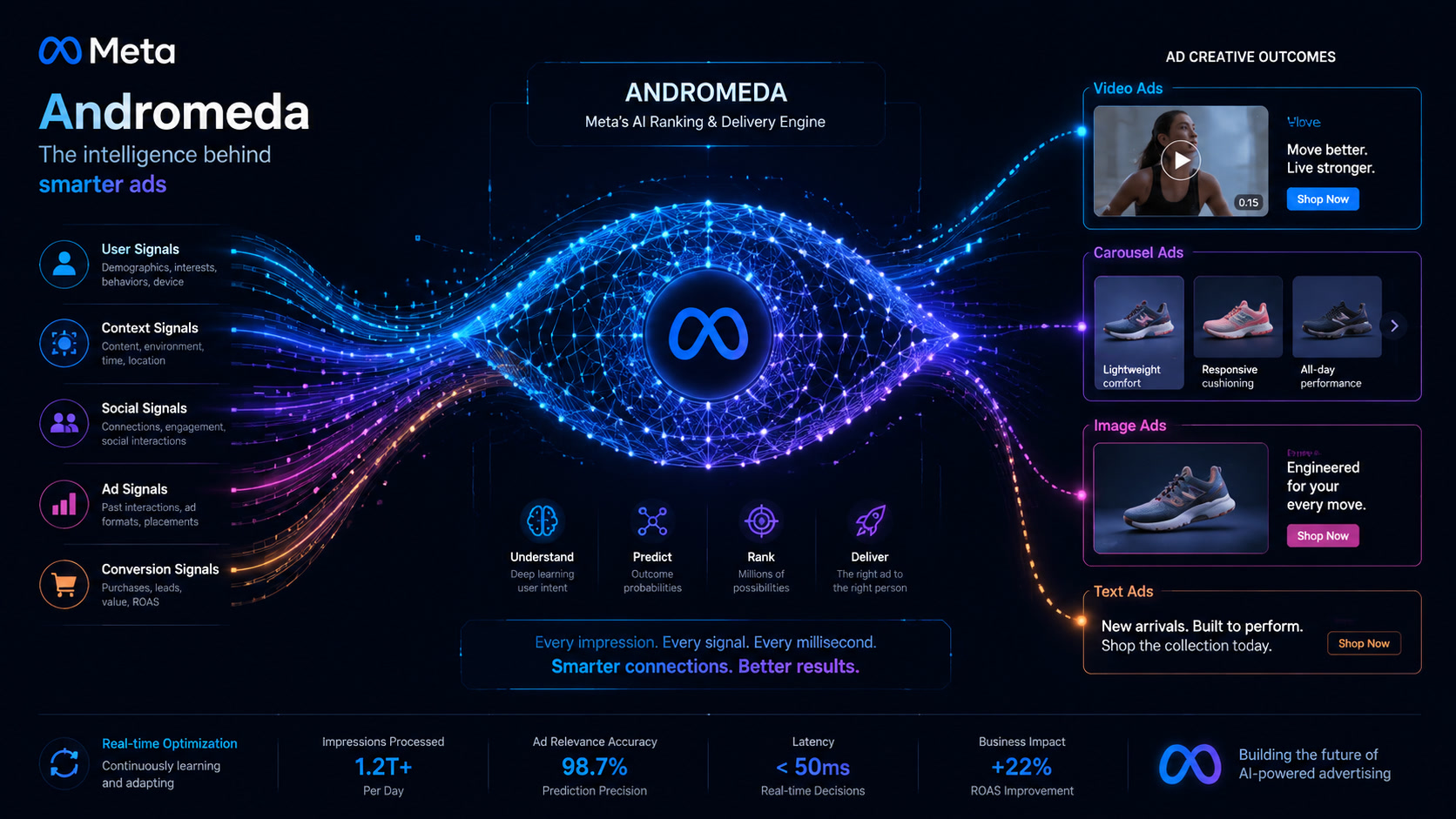
To understand the shift, you need to understand where Andromeda sits in the ad delivery chain. It operates at the retrieval stage — before bidding, before optimization, before most advertisers even know a decision has been made. Its job is to narrow tens of millions of potential ads down to a manageable pool of viable candidates for each impression.
The old system started with your audience definition and worked forward. Andromeda works in reverse:
- It evaluates your creative first — format, tone, hook, narrative style, product signals
- It predicts audience match based on historical behavioral patterns with similar ads
- It serves the ad if the probability of positive response exceeds the dynamic threshold
The audiences you manually define are no longer gates. They're suggestions. The algorithm has access to behavioral signals that dwarf anything you can build through manual targeting.
According to Meta, Andromeda is 4x more efficient than the previous ranking model. The advertiser-side implication: the algorithm is better than you at finding your buyer. What you control is the creative it reads to make that determination.
What Stopped Working
Lookalikes: The Tool That No Longer Moves the Needle
This is the most direct claim in this article, and it's worth being clear: lookalike audiences are no longer a primary targeting strategy. We stopped using them as such across our entire managed portfolio.
Not because they stopped working overnight, but because the data was clear: broad targeting with differentiated creative consistently outperformed our 1% lookalike audiences, especially on accounts with meaningful conversion volume.
The reason ties back to Andromeda. The system has access to behavioral signals — watch time, scroll patterns, early interaction behavior — that dwarf anything a lookalike seed can capture. When you feed it a 1% LAL, you're not adding precision. You're adding friction.
Exception: For accounts under $5K/month with limited conversion history, a 2-3% lookalike can help anchor early delivery. But plan for the transition to broad targeting as soon as the algorithm has enough signal.
Interest and Demographic Gates
The most common mistake we see in accounts we audit: multiple ad sets with interest stacks, layered lookalikes at 1%, 2%, and 5%, and demographic exclusions. All of that structure was designed to control a system that no longer needs that kind of guidance. What it's doing is slowing the algorithm down.
Andromeda reads your creative to decide who sees it. If your ad looks like it's for a 35-year-old woman who runs and buys wellness supplements, it'll find her. You don't have to tell it to.
The New Campaign Structure Playbook
Andromeda rewards structural simplification. Here's the framework we're running:
1. Creative Volume as the Primary KPI
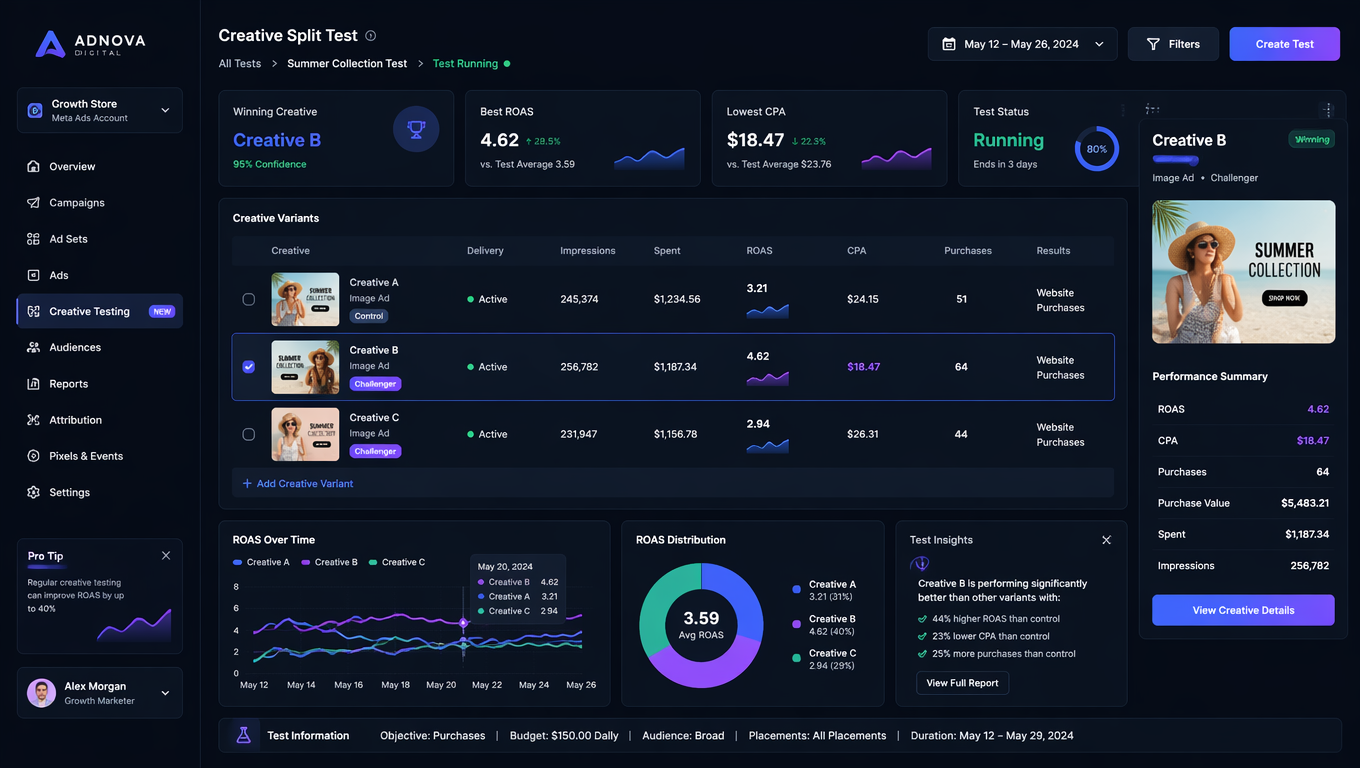
Meta's data science team has stated that creative quality accounts for 56% of campaign performance — more than targeting, budget, placement, and timing combined. That number changes where you should be spending your time.
The problem is most advertisers still think of creative diversity as "5 versions of the same ad with different background colors." That's not diversity. That's noise.
| Creative type | % of creative budget | Description |
|---|---|---|
| New concepts | 50% | Fundamentally different narratives: social proof, problem-solution, founder story, aspiration, urgency, curiosity |
| Refined variants | 30% | Proven performers with tighter hooks, updated social proof, different format (static → video) |
| Active performers | 20% | What's working keeps running until data says otherwise |
The benchmark we see across top-performing accounts: 15-20 active creatives at all times, with at least 6 distinct narrative approaches. Brands testing 20+ new creatives per month are seeing 65% higher ROAS than those testing fewer than 10.
2. Campaign Structure Simplification
Under Andromeda, fewer ad sets is more. Fragmentation slows the algorithm's learning. Our current structure:
| Objective | Campaign type | Rationale |
|---|---|---|
| Cold prospecting | Advantage+ Shopping | 17% lower CPA than manual campaigns |
| Retargeting | Manual with controlled frequency | Precision matters more than scale |
| Lead gen | Advantage+ Leads with manual oversight | 14% lower CPL, but verify incrementality |
| High AOV (>$150) | Manual with audience exclusions | AI tends to find cheap customers that don't convert |
| Low AOV (-$30) | Advantage+ full auto | Volume compensates for lower precision |
3. Founder-Led Content as Preferred Format
A consistent pattern we've observed: founder-led content formats (authentic talking-head videos, behind-the-scenes, direct-to-camera testimonials) consistently outperform polished brand creative under Andromeda. The likely reason: authenticity generates stronger engagement signals that the algorithm interprets as relevance.
This isn't to say produced creative doesn't work. It's that the system disproportionately rewards formats that generate clear behavioral responses — and authentic content tends to do that better than generic polish.
Signal Quality: The Silent Enabler
Andromeda is only as good as the conversion data it receives. This isn't new, but under Andromeda the cost of poor signal quality is higher because the system depends more heavily on behavioral data for its learning phase.
Checklist we run on every account:
- Pixel and CAPI running simultaneously — with only one, you're blind to 30-40% of the buyer journey
- Event Match Quality (EMQ) above 7 — below that threshold, Andromeda struggles to connect clicks to conversions
- Deduplication working — without it, the system overcounts conversions and optimizes against inflated metrics
- Standard events correctly mapped — don't use custom events where standard events should go; the algorithm understands standard events better
How to Measure Performance in the Andromeda Era
With Andromeda making hundreds of micro-decisions per day, traditional platform reporting loses utility. You can't reverse-engineer why an ad won or lost from a Meta dashboard alone.
Our measurement approach:
- Holdout tests every 4-6 weeks — the only reliable method for measuring real incrementality
- Multi-touch attribution — GA4 and Triple Whale for ecosystem-wide visibility
- Creative velocity tracking — how many new concepts enter per week, how many are declared winners, how long a creative takes to reach stability
- CPM as a fatigue signal, not a cost signal — rising CPM without conversion scale gains means the creative is losing freshness, not that the market got more expensive
What's Next
Meta is already building the next generation of Andromeda. The system will only get smarter and faster. But the principle will hold: the algorithm finds the audience, and you feed it high-quality inputs.
The brands winning under Andromeda aren't the ones with the biggest budgets. They're the ones with the fastest creative machines — the production pipeline that generates 20 new concepts per month, tests them, identifies winners, and scales while competitors keep adjusting targeting parameters that no longer matter.
At Mintec, we shifted from being media buyers to creative system architects. And that shift — from buying to manufacturing — is probably the most important transformation any performance marketing team can make in 2026.
Frequently Asked Questions
What is Meta's Andromeda and how does it affect ads?
Andromeda is Meta's new AI-driven ad retrieval and delivery system that replaced the old audience-based targeting model (interests, demographics, lookalikes) with creative-based targeting. The algorithm now reads your ad — format, tone, hook, visual signals — and predicts which users will respond best, rather than relying on your manually defined audience. This fundamentally changes how campaigns are structured and optimized.
Do lookalike audiences still work with Andromeda?
On accounts with 500+ monthly conversions, lookalikes no longer provide a meaningful advantage. In our managed accounts, broad targeting with differentiated creative consistently outperformed 1% and 2% lookalike audiences. For small accounts (under $5K/month or 50 conversions), a 2-3% lookalike can help anchor early delivery, but as the algorithm accumulates signal, the advantage quickly diminishes.
How many creatives do I need for Andromeda to work well?
The minimum for stable results is 6 meaningfully distinct creatives per campaign. The benchmark for top-performing accounts is 15-20 active creatives at all times. Brands testing 20+ new creatives per month see 65% higher ROAS than those testing fewer than 10. The key isn't absolute quantity — it's angle diversity: different hooks, varied formats, narratives that appeal to different purchase motivations.