
Meta Creative Similarity Score: Why Your AI Variations Are Silently Killing Performance
Meta collapses similar ad creatives into a single 'Entity ID' and suppresses delivery when your Creative Similarity Score exceeds 60%. The catch: Meta's own AI variation tool generates ads that look different to humans but identical to Andromeda. Here's how to detect, measure, and fix it — with real campaign data from managed accounts.
Meta Creative Similarity Score: Why Your AI Variations Are Silently Killing Performance
A few days ago, an advertiser shared a screenshot on r/PPC that struck a nerve with hundreds of people. It showed what Meta considers "AI variations" of a movers ad: the same layout, the same blurred background, the same stock photo of moving boxes — just different text and slightly shifted colors. The post got 226 upvotes and 52 comments. Almost everyone was asking the same thing: "Why does Meta think this is useful?"
The short answer: it isn't. And worse, these variations aren't just unhelpful — they're actively hurting your account performance without you knowing.
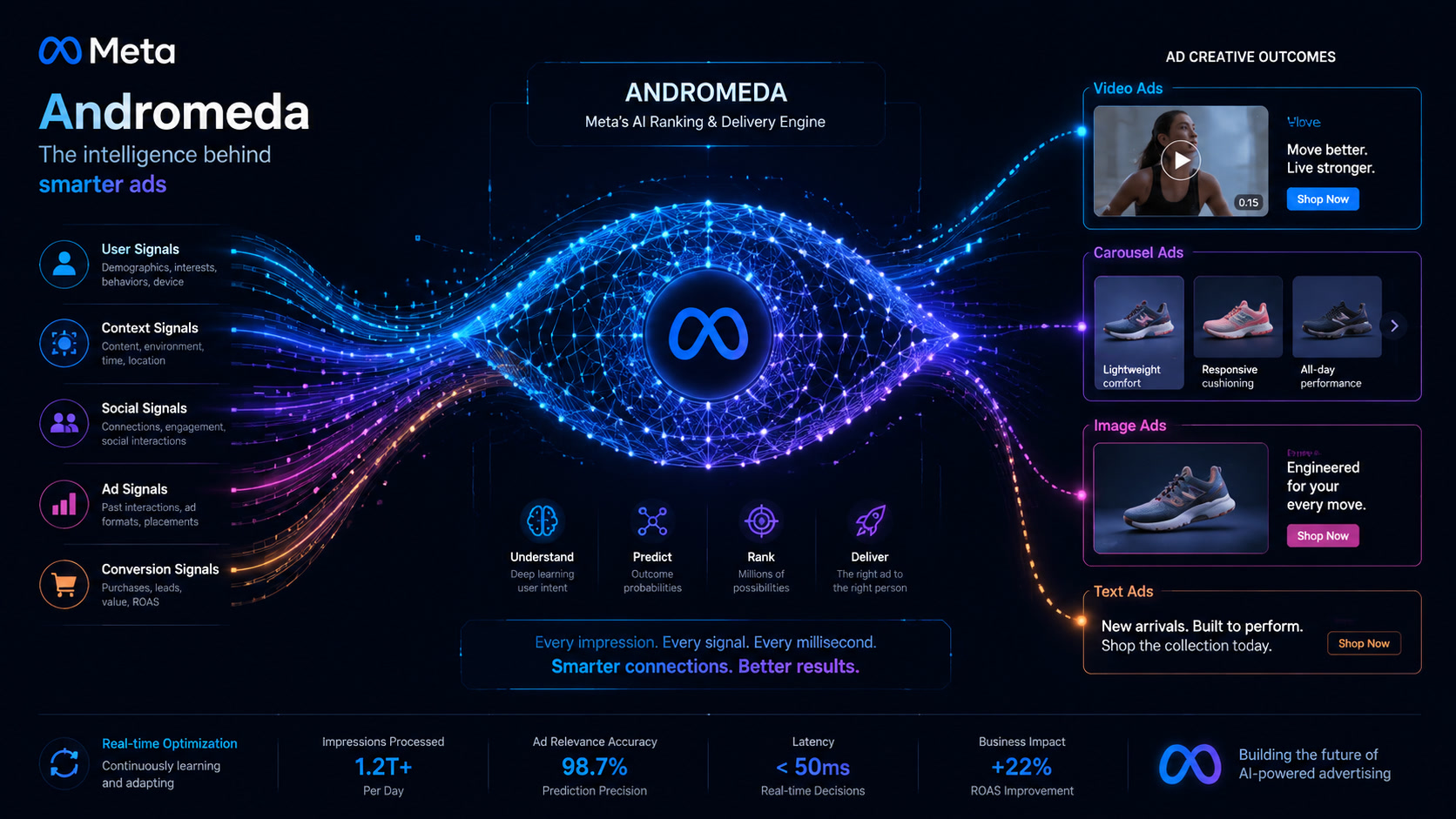
Since Andromeda — Meta's new AI-powered retrieval system — became the global standard by late 2025, there's a metric that went from irrelevant to critical: the Creative Similarity Score. And almost nobody is monitoring it.
The invisible mechanism: Entity ID and similarity suppression
Andromeda doesn't treat every ad as an independent entity. It automatically groups creatives it considers similar into a single Entity ID. When you activate "AI variations" or upload 20 versions of the same ad with different copy, the system sees them as one thing.
The problem is how the algorithm reacts. According to data from admetrics.io, when the Creative Similarity Score exceeds 60% — meaning Meta determines your ads are more than half identical — the system activates suppression at the retrieval stage. Instead of each variation reaching different audiences, they compete against each other for the same limited space.
At Mintec, we manage campaigns for clients across LATAM and the US, and we've seen this pattern repeat: accounts with 30-40 active ads that can't scale because they're effectively running as 3-4 Entity IDs. The ad count is high, but the real diversity is low.
The AI variations mirage
Meta has invested heavily in its generative creative tools. Over a million advertisers use Meta's AI tools to produce 15 million ads per month, per official data. Andromeda was built specifically to handle that scale without latency falling over.
But there's a gap between what the tool produces and what the algorithm needs. Meta's AI variations — changing button colors, testing two headlines, rotating an image — generate ads that the system considers statistically similar. They don't fool Andromeda. They don't register as distinct ads.
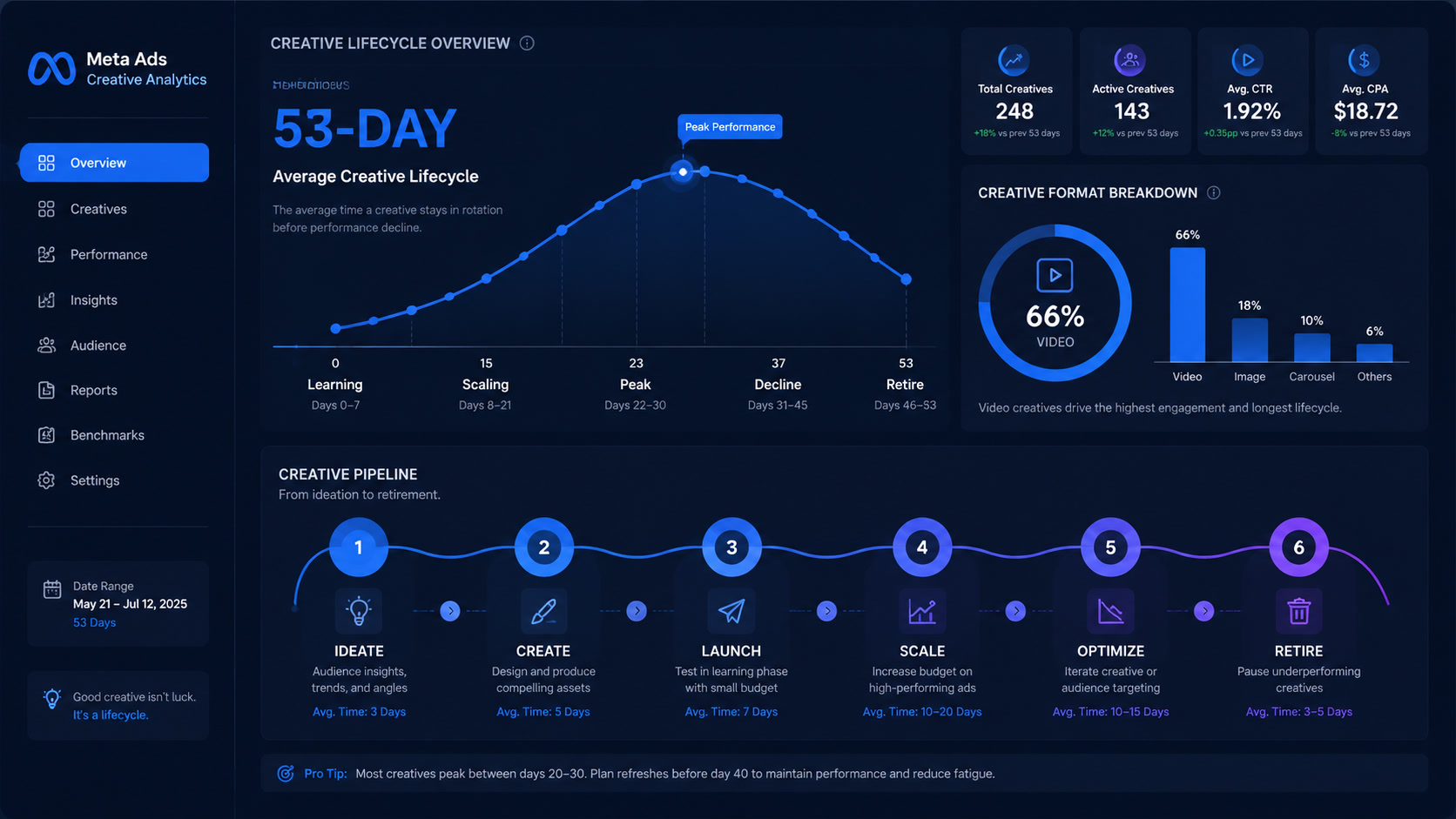
The practical result: you activate "create variations," upload 10 ads, and instead of multiplying your reach, you're feeding a single Entity ID that burns out in 2-3 weeks — down from 6+ weeks in the pre-Andromeda era, per Pixel Panda Creative's 2026 analysis.
How to check your Creative Similarity Score right now
It's not hidden data. In Ads Manager, at the ad level, Meta exposes the Creative Similarity Score as a column. You can add it from the column customization menu.
| Score | What it means | What to do |
|---|---|---|
| 0-40% | Safe zone | Your creatives register as distinct. Keep going. |
| 40-60% | Warning zone | Some ads start competing. Review your concepts. |
| 60%+ | Active suppression | System collapses ads into Entity IDs. Creative reset needed. |
If your account consistently runs above 40%, the first step isn't creating more ads — it's reviewing whether you're actually testing distinct concepts, not just surface variations.
The framework that works: 8-12 concepts × 2-3 variations
The strategy that performs best under Andromeda, based on our experience managing accounts from $5K to $100K+/month, isn't "produce 50 ads." It's build a creative concept portfolio.
For each campaign, we define 8-12 conceptually distinct creative angles:
- Problem/solution: show the pain and how your product eliminates it
- Social proof: testimonials, case studies, hard metrics
- Offer-led: discount, free shipping, limited-time bonus
- Educational: teach something valuable related to the product
- UGC / founder-led: native content that doesn't look like an ad
- Aspirational: show the ideal outcome the customer wants
Each concept gets 2-3 variations (different hook, different visual format), and that gets you to the volume Andromeda needs without falling into the similarity trap.
The data backs this up. Per Scaledon, brands testing 20+ new ads per month see 65% higher ROAS than brands testing under 10. The difference isn't just volume — it's that higher-volume testers also test more variety.
The second problem: accelerated fatigue
Creative similarity has a side effect nobody talks about enough: it speeds up fatigue. When Andromeda finds a working concept, it exploits it fast. It efficiently finds the users who respond to that creative. The problem: it also exhausts them fast.
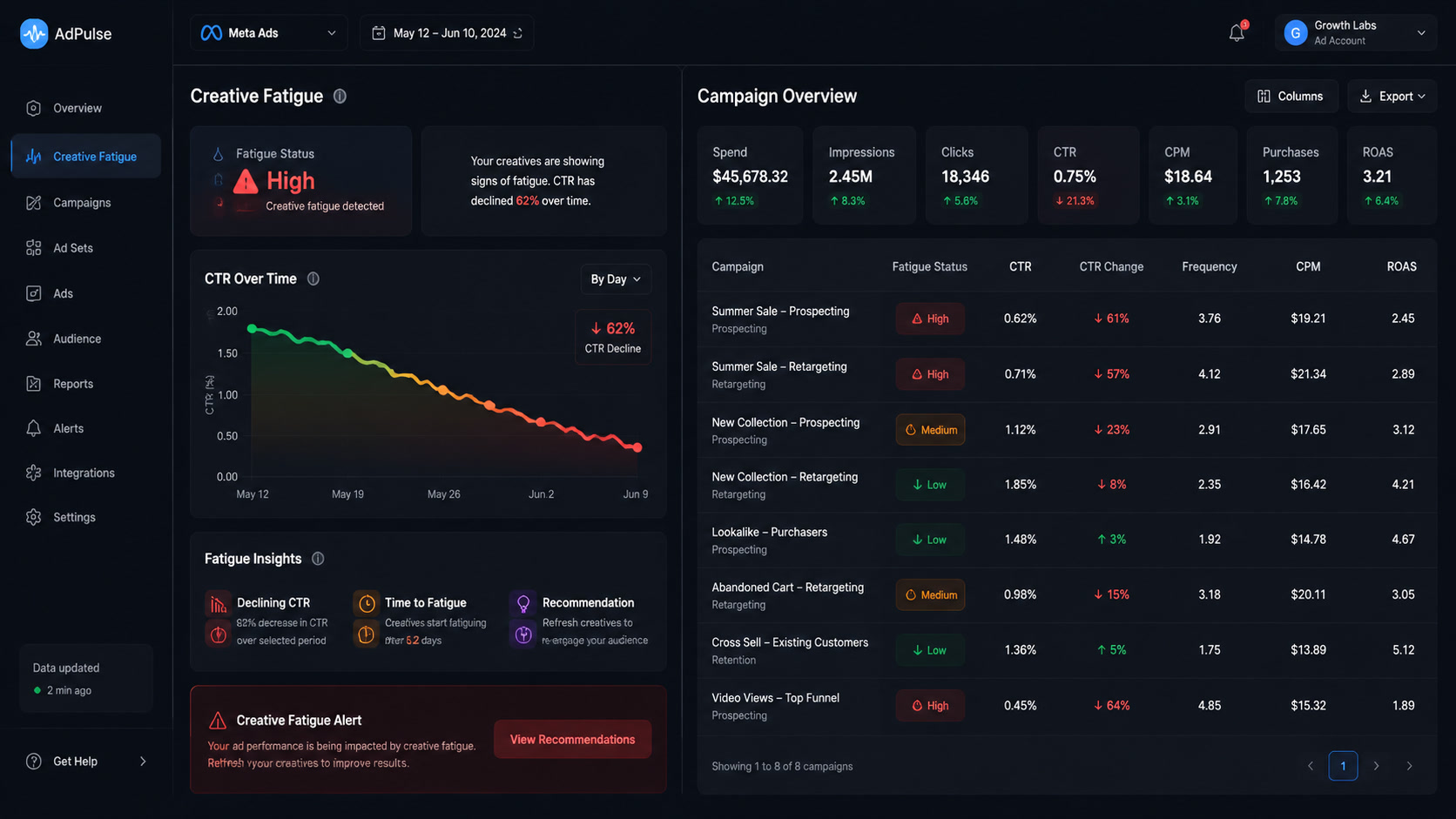
Once engagement starts declining, the drop is steep. Zentric Digital documents that when an ad enters fatigue, it loses 20-30% performance per week. The ranking system penalizes low engagement, retrieval pushes the ad down, and CPM climbs while ROAS slides.
The early signals — CTR softening, frequency creeping up — appear before campaign-level metrics move. Monitoring at the creative level, not the campaign level, is the difference between catching the signal in time and discovering fatigue two weeks later after burning budget.
Practical checklist to fix your Creative Similarity Score
Based on what works in the accounts we manage:
- Add Creative Similarity Score as a column in Ads Manager ad-level view. If you didn't know it existed, start here.
- Identify collapsed Entity IDs: look for patterns where many ads share high similarity scores.
- Replace variations with concepts: instead of 20 versions of the same ad, build 8 distinct concepts with 2-3 variations each.
- Prune redundant ads: those scoring above 60% in the same Entity ID aren't helping — they're competing.
- Measure fatigue at creative level: don't wait for campaign-level metrics to drop. Monitor weekly CTR and frequency per ad.
- Feed the pipeline weekly: if your account spends over $5K/month, you need 5-15 new creatives per week to stay ahead, per Zentric.
- Audit your conversion signal: Pixel + CAPI with Event Match Quality > 7. Andromeda learns faster with clean conversion data.
What nobody tells you
Meta's "AI variations" feature isn't inherently bad. It can be useful for exploring copy variations on a concept that's already working. But using it as your primary creative production strategy under Andromeda is a trap.
The system needs real variety — not cosmetic changes. And Meta's AI tools are designed to give you the latter, not the former.
In accounts we've migrated from mass variation production to curated concept portfolios, we see consistent 20-35% ROAS improvements, in line with what Logical Position's 2026 playbook and 1ClickReport's analysis report.
You don't need more ads. You need more distinct ads.
Frequently Asked Questions
What is the Creative Similarity Score in Meta Ads?
It's a metric Meta introduced with Andromeda that measures how similar your ad creatives are to each other. When the score exceeds 60%, the system collapses those ads into a single Entity ID and suppresses their delivery. This means 50 nearly identical variations compete against each other instead of expanding your reach.
How do I check if I have a creative similarity problem?
Add the Creative Similarity Score column to your Ads Manager ad-level view. Scores above 40% indicate your ads are starting to cannibalize each other. Above 60%, the system activates delivery suppression. You can also spot the pattern when frequency climbs fast while CTR drops — classic signs that Andromeda can't find real variation between your creatives.
How many creatives do I actually need to avoid similarity suppression?
It's not just about quantity. You need 8-12 conceptually distinct ad concepts per campaign — different hooks, formats, emotional triggers, and visual treatments — then 2-3 variations of each concept. 100 ads that look alike are worth less than 12 truly different ads.