
53 Days: The Real Lifecycle of a Winning Meta Ads Creative (Data from 6,552 DTC Ads)
We analyzed 6,552 live DTC ads to answer the question every Meta advertiser asks: how many creatives do I actually need and how often should I refresh them? Benchmarks, a production framework, and what the data reveals about creative pipeline strategy.
53 Days: The Real Lifecycle of a Winning Meta Ads Creative (Data from 6,552 DTC Ads)
Most Meta advertisers are running on wrong assumptions about creative. We assume a winning creative lasts 3-4 weeks, that 3-4 versions per campaign is enough, and that production quality matters more than iteration speed. Data from 6,552 live DTC ads in 2026 tells a very different story.
At Mintec, we manage Meta Ads campaigns for ecommerce brands, lead generation clients, and professional services across the US and LATAM. Since Andromeda became the default delivery engine, one thing has become painfully clear: the creative pipeline is no longer a design-team problem — it's the single biggest performance lever in your account.
But we didn't want to operate on anecdotal experience alone. So we analyzed 6,552 active ads from 50 leading DTC brands using ad intelligence data to understand what separates accounts that scale from accounts that stall.
The results shatter several myths we still hear in onboarding calls with new clients.
What 6,552 Ads Tell You About Your Creative Pipeline
Myth #1: "A winning creative lasts 3-4 weeks"
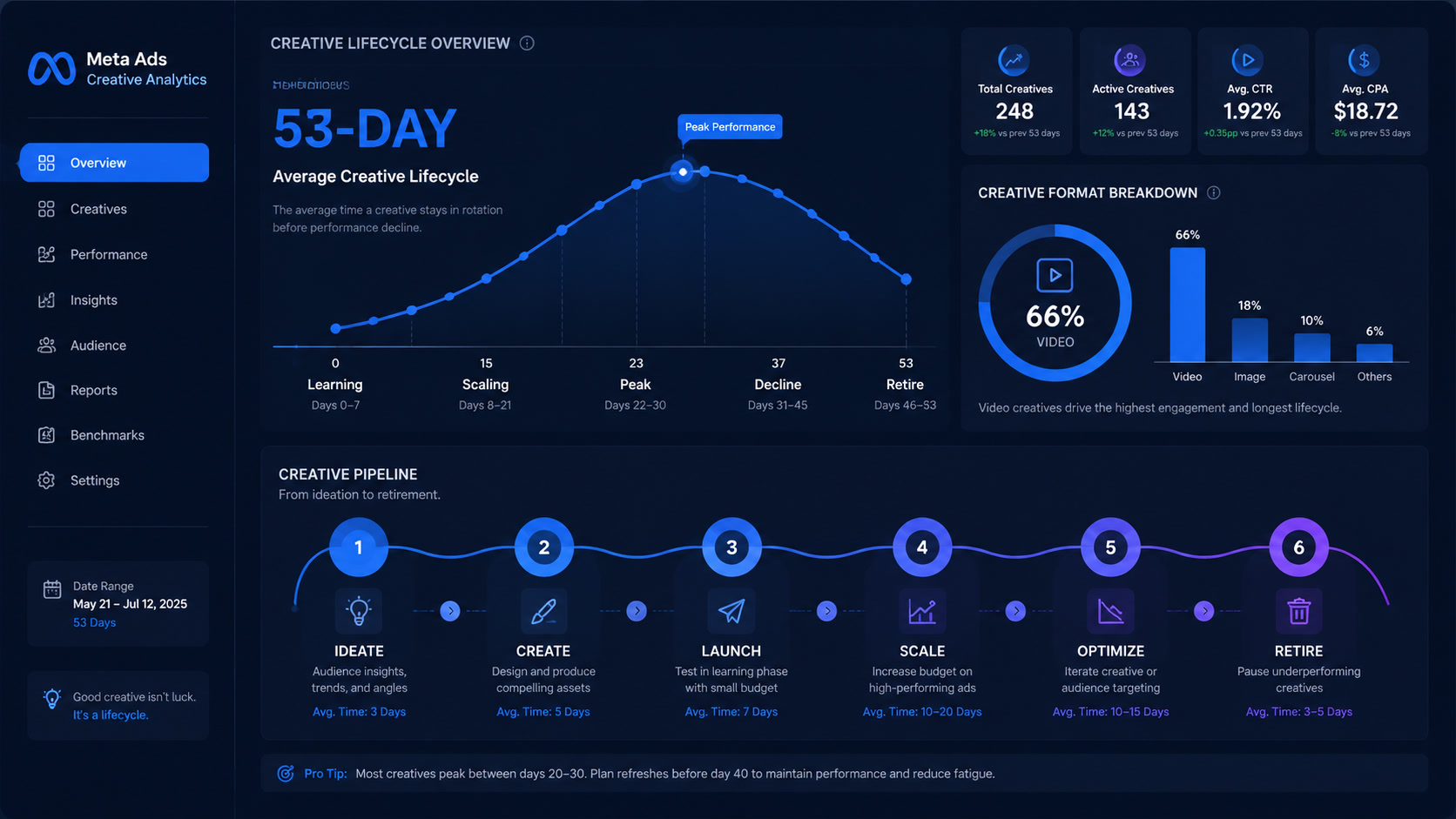
The data: the median winning creative — an ad the brand keeps running because it's still profitable — has a lifespan of 53 days. The longest-running ad in the dataset has been live for 881 days.
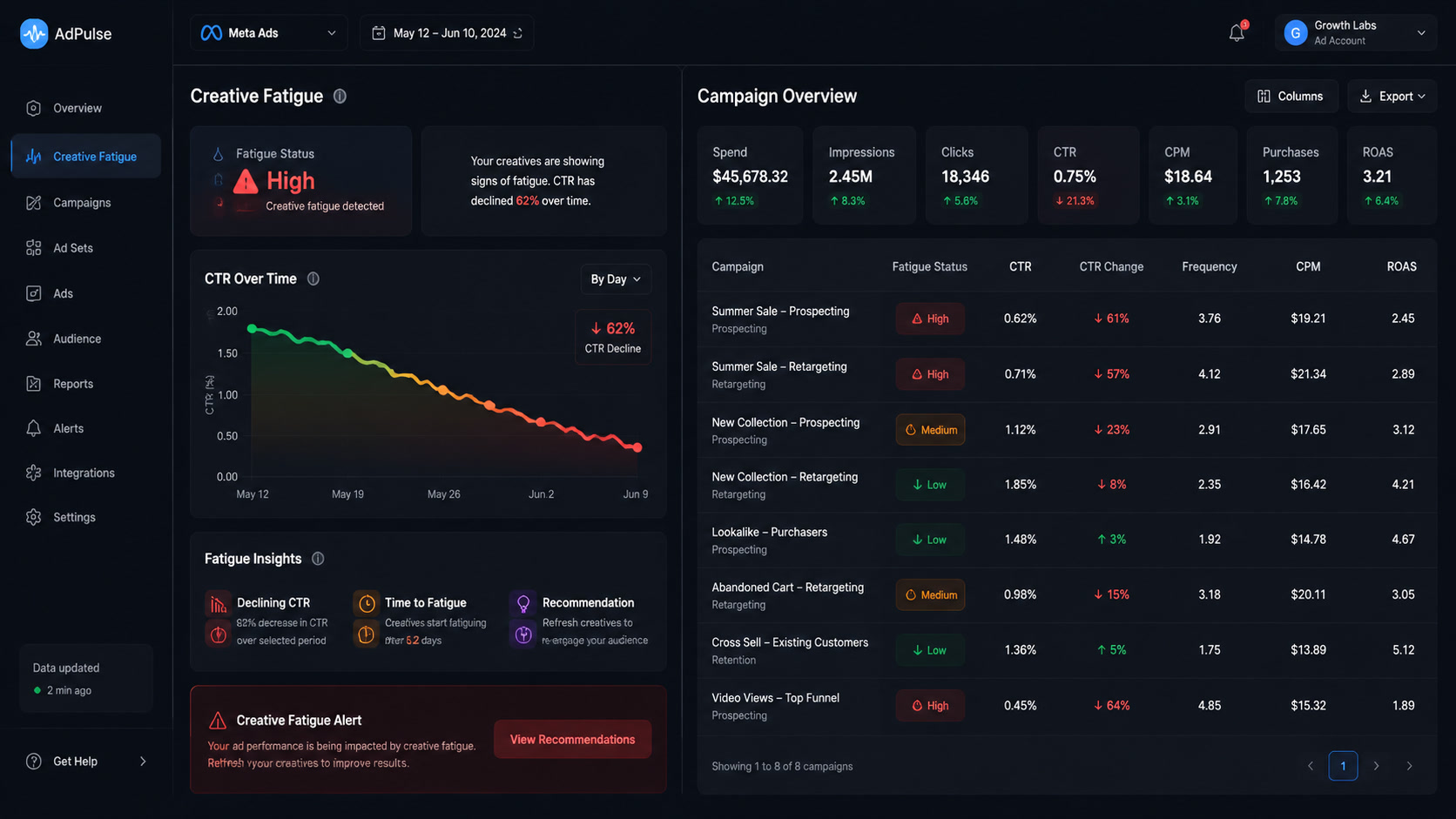
This doesn't mean you can set and forget. It means that when you rotate a creative every 3-4 weeks as "fatigue prevention," you're likely killing it early. Real creative fatigue doesn't arrive on a calendar schedule — it arrives when CTR drops consistently, frequency hits >3 within 48 hours, or CPA starts climbing even though blended ROAS looks fine.
The gap between calendar-based rotation and data-driven rotation is roughly 2-3 weeks of extra useful life per creative. Multiply that by 10-15 active creatives, and you're leaving 20-45 weeks of performance on the table if you rotate out of fear instead of evidence.
Myth #2: "3-4 creatives a month is enough"
This is the most expensive myth. Brands feeding their account 3-4 creatives a month — what most people consider "normal" — are, according to the data, starving the algorithm of the diversity it needs to optimize.
High-performing accounts in the dataset run 6-10 genuinely distinct concepts per month, spread across 3-5 different themes or angles. The key word is "genuinely distinct." Same ad with three different background colors doesn't count. Andromeda detects creative similarity, and when the Creative Similarity Score exceeds 60%, it groups your ads under one Entity ID — making them compete against each other instead of expanding your reach.
Every similar ad you add doesn't add reach — it cannibalizes it.
| What you're doing now | What you should be doing |
|---|---|
| 3-4 creatives/month, same angles | 6-10 distinct concepts, 3-5 themes |
| Color/text variations of the same concept | Different angles: problem, solution, social proof, comparison |
| Calendar-based rotation every 3-4 weeks | Signal-based rotation (CTR <0.5%, frequency >3) |
| Single format (image or video) | Mix: 66% video, 34% static image |
Myth #3: "Targeting is still the main lever"
66% of winning ads analyzed are video. Accounts running majority-video consistently outperform static-heavy accounts. And it's not because video is inherently "better" — it's because Andromeda extracts more signals from a video (motion, pacing, voice tone, usage context, body language) than from a static image.
When you limit your output to static images, you're limiting the algorithm's ability to understand your ad and match it to the right person. Images still have their place — retargeting, promotional offers, product catalog — but if your account is mostly static, you're operating with one hand tied behind your back.
The Framework for Building Your Creative Pipeline
Based on this data, here's the system we use at Mintec to plan creative production for clients. This isn't theoretical — it's what we're applying right now.
Step 1: Define your base volume
Calculate how many new concepts you need per month using this simple formula:
Monthly volume = (Current target CPA × 0.15), rounded up
If your target CPA is $25, you need 4 concepts minimum. At $50 CPA, you need 8. This formula comes from observing that creative volume needs scale with acquisition cost: the more you pay to acquire a customer, the more variation you need to find cheaper angles.
It's not a scientific law. It's an operational starting point that we adjust by industry and seasonality.
Step 2: Distribute across 3-5 themes
You're not producing "6 creatives." You're producing 2 creatives for each of 3 themes. The baseline themes we recommend:
- Functional: the product solving a specific problem
- Aspirational: the lifestyle or result the product enables
- Social: proof, testimonials, UGC
If your production capacity allows, add:
- Comparative: before/after, versus competition
- Educational: data, stats, how-it-works
Each theme needs at least 2 formats (video + image/carousel) so Andromeda has enough variation to work with.
Step 3: Measure by signals, not by calendar
Don't kill a creative because "it's been running 3 weeks." Measure it against these signals:
- Sustained CTR: if CTR is stable or climbing, the creative is still alive even at day 60
- Frequency: if frequency exceeds 3 within 72 hours, the algorithm is over-delivering — you need more variety, not less
- Relative CPA: if the creative's CPA is within 20% of the account average, don't touch it
- Creative Similarity Score: if it exceeds 60%, your creatives are cannibalizing — you need more distinct concepts
The goal isn't "fresh" creatives. It's distinct creatives that give Andromeda different signals to find different audiences.
Step 4: Decide when to let AI help
Meta offers AI-powered creative enhancements. Whether to enable them depends on your current production capacity:
Producing fewer than 8 new concepts per month: enable image expansion and text variant generation. The AI fills the gaps in your pipeline. But review what it produces weekly — not everything the AI generates is publishable.
Producing 8-15 concepts per month: enable only image expansion (lowest-risk enhancement since it preserves original content) and disable text variants and full generative variations. Your pipeline already has enough diversity; the AI only needs to adapt formats.
Producing more than 15 concepts per month: disable all automatic enhancements. Your variation exceeds what the AI could generate, and any automatic modification pollutes your tests.
AppsFlyer estimates (2026) that 70-80% of Meta Ads performance now depends on creative quality. That means every decision about your creative pipeline — how much to produce, when to rotate, which format to prioritize — is now a decision about your ROAS.
What Nobody Tells You About Video on Meta
66% of winning creatives are video. But video doesn't work the same way for every product or audience. What we've seen across real accounts:
- High-consideration / emotional products (fashion, travel, home decor): 15-30 second storytelling video outperforms everything. Andromeda reads the emotional signals and matches them with users who've shown similar responses.
- Functional products (software, services, B2B): 30-60 second explainer videos work better than short clips. The signal Andromeda needs here is value demonstration, not emotion.
- Low-price / impulse purchases: short-form video (<15s) with quick product demo consistently wins. No time for storytelling — just show the product in use and the result.
If you're producing video for all categories with the same template, you're wasting signals Andromeda could use to find your right audience.
Closing: The Pipeline Is the Strategy
The gap between a Meta Ads account that scales and one that stalls isn't targeting, budget, or technical setup. It's the creative pipeline: how many concepts you produce, how often you refresh them, and how distinct they are from each other.
The numbers are clear: 53-day median lifespan, 6-10 concepts per month, 66% video, 3-5 distinct themes. If your pipeline doesn't come close to these benchmarks, it's not a design problem — it's a strategy problem.
At Mintec, we help brands build creative pipelines that scale with Andromeda. From concept planning to production and fatigue analysis. If you want to know where your account's bottleneck is, we can audit it.
Frequently Asked Questions
How long does a winning Meta Ads creative last in 2026?
Analysis of 6,552 live DTC ads shows the median winning creative runs for 53 days. The longest-running ad found has been live for 881 days. If you're rotating creatives every 3-4 weeks out of habit, you're likely killing profitable ads before their time.
How many new creatives does my Meta Ads account need per month?
Accounts feeding the algorithm only 3-4 creatives per month are starving it of the diversity it needs to optimize. The 2026 benchmark is 6-10 genuinely distinct concepts per month across 3-5 different themes or angles. Superficial variations of the same concept don't count.
What creative format performs best with Andromeda?
66% of winning ads analyzed are video. Accounts led by video (majority of budget in video formats) consistently outperform static-heavy accounts. Video carries richer signals for Andromeda to read: motion, pace, voice tone, product usage context, and body language.