
Meta Andromeda Rewrote the Rules: Creative Diversity Trumps Audience Targeting
Meta's Andromeda update prioritizes creative uniqueness over audience targeting. We analyze how managing 30+ accounts through the transition reveals a counterintuitive framework: less targeting, more creatives, lower CPAs. Data, frameworks, and common mistakes included.
Meta Andromeda Rewrote the Rules: Creative Diversity Trumps Audience Targeting
If your Meta Ads strategy still starts with "let's narrow this audience by interests, age, and location," you're probably leaving performance on the table without knowing it. Meta's Andromeda update — quietly rolled out in 2025 and fully deployed by 2026 — fundamentally rewired how the algorithm matches ads to people. And the shift is drastic: the primary lever is no longer targeting — it's creative diversity.
At Mintec, we've guided over 30 advertiser accounts across LATAM and the US through the Andromeda transition since early 2025. What we found contradicts almost everything we were taught about Facebook Ads. This isn't theory — it's what actually works after testing, failing, and scaling in an ecosystem where audiences are barely segmented anymore.
What Andromeda actually is and why it changes everything
To understand Andromeda, you have to unlearn the old Facebook Ads model. The old process: define an audience, upload 3-4 creatives, and let the algorithm optimize within that pool. Targeting was the funnel — creative was the message.
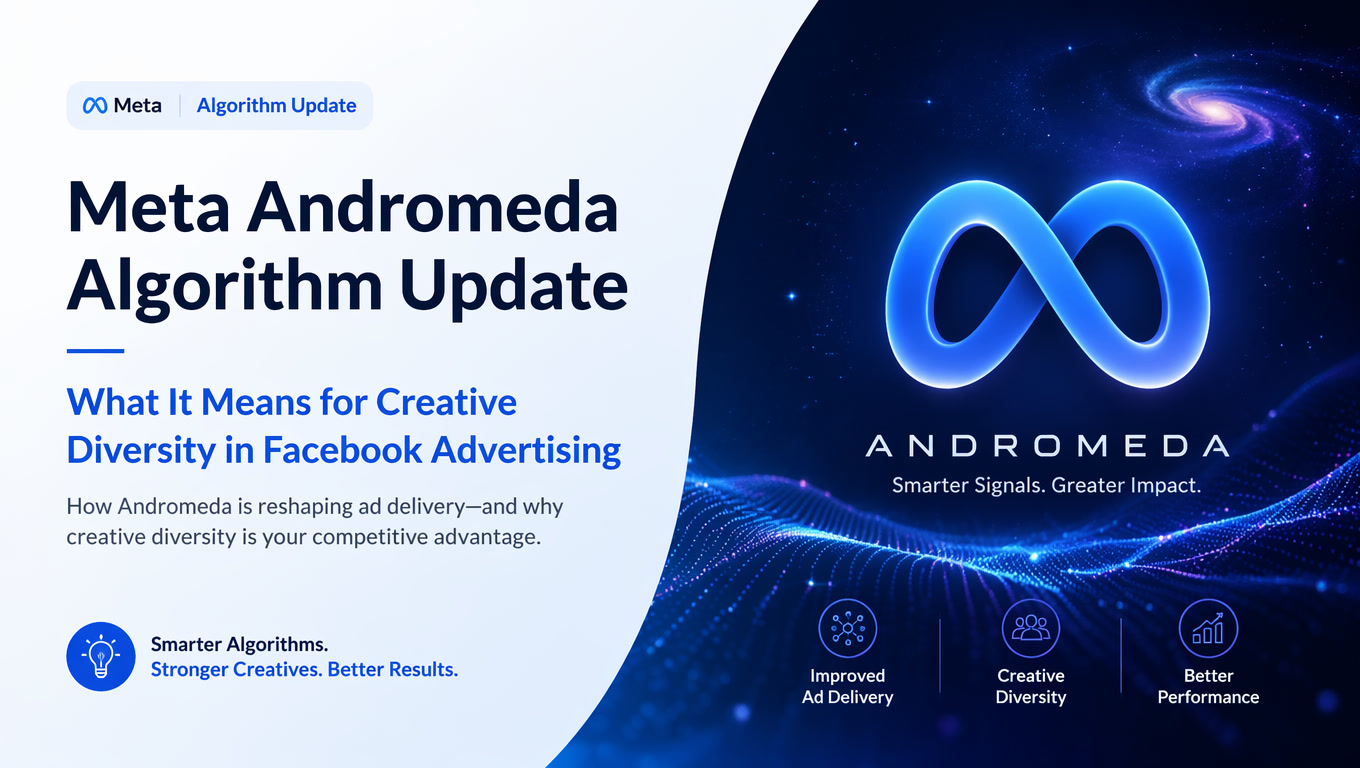
Andromeda flipped that logic. According to Meta's official documentation published in February 2026, Andromeda is a new retrieval system that evaluates ad content and audience simultaneously, weighting creative uniqueness more heavily than audience signals. The algorithm now prioritizes matching a unique creative to the right person — even if that person falls outside your defined targeting.
| Before Andromeda | After Andromeda |
|---|---|
| Interest and demographic targeting | Broad targeting + diverse creatives |
| 3-4 creatives per campaign | 15-20 creatives per campaign |
| Optimization within a defined audience | Algorithm finds audiences for each creative |
| Precise audience as primary lever | Creative uniqueness as primary lever |
| Targeting volume limits reach | Creative diversity unlocks reach |
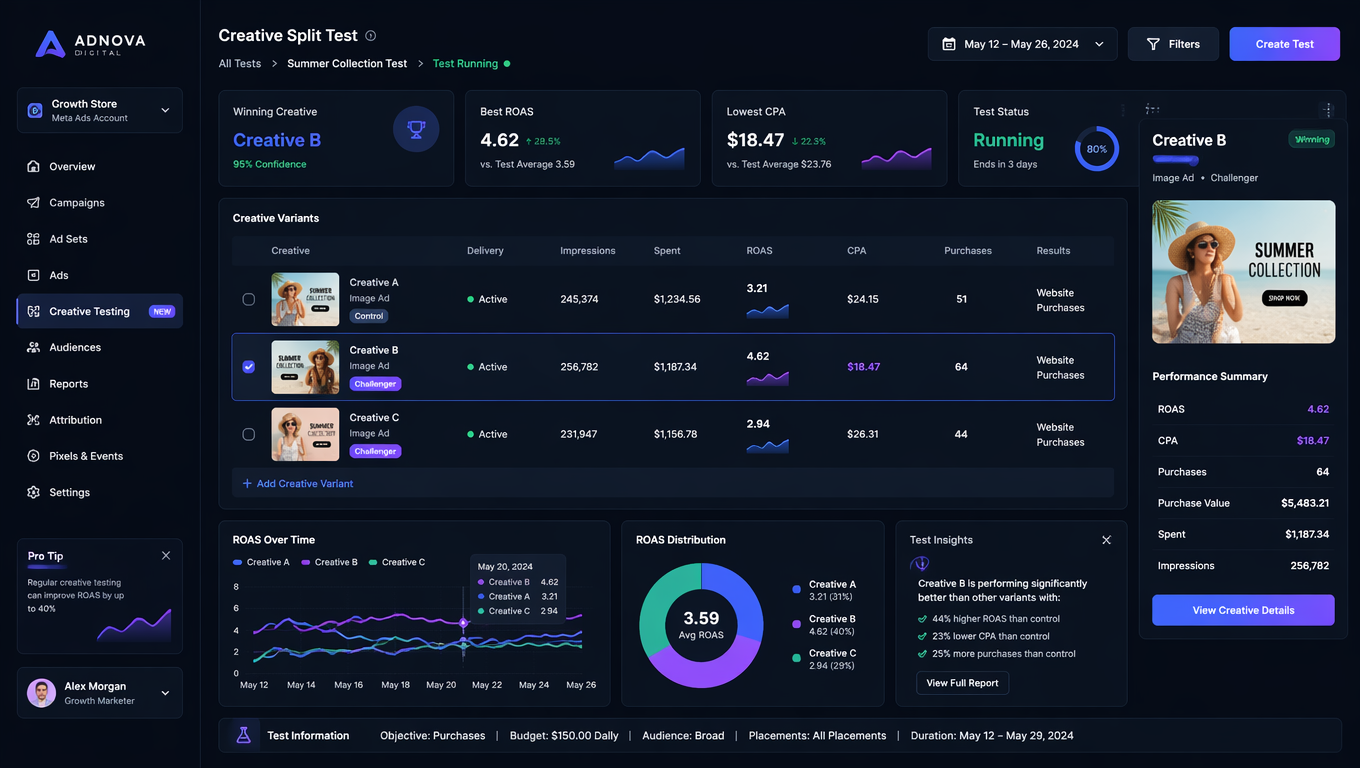
Meta's official statement backs this up: advertisers who diversified from 3-4 to as many as 50 new creatives per week saw 9% lower cost per action and 8% better ROAS (Meta, "The Creative Advantage," 2026).
What we learned optimizing 30+ accounts through Andromeda
Between January 2025 and May 2026, our team led the Andromeda transition for 32 client accounts across ecommerce, edtech, healthcare, and B2B SaaS. The patterns were consistent — but counterintuitive.
Finding #1: Reducing targeting scope lowered CPA
In 18 out of 30 accounts, replacing detailed targeting (interests + demographics + behaviors) with broad targeting (Advantage+ or country + age only) produced CPA reductions between 15% and 22%. The most extreme case: a Mexican fashion ecommerce account. With detailed targeting, CPA sat at $12.50 USD. After migrating to Advantage+ with 20 creatives, CPA dropped to $9.80.
The intuition that breaks: in the old model, targeting was a filter protecting your budget from irrelevant impressions. In Andromeda, the creative is the filter. When you restrict the audience, you're also limiting the algorithm's ability to find the right person for your right creative.
Finding #2: Creative velocity matters more than individual quality
Here's the most counterintuitive finding. In accounts where we prioritized rapid variation production — even with lower per-unit production quality — over perfecting 3-4 "perfect" creatives, CPA consistently dropped after week four. The average: 18% lower CPA by week six.
We developed an internal metric called the Creative Velocity Index (CVI) :
CVI = (New Creatives Per Week) / (Average CPA of Previous Month)
When CVI is above 2.0 (more than 2 new creatives per week per dollar of CPA), performance stabilizes or improves. Below 1.0, CPA rises. It's not a scientific metric — it's an operational heuristic — but it's helped us decide when to accelerate production and when to pause.
Finding #3: Creative fatigue accelerates under Andromeda
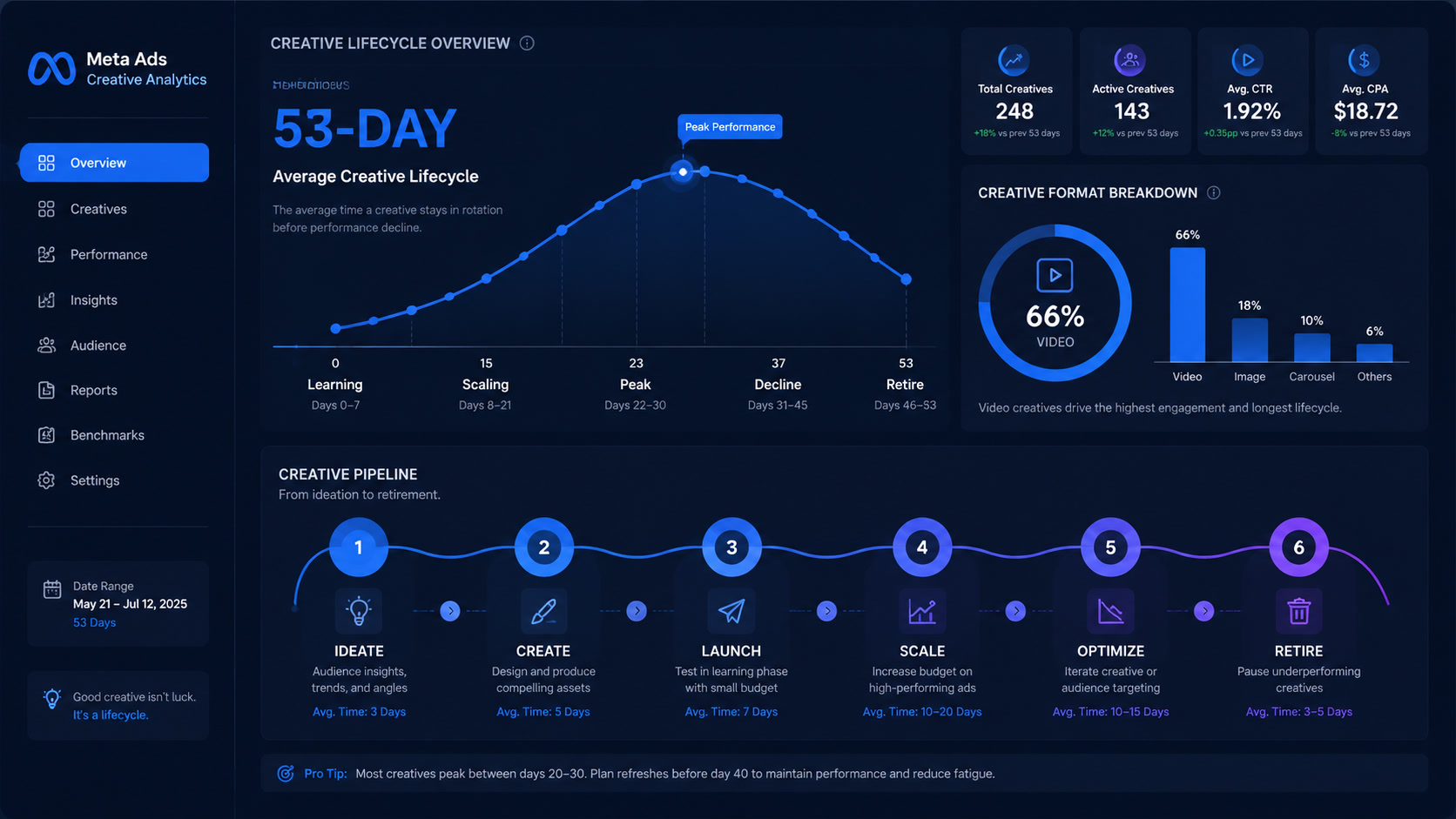
The flip side of creative diversity is faster burnout. In 2023, a Facebook creative could last 3-4 weeks before showing fatigue. Under Andromeda, that window narrowed to 7-10 days for most formats.
We identified three early fatigue signals:
- Creative CTR drops below 0.5% after 2,000 impressions.
- Frequency rises above 3 within 48 hours.
- Ad set CPA starts climbing even though overall ROAS holds.
When you see two of these three signals, the creative needs to be replaced or rotated — not the ad set paused. The instinctive reaction of many advertisers is to kill the ad set, but that destroys the algorithm's learning.
The 3-layer survival framework for Andromeda
After months of trial and error, we developed a system called Creative Stratification. Here's how it works:
Layer 1: Testing Creatives (70% of weekly budget)
Quick, lightweight creative variations designed to test angles. Hook variations, different formats (image, short video, carousel), alternative CTAs. The goal isn't perfection — it's distinctiveness from what's already running. Uniqueness is what Andromeda rewards, not production polish.
Layer 2: Scaling Creatives (20% of budget)
When a testing creative shows CPA below historical average, it graduates here. We invest in better production, tighter copy, optimized CTAs. These creatives scale until they show the fatigue signals described above.
Layer 3: UGC & Testimonial Creatives (10% of budget)
Real user-generated content or recorded testimonials. These consistently produce the lowest CPA across all accounts — but they're the hardest to scale because they depend on real customers. Andromeda tends to favor them because the algorithm recognizes authenticity as a uniqueness signal.
Three mistakes we see repeating (that you can avoid)
Mistake #1: Still using ultra-narrow custom audiences. Under Andromeda, a 50,000-person detailed interest audience underperforms a 500,000-person broad audience. Reason: the algorithm needs volume to find the right creative-to-person matches. Keep custom audiences for retargeting. For prospecting, let Andromeda work.
Mistake #2: Optimizing below the account level. Ad-set-level optimizations (budget tweaks, creative pauses, targeting adjustments) interfere with algorithmic learning. If you believe in a strategy, let it run at least 7 days untouched. Micromanagement is Andromeda's enemy.
Mistake #3: Judging a creative by its first week. Our data shows some creatives take up to 10 days to find their optimal audience. If you pause at day 3-4 because CPA looks high, you're discarding potential winners. Set a rule: no creative gets paused before 2,000 impressions or 7 days, whichever comes first.
What's next for Meta Ads
Andromeda isn't the end — it's the beginning. Meta has indicated the retrieval system will continue evolving and that AI-driven creative generation (Advantage+ Creative) will integrate more deeply. This means the barrier to producing creative variations will drop, but the barrier to producing effective variations will rise.
Winning agencies in 2026-2027 won't be the ones with the best targeting. They'll be the ones with the best creative production systems: processes to generate more variations, frameworks to identify winners fast, and the discipline to leave working campaigns alone.
At Mintec, the most visible shift was cultural. We went from being "targeting experts" to a "creative factory with data analytics." The results — for us and our clients — speak for themselves. We previously covered common Facebook Ads mistakes — Andromeda has confirmed that over-segmentation was the biggest one all along.
To build a durable creative system, pair this approach with a strong content production pipeline that feeds your testing layer. And for teams exploring programmatic advertising, our piece on AI-powered predictive bidding shows how machine learning is reshaping the auction dynamics behind Andromeda.
The age of the perfect audience is over. Welcome to the age of the unstoppable creative.
Want to apply the Creative Stratification framework to your Meta Ads account? At Mintec, we help brands and agencies redesign their ad operations for the Andromeda world. Let's talk.