
Creative Fatigue in Meta Ads: How to Detect It Before Andromeda Kills Your CPA
Meta Andromeda compressed the creative fatigue window from 6+ weeks to 2-3 weeks. A creative that works today may be burning your budget within 14 days. An early detection framework with real metrics, thresholds, and a rotation cadence based on actual campaign management — not theory.
Creative Fatigue in Meta Ads: How to Detect It Before Andromeda Kills Your CPA
If you're managing Meta Ads campaigns and watching CPA creep up without an obvious cause, your first instinct is probably to blame the algorithm or assume Meta changed something silently. Nine times out of ten, the real culprit is creative fatigue. And in 2026, with Andromeda fully deployed, it hits about twice as fast as it did two years ago.
We've watched campaigns go from 4x ROAS to 1.5x in under a week. Not because the product lost appeal. Not because targeting broke. Because the same creative that worked three weeks ago stopped generating response — and nobody caught it in time.
This isn't a theoretical overview. It's a detection framework built from managing ecommerce, lead generation, and app campaigns across multiple markets. The metrics that actually signal fatigue, the thresholds we use to decide whether to retire or refresh, and the rotation cadence we apply.
Why Creative Fatigue Is Problem #1 in 2026
Meta's Andromeda system —which since 2025 replaced audience-based targeting with creative signal prioritization— has a side effect few anticipated. By accelerating how fast the algorithm finds winning audience-creative combinations, it also accelerates how fast those combinations wear out.
The data is stark:
- Pre-Andromeda (2023-2024): A well-optimized creative could run 6-8 weeks before showing significant fatigue.
- With Andromeda (2025-2026): That window compresses to 2-3 weeks (CreaScale, April 2026; Zentric Digital, April 2026).
- Creative fatigue is now the #1 performance killer on Meta Ads, ahead of targeting issues, budget constraints, or seasonality.
Why this happens: Andromeda doesn't wait for accumulated CTR data to decide if a creative works. Within days —sometimes hours— it identifies which combinations drive conversions and funnels budget toward them. The problem is that accelerated concentration burns through the available audience for that creative much faster than the old system did.
On TikTok, the dynamic is similar but driven by trend velocity. A format that works this week can feel dated in 7-10 days. Brands that used to refresh creatives monthly now need to do so every week and a half.
The Early Detection Framework: 3 Signals You Can't Ignore
At Mintec, we use a three-signal system to catch fatigue before it hits CPA. We don't wait for performance to collapse — we act when the first indicator appears.
Signal #1: Sustained CTR Decline (-15% Over 3-5 Days)
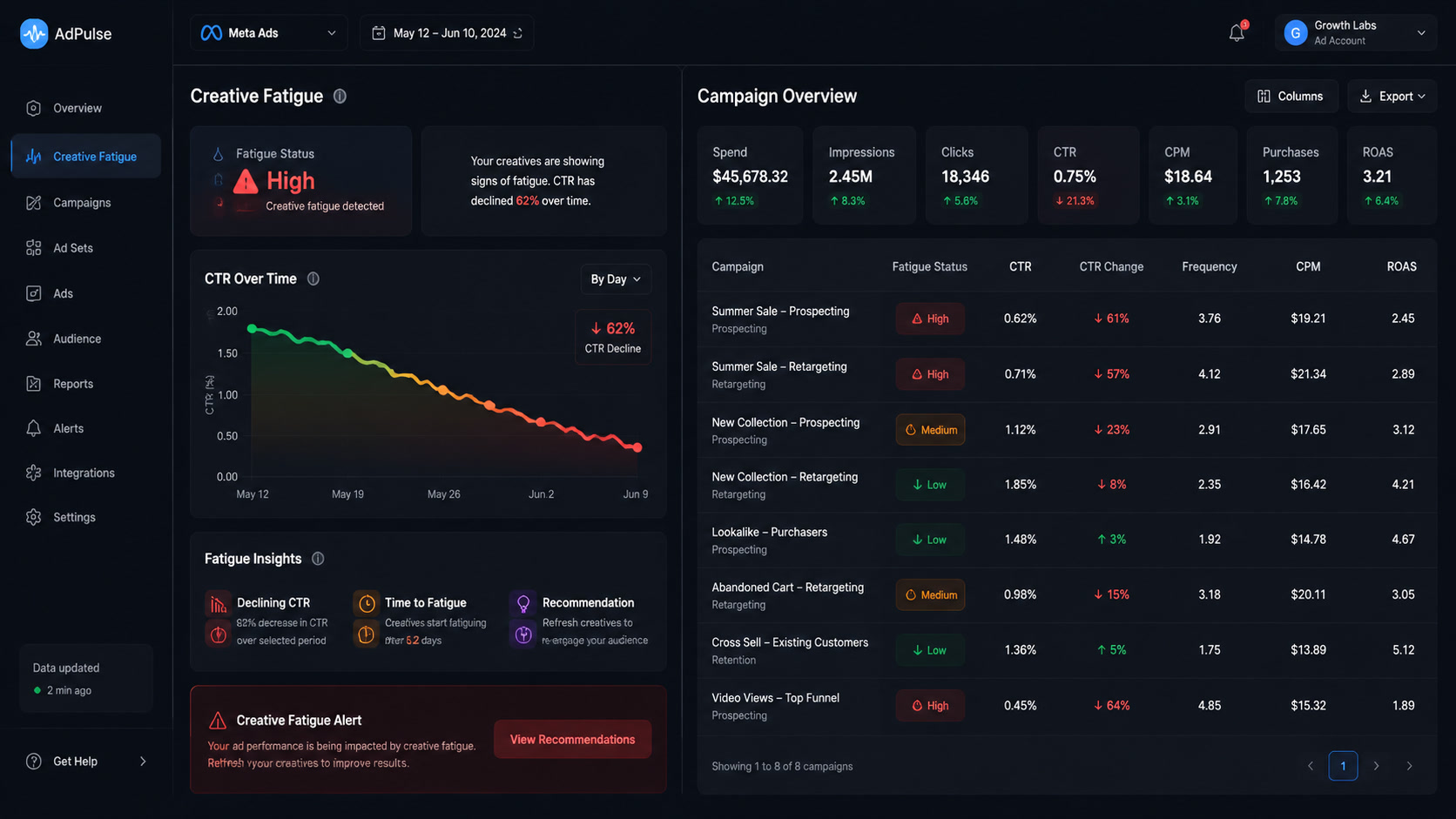
A single low-CTR day is statistical noise. Two consecutive days, pay attention. Three days with a downward trend exceeding 15% relative to the 7-day average — you have fatigue.
The pattern we see in real campaigns is characteristic: CTR doesn't cliff-dive overnight. It holds steady, then begins a gentle slope that accelerates. If you don't act during the early slope phase, CPA is already climbing by the time you notice.
Action threshold: If weekly CTR drops more than 15% vs the prior week with stable impression volume, flag that creative for review.
Signal #2: CPA Rising + CPM Flat or Dropping
This is the most deceptive signal because most people only watch CPA. If CPA rises and CPM also rises, it's likely a seasonality or competition issue. But if CPA climbs while CPM stays flat or drops, the audience has stopped clicking — and that's pure creative fatigue.
We saw this play out with a Spain-based ecommerce client: CPA jumped from €8 to €14 in a week, while CPM held at €12. The client's team assumed a budget problem. When we audited the creatives, the pieces that had been running for 18 days had a 0.4% CTR versus the 1.8% launch CTR. We rotated. CPA returned to €9 within 5 days.
Action threshold: CPA up >20% with flat or declining CPM → the creative is fatigued. Retire it.
Signal #3: Frequency > 3.5 Without Conversion Growth
Frequency has always signaled fatigue, but in 2026 the threshold is lower. With Andromeda, frequency trending above 3.5 without proportional conversion growth means that creative has delivered everything it can.
Important nuance: high frequency + growing conversions is not fatigue — that's a creative still gaining traction. The problem is high frequency + flat or declining conversions.
Action threshold: Frequency > 4.0 with stable CPA → monitor. Frequency > 4.0 with CPA rising >15% → retire.
The Rotation Calendar: When to Retire, Refresh, or Replace
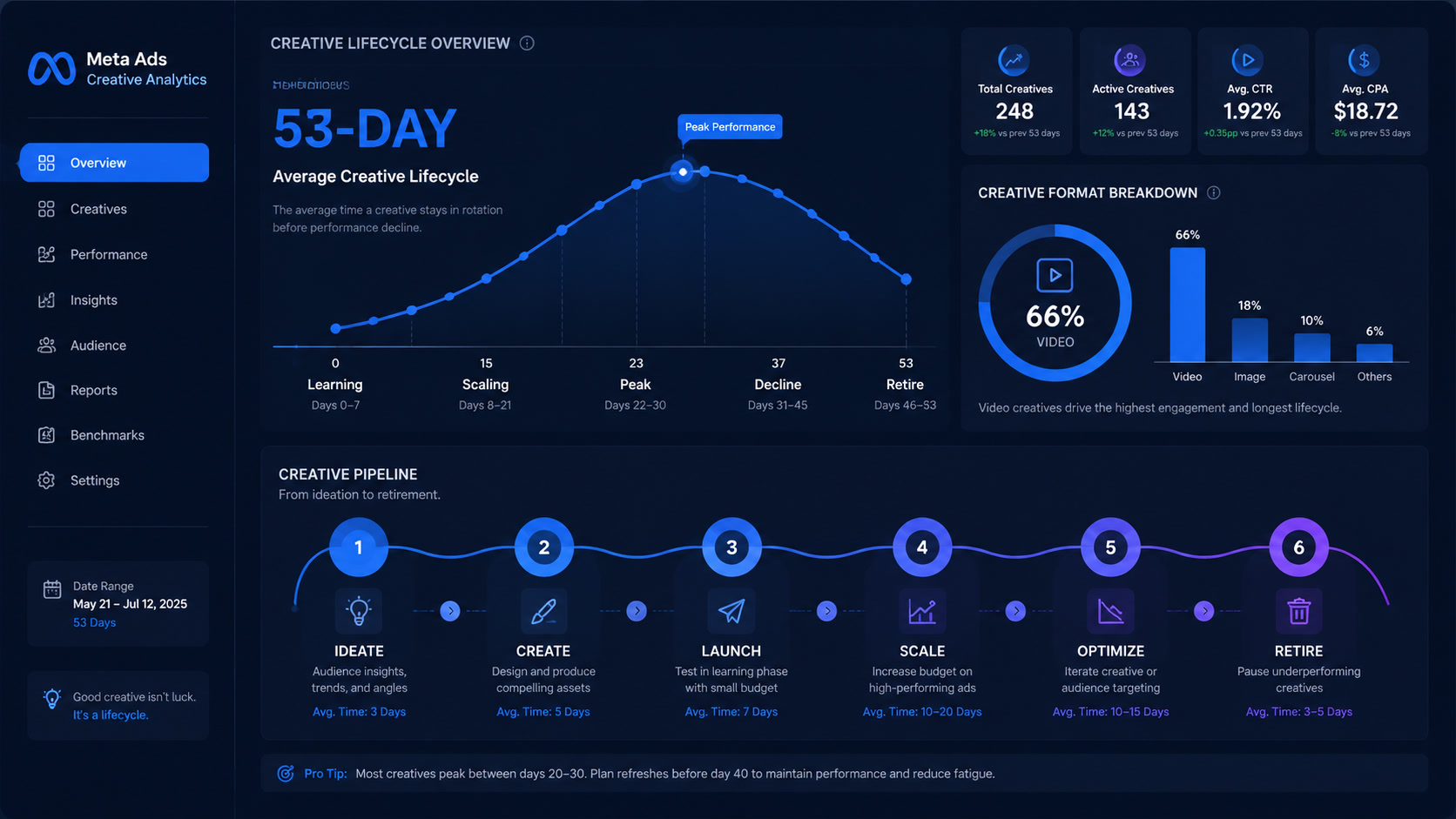
Not every fatigued creative needs to die. Sometimes a refresh —new headline, new CTA, new opening frame— is enough. Other times you need a full replacement. The key is knowing which phase each creative is in.
| Phase | CTR vs Launch | CPA vs Launch | Action |
|---|---|---|---|
| Growth (days 1-5) | >100% of launch | <80% | ✅ Let it run. Don't touch. |
| Maturity (days 6-14) | 70-100% | 80-120% | 🔄 Refresh headline or CTA if CPA edges up |
| Early fatigue (days 15-18) | 50-70% | 120-150% | ⚠️ Retire or fully refresh |
| Critical fatigue (day 19+) | <50% | >150% | ❌ Retire. Not worth keeping. |
This calendar assumes you have enough creatives in rotation. If you're running only 2-3 pieces, the problem isn't fatigue — it's creative volume, which we covered in our Meta Andromeda creative diversity analysis.
How We Manage Rotation at Mintec (The Real Process)
No magic tool. A process any team can replicate:
1. Weekly 10-minute audit. Every Monday, we check the three fatigue signals for every active ad set — CTR trend, CPA vs CPM relationship, frequency. This flags which creatives are in the risk zone.
2. Continuous production pipeline. We maintain a backlog of 5-10 creative concepts ready to enter rotation. When a piece shows early fatigue, its replacement is already briefed. This matters because producing under pressure —once CPA has already spiked— leads to bad creative decisions.
3. 3:1 rotation ratio. For every creative we retire, we introduce 3 new ones. This gives Andromeda enough variety to find the next winning combination without depending on a single bet.
In our campaigns, this process keeps CPA stable even as we scale budget. Creative fatigue never disappears —but it becomes predictable and manageable.
This ties directly into what we covered in Why Meta and TikTok Demand 6 Creative Angles Per Campaign. Without creative volume, no rotation framework can save you.
What Most Advertisers Get Wrong About Creative Fatigue
Two mistakes we see constantly:
Mistake #1: Assuming fatigue only hits high-budget campaigns. False. Fatigue depends on frequency, not total spend. A $200/day campaign with a small audience can fatigue faster than a $2,000/day campaign with broad reach.
Mistake #2: Rotating everything at once. If you replace all creatives simultaneously, you lose the ability to isolate what worked. The right approach is wave-based rotation: swap 30% of pieces every 5-7 days while keeping a control group.
Conclusion
Creative fatigue is the price we pay for Andromeda's efficiency. The algorithm finds winning combinations faster —and burns them out faster. The solution isn't to fight the system. It's to build a detection and rotation process that operates at the same speed.
Three things to do today:
- Check the 7-day CTR trend on your main campaigns. If you see 15%+ drops without explanation, you likely have fatigue.
- Set a frequency alert at 3.5 in Ads Manager.
- Start building your creative production pipeline if you don't have at least 5 concepts in backlog.
Want us to audit your Meta Ads accounts and identify fatigue before it hits your CPA? Talk to our paid media team. No magic formulas —just honest diagnostics based on real campaign data.
Frequently Asked Questions
What is creative fatigue and why is it more dangerous in 2026?
Creative fatigue happens when an audience has seen the same ad so many times that engagement drops. In 2026, Meta's Andromeda system accelerates this process: by prioritizing creative signals over audience targeting, it finds winning combinations faster — but it also burns them out faster. The fatigue window dropped from 6+ weeks to just 2-3 weeks.
What are the earliest signs of creative fatigue?
The three earliest signals are: (1) CTR dropping more than 15% over 3-5 days with stable impressions; (2) CPA rising while CPM stays flat or drops — meaning the audience stopped clicking, not that inventory got more expensive; (3) frequency exceeding 3.5 without proportional conversions. Any one of these warrants attention; all three together is a clear signal.
How often should I rotate creatives on Meta and TikTok?
On Meta with Andromeda, rotate every 10-14 days maximum for performance campaigns. On TikTok, where trend cycles are shorter, the window shrinks to 7-10 days. But rotation doesn't mean replacing everything: a smart cycle retires the worst-performing 30%, introduces 2-3 new pieces, and keeps top performers that are still in their growth phase.