

Your Meta Ads CPA Just Jumped 38% — Here's What's Driving It and How to Fix It
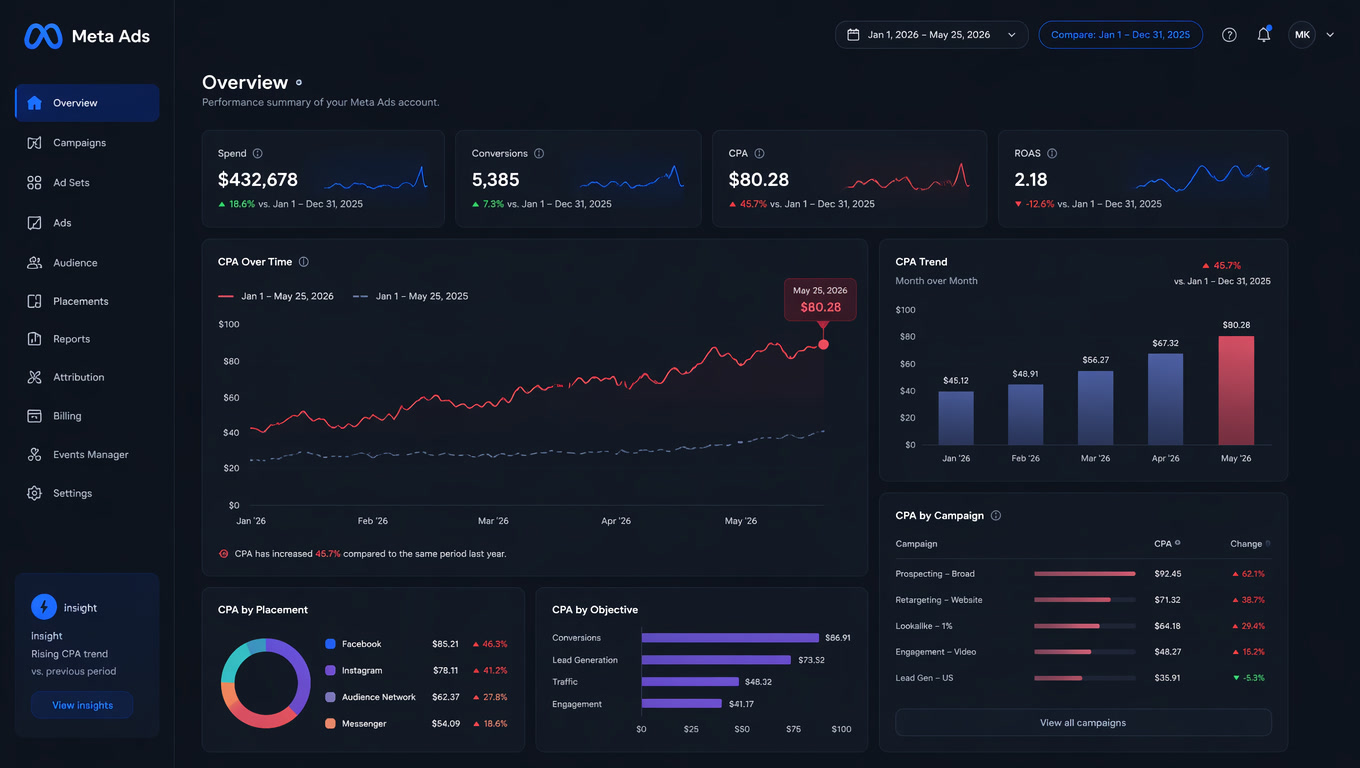
Average Meta Ads CPA climbed from $27.66 to $38.19 year-over-year — a 38.1% jump. It's not your targeting, it's not your product. It's the perfect storm of Andromeda, CPM inflation, and accelerated creative fatigue. We break down what's actually happening in the accounts we manage and the three levers we're pulling to recover ROAS.
Your Meta Ads CPA Just Jumped 38% — Here's What's Driving It and How to Fix It
The average Meta Ads CPA crossed $38.19 in 2026, up from $27.66 the year before. That's a 38.1% increase in twelve months. Before you blame your targeting, your product, or "the algorithm punishing you" — look at what's actually changed. Meta's ad ecosystem underwent a structural shift in the past year, and most advertisers are still running last year's playbook on this year's auction.
At Mintec we manage Meta Ads campaigns for clients across LATAM and the US — ecommerce, B2B leads, demand generation, and direct sales. Since January we've watched CPA climb across nearly every vertical. Some accounts held steady. Others cratered. The difference wasn't budget or product: it was how each account responded to Meta's new delivery ecosystem.
This isn't another list of generic benchmarks. This is what we're seeing in real campaigns, why we think it's happening, and what's actually working to recover performance.
The full picture: what happened to Meta Ads costs in 2026
Multi-industry benchmark data paints a stark picture:
| Metric | 2025 | 2026 | Change |
|---|---|---|---|
| Average CPA (all industries) | $27.66 | $38.19 | +38.1% |
| Average CPM | ~$11.50 | ~$13.85 | +20% |
| Average CPC | ~$0.68 | ~$0.78 (traffic) / ~$1.92 (lead-gen) | Variable |
| Median DTC ecommerce ROAS | ~2.4x | ~1.86x | -22% |
| Median conversion rate | ~1.9% | ~1.57% | -17% |
Sources: Get-Ryze Meta Ads Benchmarks 2026, Spark UGC Benchmarks by Business Type, internal data from Mintec-managed accounts (Jan-Jun 2026).
The million-dollar question: why is this happening all at once?
Three forces compressing your ROAS
1. Andromeda rewired the auction (and it demands more creative)
Meta completed its Project Andromeda rollout between late 2025 and early 2026. We've covered how Andromeda killed audience targeting and why creative diversity now outweighs targeting precision in earlier posts.
The concrete effect on your CPA: Meta's algorithm now needs distinct, diverse creative to perform well. Where you could previously run 3-4 assets for 3-4 weeks, fatigue now hits in 5 to 10 days. When a creative fatigues, CPM rises, CTR drops, and CPA spikes.
Meta labels this "Creative Limited" or "Creative Fatigue" in Ads Manager — and it's the #1 reason we see accounts where CPA doubled within weeks without any change from the advertiser.
2. More advertisers competing for the same inventory
Meta overtook Google in ad revenue in 2026, projected at $243.5B to Google's $239.5B, controlling 62.3% of the global digital ad market alongside Amazon. Great for Meta. Bad for your CPA: more advertisers in the auction means higher CPMs.
CPM jumped 20% year-over-year. You're paying roughly $2.35 more per thousand impressions than in 2025. On a $50K/month account, that's ~$1,175 in pure reach inflation.
3. Creative fatigue is faster and more expensive
The old "upload a creative, optimize, scale" model no longer works. Under Andromeda, the fatigue curve accelerated because the algorithm serves creative to more targeted audiences faster. According to Good Morning Creative's analysis, fatigue thresholds in mid-to-high-spend accounts dropped from 21-28 days to 7-12 days.
The symptom is deceptive: CPA creeps up gradually, the advertiser assumes it's "seasonality" or "the market," and increases budget to compensate. That only accelerates the decline.
What's actually working to recover CPA (from real campaigns)
We've tested multiple approaches over the past six months. Here's what's producing results:
Lever 1: Weekly creative refresh, not monthly
The single biggest change: we moved from producing creatives every 2-3 weeks to a weekly pipeline of at least 10 new assets per account. It's less heavy than it sounds — not everything needs complex production. We use:
- Quick UGC adaptations from existing customer content
- Visual hook variations with the same offer
- Format A/B tests (Reels vs static image vs carousel)
- AI-assisted asset generation to scale production
Accounts that adopted this cadence saw CPA stabilize between weeks 2-3 and begin declining between weeks 4-6.
Lever 2: Broad targeting with the right signals
In the Andromeda era, tight targeting works against you. Instead:
- We run broad targeting with conversion signals from CAPI pixel
- We only constrain by geography and time-of-day where it matters
- We let the algorithm learn from converters, not from our demographic assumptions
The accounts that recovered CPA fastest were the ones that let go of targeting control and focused on creative diversity instead.
Lever 3: Weekly creative fatigue audit
We run a Monday review across every account:
- Identify creatives flagged "Creative Limited" or "Creative Fatigue" in Meta Ads Manager
- Pause fatigued assets immediately (don't wait for the algorithm to retire them)
- Replace with fresh variations of the same angle that was working
- Increase budget only on assets in "Active" or "Learning" status
This audit alone recovered 15-30% of CPA within the first two weeks across multiple accounts.
The decision framework: when to scale vs. when to pause
One question we hear constantly: "Do I keep spending or shut it down?" Here's our framework:
| Scenario | Action |
|---|---|
| CPA up <15% in 2 weeks | Audit creative fatigue, refresh assets, maintain budget |
| CPA up 15-30% in 2 weeks | Pause fatigued creatives, reduce budget 20%, ramp creative production |
| CPA up >30% in 2 weeks | Kill campaign, audit account structure, check CAPI pixel, relaunch with new approach |
| CPA stable but CPM rising | Market signal — maintain strategy, monitor fatigue closely |
| CPA dropping but volume shrinking | Good signal — scale with new creative angles, don't just increase budget |
What nobody tells you in the webinars
Most Meta Ads content in 2026 falls into two buckets: "the algorithm is changing, adapt" (vague) or "here are 10 tips" (generic). What nobody says outright is that CPA inflation isn't temporary.
Meta is optimizing for its own revenue, not your ROAS. Andromeda, GEM, and campaign automation are designed to increase spend, not improve conversion. That's not conspiracy theory — it's Meta's business model. Your job as an advertiser isn't to fight the algorithm. It's to build a creative production system that can keep pace.
The accounts weathering 2026 best aren't the ones with the biggest budgets. They're the ones with the best creative pipelines. Full stop.
Is your CPA climbing and you're not sure why? Talk to us — we'll audit your campaign structure and show you where to start recovering ROAS.
Frequently Asked Questions
Why did Meta Ads CPA increase so much in 2026?
Average Meta Ads CPA rose 38.1% in 2026 driven by three factors: 1) CPM increased 20% due to higher demand for Reels, Stories, and Threads inventory, 2) Meta's Andromeda algorithm prioritizes unique creative over targeting, accelerating asset fatigue from 3-4 weeks to 5-10 days, and 3) more advertisers entered the auction as Meta surpassed Google in ad revenue, intensifying competition.
How many creatives do I need to fight ad fatigue on Meta in 2026?
Under Andromeda, creative fatigue hits in 5-10 days instead of the old 3-4 week cycle. To stabilize CPA you need 15-20 active creatives running simultaneously, with a refresh rate of at least 10 new assets per week per account. Creative angle diversity — different hooks, formats, and narratives — matters more than raw volume.
Should I increase my budget when CPA is rising?
Not without auditing creative fatigue first. Increasing budget on fatigued assets accelerates ROAS decline. The correct sequence is: audit creative fatigue → refresh assets → scale. In the accounts we manage, this sequence has recovered 15-30% of CPA within the first two weeks.