Meta Advantage+ 2026: The Decision Framework for Migrating from Manual to Automated Campaigns
Meta cut the Advantage+ threshold to 25 weekly conversions. Should you migrate everything? A decision framework based on real campaign management — with threshold tables, migration phases, and the one thing nobody tells you about AI-powered campaigns.
Meta Advantage+ 2026: The Decision Framework for Migrating from Manual to Automated Campaigns
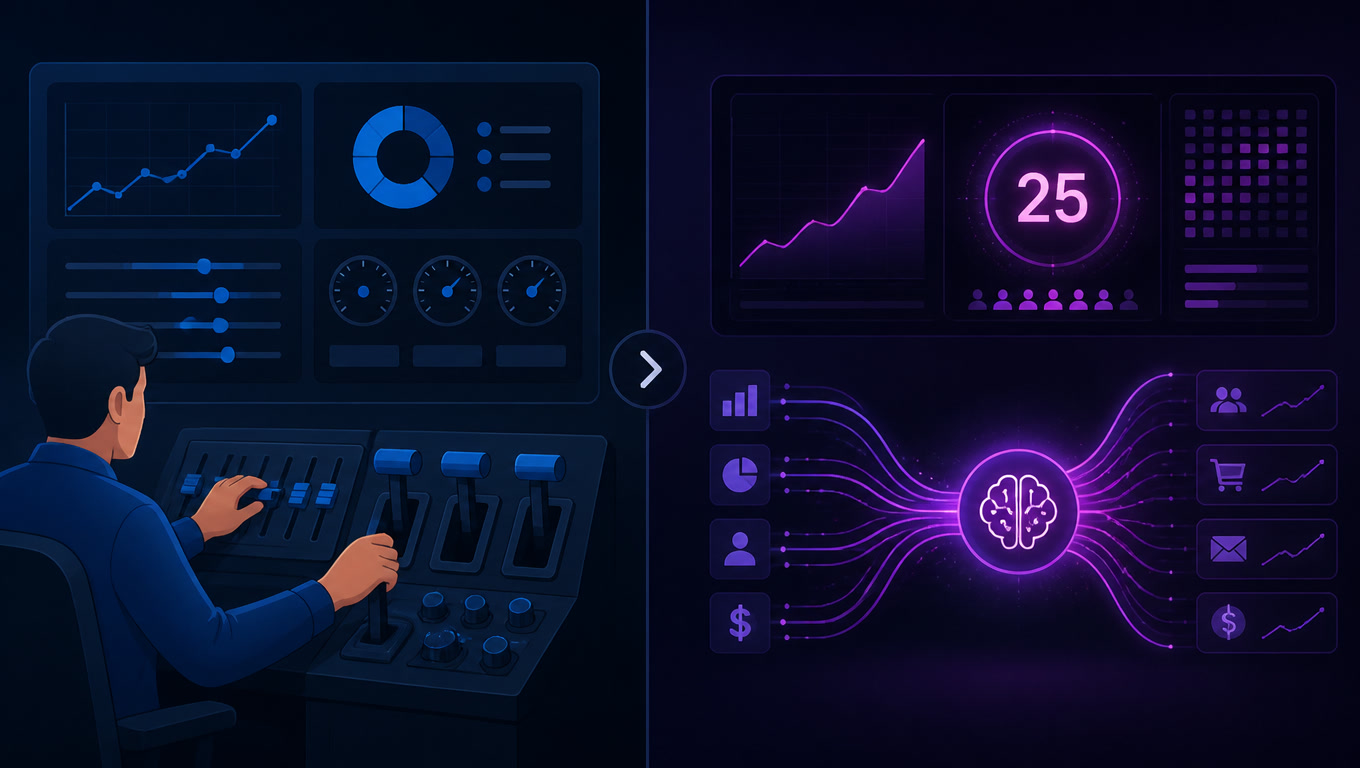
Yes, Meta dropped the Advantage+ threshold to 25 weekly conversions for Shopping and 15 for Apps. But that doesn't mean you should flip every campaign to automated tomorrow. The real question isn't "can I use Advantage+?" — it's "when does it make sense, and when doesn't it?"
We manage ecommerce, lead generation, and app campaigns for clients across multiple markets. We've seen manual campaigns outperform automation by 30%, and we've seen Advantage+ campaigns deliver 2x ROAS increases. The difference wasn't the tool — it was knowing when to use it.
This isn't a list of tips. It's a decision framework built from managing real campaigns, with real budgets, through the 2026 Advantage+ changes.
What Actually Changed in 2026 (and Why It Matters)
Advantage+ launched in 2022, but through 2025 it required at least 50 weekly conversions to exit the learning phase reliably. That excluded most SMBs, seasonal businesses, and anyone with a mid-range budget.
In 2026, Meta made three structural changes that shift the calculus:
- Threshold cut to 25 conversions/week for Shopping, and 15 for Apps. This effectively quadrupled the addressable advertiser base for AI-powered campaigns.
- Predictive Budget Allocation: the system no longer optimizes reactively (looking at what worked yesterday) but proactively shifts budget toward predicted high-conversion windows. Early adopters report 8-15% ROAS improvements (Benly analysis, March 2026).
- Advantage+ Leads launched: a dedicated campaign type for lead generation, which previously only existed for Shopping and Apps. This matters because lead gen campaigns have different optimization needs than ecommerce.
The shift from 50 to 25 conversions looks small on paper, but it's a structural change. It opens AI-powered optimization to businesses spending €500-1,500/month on Meta, which was previously the dead zone where manual campaigns underperformed but Advantage+ couldn't stabilize.
The Decision Framework: 4 Questions Before You Migrate
We use this questionnaire with every client before recommending Advantage+. Answer these four, and the path becomes clear.
1. Are you generating at least 25 weekly conversions on this ad set?
Yes → Advantage+ will almost certainly outperform a well-optimized manual campaign once it exits the learning phase (typically 7-14 days).
No → Don't migrate. The algorithm needs that volume to exit learning and optimize meaningfully. Below 25, you'll see erratic CPA and frequent learning phase restarts.
💡 Exception: High-ticket products (>$200) with fewer conversions but high value per conversion. If you're at 15-20 weekly conversions with a $500+ AOV, the potential ROAS improvement may justify the test.
2. Is your audience broad or hyper-niche?
Advantage+ works best when it has room to expand. A target like "women 25-45 interested in fitness in Miami" — clear but not microscopic — gives the algorithm signal space to find lookalike segments you hadn't considered.
Hyper-niche audiences (e.g., "compliance directors at publicly listed pharma companies in Mexico") are vulnerable to algorithmic dilution. The expansion feature will drift toward broader, cheaper segments that don't convert. For these, stick with manual campaigns and refined custom audiences.
3. Do you have enough creative variety?
Advantage+ consumes creatives. The system needs 3-5 assets minimum per campaign to test meaningful combinations. If you're running one product photo and a headline, Advantage+ has nothing to optimize.
This connects directly to the wider shift in Meta's ad delivery. We recently published a deep dive on how Meta Andromeda prioritizes creative diversity over audience targeting — Advantage+ is the campaign-level consequence of that architectural change. If you don't have creative variety, solve that first, then migrate.
4. Is this a new product or one with conversion history?
New products with zero conversion data are bad candidates. Advantage+ needs historical signals to predict. For launches, start with manual campaigns, generate 25-50 conversions, then migrate.
Products with history are safe. The algorithm has signal to work with from day one.
The Quick Decision Table
| Situation | Recommendation |
|---|---|
| 25+ conversions/week, broad audience, good creative variety | ✅ Migrate to Advantage+ now |
| 25+ conv/week, niche audience | ⚠️ Parallel test with 20% budget |
| Under 25 conv/week, low ticket | ❌ Keep manual, grow volume first |
| Under 25 conv/week, high ticket ($200+) | ⚠️ Test with 30% budget if creative variety exists |
| New product, zero history | ❌ Manual first, migrate at 50 conversions |
| Lead gen with long-form forms | ⚠️ Test Advantage+ Leads cautiously |
| App with retention optimization | ✅ Advantage+ App at 15+ conv/week |
How to Migrate Without Burning Budget
We've seen clients switch everything to Advantage+ in a day and lose 40% of ROAS because the algorithm was learning on thin data with no baseline. The safe migration has five phases:
Week 1-2: Audit. Document baseline metrics per campaign — ROAS, CPA, frequency, CTR, creative performance. Know what "good" looks like.
Week 3-6: Parallel test. Create one Advantage+ campaign with 20-30% of budget. Keep existing manual campaigns running. Do not cancel anything yet.
Week 7: Analyze. Minimum 3-4 week window for the algorithm to exit learning. Compare head-to-head. If Advantage+ wins on ROAS or CPA, proceed. If not, investigate why (creative volume? audience mismatch?).
Week 8-12: Gradual shift. Move budget in 20% weekly increments. If ROAS drops at any point, pause and reassess. The learning phase restarts with significant budget changes.
Week 13+: Hybrid optimization. Keep at least one manual campaign running for testing new creatives and audiences. Advantage+ optimizes what exists; innovation still comes from manual testing.
On creative volume — this is the bottleneck we keep coming back to. In a recent article we mapped why Meta and TikTok now require 4-6 creative angles per campaign. Advantage+ accelerates optimization, but creative production is what feeds it. No creatives, no optimization.
What Nobody Tells You About Advantage+
Meta's official messaging paints Advantage+ as universally superior. Our experience managing campaigns across different verticals tells a more nuanced story:
Advantage+ wins on efficiency in the medium term. Once past the learning phase (7-14 days), it typically outperforms manual campaigns. We see average improvements of 10-15% in ROAS and 12-18% in CPA reduction across ecommerce and lead gen.
But it loses on predictability. With manual campaigns, we can trace exactly which segment responded to which creative at what frequency. Advantage+ gives you segment-level reporting now (the 2026 transparency updates are real), but it's less granular than a well-structured manual campaign with individual ad set targeting.
And it requires more creative investment, not less. The paradox of automation: when the algorithm optimizes better, the bottleneck shifts upstream to creative production. The upside: if you solve creative production at scale, Advantage+ will compound that advantage faster than any manual setup.
Bottom Line
The 25-conversion threshold reduction is good news for most advertisers. But it's not a blanket mandate to migrate everything. Use the 4-question framework, run the parallel test, and migrate gradually.
If you're managing paid media and want a second opinion on whether your accounts are ready for Advantage+, talk to our paid media team. We analyze your current data and tell you whether to migrate — with no tool bias. We also map this into your broader digital marketing strategy so Advantage+ fits into the full funnel, not as an isolated switch.
Frequently Asked Questions
How many conversions do I need for Meta Advantage+ in 2026?
Meta lowered the minimum from 50 to 25 weekly conversions for Shopping campaigns and 15 for App campaigns. This opens Advantage+ to SMBs and startups that previously couldn't generate enough volume for AI optimization. For lead gen, the new Advantage+ Leads type works with similar thresholds.
Which campaigns should NOT migrate to Advantage+?
Campaigns with fewer than 25 weekly conversions, brand-new products with zero conversion history, hyper-niche audiences where manual targeting precision matters more than algorithmic expansion, and testing campaigns where you need granular variable control. These perform better with manual setup.
How do I migrate from manual to Advantage+ without losing performance?
Run a parallel test: allocate 20-30% of budget to Advantage+ while keeping existing manual campaigns running. Compare for 3-4 weeks minimum. If Advantage+ wins on ROAS or CPA, shift budget in 20% weekly increments. Never migrate everything at once — the learning phase needs time to stabilize.