Meta's Ads Now Run Themselves: What We Stopped Doing (and What We Started)
Meta's Advantage+ AI now runs ad campaigns end-to-end from a single URL. After managing this transition for 15+ client accounts at Mintec, we identified the skills that became obsolete, the new capabilities we had to build, and the framework we use to decide when full automation works and when it doesn't.
Meta's Ads Now Run Themselves: What We Stopped Doing (and What We Started)
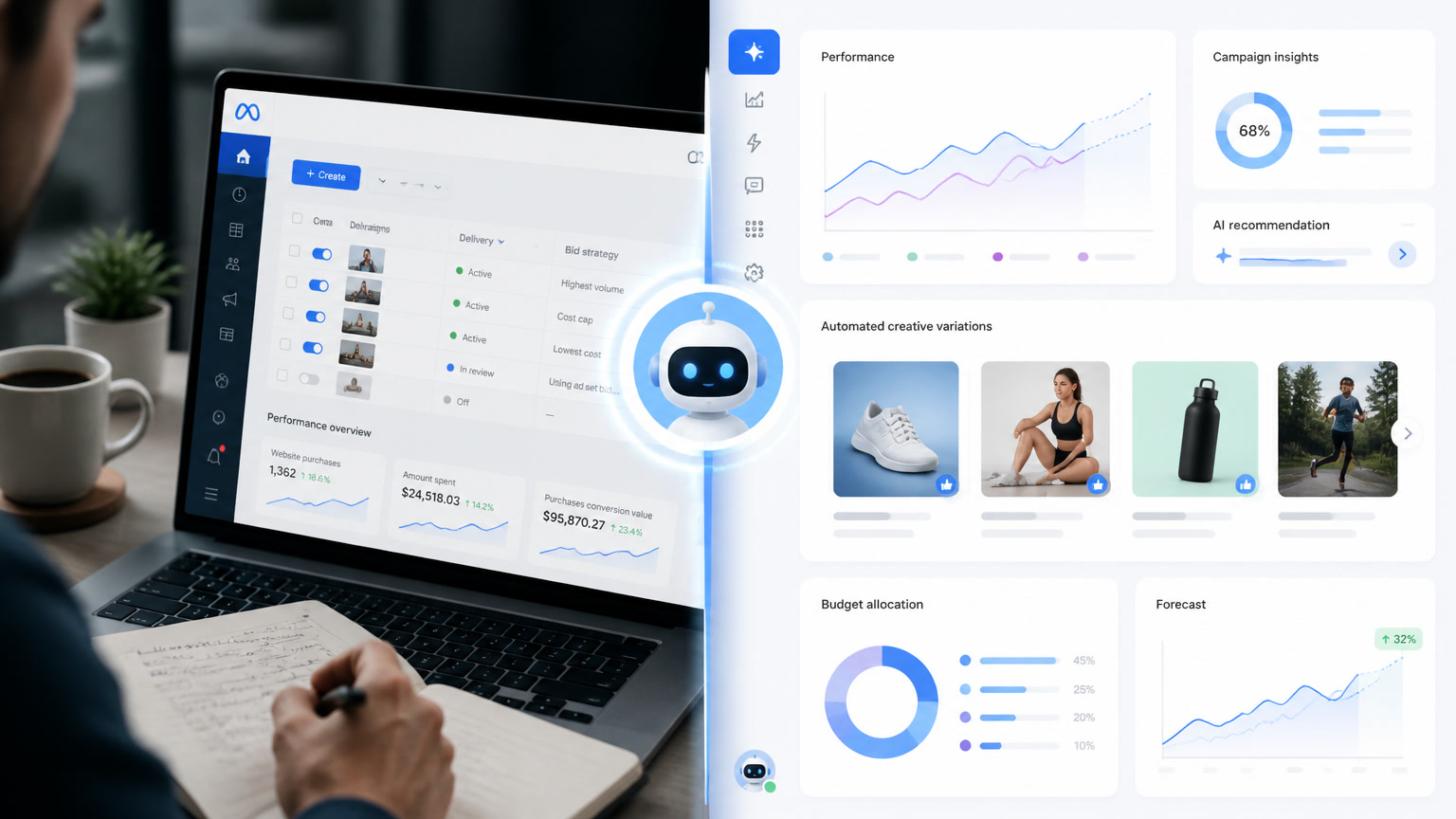
If you manage Meta Ads for a living, you've probably noticed a quiet shift over the past 12 months. The controls you used to touch daily — audience targeting, placement selection, bid adjustments — are either automated or disappearing. And now Meta has made its intent explicit: the future is a system where an advertiser provides a URL and a budget, and AI generates the entire campaign.
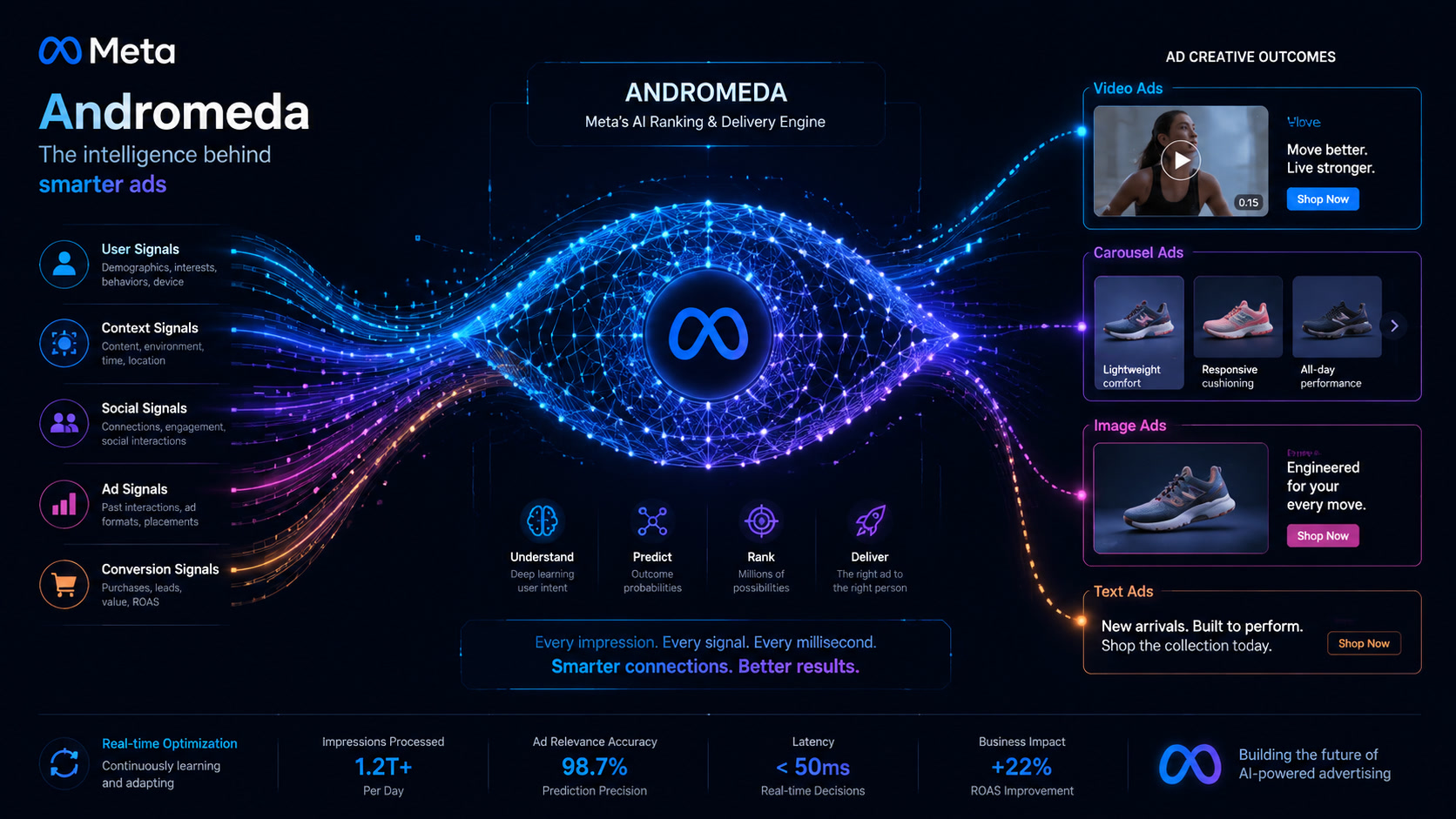
This isn't a distant projection. Meta's Advantage+ suite already generates approximately $60 billion in annualized revenue, and more than 4 million advertisers now use its generative AI tools, producing over 15 million AI-enhanced ads every month. According to Meta's own reporting, Advantage+ campaigns deliver 22% higher ROAS on average compared to manually managed campaigns.
At Mintec, we've been managing client accounts through this transition since early 2025. Across e-commerce, professional services, and education verticals in both LATAM and US markets, we've had to unlearn habits we'd spent years perfecting and build new ones from scratch. Here's what actually changed — not the theory, but the day-to-day operational reality.
What We Stopped Doing
1. Manual audience segmentation
For years, the first question on every campaign brief was: "Who are we targeting?" We'd build detailed audience stacks — interest-based segments, lookalikes, demographic exclusions — and treat them as the primary optimization lever.
Andromeda's model (now fully integrated with Advantage+) changed that. The algorithm does its own audience discovery from behavioral signals, and manual targeting inputs only constrain its reach. We stopped spending hours on audience research and instead redirected that time to creative strategy.
The data backs this shift: in our accounts, campaigns with broad (no-targeting) settings under Advantage+ outperform detailed-segmentation campaigns by roughly 15-20% on CPA, provided the creative volume is sufficient — at least 12-15 active pieces per campaign.
2. Bid management and placement optimization
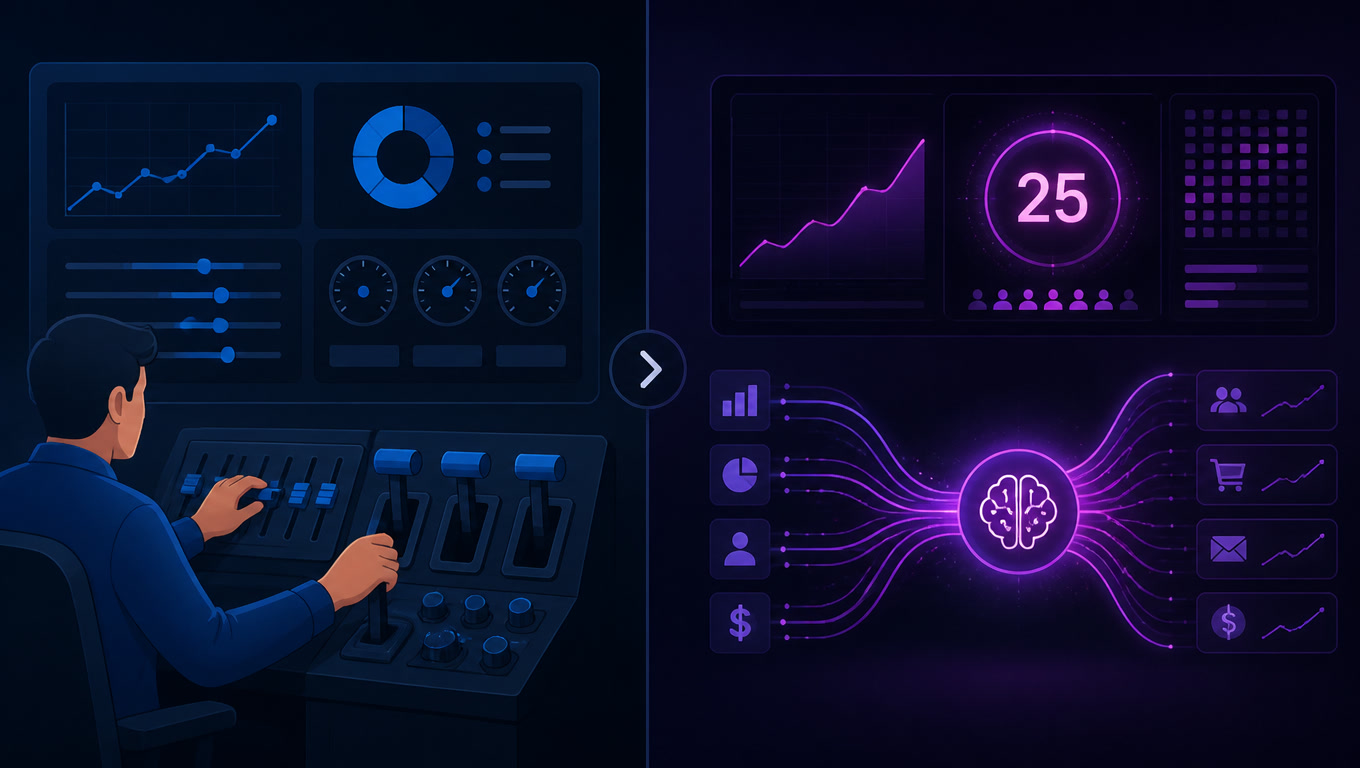
This was the first skill to go. Meta's automated bid system, combined with Advantage+ placement optimization, consistently outperforms manual bid adjustments. We were spending hours every week adjusting bids by placement, daypart, and audience — and the algorithm was simultaneously overriding our decisions.
We stopped. Now we set a target CPA/ROAS, let Advantage+ handle the rest, and monitor at the campaign level rather than the placement level. The one exception: we still intervene on new accounts (< 50 conversions) where the algorithm hasn't gathered enough signal yet.
3. Creative volume constraints
Under the old model, we ran 3-5 creatives per campaign and optimized within that set. Andromeda and Advantage+ together changed the equation: the algorithm now needs creative variety to find audience-ad matches. Running 3-5 pieces means the AI exhausts its options fast — we saw CPA climb 20-30% within 2-3 weeks of launching with insufficient creative volume.
We shifted to a minimum of 15 active creatives per campaign, produced in batches of 5 per week on a rolling basis. The total production investment went up, but the CPA improvement (roughly 25% across our managed accounts) made it worthwhile.
| Before Automation | After Automation |
|---|---|
| 3-5 creatives per campaign | 15+ creatives per campaign |
| Detailed audience targeting | Broad targeting, AI finds audience |
| Manual bid/placement management | Automated through Advantage+ |
| Weekly audience optimization | Weekly creative refresh |
| Campaign manager = media buyer | Campaign manager = creative strategist |
4. Last-click attribution as truth
This was the hardest to give up. Meta's automated systems distribute budget across placements, audiences, and creative variations in ways that make last-click attribution nearly meaningless. A conversion might start with a Reels view, move to a Feed interaction, and convert on a Search ad — all within the same Advantage+ campaign.
We stopped optimizing to last-click ROAS and shifted to incrementality measurement — holdout tests, conversion lift studies, and multi-touch attribution through GA4 and Triple Whale. The campaigns that looked worst on last-click were often the strongest incrementally.
What We Started Doing
1. Creative strategy as the primary lever
When you can't differentiate through targeting, placement, or bid strategy, creative is the only remaining lever. This is the single biggest change. Our campaign managers now spend more time on creative briefs than on campaign setup.
We developed a creative angle taxonomy — 6 distinct hooks per campaign, each targeting a different psychological trigger (urgency, social proof, problem-solution, aspiration, curiosity, FOMO). The AI tests which angles resonate with which audience segments and disproportionately serves the winners. Our job is to feed the machine enough variety to find those winners.
This shift connects directly to what we covered in our article on creative fatigue in Meta Ads — because when creative is your primary lever, fatigue hits faster and harder.
2. Hybrid campaign architecture
We learned the hard way that putting everything into Advantage+ is a mistake. The AI is excellent at prospecting and broad-reach conversion, but it struggles with precision retargeting and high-value segments where manual control matters.
Our current framework:
| Scenario | Approach | Rationale |
|---|---|---|
| Prospecting / cold audiences | Advantage+ Shopping | AI outperforms at finding new buyers at scale |
| Retargeting / cart abandoners | Manual with controlled frequency | Precision matters more than scale |
| High AOV sales ($150+) | Manual with audience exclusions | AI tends to find cheaper customers that don't convert |
| Low AOV impulse ($30-) | Advantage+ full auto | Volume compensates for lower precision |
| Lead generation | Advantage+ Leads with manual oversight | 14% lower CPL reported, but verify incrementality |
| Brand awareness | Manual with placement control | AI optimization requires conversion signal |
This hybrid architecture keeps the efficiency of automation where it works and retains human control where it matters. It's the same principle we applied to Meta + TikTok funnel strategy — different tools for different funnel stages.
3. Measurement architecture that survives automation
The biggest risk of full automation is losing visibility into why performance changes. When the AI makes hundreds of micro-decisions per day, you can't reverse-engineer results from platform dashboards alone.
We built a three-layer measurement stack:
- Platform-level — Meta's native reporting for quick checks and creative-level diagnostics
- Attribution-level — GA4 and Triple Whale for cross-platform view
- Incrementality-level — holdout tests and conversion lift studies every 4-6 weeks
Layer 3 is the one most agencies skip, and it's the most important. Without incrementality testing, you're optimizing to platform-reported ROAS that may not reflect real business impact. Our article on when to migrate to Advantage+ covers the threshold analysis in detail — but the short version is: don't migrate fully until you can measure incrementally.
The Agency's New Role
The question we hear most from clients is: "If Meta runs the ads, what are we paying you for?"
Fair question. Here's what our role actually became:
- Creative architect — designing the taxonomy, brief, and production pipeline that feeds the AI enough variety to find winners
- Measurement scientist — building and maintaining the attribution and incrementality framework that separates real results from platform vanity metrics
- Cross-platform orchestrator — Meta doesn't manage TikTok, Google, or LinkedIn. Someone has to connect the channels and allocate budget based on ecosystem ROAS, not single-platform numbers
- Risk manager — knowing when automation is the wrong tool (new accounts, low conversion volume, high AOV, regulated industries) and maintaining the manual override capability
The agencies that framed this as a threat are the ones that were selling media buying as a commodity. The ones that treat it as a forcing function for higher-value work are thriving.
The Bottom Line
Meta's shift to full ad automation is not a bug or a temporary feature — it's the product direction. By mid-2027, the "URL and budget" input model will likely be the default, not an option. Marketers who adapt now — by shifting from media buying to creative strategy, from platform reporting to incrementality measurement, from single-channel optimization to cross-platform orchestration — will be ahead of the transition.
The ones who wait until the manual controls disappear will be playing catch-up while their CPA climbs.
Frequently Asked Questions
Does Meta's full AI automation mean agencies are obsolete?
No. What Meta's automation removes is the mechanical work of campaign setup, bid management, and audience selection — tasks that were already becoming commoditized. What it doesn't replace is creative strategy, cross-platform orchestration, measurement rigor, and the judgment to know when automation is the wrong tool. Agencies that lean into strategic and creative roles are more valuable than ever.
How does Meta's URL-to-campaign automation actually work?
Meta's system scrapes your product or landing page URL, extracts images, descriptions, and brand elements, then generates multiple ad variations. It selects audiences using behavioral signals without manual targeting inputs, optimizes placements across Facebook, Instagram, Messenger, and WhatsApp, and adjusts creative in real time based on performance. The advertiser provides the URL and budget — the AI handles everything else.
What's the minimum conversion volume needed for Advantage+ to work?
Meta officially recommends 25 weekly conversions for Advantage+ campaigns. In practice, we've seen solid results at 15-20 weekly conversions for e-commerce accounts with consistent AOV. Below that threshold, the AI lacks enough signal to optimize meaningfully, and manual campaigns with narrow audience targeting still outperform.