Your Event Match Quality Is Below 7.0? Here's How Meta Silently Punishes Your Ad Performance
Meta requires an Event Match Quality score above 70% for reliable attribution, yet most advertisers never check theirs. After auditing 15+ client accounts, we found EMQ below 6.0 is the #1 hidden cause of unstable campaigns — worse than bad creative. Here's how EMQ actually works, the benchmarks that matter, and how to fix it with Conversions API Gateway.
Your Event Match Quality Is Below 7.0? Here's How Meta Silently Punishes Your Ad Performance
If your Meta campaigns are underperforming and you've already checked creative, targeting, and budget — but nothing makes sense — there's a 60% chance the problem isn't visible in Ads Manager at all. It's Event Match Quality. And most advertisers have never even looked at theirs.
We audit Meta ad accounts for clients at Mintec. Across the last 15 audits, the single most common pattern we've found isn't bad creative, wrong targeting, or insufficient budget. It's Event Match Quality (EMQ) sitting below 6.0 — a score so low that Meta's Andromeda and GEM models are effectively optimizing on noise.
Here's what happened with one client: a DTC brand spending $12,000/month on Meta. Creative was strong. Targeting was broad. Advantage+ features were on. Their reported ROAS was 2.8x — not great, but not terrible. We ran an incrementality check using blended ROAS (total revenue divided by total spend, ignoring platform attribution). Their real ROAS was 1.3x. The gap? 40% of their purchase events never reached Meta. Ad blockers, iOS restrictions, and a misconfigured Pixel were bleeding data. Their EMQ was 4.2.
When we fixed the signal quality, the reported ROAS dropped initially (Meta started seeing the full data set, including lower-quality conversions it had been missing), then stabilized at 3.1x — and campaign delivery became dramatically more consistent.
What Event Match Quality actually measures
Event Match Quality isn't a performance metric. It's a data health metric. It measures how well Meta can match the conversion events you send back to a real user profile on Facebook or Instagram.
When someone converts on your website and the Meta Pixel fires, it sends a set of parameters: the page URL, browser info, and (if available) hashed customer identifiers like email, phone, or name. Meta tries to match those parameters to a user. When it succeeds, that conversion gets attributed to your campaign, and Andromeda learns from it.
When it fails — because the parameters are incomplete, the browser blocks the tracking, or the user is on an Apple device with App Tracking Transparency enabled — the conversion still happens, but Meta never learns about it.
That's the EMQ problem in a nutshell: you're paying for ads based on data that's missing 20-40% of your actual conversions.
The benchmarks that matter
According to Meta's own documentation (and confirmed by what we see across accounts):
| EMQ Score | Status | What It Means |
|---|---|---|
| 8.0 - 10.0 | Excellent | Full signal. Algorithm has complete conversion data to optimize on. |
| 7.0 - 7.9 | Good | Acceptable. Campaigns should perform as expected. |
| 6.0 - 6.9 | Needs work | Signal degradation is starting to affect delivery. |
| Below 6.0 | Critical | Your algorithm is optimizing on a partial, biased data set. Campaign instability is guaranteed. |
The advertiser who implements Conversions API correctly typically sees roughly 20% more attributed conversions on Purchase events than Pixel-only tracking captures. That's not new conversions — those were happening all along, Meta just couldn't credit them.
The three signal leaks draining your EMQ
Through our audits, we've identified three leaks that consistently keep EMQ below 7.0:
Leak 1: Pixel-only tracking (the biggest one)
You installed the Meta Pixel three years ago, it worked fine, and you never touched it again. But the digital advertising environment has changed. iOS 14+ made IDFA collection opt-in. Browsers like Safari and Firefox block third-party tracking by default. Ad blockers are installed on 30%+ of desktop browsers.
Pixel-only tracking now captures roughly 60-80% of your conversions on a good day. That missing 20-40% is invisible to Andromeda. The algorithm optimizes toward the bias of who it can track, not the reality of who's actually converting.
The fix: Add Conversions API (CAPI) — server-side event sending that's immune to browser restrictions.
Leak 2: Low-value or no customer parameters
When the Pixel fires and sends a purchase event, it can include customer identifiers: hashed email, hashed phone, full name, external ID. Every identifier Meta can match to a user profile increases EMQ.
We consistently see accounts where the Pixel fires with only the URL and no customer identifiers. EMQ on these accounts sits between 3.0 and 5.0. Adding hashed email boosts it to 7.0-8.5 overnight.
The fix: Pass em (hashed email) and ph (hashed phone) on every purchase and lead event.
Leak 3: Fragmented data sources
Multiple Pixels on the same domain. Events Manager showing event names like "Purchase_v2" and "Sale-2026" instead of standardized names. An old Pixel still firing alongside a new one, creating duplicate events that Meta's deduplication logic has to untangle.
Every fragmentation point reduces the signal-to-noise ratio — and EMQ drops.
The fix: One Pixel per domain. Standardized event names across every campaign. Verified domain in Business Manager.
How to check and fix your EMQ today
Step 1: Find your score
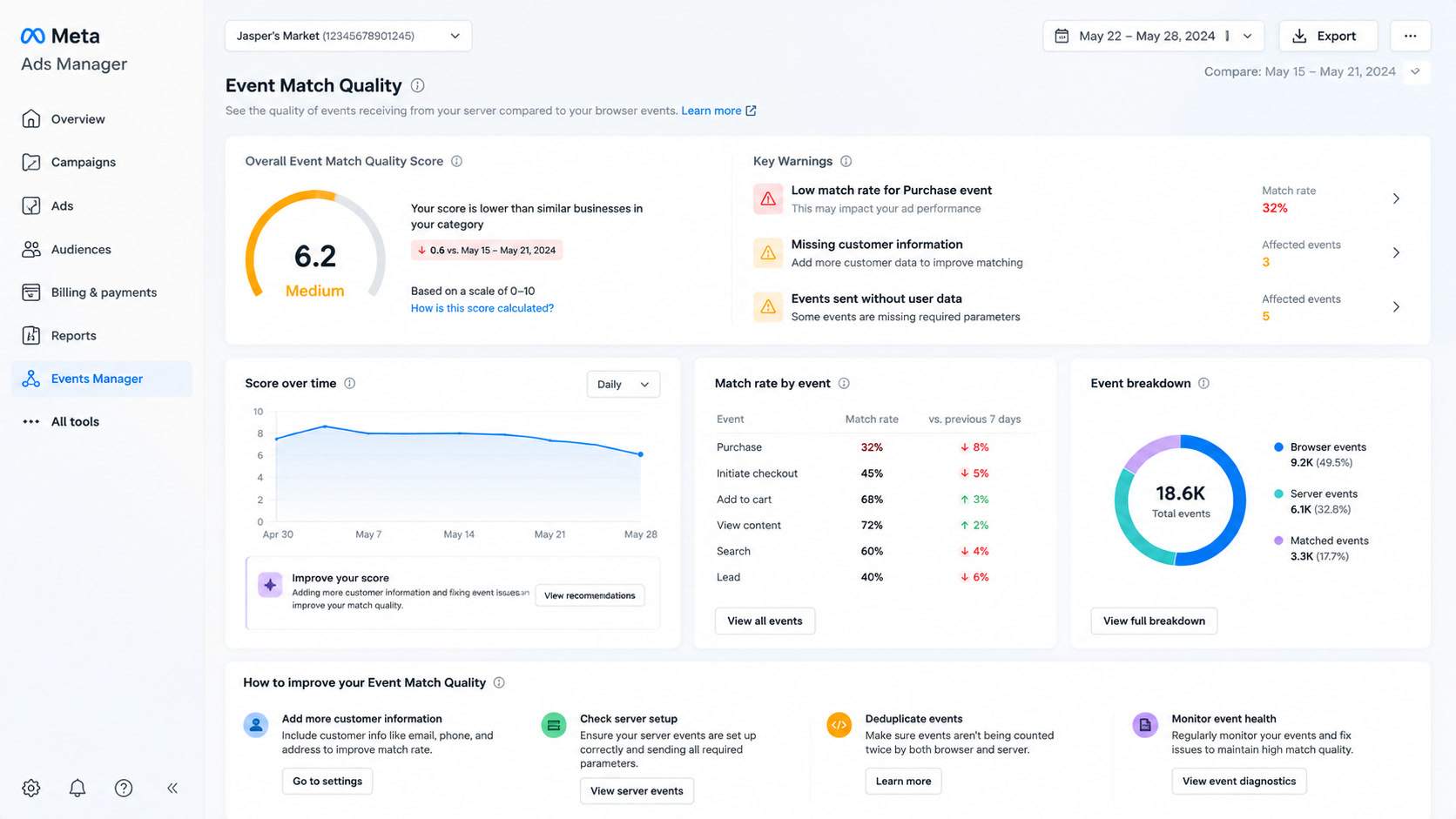
Open Meta Events Manager → select your Pixel → go to the Diagnostics tab. The Event Match Quality score is displayed per event type.
If you can't find it, click "Set up Conversions API" — Meta will show you the current EMQ as part of the setup wizard.
Step 2: Identify the gaps
In the same diagnostics view, Meta shows which parameters your events are passing and which are missing. If em (email), ph (phone), or external_id show as "not being sent" or "low volume," that's where your signal is bleeding.
Step 3: Install Conversions API
This is the highest-leverage fix. CAPI sends the same events as your Pixel, but from your server — ad blockers can't block it, browsers can't restrict it, and iOS tracking limitations don't apply.
Three integration paths, ordered by effort:
Native integration (if you're on Shopify, WooCommerce, or BigCommerce). Enable Meta's native CAPI integration in your store settings. Done in minutes. This is the path for ~80% of our clients.
Conversions API Gateway (Meta's self-serve option inside Events Manager). No dedicated developer needed. Connect your platform in hours, not weeks. Gateway handles the server-side sending for you.
Custom GTM Server-Side (for complex setups). If you need custom event enrichment or multi-platform sending, Google Tag Manager Server-Side is the most flexible option — but development time is longer.
For most mid-market advertisers, the Gateway is the sweet spot. It eliminates the main signal leak (server-side sending) without requiring a developer.
Step 4: Verify EMQ uplift
After implementing CAPI, wait 7 days and check EMQ again. The score should rise by 1.5-3.0 points. If it doesn't, check:
- Event deduplication is working (Events Manager shows "1 event from 2 sources" not double-counted)
- Your CAPI is sending the same event names as your Pixel
- Hashed identifiers are reaching Meta (check the parameters diagnostics)
The real cost of ignoring EMQ
Every day your EMQ sits below 7.0, Andromeda is learning from a biased data set. It's optimizing toward the kind of user who can be tracked — not the kind of user who actually converts.
In practice, this means:
- Your best-performing audiences are invisible to the algorithm. The people most likely to convert (often the most privacy-conscious) are the ones hardest to track. Andromeda can't learn from them.
- Campaigns that seem stable in Ads Manager may be running on fumes. We've seen accounts with 3.2x reported ROAS but 1.4x blended ROAS, entirely due to signal loss.
- Budget reallocation decisions are made on bad data. The campaign that looks like your winner might be the one whose tracking happens to work best, not the one that's actually driving the most business value.
The brands winning on Meta in 2026 treat signal quality with the same discipline as creative strategy. They check EMQ weekly. They verify deduplication. They don't trust a ROAS number until they've confirmed the data feeding it is complete.
And if your EMQ is below 6.0? That's not a tracking problem. That's a campaign performance problem you've been solving with the wrong diagnosis.
Frequently Asked Questions
What is Event Match Quality (EMQ) in Meta Ads?
Event Match Quality is Meta's score (0.0 to 10.0) measuring how reliably it can match conversion events sent back from your website to real users on Facebook or Instagram. A low EMQ means the algorithm is learning from an incomplete, biased sample of conversions — it literally cannot tell who converted.
What is a good Event Match Quality score in 2026?
Meta's official benchmark: EMQ above 7.0 is good for optimal delivery. Scores between 6.0 and 7.0 need improvement. Anything below 6.0 is critical — the algorithm is optimizing on degraded signal regardless of your creative or targeting quality. Aim for EMQ above 7.0 across your primary purchase and lead events.
Does Conversions API improve Event Match Quality?
Yes. Advertisers who implement Conversions API (CAPI) alongside the Meta Pixel typically see ~20% more attributed conversions on Purchase events than Pixel data alone. The Pixel captures browser-side signals but misses conversions lost to ad blockers, iOS restrictions, or consent settings. CAPI sends the same events from your server, capturing what the browser misses. Together they enable event deduplication and full data coverage.