Audience Targeting Is Dead on Meta: How Andromeda Changed Everything in 2026
Meta killed audience targeting as we knew it. Andromeda made creative your only targeting lever. Here's why interests, lookalikes, and demographics no longer drive performance — and how to rebuild your campaigns for 2026.
Audience Targeting Is Dead on Meta: How Andromeda Changed Everything in 2026
If you're still building Meta Ads campaigns with interest stacks, 1% lookalikes, and demographic exclusions, this is going to sting: that approach doesn't work anymore. Not "works less." The entire architecture of how Meta delivers ads has been replaced, and your detailed targeting has become the main brake on your performance.
At Mintec, we manage Meta Ads campaigns for clients across Latin America and the U.S. — ecommerce, B2B leads, demand gen, and direct sales. When Project Andromeda fully rolled out in late 2025, we saw something that took us a while to accept: accounts with the most complex targeting setups started performing worse than ones using broad targeting with strong creative.
This wasn't a minor tweak. It was a paradigm shift.
This article is what we've learned managing that transition across real accounts — what changed, why it changed, and how to restructure your campaigns so Andromeda works for you, not against you.
What Is Andromeda and Why Should You Care?
Project Andromeda is Meta's ad retrieval system, fully deployed by October 2025. This isn't just another update. It's a complete replacement of how Meta decides which ad to show to which user.
The old system worked like this: you defined an audience (women, 25-40, interested in yoga, visited your website) and Meta looked for users matching that profile. You controlled the filter.
Andromeda works in reverse. The algorithm reads your ad — visual format, copy tone, hook structure, subject matter — and predicts which users are most likely to convert based on behavioral signals. Your audience definition becomes a suggestion, not a gate.
Meta reports that Andromeda is 4x more efficient than the previous system. Creative quality now explains 56% of campaign performance — more than targeting, budget, placement, and timing combined, according to Meta's own data science team.
What No Longer Works (and Why It Hurts to Admit It)
Lookalikes: The Strategy That Ran for 8 Years and Stopped
This is the hardest change to accept. For nearly a decade, lookalike audiences were Meta Ads' scaling engine. You built a seed audience of buyers, generated a 1% LAL, and scaled.
Today, across most accounts we manage, LALs no longer move the needle the way they used to. It's not that they stopped working entirely — it's that the algorithm has access to behavioral signals that dwarf anything a seed audience can capture.
When you constrain a campaign with a 1% LAL, you're limiting a system that's already better at finding your buyers than your seed data can define. You're not adding precision. You're adding friction.
The real exception: accounts under $5K/month with limited conversion history can still benefit from a 2-3% LAL as temporary scaffolding. But plan for the transition to broad targeting as soon as the algorithm has enough signal.
Interest Stacks: The Noise You Don't Need
Interest stacks — 15-20 interests piled into a single ad set — were the go-to scaling method for years. Under Andromeda, this approach does more harm than good.
Every interest you add is a constraint the algorithm has to negotiate. Since Andromeda is already evaluating behavioral signals far richer than any declared interest, all you're doing is shrinking your delivery universe without improving quality.
In our accounts, removing interest stacks and migrating to broad targeting with good creative diversity has been the single highest-impact move of 2026.
Age and Gender Targeting: Bias You Don't Need
Unless you're in a heavily regulated category (alcohol, pharmaceuticals), segmenting by age and gender under Andromeda is counterproductive. The algorithm is already inferring these variables from behavioral signals. The limits you set only shrink its optimization space.
The New Paradigm: Your Creative Is Your Targeting
If traditional targeting is dead, what replaces it? The answer is uncomfortable because it requires a mindset and investment shift: your creative is now your targeting.
Andromeda reads from your ad: visual format, messaging tone, hook structure, product category signals, and emotional framing. It uses all of this to build an audience profile and delivers your ad to users who match that profile. If your ad looks like it's designed for a 35-year-old runner who buys wellness supplements, Andromeda will find them. You don't have to tell it to.
This radically changes how you should build your account:
| Instead of... | Do this... |
|---|---|
| Building ad sets for different audiences | Building different creative angles for different buyer motivations |
| Targeting by interests | Targeting by narratives and formats |
| Using lookalikes to scale | Using creative diversity to scale |
| Defining demographics | Letting the algorithm infer demographics from behavior |
| Analyzing results by audience | Analyzing results by creative concept |
How to Rebuild Your Account for the Post-Targeting World
Based on what we've seen work across real accounts through 2026, here's the structure we recommend:
The Campaign Hierarchy That Works
Advantage+ Shopping (ASC) — 60-70% of budget Your primary scaling engine. ASC delivers 17% lower CPA than manual campaigns per Meta's data, handling placement optimization, creative delivery, and budget allocation automatically. Requirement: at least 6 strong creatives to give the algorithm material to work with.
Broad Targeting Campaign — 20-25% of budget Single ad set, broad targeting, no lookalikes or interests. This is your creative testing sandbox. Winners (those hitting your target CPA within 7-10 days) get promoted to ASC.
Retargeting — 10-15% of budget Warm audiences only: site visitors and cart abandoners within a 30-day window. Nothing more. Aggressive retargeting fragments the signal Andromeda needs for prospecting.
The Creative Volume You Actually Need
This is where most advertisers fall short. If you used to scale on 3-4 good creatives, you now need 15-20 active ads simultaneously per account, with at least 6 new concepts tested monthly.
The data backs this up: brands testing 20+ new ads per month see 65% higher ROAS than those testing fewer than 10.
The key word is "meaningfully different." Not the same ad with different background colors or thumbnail crops. Different hooks, different formats, different narratives. Andromeda detects creative similarity, and when your Creative Similarity Score exceeds 60%, it groups ads under a single Entity ID, making them compete against each other instead of expanding reach.
Signal Quality: The Invisible Infrastructure
Here's what nobody tells you: without clean signal data, creative volume doesn't matter. Andromeda validates its predictions through conversion data. Dirty signal means the algorithm learns wrong.
The minimum checklist:
- Pixel + CAPI running simultaneously with deduplication
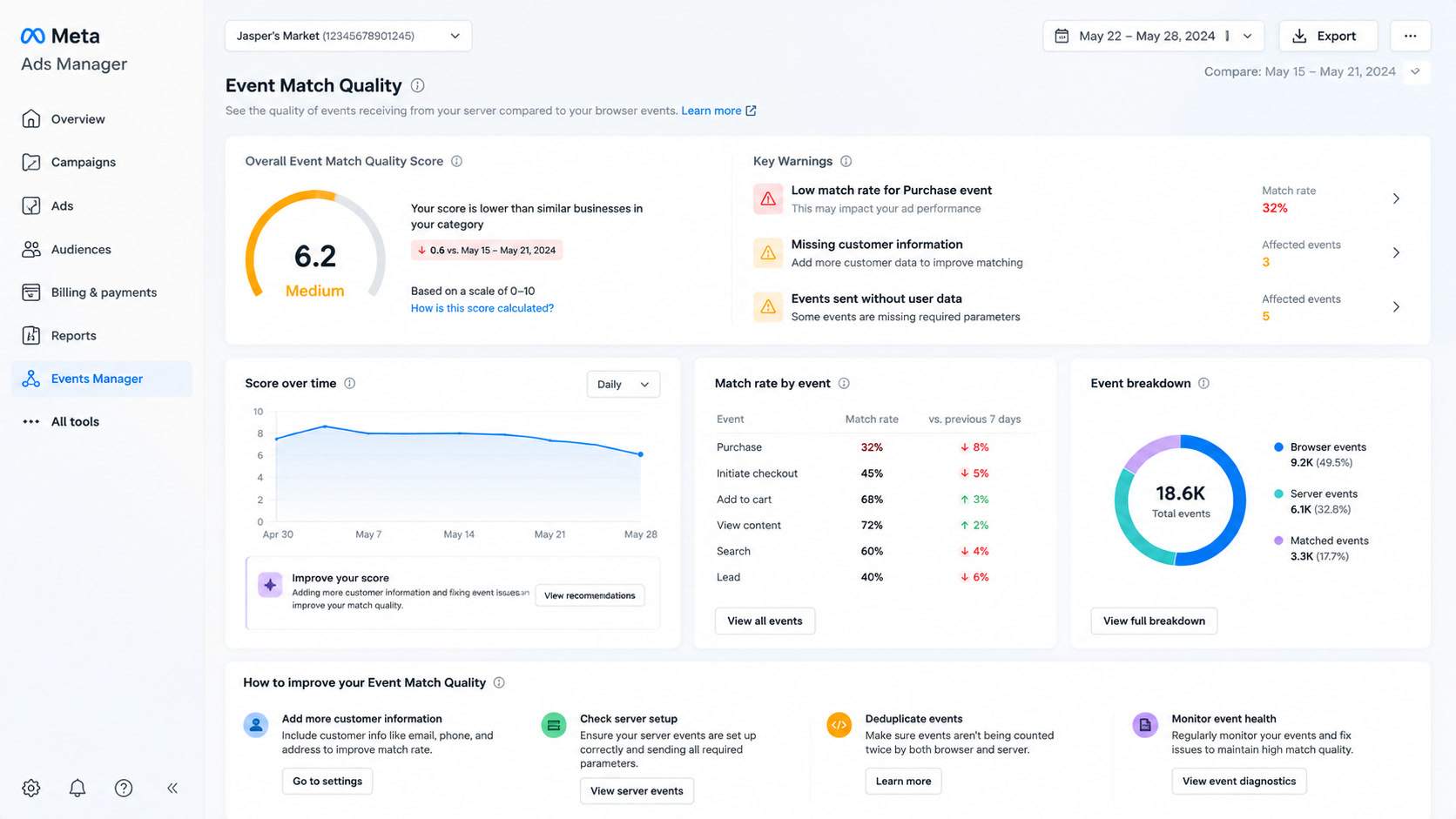
- Event Match Quality above 7 in Events Manager
- One prioritized conversion event — don't switch between Purchase and Lead per campaign
- Monthly Events Manager audit — Shopify integrations in particular can double-count events
What We're Seeing in Real Accounts
When we take over an account built for the pre-Andromeda world, the pattern is almost always the same: too many ad sets, too many campaigns, lookalikes doing work that creative should be doing, and a CAPI setup that was installed and never audited.
The transition isn't a one-day project. It takes about 4-6 weeks to run cleanly without destabilizing active delivery. Here's the sequence we follow:
- Audit signal quality (week 1) — before touching campaign structure, fix Pixel + CAPI, verify Event Match Quality
- Consolidate campaigns (week 1-2) — collapse LAL ad sets into broad targeting, combine campaigns targeting the same audience with different creatives
- Launch creative testing campaign (week 2) — separate broad campaign at 20-25% of budget, minimum 6 new concepts
- Migrate to ASC (week 3-4) — launch ASC with top 6-10 proven creatives, start at 50% of budget and scale
- Build the creative pipeline (ongoing) — the step nobody wants to take but everyone needs: a repeatable creative production process, not a one-time sprint
The Bottom Line
Audience targeting on Meta isn't evolving — it's being replaced. The accounts winning in 2026 are the ones that understood their job is no longer to define who sees the ad, but to build the ads the algorithm needs to find the right buyers.
Your targeting didn't disappear. It moved to your creative. And the sooner you accept that shift, the less money you'll lose figuring it out.
At Mintec, we help brands across LATAM and the U.S. restructure their Meta Ads accounts for the Andromeda ecosystem. If you want a review of your current account structure, we can help.
Frequently Asked Questions
What is Meta's Project Andromeda?
Project Andromeda is Meta's AI-driven ad retrieval system, fully rolled out by October 2025. It replaced the audience-based targeting model with a creative-based one: instead of routing ads using interests, demographics, and lookalikes, the algorithm reads your ad creative — visual format, hook, tone, subject matter — and predicts audience match from behavioral signals. Advertiser-defined audiences are now suggestions, not gates.
Do lookalike audiences still work on Meta in 2026?
For most accounts, no. Lookalike audiences are no longer a primary strategy under Andromeda. The algorithm's behavioral signals already exceed what a seed audience can define, so adding a LAL constraint limits delivery without improving targeting quality. The exception: accounts under $5K/month with limited conversion history may still see value in a 2-3% LAL as temporary scaffolding — but it should not be a long-term strategy.
How should I structure Meta Ads campaigns in 2026?
The winning structure in 2026 is minimal: one consolidated campaign per conversion objective, few ad sets with broad targeting, and many creatives — minimum 8-12 distinct concepts per ad set. Advantage+ Shopping (ASC) as primary (60-70% of budget), a separate broad targeting campaign for creative testing (20-25%), and minimal retargeting (10-15%). Budget fragmentation across multiple ad sets slows the algorithm's learning.