
Google Says GEO Is Still SEO. Here's Why That's Both Right and Wrong
Google's official AI optimization guide declares GEO and AEO are 'still SEO.' We break down what Google gets right, what it glosses over, and how to actually adapt your strategy for AI search.
Google Says GEO Is Still SEO. Here's Why That's Both Right and Wrong
On May 15, 2026, Google published something the industry had been asking for: an official guide to optimizing websites for its generative AI search features.
It's called Google's Guide to Optimizing for Generative AI Features on Google Search, hosted on Search Central, and within hours it was generating headlines across the SEO world. Not for what it said to do — but for what it said not to do.
The line that got everyone talking:
"From Google Search's perspective, optimizing for generative AI search is optimizing for the search experience — and that is still SEO."
Translation: AEO, GEO, llms.txt, chunking, special schema — according to Google, it's all noise. It's still SEO.
But is Google entirely right? We've been doing SEO at Mintec since 2011, and our answer is more complicated than a simple yes or no.
What the guide actually says
The guide is an official Google Search Central documentation page, most recently updated June 5, 2026. Not a blog post, not a conference sidebar — official documentation. The key points:
- AEO and GEO are not separate disciplines. They're SEO by another name.
- You don't need llms.txt. That file doesn't influence how Google cites your content in AI Overviews or AI Mode.
- You don't need to chunk content for language models to understand it better.
- You don't need special AI-only structured data. Standard schema (FAQ, HowTo, Article, Product) works.
- What does matter: clear, direct answers, well-implemented structured data, strong E-E-A-T signals, and good page experience.
The guide also debunks several myths that had been circulating in the GEO community for the past 18 months — things like "you need to write specifically for Gemini to cite you" or "you need special markup to appear in AI Overviews." Google says no to all of it.
So far, that's the official position.
Where Google is right
Google gets several things right.
Classic SEO fundamentals are still the foundation. If your site is slow, has poor information architecture, or thin content, no GEO tricks will save you. Google has been saying for years that quality content, demonstrated authority, and good user experience are what matters. The AI guide doesn't change that.
Standard schema does work for AI. In fact, it's more important than ever. AI Overviews and AI Mode rely on structured data to understand what's what on your page. FAQPage, HowTo, Article, Product, Recipe — these schemas are the language language models understand best. Google is right that you don't need to invent anything new; you need to implement what already exists properly.
E-E-A-T matters more in an AI world. When Gemini decides whether to cite your content or a competitor's in AI Mode, signals of experience, expertise, authoritativeness, and trustworthiness are decisive. Google hasn't changed the rules of the game; it's made them more visible.
Content that answers questions directly wins. AI Overviews extract fragments that answer clearly and independently. If your content circles around the point before getting there, you lose the opportunity to be cited. This isn't new — it's always been good practice — but now it has a direct visibility consequence.
Where Google's guide falls short
Here's where things get interesting. Because Google is technically right, but it glosses over several nuances that practice is bearing out.
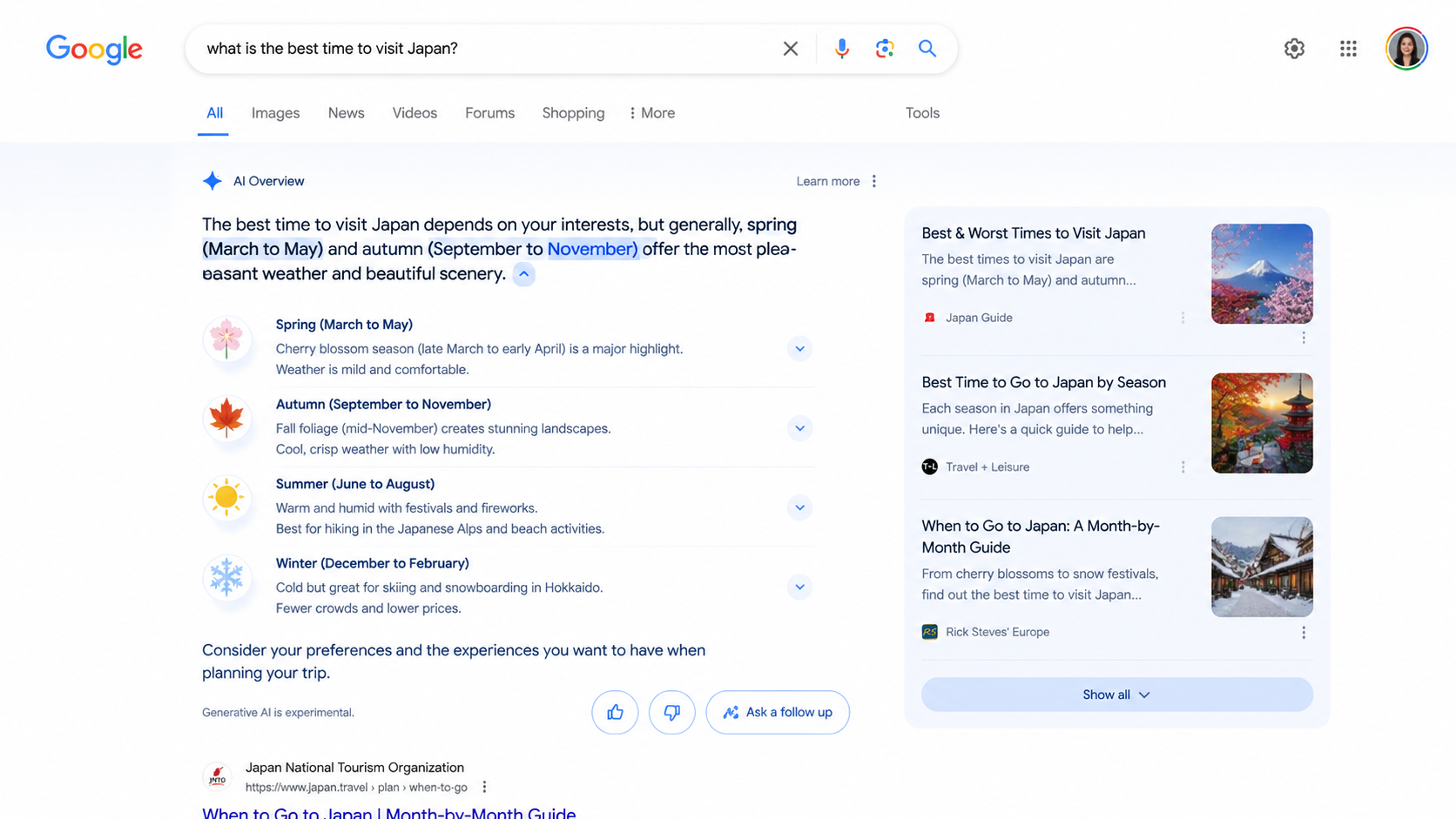
"It's still SEO" is technically true but misleading. It's like saying an electric car is still a vehicle. Technically yes, but how you use, maintain, and optimize it is radically different. Classic SEO optimized for a ranking of 10 blue links. Google AI Mode — which now has 75 million monthly active users — shows no blue links. It shows conversational answers generated by Gemini. 93% of AI Mode sessions end without a user clicking a single website. That's not "still SEO" in any practical sense. That's a paradigm shift. We covered this recently in 93% of AI Mode Searches End Without a Click — Here's What Still Gets Traffic and the numbers are hard to ignore.
The guide doesn't address entity optimization. Google mentions structured data but doesn't go into how to structure your content around entities — people, places, concepts, products — so language models understand you as an authoritative source on a specific topic. In practice, sites that organize content by entities (not keywords) are getting better citation rates in AI Overviews.
It ignores that the competition dynamic is different. In traditional SEO, you competed for positions 1-10. In GEO, you compete to be one of 3-5 sources Gemini cites in its response. The dynamic is different: the winner isn't the one with the most backlinks, but the one with the clearest, most structured, most authoritative explanation on a specific topic. That requires a different content approach.
It dismisses tactics that are actually working. The guide says llms.txt doesn't matter, and it's probably right for Google. But Perplexity, Claude Search, and ChatGPT Search do use it. Saying "you don't need anything special for AI" assumes Google is the only AI search engine that matters, and that's not true anymore.
The pragmatic take
So what do we actually do with this?
At Mintec, we think the right position is in the middle. Google is right that you don't need to reinvent the wheel. But it's wrong to suggest there's nothing new to learn.
Here's our recommendation for brands that want visibility in AI-powered search:
Fix the basics first. If your technical SEO isn't solid, nothing you do for GEO will work. Speed, architecture, structured data, quality content. That hasn't changed.
Implement schema like your traffic depends on it. Because now it does. FAQPage, HowTo, Article, Product — properly implemented with all required and recommended fields. It's the highest-ROI investment for AI visibility.
Structure your content by entities, not keywords. Define which topics you want to be an authority on and organize your content around them. Every page should answer one specific question completely and independently. This is closely related to how AI content detection works — models reward clarity and specificity.
Optimize for citation, not ranking. In AI Mode, the goal isn't position 1. It's being cited as a source in a response. That means direct answers, structured data, citations to authoritative sources, and content that works independently from the rest of the article.
Don't abandon GEO tactics that work on other engines. llms.txt for Perplexity, optimization for ChatGPT Search, Knowledge Graph presence — these are valid complements as long as they don't cannibalize your main effort.
What this means for your strategy
Google's AI optimization guide isn't a death sentence for GEO. It's a call to sanity. If someone is selling you "AI optimization" as a completely new discipline separate from SEO, they're probably selling smoke. You don't need to panic about AI Mode taking over search overnight — but you can't pretend nothing changed either.
But if someone tells you there's nothing new to learn and everything stays the same — they're selling something too.
The uncomfortable truth is that SEO is still SEO, but the playing field has changed. The fundamentals are the same; the execution tactics aren't. And the brands that understand that difference will be the ones still getting organic traffic in 2027.
At Mintec, we've been helping businesses navigate search since 2011. If you want to know where you stand with AI-powered search visibility, reach out.
Frequently Asked Questions
What does Google's AI optimization guide actually say about GEO?
Google states that 'from Google Search's perspective, optimizing for generative AI search is optimizing for the search experience — and that is still SEO.' The official Search Central guide, published May 2026 and updated June 5, explicitly says AEO and GEO are not separate disciplines, and debunks tactics like llms.txt or special AI-only schema.
Is GEO dead if Google says it's just SEO?
Not at all — but it's not a magic discipline either. Google is right that the fundamentals (E-E-A-T, structured data, quality content) haven't changed. But the guide glosses over how AI Mode's zero-click interface (93% of sessions end without a click) changes the practical optimization game. Entity-based content structure and citation optimization matter in ways traditional SEO doesn't address.
Which GEO tactics does Google say don't work?
The guide specifically advises against creating llms.txt files for AI visibility, chunking content specifically for language models, or using special structured data that only works for AI. Google says standard schema (FAQ, HowTo, Article, Product) is sufficient when properly implemented. However, some of these tactics work for non-Google AI engines like Perplexity and ChatGPT.