
AI engines won't cite your new site. How to break the cold-start loop
AI search engines cite the same established sources over and over. New sites get ignored: no citations, no traffic, no mentions. The 4-stage framework we use at Mintec to break the loop, with real measurement guidance.
AI engines won't cite your new site. How to break the cold-start loop
AI search engines keep citing the same sources, and that's not a bug, it's how the system works. If your product is new, the AI treats you with caution. No citations, no traffic. No traffic, no mentions. No mentions, no citations. The way out isn't paying for more traffic: it's targeting the right comparative query, building your entity before your content, and publishing data nobody else has. That's the 4-stage framework we use in Mintec's GEO audits, and here's how to apply it.
The loop, described by someone living it
This week a thread on r/SEO nailed the problem better than any article: “How to break the AI search / GEO loop for your new product?”. The author is launching a new enterprise product on a bootstrap budget, and describes the trap like this: GEO tools and AI are biased toward established things; because the AI won't recommend the product, there's no traffic; because there's no traffic, there's no buzz; because there's no buzz, the AI keeps ignoring it.
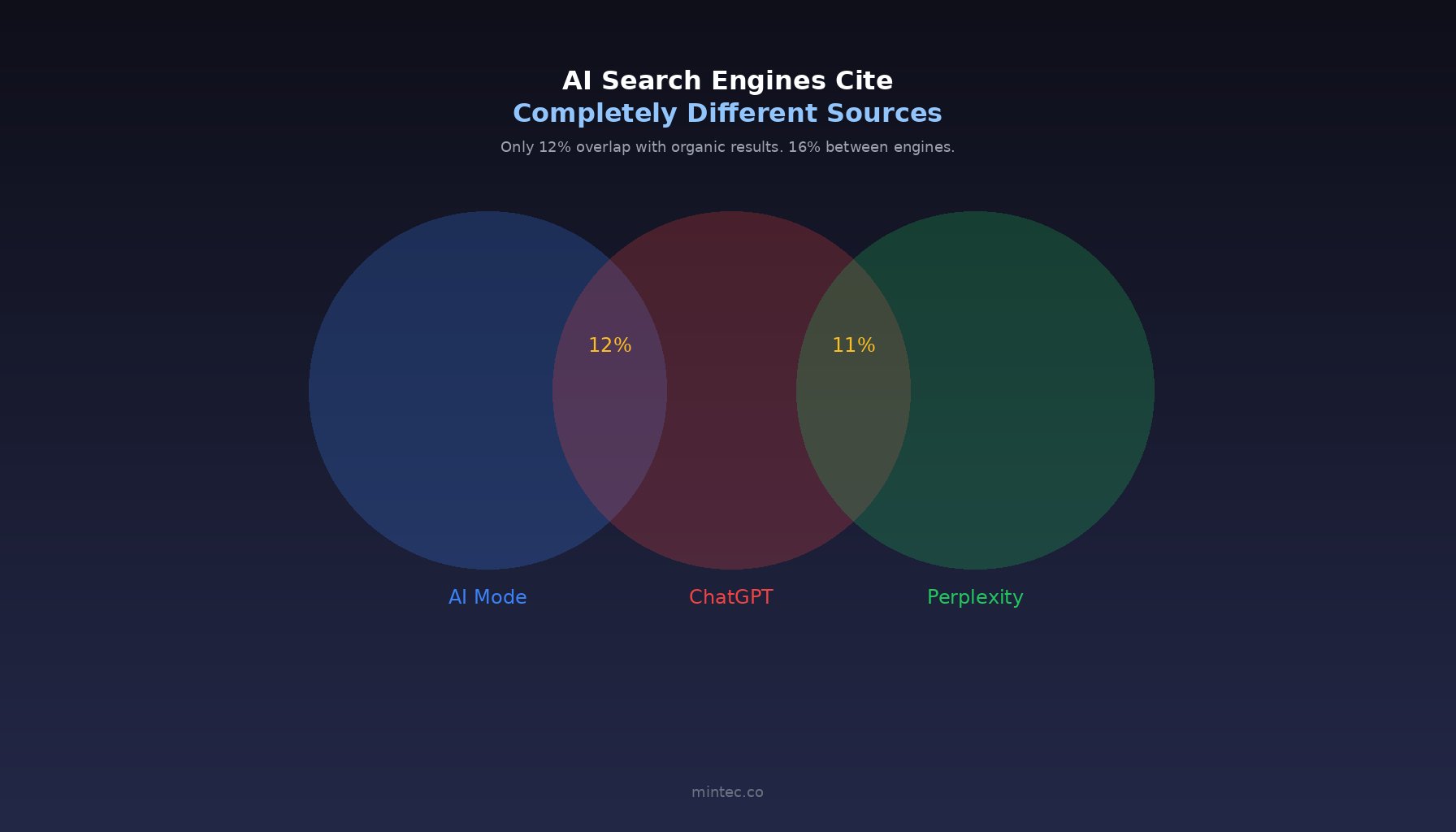
It's real. The AI Citation Source Index 2026 synthesized 680+ million citations across ChatGPT, Claude, Gemini, Perplexity, and Google AI Overviews, and found that a handful of domains absorb the overwhelming majority of citations: Reddit, Wikipedia, YouTube, LinkedIn, and Forbes. Rand Fishkin's March 2026 study, “Influence Happens Everywhere”, reached the same place from the other direction: influence is built across hundreds of surfaces, and only a fraction of it is your own site.
Don't reach for the easy conclusion though. People read those numbers as “big sites always win.” What they actually say is different: your citations aren't decided by your site, they're decided by the surfaces the model already reads. And that you can attack without being big.
Why your share of voice is lying to you
Most GEO advice assumes your brand already has some authority: optimize the content, get cited in the right format, track it with the tool of choice. For a new site, that advice doesn't apply. Your monitoring tool will show 0% share of voice for months, and that's where people make the classic mistake: they read it as the strategy failing, when the metric was never designed for their stage.
Let me be blunt. Selling GEO to a product with no mentions, no reviews, and no resolved entity, with a share-of-voice promise attached, is selling a metric that will read zero for a year. What you should track at that stage is different: how many third-party surfaces mention you, which prompts you appear in, and which comparative queries you can win. The most upvoted comment in that r/SEO thread, from someone who did GEO in fintech, says it well: for software categories, what gets cited isn't the vendor's site, it's review platforms, best-of listicles, community threads, and structured directories. Traffic is a lagging indicator, not the raw material.
The citation entry ramp, in 4 stages
When a new site lands in our audit, we don't start with content. We start with this sequence:
Stage 1: pick the query where the incumbent is generic and you can be specific. Nobody searches your brand yet. People search category plus constraint: “X alternative for Y,” “X for small teams,” “how does X compare to Z.” Incumbents wrote those pages generically because they wrote them for keyword rankings. A new product can win the citation by being more specific and more useful than them on a single query. That first citation is your lever: don't chase the brand query, chase the comparison the big player didn't bother to win.
Stage 2: build the entity before the content. A model has to resolve what your company is before it can recommend it. Organization schema, sameAs pointing to every profile you own, consistent naming everywhere, Wikidata if you qualify. Plenty of new products are stuck at this step without realizing it: the content is good, but the model can't confirm the company exists because the entity signals are scattered or missing. It's the least glamorous part, and the one that unlocks the most cases.
Stage 3: publish data nobody else has. Own benchmarks, transparent pricing, survey results from your design partners. It's the highest citation-rate tactic we've seen, because it gives the model concrete numbers it can't source anywhere else. You don't need a giant sample: you need one number that's yours and that the query asks for. A real cost comparison measured by your team is worth more for citations than ten opinion pieces.
Stage 4: show up on the surfaces the model already reads. G2, Capterra, Software Advice, AlternativeTo, Product Hunt, Crunchbase, plus any directory specific to your industry. For software, those platforms are often the direct source behind AI answers. Then the fine work: reach out to the authors of listicles that are already cited, offer free access and an expert quote. Attaching to an asset that already has citations is faster than building yours from zero.
| Stage | Concrete action | Signal it's working |
|---|---|---|
| 1 | Win the most specific comparative query | First appearance in a prompt that isn't your brand |
| 2 | Organization schema + sameAs + Wikidata | The model describes your company without errors |
| 3 | Publish an owned benchmark or pricing | Another site cites you as the source of the data |
| 4 | Get listed and mentioned on third-party surfaces | Mentions growing without you paying for them |
What to measure while share of voice reads zero
In our GEO traffic report we publish the real numbers from months of optimization: small sessions, dozens per week, converting several times better than organic. For a new product that scale is reality, and you have to size it correctly. AI citations for enterprise software are still a long-term positioning play, not a pipeline driver for this quarter. If you need pipeline now, the honest answer is to sell first and let GEO follow: land your first customers, ask for reviews and permission to publish case studies, and the loop breaks when real people start talking about you in citable places.
Meanwhile, measure what matters: third-party surface mentions (not share of voice), citation presence on the 10 prompts you want to win, and the Search Console AI report once Google enables it for you. Our 30-minute audit framework starts exactly there: first check whether the problem is content, entity, or distribution, because the fix changes with the diagnosis. Once the first citation shows up, getting cited by ChatGPT stops being about breaking the loop and becomes about repeating what worked on the adjacent query.
Checklist for this week
- List the 10 comparative queries in your category and mark the most generic incumbent page for each. That's your first possible citation.
- Audit your entity: Organization schema, sameAs, naming, Wikidata. If the model can't resolve who you are, nothing else matters.
- Pick one data point that's yours (benchmark, pricing, survey) and publish it with clean structure, even as a PDF with tables.
- Check which surfaces already list you and which are missing. For software, structured directories are the direct source behind many AI answers.
No, you don't need to pay more. You need to understand that citations aren't requested, they're built from the surfaces the model already reads, in the right order. The cold-start loop breaks with sales first, distribution second, and measurement of what actually matters.
Frequently Asked Questions
Why won't AI search engines cite my new website?
AI models are conservative by design: they prefer sources that other sources already cite and that have established entity signals. A new site gets no traffic, no traffic means no mentions, and no mentions means the model keeps ignoring it. It's not a punishment, it's how probabilistic retrieval works.
How long does it take for a new site to get cited by ChatGPT or AI Overviews?
If you go after the right comparative queries and build your entity in parallel, the first citation can arrive in weeks. Volume takes months: the first citation is an event, consistent citations are a system. The most common mistake is tracking share of voice in month one, when it will read zero even if the strategy is working.
Is paying for traffic the only way out of the loop?
No. Paid traffic accelerates visits, but traffic is not the raw material of citations: third-party mentions on surfaces the model already reads, a resolved entity, and data nobody else has are. The sequence we see working is: sell first, distribute second, and measure citations instead of share of voice.