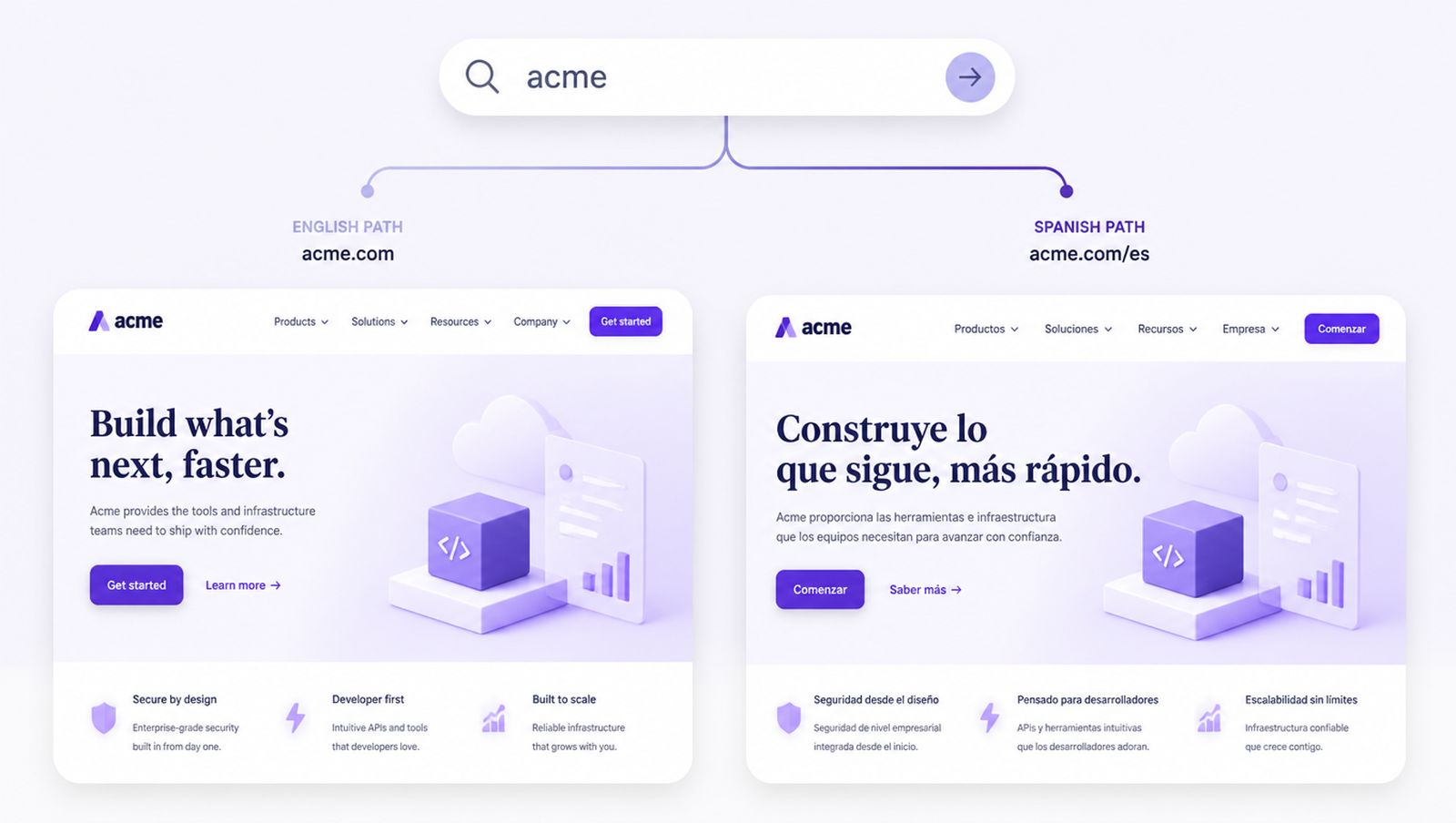


Two Spanish URL families, one canonical each, both in the sitemap
Two Spanish URL families, each self-canonical and both in the sitemap, give Google two candidates for one intent. How to pick the survivor.
A site can ship a complete second Spanish layer — every page returning 200, every page self-canonical, every page in the sitemap — and still be worse off than before it translated anything. That happens when two naming schemes for the same locale coexist: a translated path and an untranslated one. Google does not raise a duplicate-content alarm. It sees two candidates for one intent, and nobody has told it which one wins.
That is not a bug report. It is an unmade decision, and it gets more expensive every month it stays unmade, because new pages inherit whichever template ships them.
What the shape looks like
The pattern is consistent across bilingual sites, and the reason is boring. Spanish launches under a locale prefix with the English slugs still in place, because that is what most CMS routing does by default:
https://example.com/es/products/green-dress
A year later someone decides Spanish URLs should read in Spanish, so a translation layer produces:
https://example.com/es/productos/vestido-verde
The old paths are not removed. Usually because a sales deck links to them, or because the team does not want to "lose the links," or because nobody owns the redirect map. Both resolve. Both serve the same body. Both declare themselves canonical. Both are submitted.
Verifying it takes minutes. Request both URLs, read the <link rel="canonical"> in each rendered head, then search your sitemap for both strings. If a URL appears as its own canonical and in the sitemap, it is a live candidate. Do that for ten pages across the layer and you will know whether you have one problem or a hundred.
The three excuses, and what each one actually says
"Google says translated pages aren't duplicates." This cites a real line from Google's documentation on localized versions of a page: localized versions are only considered duplicates if the main content stays untranslated. True, and not about your problem. That sentence compares a page against its translation — English against Spanish. It says nothing about two Spanish pages that say the same thing in the same language. Those are duplicates of each other in the ordinary sense, and the exemption does not reach them. Quoting it to justify both families is a misread that has survived because it is convenient.
"Both have a self-canonical, so we're fine." A self-referential canonical is the right default on a page that has no twin, and Google's canonicalization guidance recommends one on the canonical page for exactly that reason. When two pages both claim themselves, you have not stated a preference. You have made two statements, each true, which is the definition of the problem. The same document warns against specifying different canonical URLs for the same page through different techniques — two self-canonical twins is that warning, not a fix for it.
"It's in the sitemap, so Google will choose." Sitemap inclusion is the weakest of the three signals Google names, ranked below redirects and below rel="canonical", and described as a suggestion. Listing both families does not ask Google to arbitrate. It recommends both and funds the crawl for both.
Four tests, ranked by what it costs to change the answer
Most teams run these tests and then let the cheapest one decide. The order below is deliberate: rank by reversal cost, not by how easy the number is to pull.
| Test | What you measure | Cost to change the answer | Should it pick the winner? |
|---|---|---|---|
| External links | Referring domains per family, from a backlink tool or server logs | Months to years | Yes — highest weight |
| Clicks | Search Console, grouped by page, three-month window | Weeks to months | Yes — second weight |
| Internal links | Count of in-site links from nav, footer, hubs and posts to each family | An afternoon | No |
| Title and description uniqueness | Per-page metadata versus boilerplate repeated across the family | An afternoon | No — tiebreaker only |
The rule that falls out of that table: the survivor is the family holding the two signals you cannot rewrite. External links and clicks are other people's decisions. Internal links and metadata are yours, which is exactly why they should decide the migration work and never the winner.
The tie that comes up most often is one family holding the internal links while the other holds the clicks. Follow the clicks. Your internal links are an opinion you can change before lunch; clicks are evidence. Google's instruction to link internally to the canonical URL is about making your preference legible to the crawler, not about that preference outranking what searchers already do.
There is a third case, and it is the one teams avoid saying out loud: neither family earns links or clicks. Then you are not choosing between two assets, you are choosing between two liabilities, and the only sane criterion is which URL shape you want to keep writing for the next two years. Say that in the kickoff, because it is the only input that changes anything.
The migration order
Merges fail on sequencing more than on direction. Do it in this order and ship steps three through six as a single deployment.
- Freeze both families. New pages go to the survivor only. A merge running while content is being added is a merge against a moving target, and the moving target always wins.
- Build a strict one-to-one map. Every losing URL gets exactly one surviving URL. Any loser with no twin is not a redirect, it is a page you are deleting — decide between a 410 and a replacement now, in a spreadsheet, not in production. The 301-versus-410 distinction is worth getting right once: the four tests that decide it cover the cases where a 410 is the honest answer.
- Ship all the redirects in one deploy. A staged migration consolidates in stages, and a partial merge produces a number you cannot interpret.
- Remove the losing family from the sitemap in the same deploy. Sitemap inclusion is a canonical hint, so leaving the family listed keeps Googlebot fetching URLs you just declared dead and keeps arguing for them.
- Repair the hreflang cluster in the same deploy. The Spanish survivor's
hreflang="en"must point at the English page's canonical URL, and the English page'shreflang="es"must point back at the Spanish survivor. Google's guidance is to specify the canonical page in that language — and if the target has to be the canonical page, a target that redirects is not it. - Repoint internal links. Navigation, footer, hub pages, in-post links, buttons, and any hardcoded CTA. This is the only signal you can make unanimous in a day, so make it unanimous.
- Verify before you report anything. A sample of ten losing URLs should return a 301 with a single hop to the survivor — not two hops. Confirm the sitemap no longer lists them. Then leave it alone for a full crawl cycle.
Four ways it goes wrong anyway
Redirect chains. Loser to intermediate to survivor. Every hop is a chance for the signal to leak and a chance for a crawler to stop. Check Location on the first response, not just the final status.
Picking the prettier slug. This is the expensive version of the mistake: redirecting the family that earned the links into the family with the nicer URLs, because the nicer URLs feel like the ones that should win. Read the table again. The nicer URL is worth nothing if it is the one with no links.
Using a canonical tag where a redirect belongs. A canonical is a hint. The duplicate stays crawlable, stays indexable, and can still be served. If the goal is for one family to stop existing, redirect it. Keep the canonical-tag approach for the cases where both URLs genuinely must resolve.
Keeping the loser alive "for the campaign." A 301 preserves the campaign. The landing URL in a two-year-old ad still works and now hands the visitor to the survivor. Keeping a live duplicate so an old link does not break is paying a permanent structural cost to protect a temporary asset.
What you can and cannot claim afterwards
Consolidation is not visible in a week. Google has to recrawl, follow, and re-consolidate before any number moves, so a seven-day read is noise. Compare three-month windows.
Be equally precise about the ceiling. If the two families were never instrumented separately, you will be able to show that one family stopped earning impressions, and you will not be able to show what the merge did to revenue. That is a limit of the measurement, not a failure of the work — and stating which of the two you are reporting is the difference between a finding and a claim.
A bilingual site's expensive decision is not translation. It is the URL contract: one shape per language, one canonical per page, one family per intent. Once that contract exists, adding a third language is a template setting. Without it, every language you add doubles the mistake — and the brand-query split between two homepages is what the same failure looks like one level up, where it costs you your own name.
If you are looking at two families and cannot tell which one Google is actually serving, that is the audit. Our SEO and GEO team runs exactly that comparison — crawl, Search Console grouping, and the redirect map — and it closes a decision most sites have been deferring for a year. Start the conversation here.
Frequently Asked Questions
Does hreflang fix a duplicate Spanish URL family?
No. hreflang tells Google which page to serve to a Spanish-speaking searcher; it does not pick a canonical. Google treats hreflang and canonicalization as separate mechanisms, and it lists hreflang clusters only as a preference signal when choosing a canonical. If two Spanish pages both sit in the same cluster, you have documented the duplicate, not resolved it.
Should I merge duplicate URL families with a 301 or a canonical tag?
A 301 if you want the losing family gone. Google ranks redirects as a stronger canonicalization signal than rel=canonical, and rel=canonical as stronger than sitemap inclusion. A canonical tag leaves the loser crawlable and eligible to be shown; a redirect removes it. Use canonical only when both URLs must stay reachable, such as tracked campaign URLs or printable versions.
How long does it take for a merged URL family to settle in Search Console?
Longer than a reporting week. Google has to recrawl the loser URLs, follow the redirect, and consolidate signals before anything changes. Read the result after a full crawl cycle, not after seven days, and compare three-month windows rather than week over week. Judging a migration in the first fortnight produces noise, not signal.