The Lead Nurture Automation Stack: Why 88% of B2B Teams Still Use Static Drips (and How to Move Up the 4-Level Maturity Curve)
88% of B2B companies still send the same nurture emails to every lead. AI-driven nurture delivers 45% higher engagement and 30% faster pipeline velocity. Here's the 4-level maturity framework and the modular stack to build it — from basic drip campaigns to autonomous multi-channel nurture with AI agents.
The Lead Nurture Automation Stack: Why 88% of B2B Teams Still Use Static Drips (and How to Move Up the 4-Level Maturity Curve)
88% of B2B organizations still operate at level 1 or 2 of nurture maturity: static email sequences that treat every lead identically. According to Demand Gen Report's 2025 Benchmark Survey, only 12% have implemented true account-level personalization in their nurture programs. The cost of that gap is substantial: Forrester's 2026 B2B Marketing Automation report found that companies using AI-driven lead nurture see 45% higher engagement rates and 30% faster pipeline velocity than teams still running traditional drip sequences.
At Mintec, we've implemented nurture stacks for clients across consulting, education technology, and professional services in Latin America. What we've consistently seen is that most teams fall into one of two traps: either they over-invest in tools before defining their segments, or they under-invest in data quality and wonder why their sequences don't convert.
This article breaks down the 4-level nurture maturity framework we use to diagnose where a team is, what the next step looks like, and which stack makes sense for each level — with a specific focus on what works for B2B companies operating in Latin American markets.
Why Static Drip Campaigns Are Failing B2B Teams
The classic drip campaign was a product of its time: capture a lead through a form, add them to a pre-built 5-email sequence, and send one message every few days until they convert or unsubscribe. For a decade, this was standard practice.
That era is over. Gartner's 2025 B2B Buying Journey report found that 77% of B2B buyers describe their most recent purchase as "very complex or difficult", with the average buying group including 11 stakeholders across 6 to 10 decision-making stages. Sending the same three emails to everyone in your database doesn't address this complexity — it amplifies it.
The data confirms the shift. HubSpot's 2025 State of Marketing report documents that B2B email engagement rates have declined 18% over three years, while unsubscribe rates on nurture sequences have increased 22%. Buyers aren't rejecting nurture itself — they're rejecting irrelevant, impersonal, poorly-timed outreach.
Forrester's research puts the opportunity in sharp relief: companies with mature nurture programs generate 50% more sales-ready leads at 33% lower cost per lead than those without systematic nurturing. The gap isn't about whether nurture works — it's about why so few teams do it well.
The 4-Level Nurture Automation Maturity Framework
Based on our client implementations combined with industry data from Forrester, TofuHQ, and LeadsuiteNow, we've identified 4 distinct maturity levels. Most teams start at Level 1. Competitive advantage begins at Level 3.
| Level | Approach | Typical Tools | Results |
|---|---|---|---|
| 1. Static Drip | Fixed sequence, same content for everyone | Mailchimp, basic CRM email | 15-20% open rate, <1% conversion |
| 2. Segment-Based | Groups by industry/role/size, differentiated tracks | ActiveCampaign, HubSpot Pro | 25-30% open rate, 3-6% CTR |
| 3. AI-Optimized Nurture | Dynamic segmentation, send-time optimization, predictive content | Make + n8n + Clientify + AI APIs | 35-40% open rate, 45% higher engagement |
| 4. Autonomous Multi-Channel | Email + WhatsApp + LinkedIn + AI agents in full orchestration | Self-hosted n8n + AI APIs + multi-channel CRM | 50%+ more qualified leads, 30% faster pipeline velocity |
Level 1: Static Drip (Where Most Teams Are Stuck)
A fixed email sequence fires when a lead fills a form. Everyone gets the same messages in the same order at the same interval. Personalization is limited to {{first_name}} in a template.
When it works: When you're proving that email marketing generates results before investing in more complex automation. At this level, a LinkedIn article from someone seeing 0.7% engagement is still being impressed by 15-20% email open rates.
The problem: Open rates decline with every send. Leads who aren't ready to buy unsubscribe. And critically — you learn nothing about what works because there's no segmentation or feedback loop.
Level 2: Segment-Based Nurture (The Most Accessible Upgrade)
Leads are organized into segments based on static attributes: industry, company size, job function. Each segment receives a different content track. Behavioral triggers (email opens, page visits, content downloads) move leads between segments or adjust cadence. Lead scoring determines when a lead is sales-ready.
What we've seen in client implementations: This is where most LatAm B2B teams should be operating, but many haven't even reached it. Implementing basic segmentation in Clientify or ActiveCampaign with Make as the orchestrator doubles engagement rates within the first 4 weeks.
LeadsuiteNow's 2026 benchmarks show that segmented nurture generates 4-6x better engagement than unsegmented sends. The difference isn't the tool — it's defining the segments before building the sequences.
Level 3: AI-Optimized Nurture (Where the Competitive Edge Lives)
At this level, AI optimizes execution: predictive send-time optimization, AI-recommended content based on past behavior, automated A/B testing, and smart cadence that accelerates or pauses based on lead signals.
Forrester's data is unambiguous: teams using AI-driven nurture see 45% higher engagement and 30% faster pipeline velocity than those on traditional sequences. We've seen this play out with clients who integrate OpenAI or Claude APIs with their Make or n8n workflows to personalize email body content based on each lead's engagement history.
The challenge in Latin America is that most all-in-one AI platforms are priced in dollars and lack native integrations with local tools like Clientify or Mercado Pago. That's why we recommend a modular stack: Clientify as CRM, Make as visual orchestrator, and AI APIs for the personalization layer.
Level 4: Autonomous Multi-Channel Nurture (The Frontier)
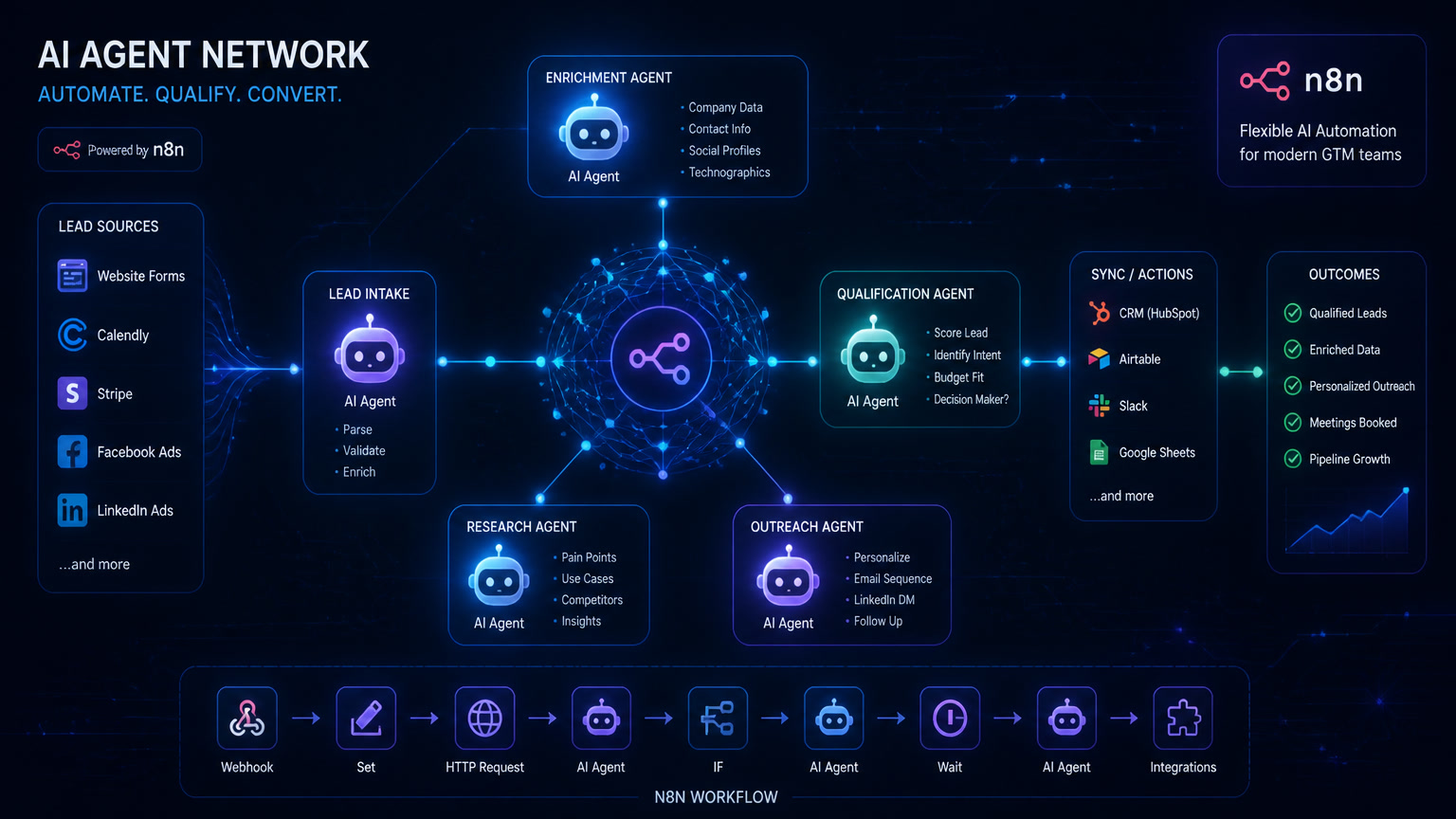
Multiple AI agents operating across email, WhatsApp, LinkedIn, SMS, and retargeting simultaneously. Orchestration decides which channel to use at each moment based on conversion probability. The CRM updates automatically with every interaction — governed by a middleware layer that prevents the data corruption we documented in our multi-agent CRM article.
This level requires a solid architecture: clean data, orchestration with n8n or Make, and a CRM that functions as the system of record. Without a governance layer, having multiple agents writing to the same CRM produces chaos — duplicate records, hallucinated notes, and inconsistent pipeline stages.
Why the Modular Stack Wins for LatAm B2B Teams
We've tested all-in-one platforms and modular stacks with clients across Mexico, Colombia, Honduras, and Peru. Our conclusion is consistent: for Latin American B2B companies, the modular approach wins for three reasons.
First, dollar cost. A platform like HubSpot Enterprise runs $1,200+/month. With that budget you can run Clientify ($29-79/month), Make ($9-29/month), AI API credits ($20-50/month in consumption), and a transactional email service — and still have room for someone to manage the stack.
Second, local integration. Clientify has native connectors for electronic invoicing, Mercado Pago, and local payment methods that global platforms ignore. Combined with Make, you can build flows that a monolithic platform wouldn't support without custom development.
Third, data sovereignty. With self-hosted n8n, your lead data never leaves your infrastructure. In regulated industries (healthcare, finance, education) this isn't optional — it's a requirement. As we covered in our self-hosted automation article, data control is becoming increasingly important across the region.
The #1 Mistake We See in Nurture Implementations
If there's one lesson from the stacks we've deployed, it's this: segmentation without data quality is noise. We've seen companies build sophisticated segments on a CRM with 40% outdated records. The result: emails bouncing to dead addresses, content targeting a role the lead no longer holds, and offers for a company that's no longer relevant.
CRM data quality automation isn't an optional step — it's the prerequisite for any nurture strategy to work. Without clean data, AI can't segment, can't personalize, and can't optimize. You're burning budget sending emails nobody wants to receive.
We cover the foundation of behavioral triggers in depth in our recent article on B2B email automation. The behavioral trigger layer integrates directly with a nurture maturity framework — once your segments are defined and your data is clean, triggers turn static sequences into responsive conversations.
The Recommended Starter Stack
If you're at Level 1 or 2 and want to reach Level 3, here's the minimum viable stack:
- CRM: Clientify or HubSpot Starter (lead management and segmentation)
- Orchestrator: Make ($9/month to start, visual, no-code)
- Sequences: ActiveCampaign ($29-149/month) or Clientify's native automation for low volume
- Enrichment: Make + enrichment APIs to keep data fresh
- AI (optional): OpenAI or Claude API for content personalization
The tools matter less than the architecture: clean data → behavioral segmentation → relevant content → measurement → iteration. That cycle is what separates nurture that generates pipeline from nurture that generates unsubscribes.
The Bottom Line
88% of B2B teams are still running static drips. The technology to reach Level 3 or 4 exists, it's affordable, and it delivers measurable ROI in weeks, not months. The real obstacle isn't technical — it's organizational: defining your segments, cleaning your data, and committing to a nurture strategy that puts lead behavior at the center instead of the calendar.
We implement these stacks for B2B clients across Latin America. If your team is still sending the same email to every lead, the jump to Level 3 is shorter than it looks — and the data says it's worth making.
Frequently Asked Questions
What's the difference between a static drip campaign and AI-driven lead nurture?
A static drip sends the same emails to every lead on a fixed calendar schedule. AI-driven nurture segments leads by behavior, industry, and buying stage; optimizes send timing and content dynamically; and accelerates or pauses cadence based on engagement signals. Companies using AI nurture see 45% higher engagement rates.
What tools do I need to start automated lead nurture?
Three layers: a CRM with clean data (Clientify, HubSpot), an automation platform to run sequences (Make, n8n, ActiveCampaign), and a segmentation system that categorizes leads by stage, persona, and behavior. Data quality is the non-negotiable prerequisite — without it, no tool stack will deliver results.
How long until automated nurture sequences show results?
Engagement improvements appear within 2-4 weeks. Pipeline impact — more qualified leads, faster velocity — is consistently measurable by month 2 or 3, once sequences have run their full cycle. Segmented nurture programs generate 4-6x better engagement than unsegmented sends.