One Gemini answer does not prove your local business is visible
A favorable Gemini answer can change when the query is repeated. Mintec's local audit checks sources, business facts, and next actions without promising citations.
One Gemini answer does not prove your local business is visible
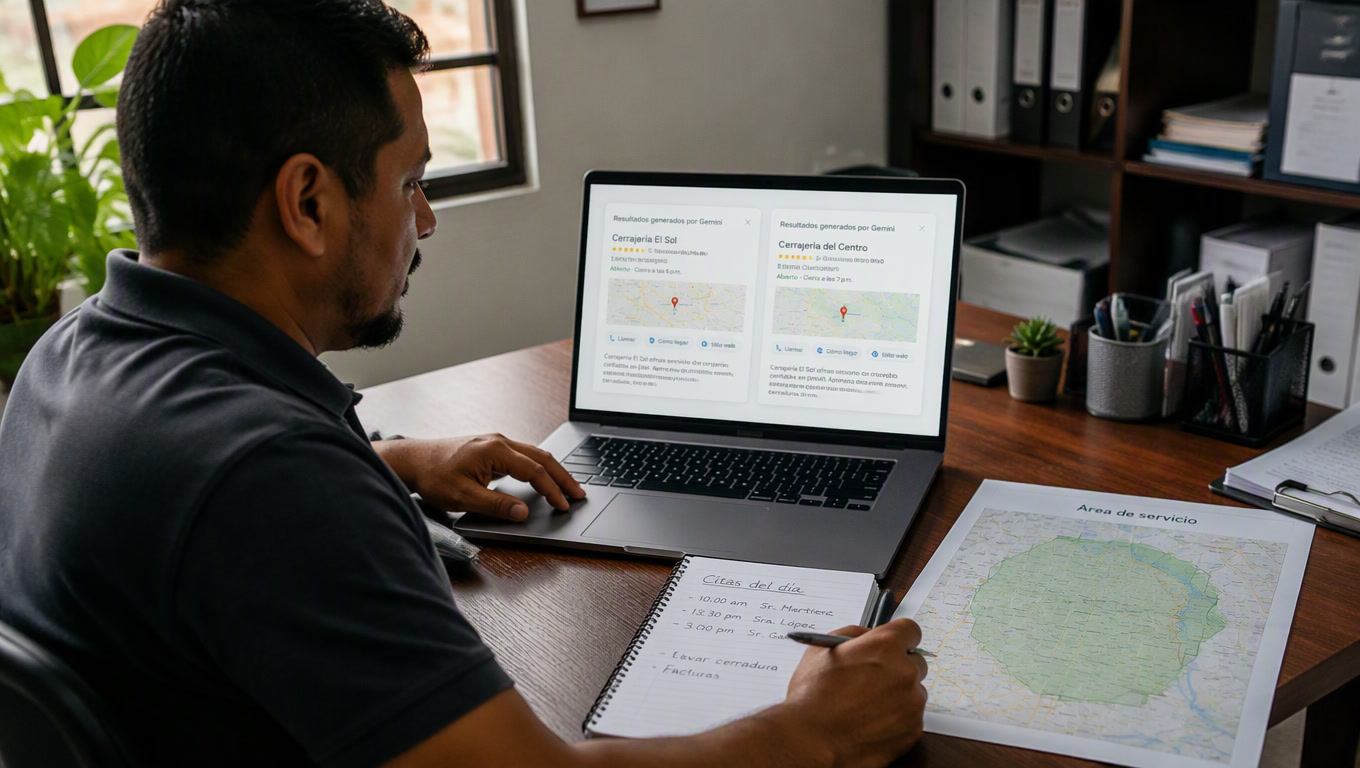
Seeing your business cited once in Gemini does not mean you have won local AI search. It proves something narrower: for that query, in that location and at that moment, Gemini found a source it could use. Repeat the question and the answer can change. A useful local audit does not chase a flattering screenshot. It checks whether the business appears, whether the facts are right, and what sources support the answer.
That distinction matters. A clinic might show up for "emergency dentist in Monterrey" and vanish for "dentist open Saturday near San Pedro." A restaurant can be recommended with opening hours that changed months ago. The first answer looks good. The operational problem is still there, waiting to cost a booking, a phone call, or a visit.
On August 19, Search Engine Land reported on a study of 14,472 AI citations in Gemini local results. Business websites led the sample, but the sources varied heavily when the same search was repeated. That is not a promise for your website. It is a good reason to stop treating one answer as a fixed ranking.
The audit we recommend uses two passes, five buying questions, and four verifiable business facts. A single-location business can complete it in about 45 minutes. More importantly, it tells you what to fix first.
What this audit measures, and what it does not
It does not measure a "Gemini rank." Gemini does not give local businesses a stable ranking table for local questions. It also does not prove that a citation caused a sale. Business measurement still lives in calls, forms, bookings, and analytics.
It does measure three reviewable things:
- Presence: whether Gemini names the business or cites an owned URL for a question a buyer would ask.
- Accuracy: whether the business name, service, service area, and operational detail are true.
- Useful consistency: whether the same source turns up again, or whether changing sources still preserve the facts that matter.
The third measure is not about forcing every response to stay the same. Generative results do not work that way. A source changing from one answer to another is not automatically bad. It becomes a problem when every change alters what Gemini says about the business.
Build a sample that looks like a real purchase decision
Do not start with "best [category]." That query is too broad and often favors directories, publishers, or businesses nowhere near the searcher. Pick five questions someone would use when they need to hire, book, or visit. Keep the language, country, and local context consistent across both passes.
For a service business, the sample could look like this:
- "Who repairs water heaters the same day in Queretaro?"
- "Emergency plumber near Juriquilla"
- "What does it usually cost to repair a water leak in Queretaro?"
- "Which plumbing company is open on Saturdays in Queretaro?"
- "Residential plumber or maintenance company for a condo water leak?"
For a clinic, firm, or restaurant, keep the structure and replace the job to be done: urgency, area, price, or buying constraint. Do not make up a city or need. Use language from real calls, messages, and reviews.
Run all five questions twice. The first pass is the baseline. Do the second pass a few hours later or the next day, using the same wording and language. Before each pass, record date, time, city expressed by the query, and whether you were signed into an account. Save the source URLs and a screenshot when Gemini provides sources. A screenshot without the prompt and date cannot be compared later.
Record four facts before you inspect an answer
An audit breaks down when nobody has agreed which version of reality the team is defending. Make a short sheet with these fields and confirm them internally before opening Gemini:
| Fact | The version that must be true | Where to verify it |
|---|---|---|
| Trading name | Exact name, without improvised variants | Website, Google Business Profile, invoices |
| Service and constraint | What you do and do not do | Service page and operations team |
| Area served | Address, city, or real service zones | Website, business profile, logistics |
| Operational detail | Opening hours, phone, booking, or response window | Daily operations, not an old PDF |
Add prices, licenses, languages, or service format when the query needs them. Do not mix a marketing promise with a fact. "The city's best service" cannot be audited. "Emergency calls answered until 10 pm" can.
This feels administrative until you discover two phone numbers, a service area the team no longer covers, or an old page that promises same-day work. Gemini did not create that contradiction. It surfaced it.
The two-pass worksheet
Every question gets two rows, one for each pass. Record the answer without translating it into a more favorable version.
| Query | Pass | Does the business appear? | Cited URL or source | Are the four facts right? | Action |
|---|---|---|---|---|---|
| Urgent need in area X | 1 | Yes / No | Exact URL | Yes / No, and what is wrong | Verifiable change |
| Urgent need in area X | 2 | Yes / No | Exact URL | Yes / No, and what is wrong | Review only if the diagnosis changes |
Do not turn this into a single score on day one. A mention with wrong opening hours does not cancel out a second accurate mention. Those are separate problems: one is data quality; the other is coverage.
When you finish, place every question in one of these situations:
You do not appear, and Gemini cites a competitor's owned page. Read that page before rewriting your home page. Identify what it answers specifically: area, service, conditions, verified experience, or contact instructions. Then check whether your equivalent page is indexed, accessible, and answering the same need. Do not copy the competitor or publish five city variations with the same text.
You appear, but Gemini gets a fact wrong. Fix the source before chasing another mention. Check the cited URL, contact page, Google Business Profile, and directories your customers actually use. Choose a source of truth for hours, service area, and phone numbers. If Gemini keeps using an external source you cannot control, document the discrepancy. Schema alone will not fix it.
You do not appear, but Gemini cites valid third-party directories or publications. This does not call for another generic blog post. Check whether the business is absent, badly described, or out of date on those surfaces. For a B2B company, it might be an industry directory; for a clinic, a map or professional listing. Prioritize the sources in your five questions, not a universal directory checklist.
Sources change, but the facts stay true. Leave the website alone for now. The useful signal is that Gemini can reach an accurate description through more than one path. Run the same sample again in two or four weeks and watch whether you cover more buying questions.
Where your own site fits
The most useful point in the study is not that business websites led the sample. It is that your own site remains an asset you can correct without asking a third party. Make service and location pages answer a specific question, show real operational facts, and give people a clear way to confirm availability.
Google's LocalBusiness documentation explains how to describe details such as opening hours and departments. Use it to help Google understand facts that are also visible to people. Do not treat it as a button for getting into Gemini. Google requires structured data to match visible page content and comply with its policies. Markup does not guarantee a rich result or a citation.
The order matters. First make the page a customer would visit clearer. Then inspect schema, canonicals, indexing, and internal links. Finally, check profiles and directories where you have already seen Gemini source information. It is less glamorous than "optimizing for AI," but it finds errors you can actually fix.
Our GEO guide for local businesses covers the content and entity-data foundations. If the issue is that each engine selects different sources, read how citation patterns differ across ChatGPT, Perplexity, and Gemini. To keep a tracking tool from turning an observation into a promise, review what a GEO agency should be able to demonstrate.
The decision that comes out of the audit
At the end of the worksheet, pick one evidence-backed correction. That may be updating opening hours on the website and business profile, replacing a duplicate area page with a real service explanation, or claiming a directory Gemini cited with an old phone number. Give it an owner and a date to check again.
Do not change the site, profile, directories, and content all at once. If everything moves, you will not know why the next pass improved or got worse. Start with the incorrect fact that affects the highest-intent question. Then repeat the sample.
A Gemini answer can be a useful clue. The audit turns that clue into reviewable work. That is more valuable than a favorable screenshot nobody checks again.
Sources
- https://searchengineland.com/business-websites-gemini-citations-local-ai-search-study-485506 — Search Engine Land, study of Gemini local citations, August 19, 2026
- https://developers.google.com/search/docs/appearance/structured-data/local-business — Google Search Central, LocalBusiness structured data
Frequently Asked Questions
How do I measure my local business visibility in Gemini?
Define five buyer questions, run each under comparable conditions twice, and record the answer, cited sources, and business facts Gemini gives for every recommendation. Review presence, factual accuracy, and source consistency separately.
Does a Gemini citation guarantee traffic or customers?
No. A citation is an observation of one answer, for one context and date. It may change with the query, location, time, or available sources. Measure traffic and conversion separately in analytics.
Will LocalBusiness schema make Gemini cite my website?
No markup guarantees a citation. LocalBusiness can help Google understand facts such as opening hours and address when they match the visible page. Use real, consistent information, not keyword lists or made-up reviews.