Why ChatGPT, Perplexity, and Gemini Cite Completely Different Sources (And What to Do About It)
Only 11% of domains cited by ChatGPT also appear in Perplexity. Here's a breakdown of each AI engine's citation fingerprint and a framework to optimize your content for every platform.
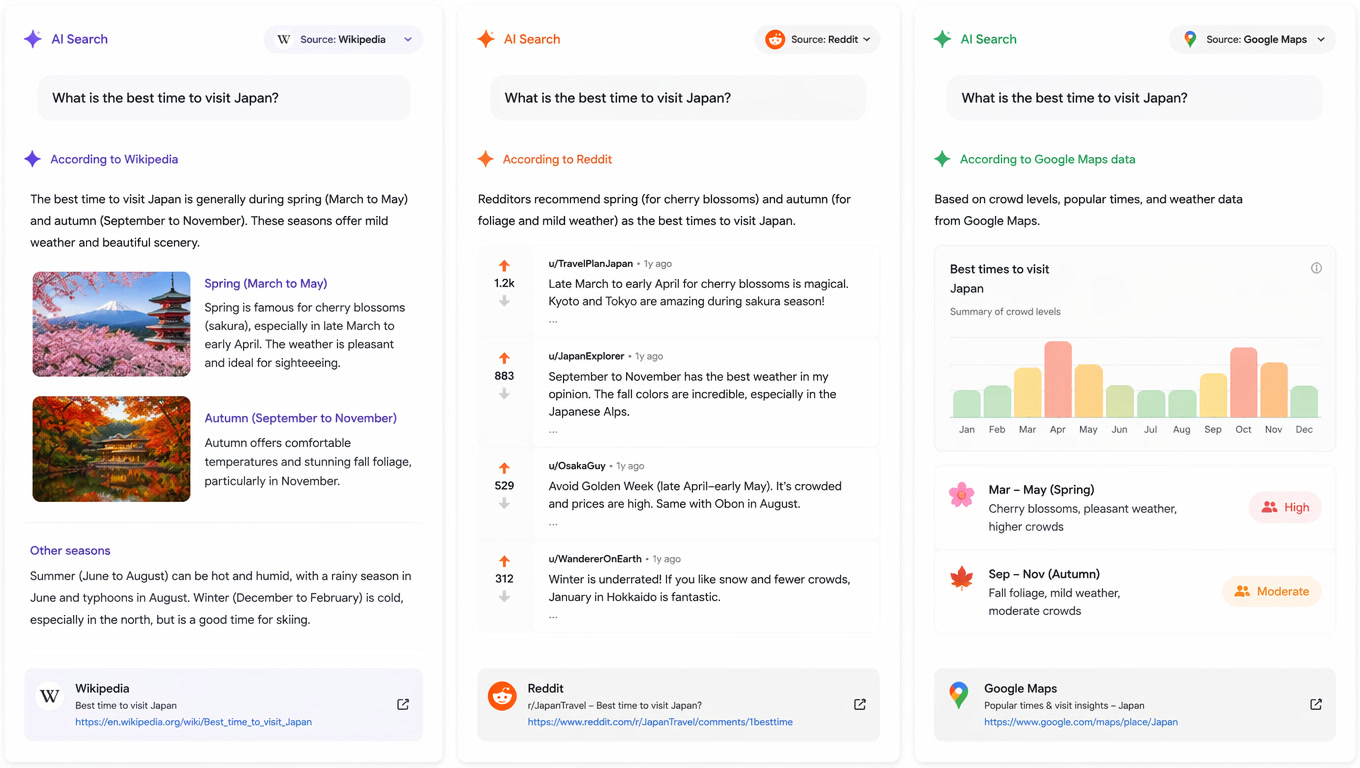
Ask three different people the same question and you get three different answers. One quotes a textbook. Another pulls from a Reddit thread. A third shows you a YouTube video and a Google Maps listing. That is exactly what is happening with ChatGPT, Perplexity, and Gemini right now.
Every AI engine has its own citation fingerprint. If your GEO strategy treats them as interchangeable, you're invisible on two out of three platforms.
The data backs this up. Averi's March 2026 analysis of 680 million citations found that only 11% of domains cited by ChatGPT also appear in Perplexity. Passionfruit's independent study measured 12% source overlap across three platforms. Whitehat SEO's analysis of 118,000 responses hit the same number.
Eleven percent. Turn it around: 89% of citations are engine-exclusive. Optimize for one and you miss almost everything on the others.
At Mintec, we have been auditing client visibility across these engines since early 2025, when we first started seeing real traffic from AI Overviews and ChatGPT. Here is what we have learned about how each engine thinks.
ChatGPT's citation profile: the academic
ChatGPT is the most conservative of the three. It prefers established, editorial, authority-weighted sources. Wikipedia is the most-cited domain by a wide margin, followed by government sites, universities, academic publications, and major media outlets.
This makes sense when you understand how ChatGPT works. It generates responses from a curated, authority-weighted index, not from live web search. When browsing mode is off, it draws from training data. Even with search enabled, its citation behavior skews toward sources that look "reference-like."
What this means for your content:
If you want ChatGPT to cite you, lead with structure. Direct definitions — paragraphs starting with "X is..." followed by a clear statement — are far more extractable than narrative intros. When ChatGPT needs to answer "what is generative engine optimization," it scans for a paragraph that begins with exactly that phrasing.
Well-structured FAQ sections give you a clear advantage. Each question-answer pair is a pre-packaged citation target.
Authority signals matter indirectly. Backlinks from .edu, .gov, and established media outlets raise your odds, even if the linking page isn't the one being cited. Wikipedia citations are the strongest signal of all.
Perplexity's citation profile: the live-web curator
Perplexity is where the interesting stuff happens, and the engine most likely to disrupt your current content strategy.
Perplexity browses the live web for every response. It does not rely on a static index. This makes it value recency, community-sourced content, and conversational formats above all else. Reddit is one of its most-cited sources — something ChatGPT almost never does.
Citation studies show Perplexity averages 5 to 10 citations per answer, significantly more than ChatGPT. It is a citation maximalist: it prefers showing multiple sources to betting on one.
What this means for your content:
Update frequency matters more here than on any other engine. A 2023 article will not get cited by Perplexity, even if it is the best piece on the topic. Perplexity favors content published or updated within the last 90 days.
Community forums work. Active Reddit presence, Hacker News threads, or industry-specific forums can get your content cited even if your blog does not appear.
How-to guides and step-by-step tutorials perform well. Perplexity likes content that breaks down into actionable fragments.
Counterintuitive finding: blog comments can also get cited. Perplexity does not distinguish between main content and comment sections on the same page.
Gemini's citation profile: the multimedia connector
Gemini, powering Google AI Overviews and AI Mode, behaves differently from the other two. It's wired into the Google ecosystem: Knowledge Graph, Google Business Profile, YouTube, and every piece of structured data Google has indexed over the years.
Gemini is the only engine that regularly cites visual content. YouTube videos appear in its responses frequently. It also pulls Google Business Profiles for local queries and depends heavily on schema markup.
What this means for your content:
If you do not have schema markup, Gemini partially ignores you. FAQ, Article, and HowTo schema have the strongest correlation with Gemini citation.
Google Business Profile is non-negotiable for local queries. Incomplete or unverified profiles mean Gemini will cite a competitor.
Video content feeds Gemini's answers. You do not need a massive YouTube channel, but embedding videos with descriptions and transcripts on your pages measurably improves citation odds.
The 3-profile framework
After auditing dozens of client sites, we built a simple framework to prioritize GEO effort:
| If your business... | Start by optimizing for... |
|---|---|
| Depends on authority and credibility (health, finance, legal) | ChatGPT — structured authority content, clear definitions, .edu/.gov backlinks |
| Competes in fast-changing topics (tech, marketing, trends) | Perplexity — frequent updates, forum presence, actionable guides |
| Has a local or physical presence | Gemini — Google Business Profile, schema markup, local video content |
| Is B2B with long decision cycles | All three — but start with ChatGPT (authority) and Gemini (structured data) |
Most brands need all three, but the priority order depends entirely on your industry and audience.
Common mistakes we are seeing
We keep watching companies make the same mistakes:
Treating GEO as SEO with a new name. It is not. Ranking #1 on Google does not guarantee ChatGPT will cite you. NJIT's June 2026 study tracked 161,382 article pairs and found that the overlap between Google organic top-10 rankings and AI Overview citations dropped from ~70% in early 2024 to under 20% by mid-2026. Separate channels entirely.
Ignoring Perplexity because it has less traffic. Perplexity has fewer users than ChatGPT, but its users have higher purchase intent and its citations generate more clicks per visit. Hotter funnel, fewer competitors.
Publishing and forgetting. This was always bad for SEO. For GEO it is terminal, especially on Perplexity. Content older than 90 days without updates will lose to a competitor who published last week.
Skipping structured data. Schema markup is not optional for GEO. It is the native language of Gemini and increasingly of ChatGPT as well.
Where to start today
If you have not done GEO work yet, here is your three-step plan:
- Audit your current presence. Search for your brand and key terms on ChatGPT, Perplexity, and Gemini. Do you show up? What does the engine cite instead?
- Pick your priority engine. Based on the framework above, which one gives you the best return per effort?
- Optimize one page. Not the whole site. One well-optimized page gives you enough data to decide whether to scale.
GEO is not a trend. It is what happens when search shifts from a list of links to a conversation. And in a conversation, it is not enough to be present — you need to be cited.
For a deeper dive into writing content optimized for each engine, check out our guide on writing for GEO. And if you want to measure whether this work actually moves the needle, this article on GEO metrics has the framework we use with clients.
Frequently Asked Questions
What's the difference between how ChatGPT, Perplexity, and Gemini cite sources?
ChatGPT prioritizes authoritative editorial sources (Wikipedia is the most-cited domain). Perplexity relies on live web content with heavy Reddit and forum sourcing. Gemini/Google AI Overviews favors structured data, Google Business Profiles, and visual content. Only 11% of cited domains appear across more than one engine.
Should I optimize my content differently for each AI search engine?
Yes. A one-size-fits-all GEO strategy won't work because each engine has a distinct citation profile. For ChatGPT: structure content with direct definitions and authority citations. For Perplexity: engage in forums and keep content updated bi-weekly. For Gemini: implement schema markup, Google Business Profile, and visual content.
What percentage of domains get cited by more than one AI engine?
According to Averi's analysis of 680 million citations in March 2026, only 11% of domains cited by ChatGPT also appear in Perplexity. Passionfruit found 12% source overlap across three platforms. Whitehat SEO's independent study of 118,000 responses confirmed the same figure. If you optimize only for ChatGPT, you're invisible to 89% of the AI search ecosystem.