AI Crawlers Don't Read JavaScript — Why SSR and SSG Are Now Essential for Content Sites
GPTBot, ClaudeBot, and PerplexityBot do not execute JavaScript. If your site depends on client-side rendering, 50-80% of your content is invisible to AI. Here's what rendering architectures actually work — with real production data from migration projects.
AI Crawlers Don't Read JavaScript — Why SSR and SSG Are Now Essential for Content Sites
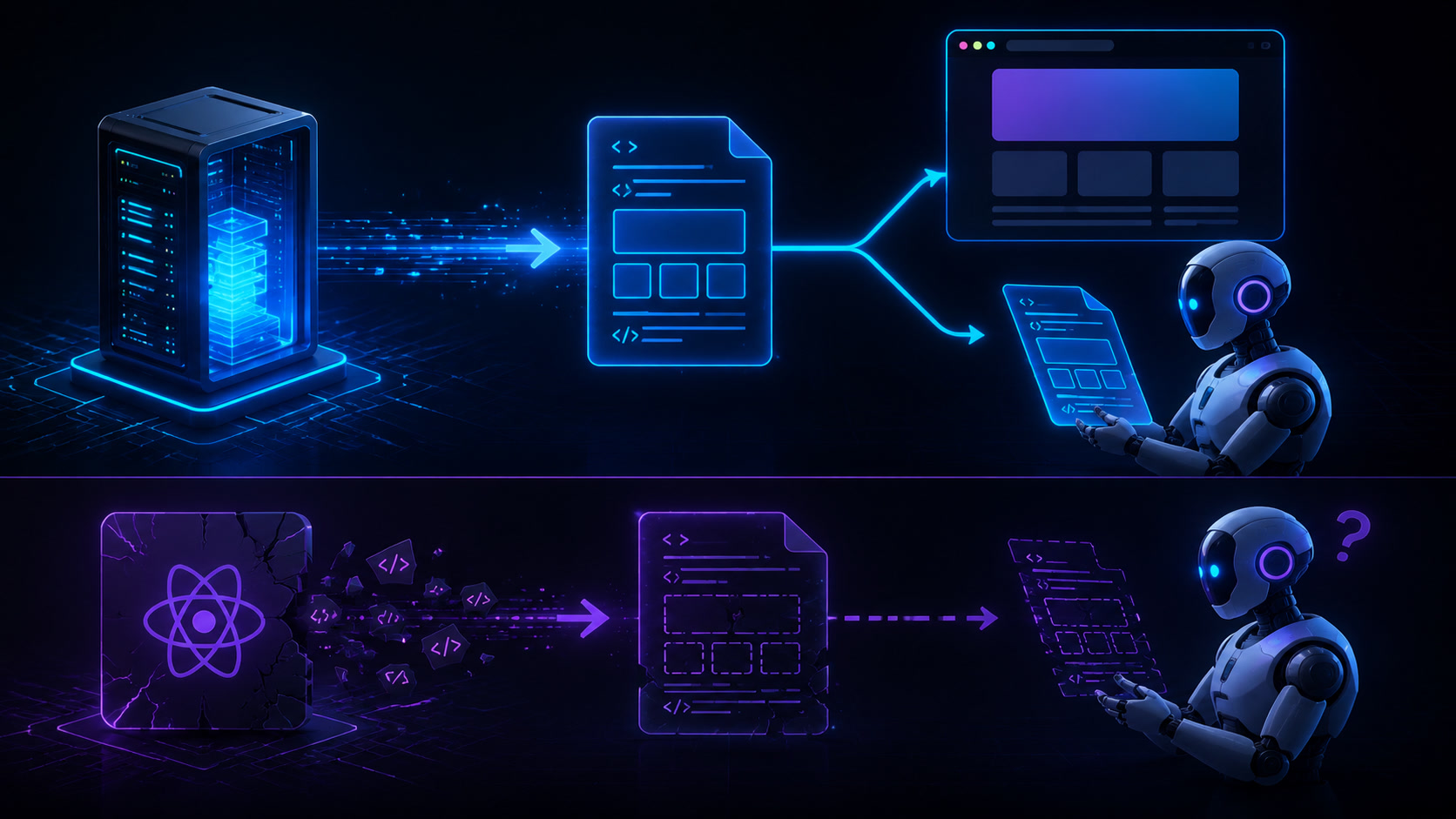
GPTBot, ClaudeBot, PerplexityBot, Bytespider, Meta-ExternalAgent. None of the crawlers feeding today's AI assistants execute JavaScript. If your website relies on Client-Side Rendering (CSR) — the typical React, Vue, or Angular SPA pattern — between 50% and 80% of your content is literally invisible to the models reshaping how users discover information.
Google published its official optimization guide for AI Overviews and AI Mode on June 18. The core message: schema markup, llms.txt, and "AI-specific rewriting" matter far less than having real content in the initial HTML response. The problem is that most modern web applications don't deliver real content in the initial HTML at all.
This isn't an SEO problem. It's an architecture problem.
The silent AI crawler gap
Since 2025, the major AI crawlers have been explicit: they do not execute JavaScript. This isn't a bug or a technical limitation they plan to solve — it's a design decision. Running JavaScript at scale would cost prohibitive amounts of compute per crawled page, and for language models, only the textual content matters.
The contrast with Googlebot is stark. Google runs a headless Chromium engine to render JavaScript and extract the full DOM. AI crawlers don't.
According to technical analyses published through mid-2026, a typical SPA built with Create React App or Vue CLI — which loads a near-empty HTML shell and renders everything via JavaScript — delivers between 50% and 80% less textual content to AI crawlers than its server-rendered equivalent.
The real-world effects are immediate:
- An ecommerce site: crawlers see the navigation and footer, but not product descriptions or prices — because those load via asynchronous fetch calls.
- A corporate blog: crawlers see the site name, but not the articles — because content hydrates from an API on the client.
- A SaaS portal: crawlers see the login page, but not the technical documentation or use cases — because the client-side router decides what to render.
If your site uses AI to generate content, the irony doubles: the content your AI generates is invisible to AI crawlers.
Rendering architecture comparison
To understand the scale of the problem, here is a direct comparison of the four main rendering strategies in 2026:
| Dimension | CSR (Classic SPA) | SSR (Next.js, Nuxt) | SSG (Astro, Eleventy) | Hybrid (Astro + Server Islands) |
|---|---|---|---|---|
| AI crawler visibility | ❌ 20-50% of content | ✅ 100% | ✅ 100% | ✅ 100% |
| Mobile LCP (median) | 4.2-6.8s | 1.8-2.5s | 0.8-1.5s | 1.0-1.8s |
| JS shipped to client | 150-400 KB | 70-120 KB + runtime | 0-30 KB | 0-50 KB |
| Build time (1000 pages) | N/A | N/A | 2-8 min | 2-10 min |
| Real-time updates | ✅ Excellent | ⚠️ Limited | ❌ No | ✅ Via Server Islands |
| Infrastructure cost | Low (CDN + API) | Medium-High (servers) | Low (static CDN) | Medium (CDN + edge) |
| Developer experience | Simple (pure SPA) | Complex (SSR hydration) | Simple (Markdown + components) | Medium |
The rule in 2026 is straightforward: if your site publishes content you want appearing in AI assistants, you need SSR, SSG, or a hybrid architecture. Pure CSR is no longer a safe choice for content sites.
What we learned migrating CSR sites to SSR/SSG at Mintec
We've migrated several projects from pure CSR to Astro and Next.js over the past year. Here is what worked and what didn't.
Case 1: Technical documentation portal (CSR → Astro + SSG)
A client had 500+ pages of technical documentation built with React + React Router. Page load time: 5.8s LCP on mobile. AI Overviews crawlers indexed less than 30% of the content.
We migrated to Astro 5 with Content Collections. Results: LCP dropped to 1.2s. AI crawler visibility: 100%. Full build: 3 minutes 40 seconds, incremental builds in 12 seconds.
The lesson: for pure content (documentation, blogs, editorial portals), Astro with SSG is the optimal choice. Zero JavaScript on the rendered page, maximum performance, full AI visibility.
Case 2: B2B SaaS with content landing pages (CSR → Next.js with SSR)
A B2B SaaS needed use-case landing pages to appear in both traditional search and AI Mode. Their React SPA loaded content via API — ClaudeBot saw empty pages.
Selective migration: we kept the React application for the dashboard (where interactivity matters) and migrated the public pages to Next.js 15 with SSR. Results: full AI visibility, LCP at 1.8s, and landing pages started receiving traffic from Perplexity and AI Overviews within three weeks.
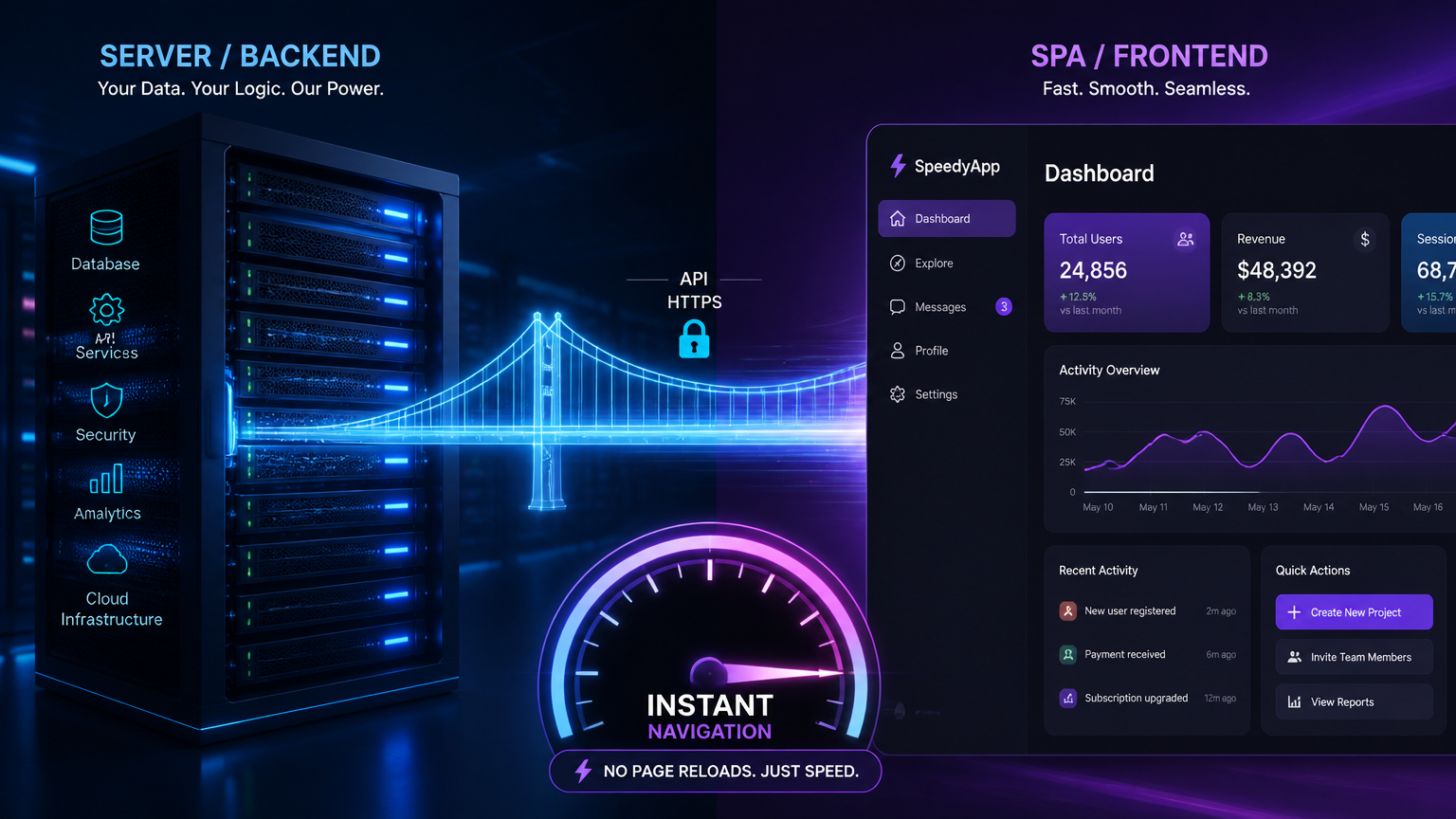
The lesson: you don't have to migrate everything. A hybrid architecture — CSR for interactive sections, SSR/SSG for content pages — is the most pragmatic strategy.
SSR vs SSG: how to choose
Once you've decided to move beyond CSR, the next question is SSR or SSG.
SSG (Static Site Generation) wins when:
- Your content changes infrequently (blogs, documentation, corporate sites)
- You want the fastest possible load times
- Your infrastructure budget is constrained (static CDN is cheap)
- You need green Core Web Vitals on every page
SSR (Server-Side Rendering) wins when:
- Your content is personalized per user
- You need real-time data (prices, inventory, search results)
- You have forms or transactional flows
- You use Server Actions or similar for mutations
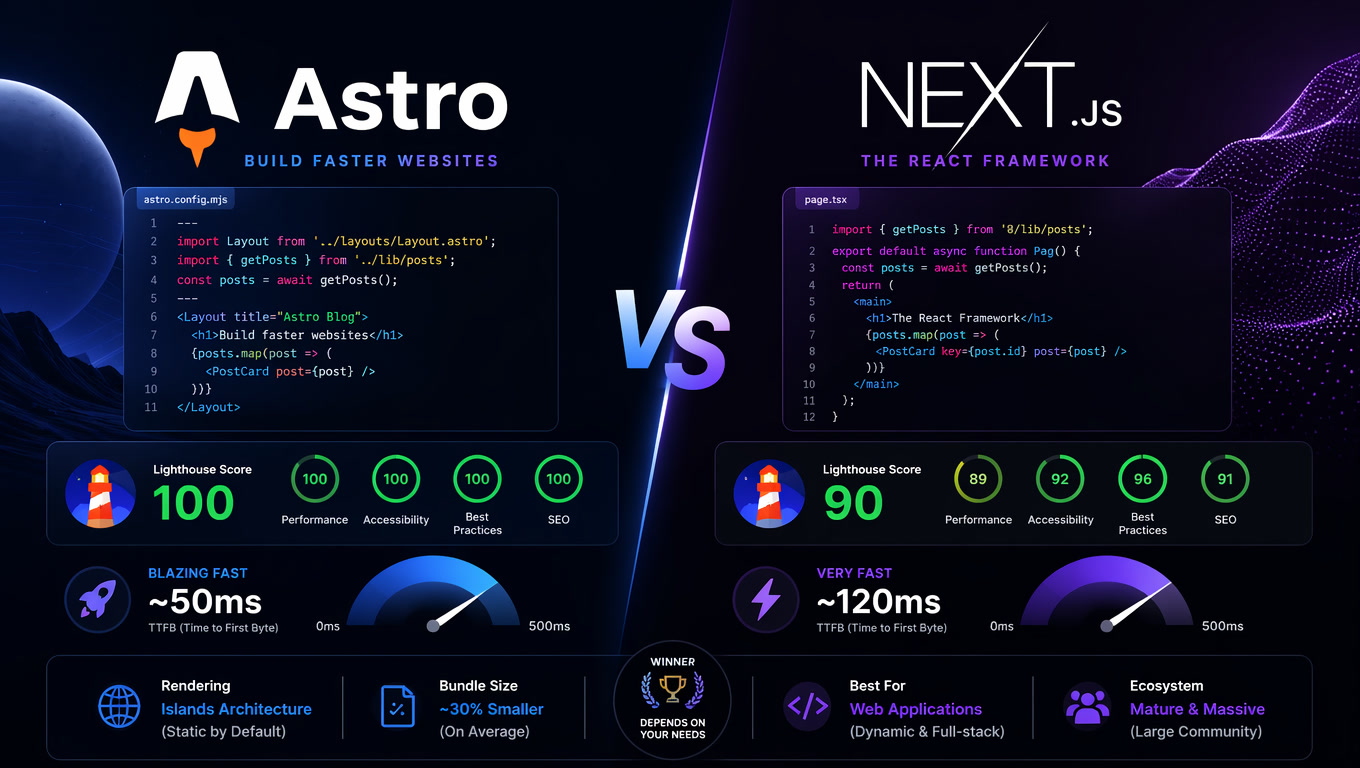
Astro 5 simplified this decision significantly with Server Islands: render 90% of the page statically and only server-render the sections that need dynamic data. It's the best of both worlds. We covered this in depth in our Server Islands vs Partial Prerendering comparison, and our Astro vs Next.js benchmarks show exactly where each framework excels.
The cost of not migrating
In a recent evaluation, we analyzed an ecommerce site with a CSR catalog competing in a niche where Perplexity and AI Overviews drove 22% of referral traffic. The site was invisible to both sources. We projected approximately $18,000/month in uncaptured traffic.
This isn't theoretical. Google I/O 2026 data shows brands cited in AI Mode receive 35% more organic clicks. Brands that aren't cited — because they're invisible to AI crawlers — simply don't exist in that channel.
The bottom line: server rendering is no longer optional
In 2024, choosing CSR was a performance and developer experience decision. In 2026, it's a decision that determines whether your content exists in the fastest-growing discovery channels.
The good news: frameworks like Astro 5 and Next.js make migration more manageable than ever. You don't have to rewrite everything at once — a hybrid architecture with Server Islands or Partial Prerendering can give you full AI visibility without rebuilding your entire application.
At Mintec, we've been helping companies navigate this transition. Our composable web architecture guide covers migration strategies in detail, and our headless CMS article explains why modern web development is going architecture-first.
The rule is simple: if your content isn't in the initial HTML, it doesn't exist for AI. And in 2026, that's no longer acceptable.
Frequently Asked Questions
Do AI crawlers execute JavaScript?
No. GPTBot, ClaudeBot, PerplexityBot, Bytespider, and Meta-ExternalAgent do not execute JavaScript. They read only the static HTML from the initial server response. If your content renders client-side via React, Vue, or any SPA framework, AI crawlers see an empty or partial page.
Will my existing SPA appear in AI Overviews or AI Mode?
Probably not. Googlebot does execute JavaScript and can index SPAs, but the AI crawlers powering ChatGPT, Claude, Perplexity, and other assistants do not. That means even if your SPA ranks well in traditional Google Search, it can be completely invisible in AI-powered surfaces like AI Overviews, AI Mode, and Perplexity.
Is migrating from CSR to SSR/SSG worth it just for AI crawlers?
Yes — but not solely for that reason. SSR and SSG also improve Core Web Vitals (LCP drops 40-60%), reduce time-to-first-render, improve screen reader accessibility, and make your site visible to any future crawler. AI visibility is an important additional benefit, but the performance and accessibility gains justify the migration on their own.