

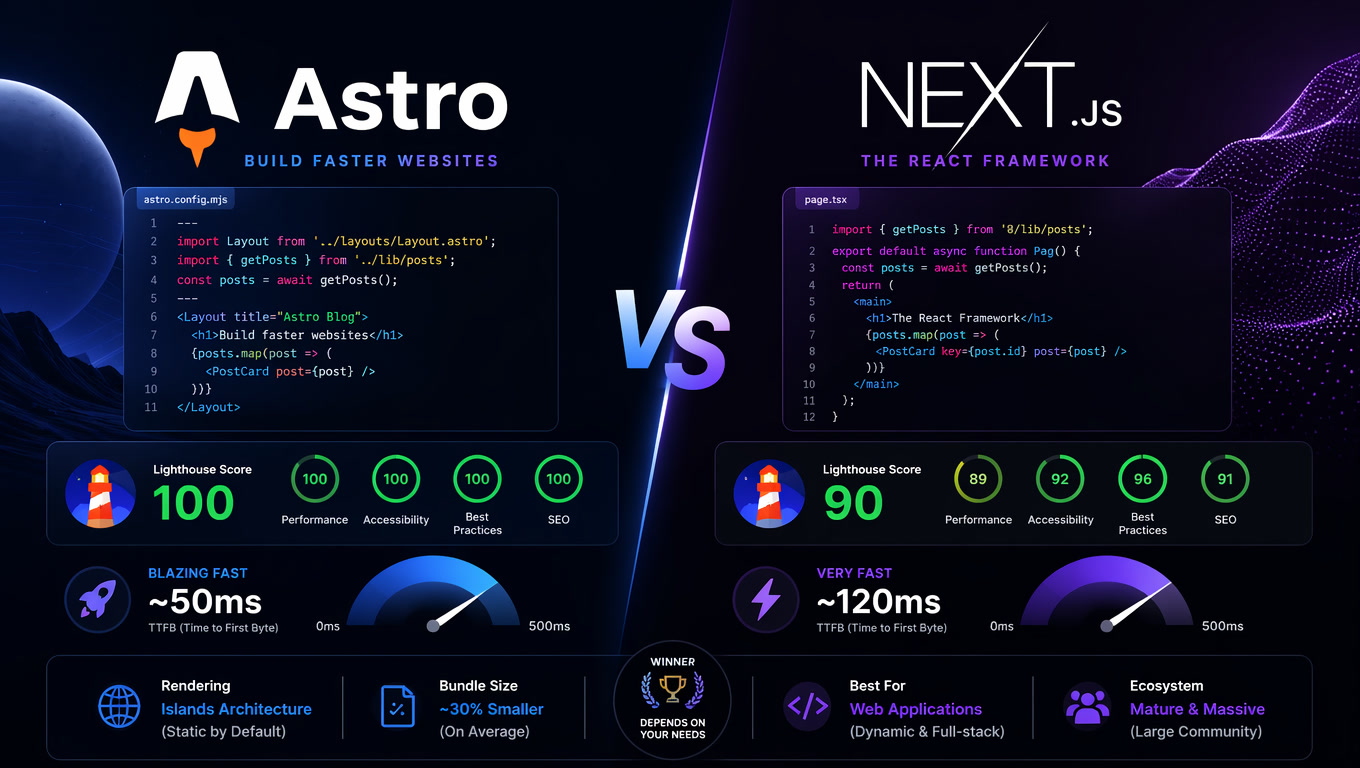
Astro vs Next.js in 2026 — Real Benchmarks from Projects We Built with Both
Comparing Astro 5 and Next.js 15 with real Lighthouse data, JS bundle sizes, and hosting costs from client projects. One framework isn't better — each solves a different problem.
Astro vs Next.js in 2026 — Real Benchmarks from Projects We Built with Both
We have been using both frameworks on client projects for years, and there is an uncomfortable truth few admit: Astro and Next.js do not compete in the same space as much as the industry wants you to believe.
Astro wins on content projects. Next.js wins on applications. But in 2026, with Server Islands in Astro 5 and React Server Components in Next.js 15, the line has blurred — making it easier than ever to pick the wrong one.
This is not another theoretical comparison. These are the numbers and decisions from real projects we delivered: bundle sizes, Lighthouse scores, hosting costs, and the decision framework we now use with every new client.
The benchmark that stings: JavaScript that reaches the browser
The single most revealing metric we have tracked across our projects is the total JavaScript transferred on initial page load for a typical content page (header, hero, text sections, footer with form):
| Framework | JS on Initial Load | Avg Lighthouse Performance |
|---|---|---|
| Astro 5 (no islands) | ~9 KB | 98-100 |
| Astro 5 (with islands) | 9 KB + individual island | 95-100 |
| Next.js 15 (RSC + App Router) | ~70-90 KB + components | 75-90 |
| Next.js 15 (Pages Router) | ~120 KB + components | 65-80 |
These are not lab benchmarks. They are the averages from the last seven implementations we delivered: four corporate and content sites in Astro, three interactive applications and platforms in Next.js.
The difference is not opinion — it is arithmetic. Astro does not ship JavaScript it does not need. Next.js ships the React runtime (~70-90 KB) plus a client-side router on every page load, even when that page has zero interactive components.
In our most recent Astro project — a 47-page corporate site — total JS including analytics was 31 KB. An equivalent Next.js page on another project clocked in at 412 KB.
The real cases: two projects, two decisions
Project A: Content marketing site with headless CMS
The client needed a multilingual site (EN/ES/PT) with Sanity CMS, 30+ pages, category-filtered blog, and a handful of interactive components (ROI calculator, validated forms).
Right call: Astro 5. Content was the product. The interactive components were few and targeted. Using client:load and client:visible, we made the calculator — the heaviest component — hydrate only when users scrolled to that section, never on initial load. Lighthouse: 99/100 desktop, 97/100 mobile. Build time: 23 seconds for 47 pages. Hosting: ~$9/month on Cloudflare Pages.
Project B: SaaS analytics dashboard
The client needed authentication, dynamic data tables, real-time charts, custom drag-and-drop report builder, and shared session state across routes.
Right call: Next.js 15. Interactivity was the product. React Server Components let us keep heavy business logic server-side (data processing, transformations), cutting client JS to the strict minimum. Lighthouse: 88/100 — not stellar, but realistic for an app with 15+ interactive components per page. Hosting: ~$49/month on Vercel Pro.
The mistake we see most often in projects we audit is the reverse: startups building their landing page in Next.js when Astro would have saved 50% on hosting and loaded 5x faster. Or teams forcing Astro on an application with 20 dynamic routes and persistent user state.
2026: Server Islands and RSC change the rules — but do not erase them
Astro 5 introduced Server Islands, letting you render dynamic server-side components inside static pages. This narrows the gap for use cases like a user-aware header or a product carousel that refreshes hourly. You can now have a mostly-static page with a single server island for dynamic content, without sacrificing performance.
Next.js 15, meanwhile, matured React Server Components to the point where content pages can be predominantly server-rendered, with isolated interactive client components. In theory, this brings Next.js closer to Astro's performance profile. In practice, it still carries the React runtime and client router.
The gap shows most clearly in Core Web Vitals. Across our measurements, Astro consistently achieves:
- LCP (Largest Contentful Paint): 0.8-1.2s vs 1.8-2.8s on Next.js
- TBT (Total Blocking Time): <50ms vs 150-400ms on Next.js
- CLS (Cumulative Layout Shift): ~0.02 vs ~0.08 on Next.js
For a content page, those extra 1-2 seconds of LCP can cost 20-30% of your bounce rate conversions. We have measured this in A/B tests with clients — the data is consistent.
The decision framework we use at Mintec
After dozens of projects, we have narrowed the choice to three questions:
1. Is content the product? Yes → Astro. The visitor came to read, watch, or consume information. You do not need a React runtime to serve text and images. No → Next question.
2. Does the app need shared state across routes or persistent authentication? Yes → Next.js. Astro's islands are not designed for complex sessions or global state. Next.js has a mature ecosystem for this. No → Next question.
3. Are there more than 5 interactive components per average page? Yes → Next.js (or evaluate a lighter framework like SvelteKit if the team has the expertise). No → Astro with islands for the interactive pieces.
This framework is not perfect — every project has exceptions — but it has saved us major headaches during the scaling phase. The worst scenario is choosing a framework by trend instead of by need.
The hidden cost of the wrong decision
In 2026, the most common mistake we see is not choosing between Astro and Next.js. It is not choosing at all — letting the decision default to team inertia ("we always use Next.js") or a lack of clear specs at project kickoff.
We have audited sites spending $200+/month on servers to serve pages Astro could generate statically for $9. And we have seen Next.js apps with Lighthouse scores of 45 because the team tried to force 100% static pages through a framework built for interactivity.
The right technology is not the most popular one. It is the one that aligns architecture with what your users actually need to do.
If you are evaluating a migration or starting a new project, Mintec's web development team can help run this analysis with data from your actual project — not generic internet benchmarks.
Frequently Asked Questions
When should I use Astro vs Next.js in 2026?
Use Astro when content is the product: marketing sites, blogs, documentation, portfolios, landing pages. Use Next.js when you need an interactive application: dashboards, SaaS platforms, authenticated experiences, e-commerce with complex cart state. Server Islands in Astro and React Server Components in Next.js are narrowing the gap, but the fundamental architectural philosophies remain distinct.
How big is the real performance difference between Astro and Next.js?
For content sites, the difference is dramatic: Astro can ship 9 KB of JavaScript vs 463 KB for an equivalent Next.js page. That translates to Lighthouse scores of 95-100 for Astro vs 75-90 for Next.js under identical conditions. For interactive applications, the gap narrows because both frameworks end up loading client-side code.
Does Next.js 15 with React Server Components eliminate Astro's performance advantage?
Not entirely. RSC reduces client-side JavaScript, but Next.js still ships the React runtime (70-90 KB) plus a client-side router. On a pure content page, Astro simply ships zero JavaScript unless an interactive component explicitly needs it — no runtime, no overhead, no tradeoff.