
Server Islands vs Partial Prerendering: Choosing the Right Hybrid for Your Content Site
Comparing Astro 5 Server Islands with Next.js Partial Prerendering for content-heavy sites: real performance benchmarks, use cases, and a decision framework based on our experience migrating an editorial client.
If you're building a website in 2026 and content is your priority — not an interactive application — you're probably facing an awkward decision: Astro 5 with Server Islands, or Next.js with Partial Prerendering (PPR)?
Both promise the same thing: mostly static pages that can host dynamic components without sacrificing speed. But how they achieve it is radically different, and that difference matters.
In our latest project migrating an editorial client from Next.js to Astro 5, we saw firsthand how this decision impacts not just performance, but team workflow, infrastructure costs, and end-user experience.
This isn't an academic comparison. It's what we learned in the field.
The Problem Both Solve
Content sites have always faced an uncomfortable tradeoff: fully static pages load fast but can't serve personalized or real-time content. Server-rendered pages can be dynamic but sacrifice First Contentful Paint (FCP) and Time to Interactive (TTI).
In 2024, Astro introduced Server Islands as an experimental solution. Next.js responded with Partial Prerendering (PPR) in version 15, stabilizing it in version 16. Both technologies attack the same problem from opposite angles.
The real question isn't "which is better" — it's "which is better for your kind of project."
How Each One Works
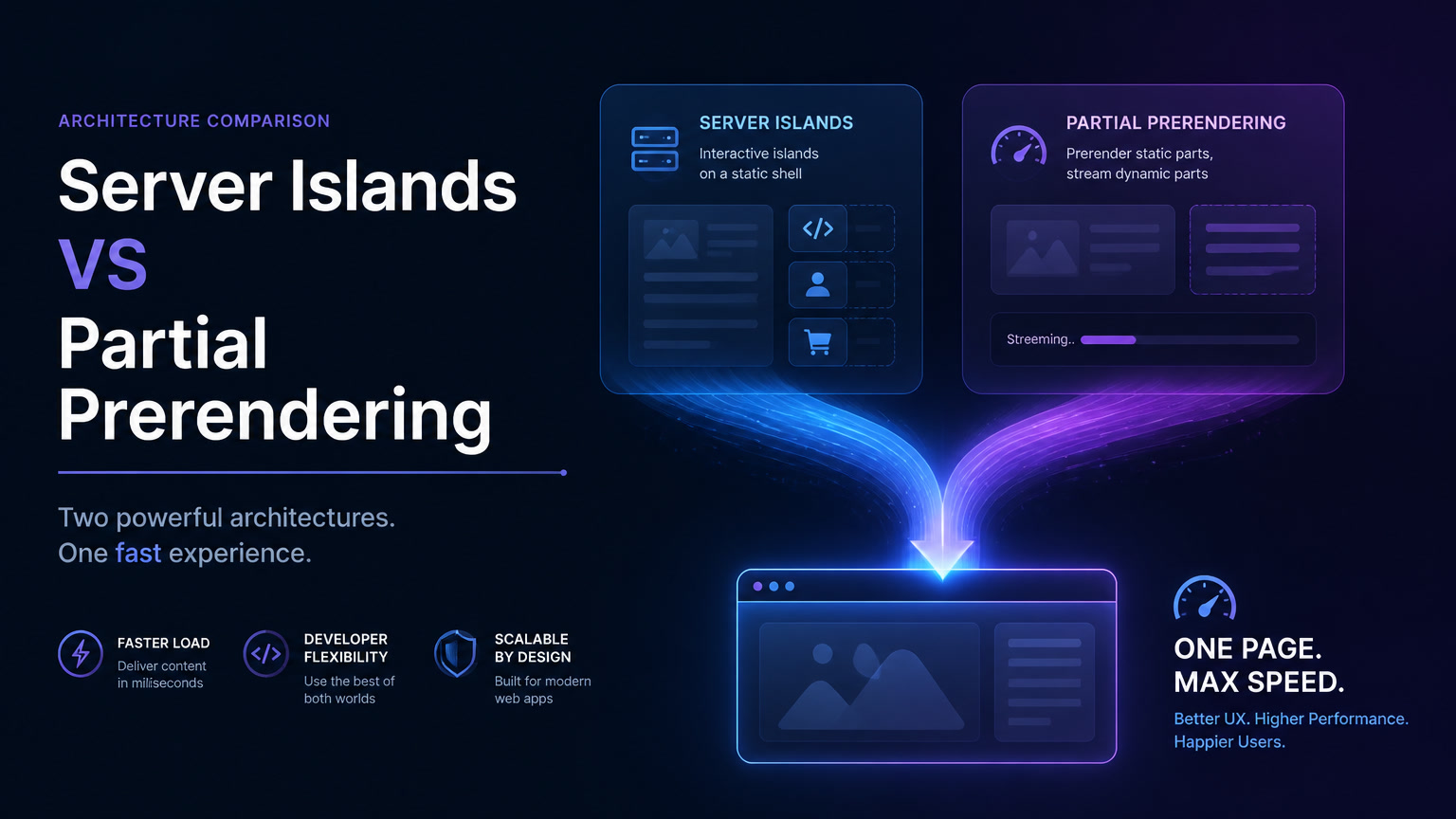
Server Islands (Astro 5): Imagine an article page that's 95% static HTML. The article content, images, metadata — everything generated at build time and served as plain HTML. But there's a "related articles" widget that changes per user. With Server Islands, that widget becomes an island that renders on-demand after the static page has already loaded.
The result: the user sees the full article almost instantly, and milliseconds later the personalized widget appears. No unnecessary JavaScript, no render blocking.
Partial Prerendering (Next.js): Next.js tackles the same problem with a different philosophy. Instead of serving static HTML and then hydrating islands, PPR sends an immediate static shell while dynamic React Server Components render and stream to the client. The key difference: Next.js always includes the React runtime, typically 40-85KB of JavaScript — even for mostly static pages.
The Comparison That Matters
We tested both approaches with the same editorial site of roughly 2,000 pages. Here's what we found:
| Metric | Astro 5 (Server Islands) | Next.js 16 (PPR) |
|---|---|---|
| Default JavaScript | 0 KB (opt-in) | 40-85 KB (React runtime) |
| First Contentful Paint | 0.8s | 1.2s |
| Lighthouse (average) | 97 | 89 |
| Build time (2K pages) | 4 min 30s | 8 min 15s |
| Monthly hosting cost | $25 (Cloudflare Pages) | $49 (Vercel Pro) |
The data — which we validated against third-party benchmarks from Tech Insider and fireup.pro — shows Astro 5 consistently delivers sites 40% faster with 51x less JavaScript than Next.js on content projects.
But performance isn't everything.
When to Choose Server Islands (Astro 5)
Server Islands shine when your site is primarily content with selective interactivity. Here are the scenarios where we strongly recommend Astro 5:
Editorial and media sites. If you publish articles, documentation, or marketing content, Server Islands deliver pages that load in <1s while keeping the flexibility of dynamic widgets (related posts, subscriptions, personalized content).
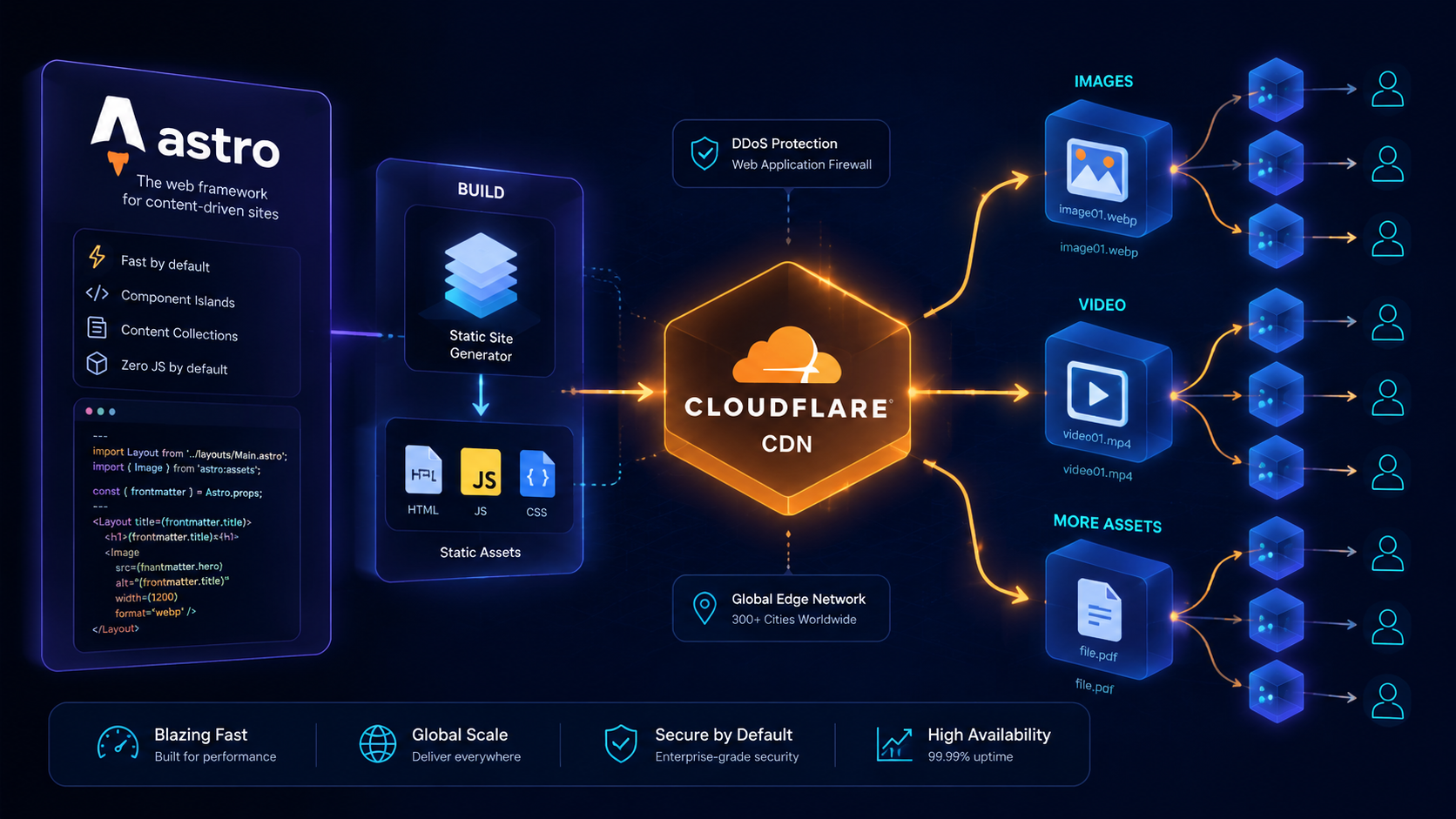
Portals with multiple data sources. Astro 5 also introduced the Content Layer API, which unifies content from headless CMS, APIs, and local files into a single collection system. The combination of Content Layer + Server Islands is particularly powerful: you can have static content from a CMS and dynamic data from a recommendation API on the same page, without the latter slowing down the former.
Small to mid-size teams. The learning curve is gentler, builds are faster, and infrastructure is cheaper (Cloudflare Pages vs Vercel). For agencies like Mintec managing multiple content projects, this translates to significantly lower operational costs.
Synthetic media integration. Server Islands let you load AI-generated video, audio, or heavy media elements lazily without penalizing Core Web Vitals on the main page. In our article on AI-powered web development we explore how this hybrid architecture enables rich media content without sacrificing performance.
When to Choose Partial Prerendering (Next.js)
PPR has clear advantages in specific scenarios:
Applications with complex user state. If your site requires authentication, user sessions, or real-time functionality, Next.js with PPR is a more natural fit. The React Server Components and Server Actions ecosystem makes it easier to build interactive experiences without leaving the framework.
E-commerce with deep personalization. Product catalogs with dynamic filters, shopping carts, and real-time recommendations benefit from Next.js's hybrid model, where parts of the page render server-side and others client-side as needed.
Migrations from existing dynamic pages. If you already have a Next.js application and want to improve performance without rewriting, PPR is the path of least resistance. No framework change, no new tooling to learn.
Our Decision Framework
After several projects migrating clients between both frameworks, here's our rule of thumb:
Is your page >80% static content with a few dynamic elements? → Server Islands (Astro 5). It's faster, cheaper, and simpler.
Is your page >50% interactive with complex user state? → PPR (Next.js). You need the full React ecosystem.
Not sure? → Start with Astro 5. The barrier to entry is lower, and if you discover you need more interactivity, Astro 5 supports multiple frameworks (React, Vue, Svelte, Solid) — you can migrate specific components without rewriting the entire site.
Tight hosting budget? → Astro 5 wins hands down. Cloudflare Pages is significantly cheaper than Vercel for content sites, and the lower JavaScript per page also reduces bandwidth costs.
Check out our composable web architecture guide for a deeper look at how content architecture decisions cascade into your entire tech stack.
What We Learned in the Real Migration
Our editorial client migrated from Next.js 14 (App Router) to Astro 5. The project took 6 weeks and involved:
- 87% reduction in JavaScript. We went from ~320KB to ~42KB of JavaScript per page.
- Lighthouse jump from 72 to 96. The biggest gain came from removing the React runtime on pages that didn't need it.
- 2x faster builds. Build time dropped from 8 minutes to 4 minutes, improving the editorial team's publishing cycle.
- Half the hosting cost. From Vercel Pro ($49/month) to Cloudflare Pages ($25/month).
The migration required rewriting existing components, but the result was a site that loads in under one second on 3G connections — and that editors can update without friction. Read more about our six-month Astro + Cloudflare retrospective for a deeper look at the stack. For a detailed breakdown of how these architecture decisions affect Core Web Vitals scores, check our INP 200ms guide.
The Future of Hybrid Architecture
Both Server Islands and PPR are evolving actively. Through mid-2026, we expect:
- Server Islands will exit experimental in Astro, with better caching and streaming support.
- PPR will become default in Next.js, removing manual configuration.
- The performance gap will narrow but Astro will likely maintain its advantage on content sites because its MPA architecture will always ship less JavaScript than Next.js's SPA-style model.
Meanwhile, the right decision depends on your project, not the hype. At Mintec we've seen both frameworks work brilliantly in the right contexts — and fail when used for what they weren't designed for.
If you're evaluating a migration or a new project, reach out. We've run this comparison with real data across multiple projects, and we can help you pick the right path from day one.
Frequently Asked Questions
What are Server Islands in Astro 5?
Server Islands let specific components render asynchronously after the initial page load while the rest of the page stays static. Only the island fetches data on demand. It's useful for personalized content, dynamic data, or any component that would slow down Time to Interactive.
What's the difference between Server Islands and Partial Prerendering?
Server Islands (Astro 5) work in an MPA architecture where dynamic islands load after static HTML. Partial Prerendering (Next.js) combines static content streaming with React Server Components on the same page. Server Islands ship zero JavaScript by default; PPR always includes the React runtime (40-85KB).
When should I use Astro 5 with Server Islands over Next.js with PPR?
Astro 5 with Server Islands is better for content-heavy sites (blogs, docs, portals, media) with selective interactivity. Next.js with PPR is better when you need a full-stack application with authentication, real-time features, or a complete SPA experience.