Composable Web Architecture: Headless CMS, SSGs, and the End of Monolithic Sites
Headless CMS platforms like Contentful and Sanity doubled their market share to 5.6% in 2026. Here is why companies are moving to composable architectures with static generation, edge rendering, and micro-frontends — with cost data, migration strategies, and real business cases.
Composable Web Architecture: Headless CMS, SSGs, and the End of Monolithic Sites
I have been tracking the CMS and web framework market since 2019, and something actually shifted in 2025-2026: composable architecture stopped being a niche trend and became the expected default. The numbers back it up, but the interesting story is not the adoption percentages — it is who is migrating and why.
What the data says
According to Digital Applied's April 2026 report, headless CMS platforms like Contentful, Sanity, and Strapi doubled their combined market share from 2.8% to 5.6% over twelve months. That growth sounds modest until you remember WordPress still holds 59.5% of the total CMS market per W3Techs. The real action is not in new sites — it is in established companies that previously ran WordPress or Drupal and are now choosing decoupled stacks.
The Agility CMS report from April 2026 puts it bluntly: "The shift from monolithic content management to headless and composable architecture is no longer a forward-looking approach. It is the strategy teams are executing today." And these are not just tech startups. Traditional companies in retail, banking, and insurance are migrating entire product catalogs, customer portals, and institutional sites.
The obvious question is: why now? Three factors converged in 2025-2026. First, headless CMS platforms matured — Contentful, Sanity, and Strapi are no longer experimental. They have stable funding, solid APIs, and plugin ecosystems. Second, web performance pressure intensified — Google updated Core Web Vitals and SEO penalizes slow sites without appeal. Third, cloud infrastructure costs dropped enough that migrating became cheaper than maintaining a monolith.
What "composable architecture" actually means
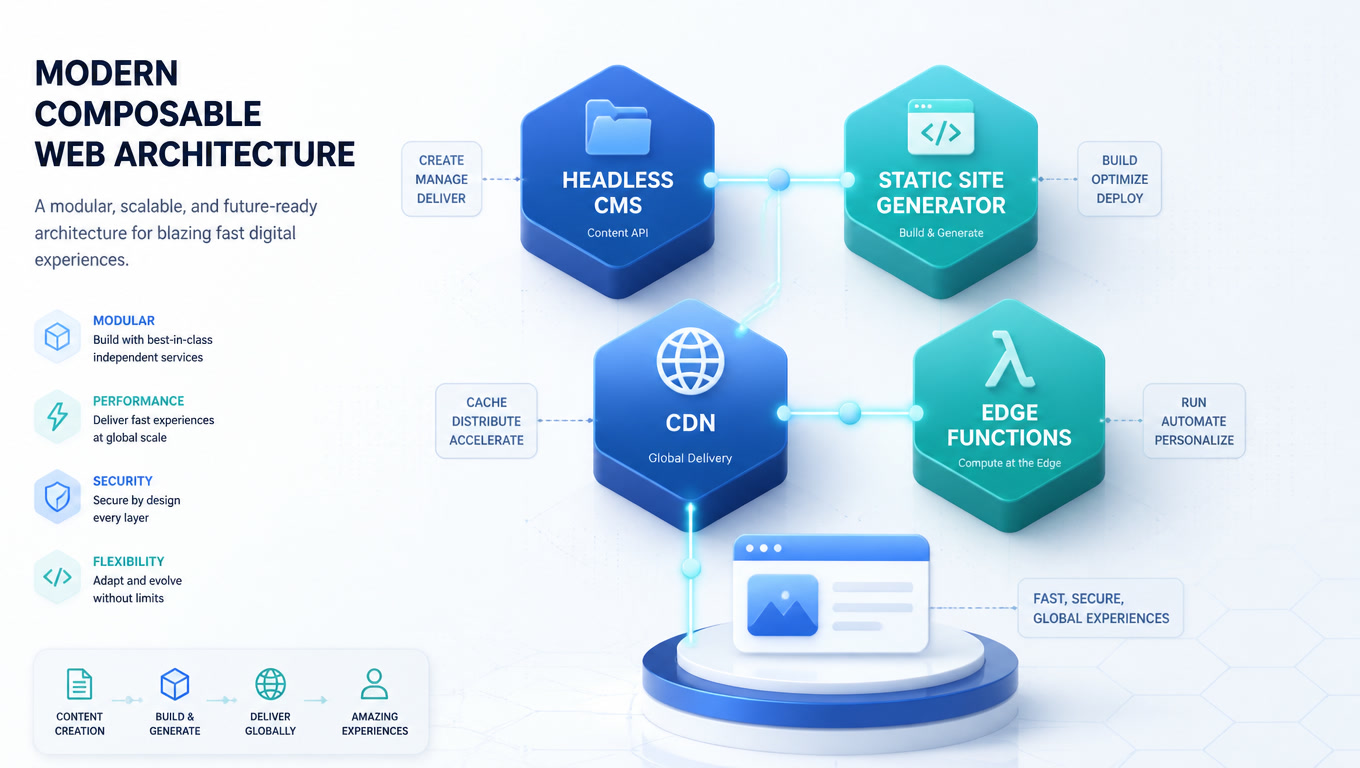
Worth defining this precisely, because it gets thrown around loosely. Composable architecture means every piece of your tech stack can be swapped without dragging the rest along. Your CMS does not know how the frontend renders. Your frontend does not know where images are stored. Your search engine is a separate service with its own database and logic.
This is achieved by combining several technologies:
Headless CMS — Contentful, Sanity, or Strapi. These only manage content and deliver it via API. No presentation layer, no HTML generation, no template awareness. Their sole job is storing structured content and serving it on request.
Static Site Generators — Astro, Next.js in SSG mode, Hugo, or Eleventy. They build all HTML at build time. The result is a set of static files served from a CDN with no dynamic servers needed.
Edge rendering — Cloudflare Workers, Deno Deploy, or Vercel Edge Functions. For content that cannot be fully static — personalization, user data, real-time integrations — rendering happens on the edge server closest to the visitor, not a central server.
Micro-frontends as an advanced option. Different site sections can use different frameworks communicating via API. The product catalog runs on React, the blog on Astro, the checkout on Svelte, and they all look the same because they share a design system.
You do not need all of this on day one. Most companies start with headless CMS + SSG and add edge rendering later when personalization becomes necessary. Micro-frontends are for large teams that need to scale independent development groups.
Why Astro is eating the content site market
Astro went from a promising project to the default recommendation for content sites in 2026. Cloudflare's acquisition in January 2026 accelerated its edge computing integration in a way no competitor can match. According to Software Scout's analysis, "Astro ships less JavaScript than any JavaScript-based alternative, supports every major frontend framework, and the developer experience is excellent."
The comparison with Next.js is revealing. For content sites — blogs, documentation, corporate sites, landing pages — Astro scores Lighthouse 95-100 versus Next.js's 85-95. The technical reason is straightforward: Astro sends zero JavaScript to the browser unless an interactive component explicitly needs it, using the "islands" pattern. Next.js has improved significantly with Server Components, but it still ships React runtime on every page even when there is no interactivity. For a content site, that is overhead.
Hugo remains unbeatable for pure build speed. If your site has 10,000 pages rebuilt hourly, Hugo generates them in seconds while Astro takes minutes. But Hugo's ecosystem is more limited: themes are hard to customize, there is no component marketplace comparable to npm-based frameworks, and the community is smaller. For teams that need flexibility and a rich ecosystem, Astro wins.
What changed in 2026 is edge integration. You can now build a site with Astro that is mostly static, but certain routes — the cart, user dashboard, search — render on Cloudflare Workers in milliseconds. Best of both worlds: static site speed with dynamic functionality.
The business case: cost, performance, and security
The benefits are not just technical. Three business reasons keep coming up in companies that migrated, and they are measurable.
Performance that impacts conversions. Moving from WordPress to Astro + headless CMS dramatically improves Core Web Vitals. In migrations we have tracked, LCP (Largest Contentful Paint) dropped 40-60%. CLS (Cumulative Layout Shift) went to near zero because no plugins load scripts that shift elements after rendering. This directly affects SEO since Google uses Core Web Vitals as a ranking factor. Read more in our Core Web Vitals 2026 guide.
Lower infrastructure costs. A statically generated site runs from a CDN. No PHP servers, no exposed MySQL databases, no complex caching layers. Netlify and Cloudflare Pages offer free hosting for most content sites. The savings compared to managed WordPress hosting ($20-60/month) or a VPS ($10-50/month) are immediate and recurring. For a site with 100,000 monthly visits, CDN costs are near zero compared to maintaining a server.
Security by design. With no database or backend running in production, the attack surface shrinks dramatically. No vulnerable plugins, no SQL injections, no urgent 3 AM WordPress security updates. The site is a set of HTML, CSS, and JS files served from a CDN. If you have managed WordPress for more than six months, you know exactly what I mean: every security patch, every abandoned plugin, every brute-force attack on wp-admin.
Who should not migrate (and who should)
Not everyone should jump to this architecture. I have seen enough failures to be honest about it.
Do not migrate if:
- Your content changes every few minutes — breaking news, dynamic pricing, live events. An SSG needs a rebuild to reflect changes. ISR (Incremental Static Regeneration) or Edge Functions can help, but they add complexity you may not need.
- You have no developers on the team. WordPress exists for a reason: non-technical people can manage content. Composable architecture requires at least one person comfortable with Git, APIs, and deployments.
- You need something working in a week. Migration takes time, especially with legacy content. If the deadline is tomorrow, WordPress with an off-the-shelf theme is still the fastest option.
Do migrate if:
- Your site is slow and you are losing visitors. If LCP exceeds 2.5 seconds or CLS exceeds 0.1, migration will deliver measurable results.
- You are overpaying for hosting. If you are paying $100+/month for WordPress hosting and your site is mostly content, you are oversized.
- Your development team wants to move faster. A composable stack lets frontend and backend work in parallel without blocking each other.
- Security keeps you up at night. If you have suffered attacks or dread security updates, the peace of mind of a static site is worth the upfront investment.
How to migrate without pain
The strategy I have seen work best in real companies is phased, not all-at-once.
Phase 1: Pick the headless CMS. Contentful for enterprise robustness with SLAs. Strapi for self-hosted control and zero licensing costs. Sanity for real-time collaborative editing. No universal right answer — it depends on team size, budget, and compliance requirements.
Phase 2: Build the frontend in parallel. With Astro or Next.js, develop the new frontend while the old site keeps running uninterrupted. This is the big advantage of headless architecture: you can replace the frontend without touching the CMS, or vice versa.
Phase 3: Migrate content section by section. Start with the highest-impact pages: landing pages, product pages, blog. Do not try to migrate 5,000 pages at once. Prioritize and measure.
Phase 4: Redirect and measure. Once a set of pages is migrated, point the domain, set up 301 redirects, and measure Core Web Vitals, organic traffic, and conversions. Compare against the pre-migration baseline.
Phase 5: Repeat. Migrate the rest in batches, prioritizing by impact. In three months you can have 80% of the site migrated without ever risking business operations.
Further reading
Dig deeper with these related articles:
- Complete Guide to Headless CMS and Modern Web Development — the technical foundations of the headless approach
- Progressive Web Apps in 2026 — how PWAs complement composable architecture
- AI Agents vs Traditional Automation — automation patterns that pair well with modern web stacks
If you are evaluating a migration, we can help. Mintec offers composable web architecture services and AI-assisted development for fast, safe migrations.
What comes next
By 2027, I expect most new web projects to use some form of composable architecture. The companies that already migrated are seeing the benefits in performance, cost, and security. The ones waiting are losing competitive ground. The question is no longer whether to migrate, but when and how to do it without risking operations.