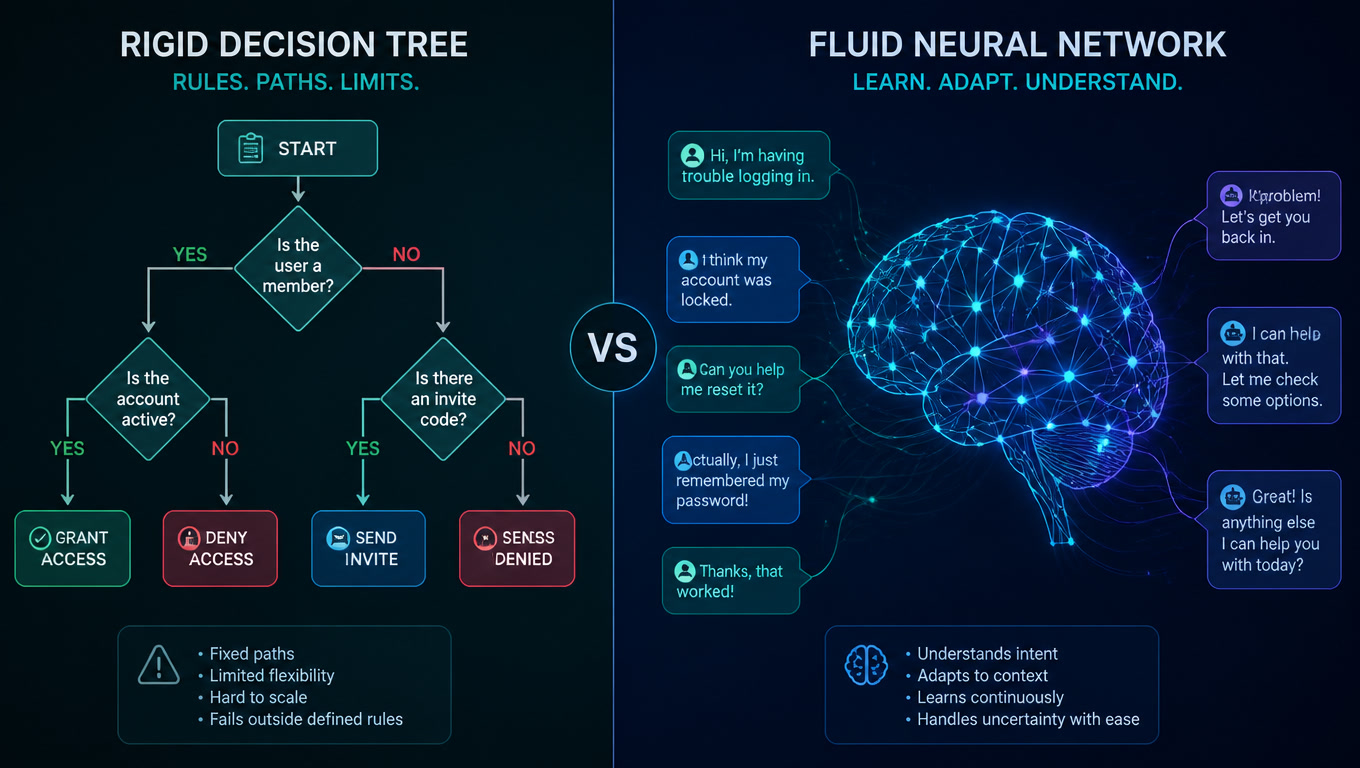
WhatsApp Business AI Agent vs Traditional Chatbot: Why the Gap Matters More Than You Think
Traditional WhatsApp chatbots handle menus. AI agents handle intent. We deployed both for LATAM clients and the difference in response quality, lead capture, and revenue was not subtle — it was a 3x improvement in qualified conversations. Here's the technical breakdown and decision framework.
WhatsApp Business AI Agent vs Traditional Chatbot: Why the Gap Matters More Than You Think
Short answer: a traditional chatbot follows scripts. An AI agent follows intent. If your WhatsApp channel handles more than 30 conversations a day and the questions vary, you're leaving revenue on the table with a rule-based bot.
We've been deploying WhatsApp Business automation for clients across LATAM for three years. Early on, every solution was a flow-based chatbot — decision trees, button menus, predefined responses. Then, in late 2025, we started wiring LLM-powered agents into the same WhatsApp API pipelines. The difference wasn't incremental. It was structural.
Here's what we learned about when each approach works, where the real technical differences live, and how to decide what your business actually needs.
The Core Difference: Scripts vs Understanding
A traditional WhatsApp chatbot is a state machine. It receives a message, matches it against predefined keywords or button selections, and follows a pre-programmed path. It's predictable, cheap to build, and breaks the moment a customer says something the flow designer didn't anticipate.
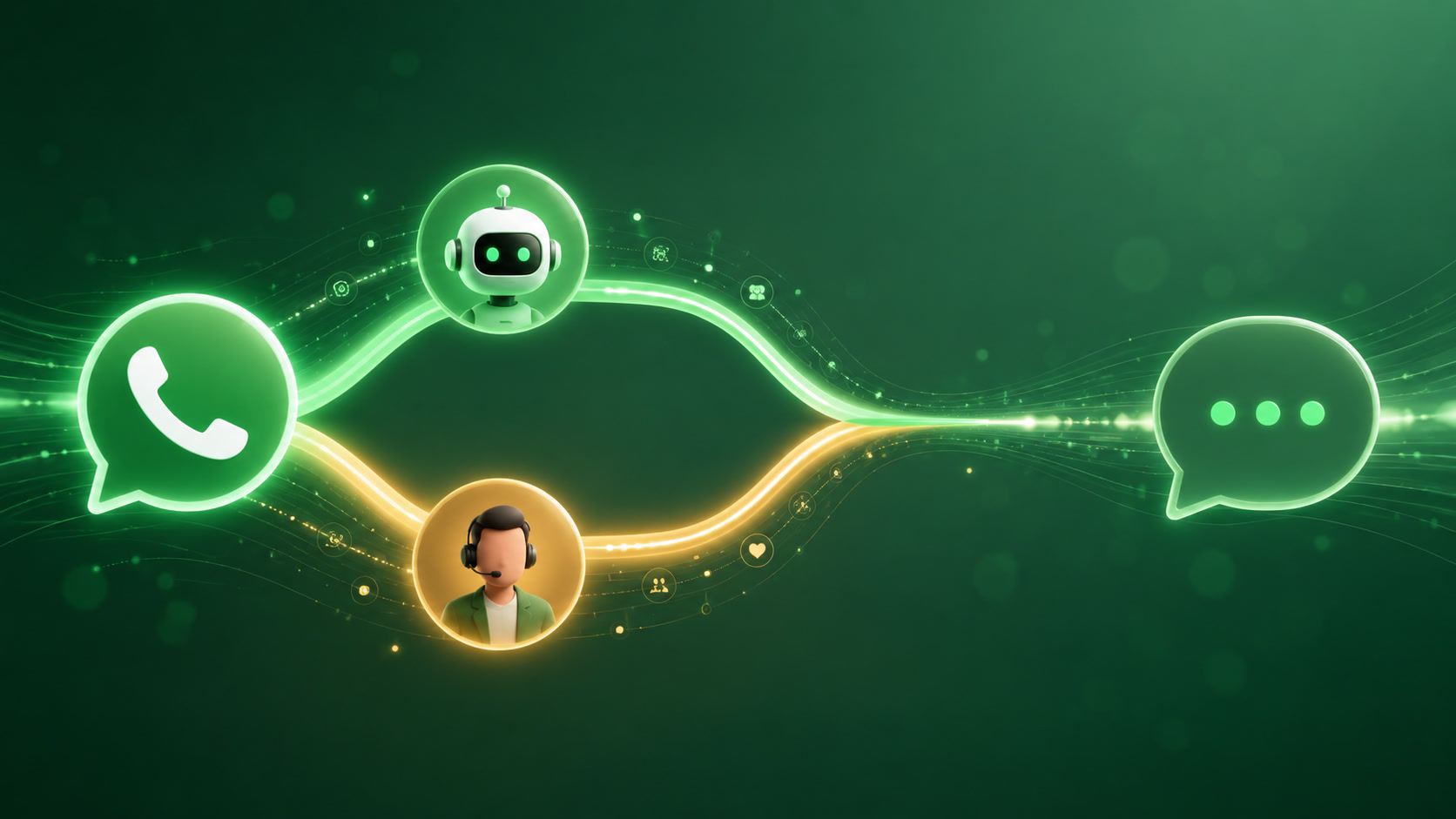
An AI agent built on a large language model (LLM) processes natural language. It understands intent, handles ambiguity, maintains conversational context across turns, and can call external tools — look up a CRM record, check inventory, schedule an appointment — without a human pre-programming every possible path.
The practical difference shows up in three places:
1. Conversation completion rate. Traditional chatbots typically resolve 40-60% of conversations without human handoff. AI agents resolve 70-85%. The gap comes from handling edge cases — the "weird" questions that make up a surprising portion of real customer interactions.
2. Lead qualification accuracy. A flow-based bot qualifies leads based on the answers you ask for. An AI agent qualifies based on what the customer actually says, cross-referenced with your business rules and CRM data.
3. After-hours capture. Both operate 24/7, but the AI agent maintains quality. A chatbot at 2 AM handles the same limited set of paths it handles at 2 PM. An AI agent at 2 AM processes a complex product question with the same nuance as during business hours.
What We Built: Three Implementations Compared
Over the past 18 months, we deployed three WhatsApp automation solutions for LATAM clients using n8n as the orchestration layer and WhatsApp Business Cloud API as the messaging backbone. Here's what each one looked like.
Implementation 1: Rule-Based Bot for an E-Commerce Store (June 2025)
Stack: WhatsApp Business API + n8n + Google Sheets (as temporary CRM)
The store needed basic order status, product catalog browsing, and return policy information. We built a flow with 12 predefined paths covering the top 20 customer questions.
Results:
- 52% of conversations handled without human intervention
- Average resolution time: 45 seconds (fast, but only for covered topics)
- 48% of conversations escalated to a human — mostly questions about specific products, sizing, or customization that the flow didn't cover
- Monthly cost: ~$95 (WhatsApp API fees) + $0 infrastructure (n8n self-hosted)
What broke: The store added 200 new SKUs. The bot had no way to answer product-specific questions about the new inventory without manual flow updates. Each update took 2-3 hours of developer time.
Implementation 2: LLM Agent for a Dental Clinic (October 2025)
Stack: WhatsApp Business API + n8n + OpenAI API + Google Calendar integration
The clinic needed appointment scheduling, treatment information, insurance verification, and patient intake. We built an AI agent with three tool capabilities: calendar lookup, patient record retrieval (via API call to their practice management system), and FAQ response from a knowledge base.
Results:
- 78% of conversations handled without human intervention
- Average resolution time: 2.3 minutes (longer, but because the agent handles complex multi-turn questions that a flow bot would simply escalate)
- 22% of conversations escalated — mainly treatment-specific medical questions the agent correctly identified as requiring human expertise
- Monthly cost: ~$120 (WhatsApp API) + ~$35 (OpenAI API) + $0 infrastructure
What worked: A patient messaged at 11 PM asking about insurance coverage for a specific procedure. The agent verified insurance eligibility through the clinic's system, compared it against the treatment plan, and sent the patient a cost breakdown. The patient booked for the next morning. A traditional chatbot would have sent the patient a "we'll get back to you during business hours" message.
Implementation 3: Hybrid System for a Real Estate Agency (March 2026)
Stack: WhatsApp Business API + n8n + Claude API + Clientify CRM + property listing API
This was the most complex build. The agency needed lead qualification, property matching based on budget and preferences, virtual tour scheduling, and CRM integration. We combined an AI agent for the conversation layer with a traditional decision tree for the lead scoring logic.
Results:
- 72% of conversations handled without human intervention
- Lead qualification accuracy improved from 34% (previous chatbot) to 61% (AI agent)
- Average time from first message to qualified lead: reduced from 4.2 days to 18 minutes
- Monthly cost: ~$180 (WhatsApp API) + ~$55 (Claude API) + $0 infrastructure
The hybrid approach matters. Pure AI agents can hallucinate pricing or make promises about property availability. The decision tree layer enforces hard business rules (budget thresholds, availability checks, compliance requirements) while the LLM handles natural language conversation.
The Technical Architecture: How n8n Orchestrates Everything
Whether you use a traditional chatbot or an AI agent, the WhatsApp Business API connection is the same. The difference is what happens after the message arrives.
Traditional chatbot flow in n8n:
- Webhook trigger receives incoming WhatsApp message
- Switch node matches message content against keywords
- Predefined response is sent via WhatsApp Business node
- If no match → escalate to human via internal notification
AI agent flow in n8n:
- Webhook trigger receives incoming WhatsApp message
- AI Agent node processes the message with an LLM (GPT-4o, Claude, Gemini)
- Agent has tool access: CRM lookup, calendar API, knowledge base search, inventory check
- Agent generates a contextual response
- Response is sent via WhatsApp Business node
- If agent confidence is low → escalate to human with full conversation context
The n8n AI Agent node (released in late 2024) is the key differentiator. It provides a managed interface for LLM calls with tool binding, memory, and guardrails — no need to build prompt management, tool routing, or response parsing from scratch.
Decision Framework: Which One Do You Need?
Here's the framework we use with clients to determine which approach fits.
Choose a traditional chatbot if:
- Your customer interactions follow fewer than 15 distinct paths
- You have fewer than 30 conversations per day
- The questions are highly repetitive (order status, business hours, return policy)
- You have zero budget for LLM API costs
- Compliance requires every response to be pre-approved
Choose an AI agent if:
- Your customer questions are varied and unpredictable
- You handle 30+ conversations per day
- You need the bot to look up information from external systems (CRM, calendar, inventory)
- Response quality matters more than response speed
- You want the system to improve over time without manual flow updates
Choose a hybrid approach if:
- You need natural language conversation AND hard business rules
- You're in a regulated industry (healthcare, finance, real estate)
- You want the AI to handle the conversation but enforce specific workflows for compliance
The cost difference is smaller than most people expect. A traditional chatbot costs $50-100/month for WhatsApp API fees. An AI agent adds $30-80/month for LLM API costs. The infrastructure (n8n) is the same either way. For most businesses handling more than 30 conversations a day, the ROI difference makes the LLM cost trivial.
What We Got Wrong (And What You Should Avoid)
We over-automated at first. Our first AI agent tried to handle every conversation end-to-end. The result was 15% of conversations ending with frustrated customers who needed a human but couldn't reach one. The fix: always maintain a clear escalation path. The agent should recognize when it's out of its depth and hand off gracefully.
We under-invested in the knowledge base. The AI agent is only as good as the information it can access. An agent with a poor knowledge base gives confident wrong answers. We now spend 40% of implementation time building and testing the knowledge base — not the automation workflow.
We ignored the data layer. Every conversation an AI agent handles is a data goldmine. Customer pain points, product questions, objection patterns, feature requests. We started capturing this in a structured format and feeding it back into the client's marketing strategy. That turned the chatbot from a cost center into a market research engine.
The Bottom Line
The WhatsApp Business AI agent isn't a better chatbot. It's a fundamentally different tool. A chatbot is a decision tree that happens to live in WhatsApp. An AI agent is a reasoning engine that happens to use WhatsApp as its communication channel.
If your business is still running a rule-based chatbot and handling more than 30 conversations a day, the upgrade to an AI agent will pay for itself within 60 days. The data from our implementations consistently shows a 2-3x improvement in conversation quality and a measurable impact on lead capture and customer satisfaction.
The question isn't whether AI agents are better than traditional chatbots. The question is how much longer you can afford to use the wrong tool for the job.
Interested in implementing a WhatsApp AI agent for your business? Contact Mintec to discuss your specific use case. We've deployed solutions for e-commerce, healthcare, real estate, and professional services across Latin America.
FAQ
What is a WhatsApp Business AI agent?
A WhatsApp Business AI agent is an automated system that uses a large language model (LLM) to understand and respond to customer messages on WhatsApp. Unlike a traditional chatbot that follows predefined scripts, an AI agent interprets natural language, maintains conversation context, and can call external tools like CRM systems, calendars, and databases to provide accurate, personalized responses.
How much does it cost to set up an AI agent on WhatsApp Business?
The total cost depends on message volume and the LLM provider. For a typical small business handling 50-100 conversations per day, expect $150-250/month total: WhatsApp Business API fees (~$100-120), LLM API costs (~$30-80), and infrastructure (n8n self-hosted is free, or ~$20/month on cloud). The ROI typically exceeds the cost within 60 days through reduced support hours and improved lead capture.
Can I replace my current chatbot with an AI agent without losing existing workflows?
Yes. An AI agent can be layered on top of your existing WhatsApp Business API connection. The key is to preserve your escalation paths and business rules while replacing the response generation layer. We typically recommend a hybrid approach during the transition: keep critical compliance workflows as decision trees while letting the AI agent handle general conversation.