
Shopify Hydrogen 3.0: The Composition Layer That Changes Headless Commerce Rules
On September 15, 2026, Shopify launched Hydrogen 3.0 with native React Server Components, 90+ edge nodes, and a Storefront Composition Layer that enables selective headless migration page by page. We analyze what this means for agencies and mid-market merchants.
Shopify Hydrogen 3.0: The Composition Layer That Changes Headless Commerce Rules
Last week, Shopify stopped being a platform where "headless" meant a binary decision: all or nothing. On September 15, the company began rolling out Hydrogen 3.0 to its Partners, and what arrived isn't a simple framework update — it's an architectural shift that redefines who can afford headless commerce and how it gets implemented.
In our earlier analysis of the headless CMS and AI content governance layer, we mapped how headless CMSs are becoming control layers for AI agents. Today's news confirms that headless commerce is crossing the same threshold: from an enterprise luxury to a mid-market option.
What actually changed in Hydrogen 3.0
The Hydrogen framework was never the problem. The problem was always cost, complexity, and the binary decision between Liquid and headless. Hydrogen 3.0 attacks all three.
Native React Server Components
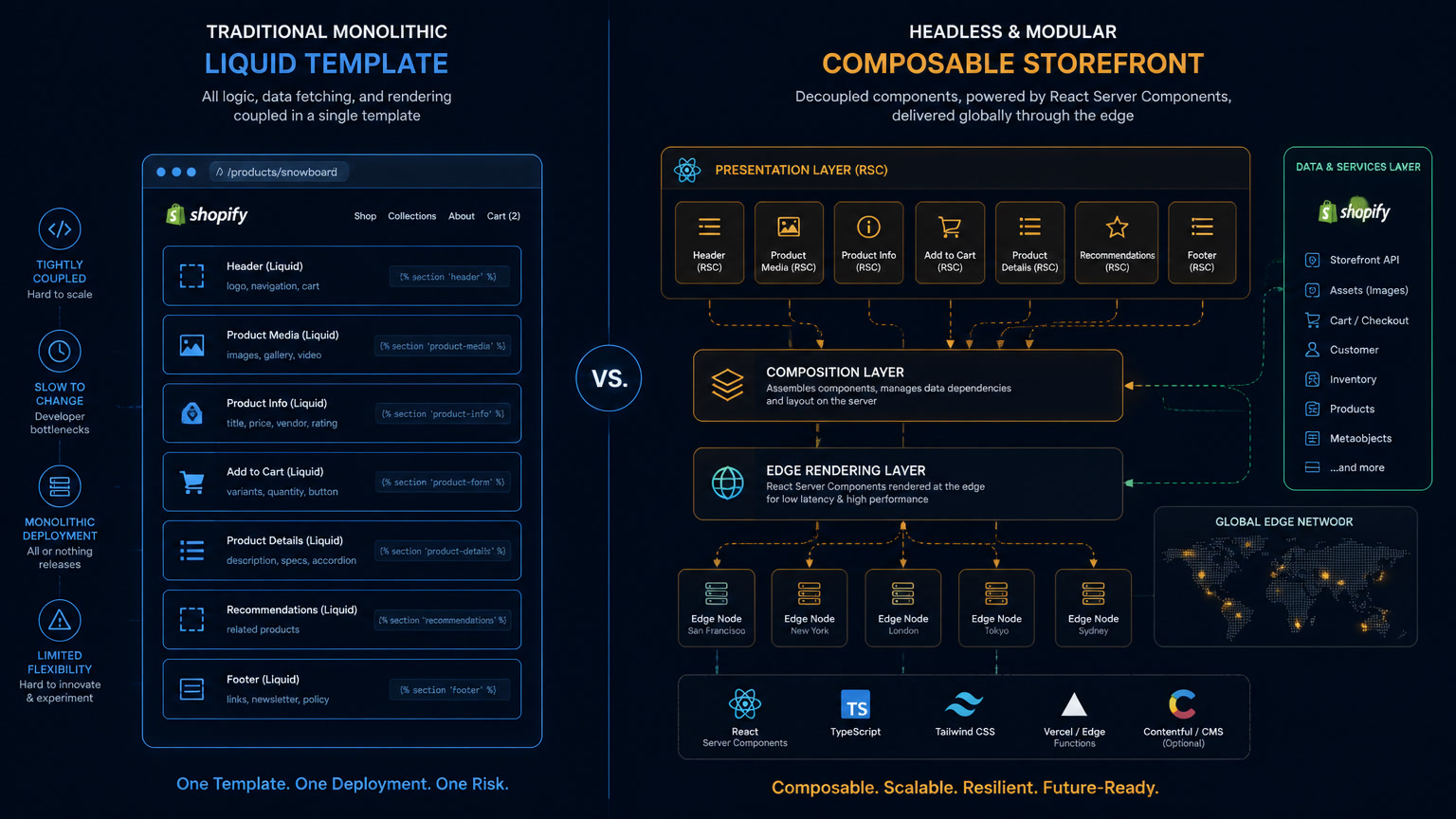
The most visible feature is native React Server Components (RSC) support. Components render on the server without shipping their JavaScript to the browser — a direct improvement in page weight and Core Web Vitals. According to Shopify's internal benchmarks shared with Partners, Time to First Byte (TTFB) on the Oxygen network dropped from 380ms to 95ms in markets like Lagos and Riyadh.
But the real advantage isn't just speed. RSC in Hydrogen 3.0 works natively with Shopify Functions — custom checkout logic, discount rules, and payment customizations now execute from server-side components without REST round-trips. If your cart has 15 volume-based discount rules and 3 currencies, that per-request latency is gone.
The Storefront Composition Layer
This is the paradigm shift. The Composition Layer is an abstraction that enables selective headless: you migrate pages where performance matters most (product detail pages, collections, checkout) to Hydrogen 3.0, while the rest of the store stays on Liquid.
This is non-trivial. According to Pointer Digital's agency benchmarks, a full Hydrogen 2.x buildout typically ran $80,000–$200,000 in initial development plus $15,000–$40,000 annually in maintenance. With the Composition Layer, initial build costs drop 40–60% for brands that only need headless on their highest-traffic pages.
In our post on choosing a headless CMS in 2026, we argued that framework decisions should align with content model and team structure. The Composition Layer confirms that thesis: you can start with headless on the pages that convert most and expand gradually without replatforming.
Oxygen network: from 35 to 90+ edge nodes
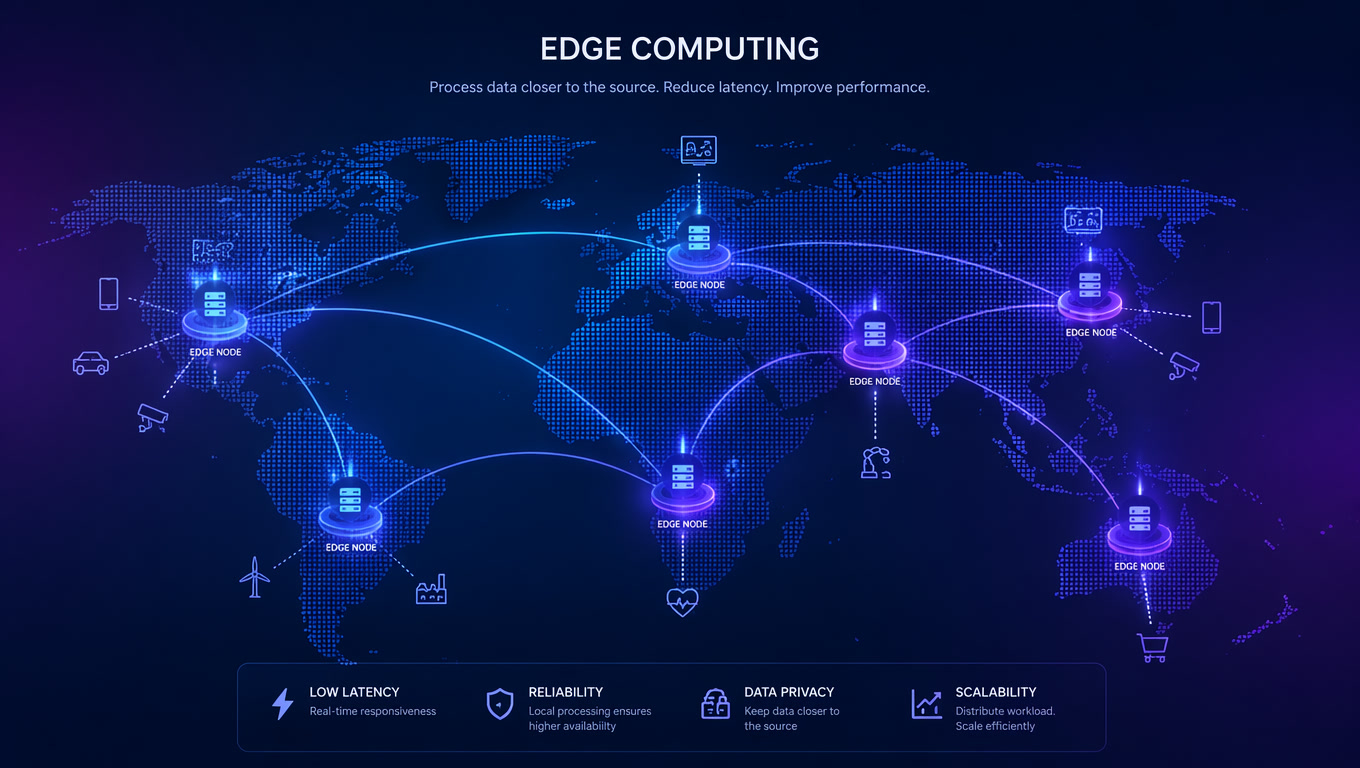
Shopify expanded Oxygen from roughly 35 to over 90 edge nodes globally, with new presence in Southeast Asia, the Gulf region, and West Africa. For cross-border merchants, the last-mile latency where headless performance gains typically evaporated has been significantly reduced.
Merchants operating in LATAM, the Middle East, or sub-Saharan Africa now have real edge rendering, not CDN cache with 60-second revalidation.
WooCommerce 9.0: the other side of the coin
While Shopify bet on selective headless, Automattic shipped WooCommerce 9.0 on September 10 with its own composable layer: the Commerce Composition Layer (CCL). It's a different but converging strategic move — WooCommerce no longer demands replatforming for modern architecture.
The key difference: WooCommerce 9.0 decouples commerce logic from the rendering layer but keeps WordPress's editorial experience intact. Merchants can run the cart, pricing engine, and order management as independent services while editors keep working in Gutenberg blocks.
For agencies with existing WordPress teams, this changes the pricing conversation. You no longer need to route every mid-market merchant to Shopify Hydrogen or BigCommerce because "WooCommerce can't be composable."
Storyblok Agents: the AI layer in headless CMS
Another signal of the same shift: Storyblok launched Storyblok Agents on September 10 — an AI-powered content operations layer built directly into the CMS. Content teams can talk to their content (find duplicates, missing translations, stale content) and build custom agents for recurring tasks.
Storyblok also offers an MCP Server enabling external AI agents to access Storyblok workspaces with structured, permissioned access. It's the "AI content governance" pattern we described in our MCP governance analysis — executed at the product level, not as custom pipeline work.
If you're evaluating a headless CMS for a project with AI agent presence, the combination of Hydrogen 3.0 + a CMS with an MCP server (Storyblok, Strapi, Sanity) gives you a stack where rendering, content, and AI governance are separate but interconnected layers.
The architecture decision in 2026
The pattern emerging from these launches is clear: the era of binary headless is over. Both Shopify and WooCommerce, along with headless CMSs, now offer incremental paths. The question is no longer "headless yes or no?" but "where in the funnel do I need headless and what level of content governance do I need?"
Decision framework
| Situation | Recommendation |
|---|---|
| Shopify merchant $3M+ GMV, poor Core Web Vitals | Hydrogen 3.0 Composition Layer on PDPs and checkout |
| Shopify merchant $500K–$3M GMV, simple catalog | Optimized Liquid theme, evaluate Hydrogen in 6 months |
| WordPress store with $1M–$5M GMV | WooCommerce 9.0 CCL + modern front-end |
| Multi-platform editorial brand | Headless CMS (Storyblok/Sanity) + static framework |
| Shopify Plus merchant with complex B2B | Full Hydrogen 3.0 — first version with native B2B context |
The inflection point isn't technical — it's economic. When your mid-market merchant can access headless with 40–60% less investment, the agency conversation shifts from "it's too expensive" to "which page are you losing the most by not having it?"
What to do now
- Audit your client base. Identify Shopify merchants with suboptimal Core Web Vitals — the Composition Layer gives them a path without replatforming.
- Pilot the Composition Layer. Shopify GA is September 22. The Alloy starter theme arrives in October. Now is the time to test, not commit.
- Revisit WooCommerce proposals. If you had merchants leaving for BigCommerce or Shopify because "WooCommerce can't be composable," WooCommerce 9.0 changes that conversation.
- Evaluate CMS with MCP. If your stack includes or plans AI agents, a CMS with an MCP server (Storyblok, Strapi, Sanity) gives you the governance layer you need.
Headless commerce stopped being an architecture decision — it became a per-page optimization decision. And that changes everything.
Frequently Asked Questions
What is Shopify's Storefront Composition Layer?
It's an abstraction in Hydrogen 3.0 that lets developers go headless selectively: you can migrate specific pages (like product detail pages or checkout) to server-rendered architecture while the rest of the store stays on Liquid. It's not a binary headless decision — it's composable at the page level.
Does Hydrogen 3.0 replace composable stacks with independent CMS?
No. Hydrogen 3.0 narrows the gap but doesn't eliminate it. Composable stacks with Contentful, Sanity, or Hygraph + Next.js still offer more vendor independence and editorial flexibility. Hydrogen wins when you need Shopify-native integrations (Functions, Metaobjects, B2B context) with lower implementation cost.
When should I migrate my Shopify store to Hydrogen 3.0?
Migration makes the most sense if your store generates over $3M in annual GMV, you have measurable Core Web Vitals issues affecting Google Shopping performance, and you have a technical team or agency. For stores under $1M GMV with simple catalogs, an optimized Liquid theme remains the best option.