
WhatsApp abandoned cart recovery: the architecture that converts 20%+ of what email can't
Email recovers 3-5% of abandoned carts. WhatsApp with the right architecture hits 22-28%. Here's the 4-layer design we use with real stores.
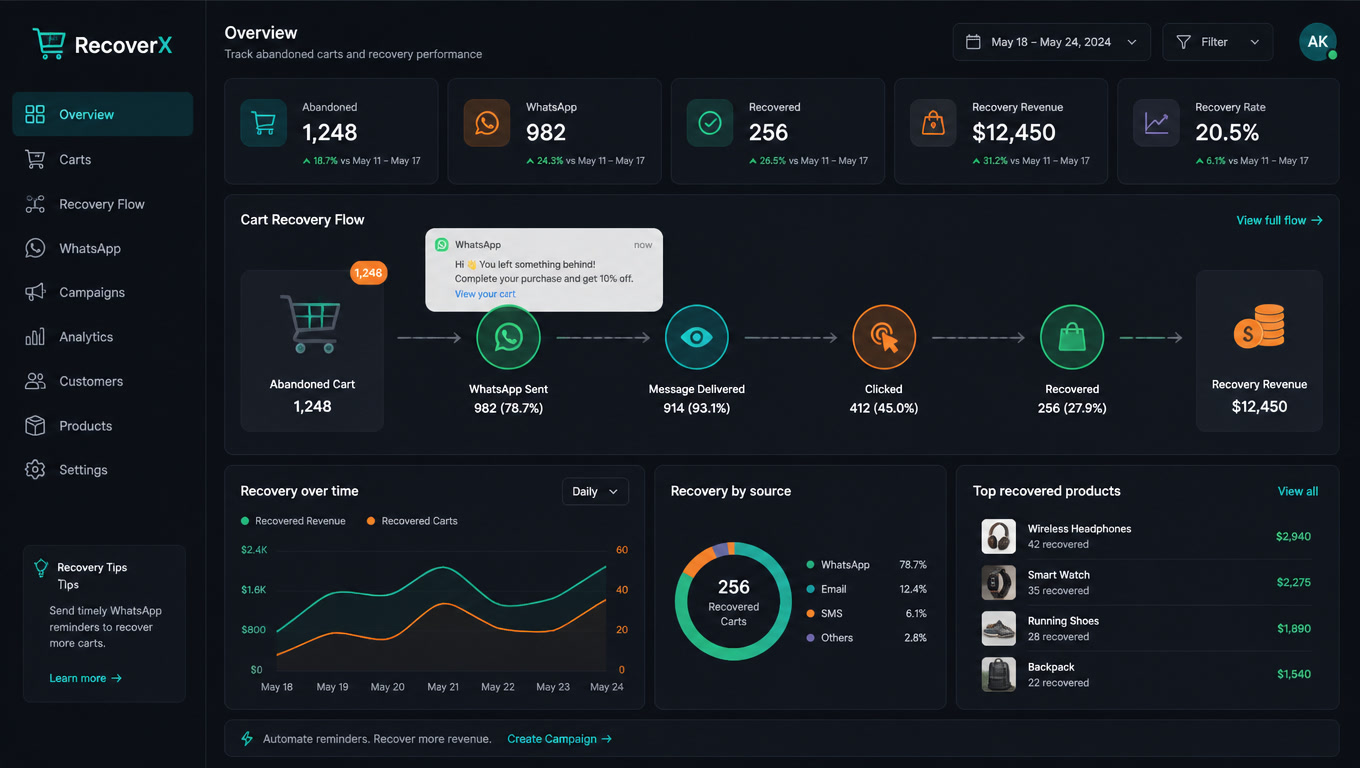
Recovering abandoned carts on WhatsApp isn't a channel switch — it's an architecture change. And the difference between a flow that recovers 8% and one that recovers 25% isn't in the initial message. It's in what happens when the customer replies. Zefir's data across 317 Shopify brands shows a 52.98X ROI on abandoned checkout recovery via WhatsApp, with 33.84% recovered-checkout conversion. AsisteClick, working with real LatAm accounts on tickets between USD 30 and USD 200, documented 22-28% recovery rates using a 4-layer architecture that includes an AI agent responding to objections. Email, on average, recovers 3-5%.
The question isn't whether WhatsApp cart recovery is worth implementing. It's why you're still leaving 70% of your potential demand unattended.
Why email stopped being enough
Email worked as the standard recovery channel. But 2026 numbers tell a different story: email open rate for ecommerce: 18-25%. WhatsApp open rate: 85-95% in LatAm. Email recovery rate: 3-5%. WhatsApp recovery rate: 15-30% with template, 22-28% with AI agent.
Email didn't die, but its ceiling is lower than WhatsApp's floor. And in Mexico, Colombia, and Brazil, the gap is structural. What changed is that WhatsApp enables real-time bidirectional conversation. An abandoned cart isn't always a "no" — sometimes it's a shipping question, a size doubt, or a cash-on-delivery preference. Email can't resolve that. An AI agent on WhatsApp can.
The 4-layer architecture: detect, send, respond, escalate
The difference between an operation recovering 8% and one recovering 25% isn't the channel. It's the architecture. After implementing cart recovery for multiple LatAm stores, the pattern that consistently produces the best results has 4 layers:
Layer 1: Real-time detection
The flow activates when checkout is abandoned. On Shopify, checkout/update webhook or cron polling every 5 minutes. On WooCommerce, native abandoned cart webhook — more reliable. Other platforms via REST API or official app.
Opinion: Most stores implement Layer 1 and stop. A template with a link and nothing else. That gets you 8-12%. Layers 2-4 are where the result multiplies.
Layer 2: Timing and segmentation
The first message doesn't send immediately. Recovery platform data shows a 23% lift when the first touch lands under 30 minutes vs. after an hour. But sending before 15 minutes can feel invasive.
The sequence that works in production:
| Touch | Timing | Content | Template type |
|---|---|---|---|
| 1. Warm reminder | 30-60 min | Product + image + direct checkout link. No discount. | Marketing |
| 2. Reinforcement | 24 h | Social proof, low stock, or free shipping. | Marketing |
| 3. Close | 48-72 h | Small incentive or urgency. Last attempt. | Marketing |
Critical segmentation: not every cart deserves the same sequence. A USD 200 cart with a high-consideration product needs a different approach than a USD 15 impulse buy. Layer 3 is where personalization happens.
Layer 3: AI response to objections (the real multiplier)
This is the layer that separates 8% operations from 25% ones. When the customer replies to the WhatsApp template — "Is shipping free?", "Will size M fit?", "Can I pay on delivery?" — they need an answer within 15 minutes. If they don't get one, the recovery window closes.
A well-trained AI agent:
- Queries stock, updated prices, shipping policies, and payment methods in real time
- Answers FAQs (70-85% of inquiries resolve without a human)
- Escalates complex cases (returns, special orders, price objections)
What we saw in real implementations: a fashion store in Mexico City with a USD 65 average ticket went from 9% recovery (template + link only) to 24% after activating Layer 3. The difference was purely response speed to objections. Customers who received answers within 10 minutes had a 3.2x higher close rate than those who waited 30+ minutes.
Layer 4: Human escalation for high value
Not everything gets resolved by AI. A USD 500+ cart or a repeat customer with a specific issue needs human attention. Layer 4 automatically classifies cases requiring personalized attention and routes them to the right team member.
| Case type | Action | Human time needed |
|---|---|---|
| Shipping / stock inquiry | AI resolves | 0 |
| Price objection | AI offers alternative, escalates if persistent | 2-5 min |
| Payment issue | Escalate immediately | 5-15 min |
| Special / corporate order | Escalate + CRM | 15-30 min |
A store processing 500 abandoned carts monthly with a 15-30% escalation rate needs 15-20 hours of human attention per week. It's not a dedicated agent — it's a team that can respond alongside other functions.
The real cost: investment vs. return
WhatsApp cart recovery isn't cheap because the channel is cheap — it's that the return outpaces the investment by 10 to 50x.
| Component | Monthly cost | Notes |
|---|---|---|
| n8n self-hosted (VPS) | USD 6-20 | DigitalOcean or similar |
| WhatsApp Business API (messages) | USD 30-100 | Depending on volume and category |
| OpenAI / Claude API (AI agent) | USD 20-50 | ~2,000-5,000 interactions/month |
| SaaS recovery platform (alternative) | USD 100-200 | If not using n8n |
| Total with n8n | USD 56-170 | |
| Total SaaS | USD 150-350 |
ROI calculation:
A store with 1,000 abandoned carts monthly, USD 80 average ticket, and 20% recovery rate:
- Carts recovered: 200
- Revenue recovered: USD 16,000/month
- Stack cost: USD 100-200/month
- ROI: 80x to 160x
Even at a conservative 12% recovery rate, ROI exceeds 40x.
Cost by country in LatAm
Marketing message costs vary: Mexico USD 0.03, Colombia USD 0.0125 (cheapest in LatAm), Brazil USD 0.0625, Argentina USD 0.03-0.07, Chile USD 0.0889. In real implementations, cost per recovery typically runs USD 0.15-0.50 per recovered cart. With USD 60 average ticket, the cost-to-recovery ratio is 0.25% to 0.83%.
The opt-in trap: why most stores fail before they start
A 20% recovery rate means nothing if you only have 50 opt-ins. With 1,000 abandoned carts monthly and only 5% consent, you can send 50 messages. At 20% recovery: 10 orders. Opt-in is where most stores fail before they start.
The 3 moments to capture consent:
- On-site popup: coupon in exchange for WhatsApp consent — the biggest lever for most stores
- Checkout: ask for consent during purchase. Conversion 30-60% because the customer is already entering their phone
- Offline touchpoints: QR at the register routing to WhatsApp for brands with physical retail
Opinion: most articles jump straight to the message flow. But opt-in capture is where most fail. Without a consent strategy from day one, you're building a system that only works for 5% of your audience.
Decision matrix: when is WhatsApp worth it over email for recovery?
| Factor | Recommendation | ||
|---|---|---|---|
| Open rate | 18-25% | 85-95% | WhatsApp wins by 4x |
| Low ticket (<USD 30) | 3-5% recovery | 25-35% recovery | WhatsApp without question |
| Mid ticket (USD 30-100) | 4-6% recovery | 18-25% recovery | WhatsApp with AI agent |
| High ticket (>USD 100) | 5-8% recovery | 12-18% recovery | WhatsApp + human |
| Recurring consumables | 3-5% | Up to 40% | WhatsApp — customer was already buying |
| Discretionary products | Baseline | -5 to -10pp from baseline | If they hesitated, they probably won't buy |
| Cost per message | USD 0.001-0.01 | USD 0.01-0.08 | Email cheaper per send |
| Cost per recovery | USD 2-10 | USD 0.15-0.50 | WhatsApp 5-20x more efficient |
Mintec's rule: if your average ticket exceeds USD 10 and you have more than 200 abandoned carts monthly, WhatsApp with a 4-layer architecture outperforms email on ROI by 10 to 50x.
The complete n8n flow: detection to close
For stores building from scratch, the n8n architecture uses 8 nodes:
- Webhook or polling → detects abandoned checkout
- IF node → verifies valid phone (no phone → email fallback)
- Wait node → waits 30-60 minutes
- HTTP node (Shopify/Woo) → verifies checkout wasn't completed. If completed, stops.
- HTTP node (WhatsApp API) → sends template with dynamic cart data
- Webhook node (response) → customer reply activates second workflow
- AI node (OpenAI/Claude) → responds using store's knowledge base
- IF node → AI can't resolve → escalates to human with full context
LatAm: offering cash on delivery in the recovery message removes a top objection. In real implementations, adding COD to the flow increased close rates by 8-12 percentage points.
The most expensive mistake: treating WhatsApp as broadcast
If your recovery flow is "send template and wait," you're in the 8-12% range. The difference to 25% isn't template quality — it's response infrastructure. AsisteClick's data is clear: static template without response → 8-12%. Template plus AI agent → 18-25%. With human escalation → 22-28%.
Stores achieving above 20% share three traits: real-time detection, response within 15 minutes, and a living knowledge base updated weekly.
30-day implementation roadmap
| Week | Activity | Deliverable |
|---|---|---|
| 1 | WhatsApp Business API + approved template + checkout opt-in | Template working, consent flow live |
| 2 | Detection + sending flow in n8n + ticket-based segmentation | First 100 messages sent |
| 3 | AI agent with store knowledge base | Automated objection response |
| 4 | Monitor, adjust timing, train AI with real conversations | Stable recovery rate benchmark |
After 30 days with minimum 200-300 carts processed, you'll have a reliable benchmark.
WhatsApp abandoned cart recovery isn't a marginal optimization — it's the difference between leaving 70% unattended or capturing 18-28% of lost volume. In a store billing USD 50,000 monthly, that's USD 6,000-9,000 in additional revenue with no new traffic.
If your store is leaving carts unrecovered, the stack with WhatsApp Business API, Clientify, and n8n is the highest-ROI investment this quarter. Our AI chatbot cost framework covers the full economics.
Frequently Asked Questions
How much can you recover from abandoned carts with WhatsApp?
It depends on product type and average ticket. With a basic template + link flow, stores recover 15-20%. With an AI agent answering objections in real time, recovery climbs to 22-28%. Low-ticket stores (USD 10-30) hit up to 35%. The difference isn't the channel — it's whether someone answers when the customer responds.
How much does WhatsApp cart recovery cost to implement?
A basic flow with n8n + WhatsApp Business API costs USD 30-80/mes in infrastructure plus USD 0.01-0.07 per message depending on country. A store processing 500 abandoned carts monthly at 20% recovery with USD 60 average ticket recovers USD 6,000/month — the message cost is marginal compared to ROI.
Does WhatsApp cart recovery work in Latin America?
It's the market where it works best. Mobile cart abandonment in LatAm exceeds 85% in many countries. WhatsApp open rates in the region hit 90-95%, and 80% of consumers use WhatsApp as their primary brand communication channel. Email has significantly lower penetration and engagement than in North America or Europe.