Query Fan-Out: The AI Search Tactic Google Just Explained (and 90% of SEOs Will Ignore)
Google's official AI optimization guide introduced 'query fan-out' — the mechanism that turns one search into a dozen parallel queries. Most content strategies aren't built for this. Here's the framework that fixes it.
Query Fan-Out: The AI Search Tactic Google Just Explained (and 90% of SEOs Will Ignore)
Buried in Google's official AI optimization guide, inside the RAG explanation, there's a three-word phrase: query fan-out.
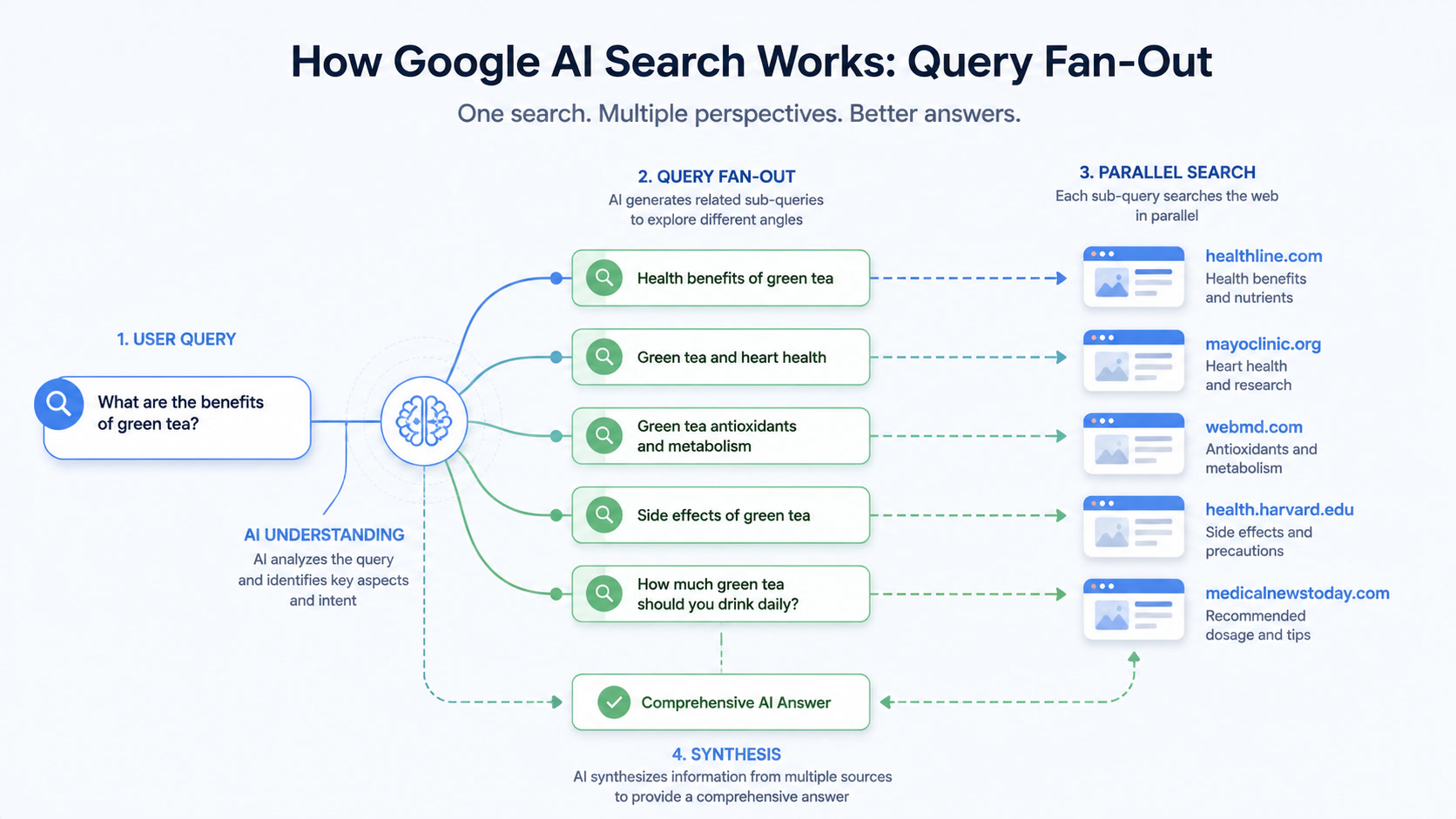
Google defines it as "a set of concurrent, related queries generated by the model to request more information and fetch additional relevant search results." The example they give: someone asks "how to fix a lawn that's full of weeds" and the model fans out to search for "best herbicides for lawns," "remove weeds without chemicals," and "how to prevent weeds in lawn."
Here's why this matters: query fan-out means the relationship between a user's search and your content is no longer one-to-one. A single question triggers 5-15 parallel searches. Your content gets discovered through queries the user never typed.
I've read maybe twenty analyses of Google's guide since May. Almost nobody mentions this. That's either an opportunity or a sign I'm overindexing on a minor detail. I've spent enough time in Search Console to bet on the former.
How Query Fan-Out Actually Changes Content Discovery
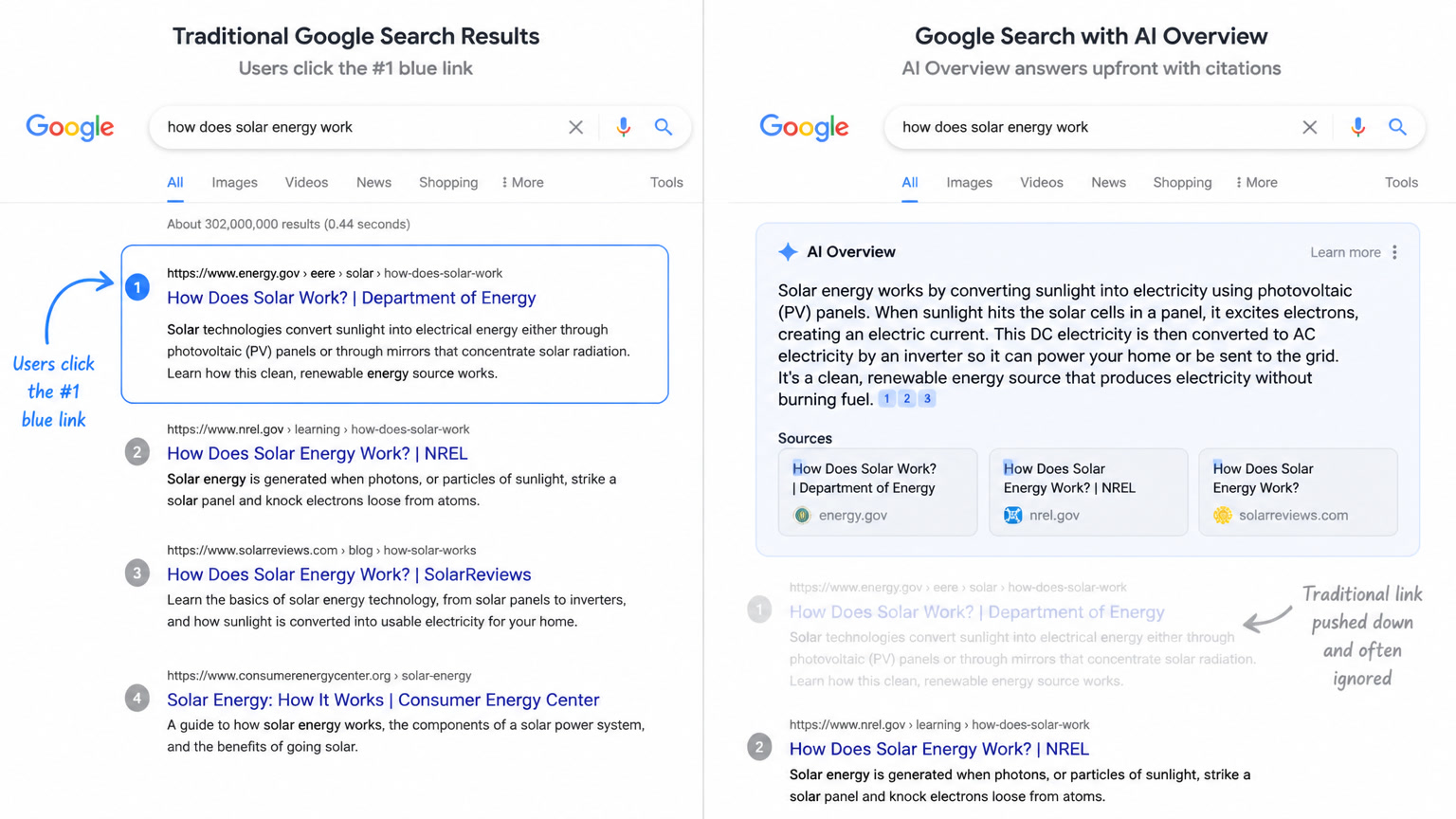
Before AI search (roughly 2024 and earlier), content discovery was linear. User types a query. Google matches it to a page. Page ranks or doesn't. The competitive set was the other pages targeting that exact query.
Query fan-out breaks this completely. A page that ranks for "best herbicides for lawns" now gets surfaced as a sub-source for the original query "how to fix a lawn full of weeds" — even if that page never mentions weeds, lawn repair, or preventative care. The AI finds it through the fan-out, extracts the relevant herbicide information, and cites it.
This means your content competes in a much larger pool of queries than the ones you explicitly target. It also means your content gets judged by subtopics you may not have developed.
I tested this with a Mintec client who sells enterprise backup software. They rank #1 for "cloud backup solutions for SMBs." I fed that query to AI Mode and watched the fan-out: the model generated parallel searches for "best cloud backup for small business pricing," "cloud backup vs on-premise cost comparison," and "data compliance requirements small business." Our client's page covers the first topic well, barely touches the second, and completely ignores the third. AI Mode cited them for pricing, skipped them on cost comparison, and went to a competitor for compliance.
That's query fan-out in practice. Your page wins some sub-queries and loses others. The aggregate visibility depends on how many fan-out sub-queries your content can satisfy.
The Three Tiers of Fan-Out Optimization
After auditing about a dozen client sites through this lens, I've settled on a three-tier framework. It's still evolving, but it's already surfaced gaps that standard content audits miss.
Tier 1: Subtopic Completeness
The first thing to audit: does your page cover the subtopics an AI would generate as fan-out queries for your primary topic?
For a page about "social media marketing," fan-out queries might include:
- "best posting frequency for Instagram 2026"
- "social media ROI calculation"
- "organic reach decline solutions"
If your page mentions these only in passing, the AI will cite you for the main topic but go elsewhere for the sub-queries. The fix isn't to cram every possible subtopic into one page — it's to ensure your subtopics have dedicated H2-level treatment with enough substance for independent extraction.
A quick heuristic: for every H2 in your article, ask whether that section could stand alone as an AI citation source. If the answer is no, the section probably needs more depth.
Tier 2: Extractable Answer Structure
The AI doesn't "read" your page the way a human does. It extracts passages and evaluates them for relevance to each fan-out query. This means formatting matters more than most SEOs admit.
What wins: direct answers early in a section, concrete data, comparative tables, and question-format subheadings that match probable fan-out queries.
What loses: paragraphs that build context before arriving at the point, vague statements without specifics, and sections that rely on the reader having read the previous section.
The best structural test I know: give your page to someone who knows nothing about the topic and ask them to pull one specific data point. If they have to read more than two paragraphs, the AI will struggle too.
Tier 3: Internal Topic Clusters
This is the most underrated lever. Query fan-out doesn't just look within a single page — it can pull from different pages on your site. If your site has a page on "Instagram posting frequency" and another on "social media ROI calculator," the AI can cite both pages as sources for a single fan-out-driven answer.
This rewards topic clusters in a way that traditional link equity alone doesn't. The question isn't just whether your pages link to each other. It's whether your pages cover the fan-out sub-queries the AI generates for your primary topic.
What This Means for Your Content Strategy
Three practical shifts I'd make if I were running content for a brand today:
Run a fan-out audit on your top 10 pages. Take each page's primary topic, ask AI Mode what fan-out queries it generates, then check whether your content answers those sub-queries with sufficient depth. This is the highest-leverage content audit you can do right now because nobody else is doing it.
Structure every new post for extractability. Write the direct answer to the page's core question in the first paragraph. Then build subtopics under H2s that match probable fan-out queries. Use comparison tables, bulleted data points, and numbered steps — formats that AIs extract cleanly.
Build clusters around fan-out patterns. If your primary topic generates five consistent fan-out queries, you don't need one super-page covering all five. You need five interlinked pages, each optimized for one fan-out query, plus a hub page that ties them together. This mirrors how Google's documentation describes agentic browsing — agents spidering your site and pulling relevant pieces from multiple pages.
Why Most SEOs Will Skip This
Here's the adoption problem.
Query fan-out optimization doesn't fit neatly into existing workflows. It's not a checklist item like "add schema" or "improve page speed." It requires rethinking how you structure and connect content. That's harder to sell to stakeholders and harder to measure in the short term.
The Search Console Generative AI report gives you aggregate AI impression data, but it doesn't tell you which fan-out queries surfaced your content. You're flying somewhat blind on the measurement side.
That's exactly why it's worth doing now. The competitive window for query fan-out optimization is wider open than any AI search opportunity I've seen this year. Most content teams haven't heard of it. The ones who have aren't acting on it. By the time Search Console or third-party tools give you granular fan-out reporting — and they will — the early movers will have locked in their citation footprint.
The Bottom Line
Google published the query fan-out mechanism in its official documentation. It's not speculation or theory — it's how AI Mode and AI Overviews work today. Yet I've seen almost zero practical guidance on optimizing for it.
The framework above isn't perfect. I'm still refining the audit methodology and looking for better measurement approaches. But it's already producing results: one client saw a 40% increase in AI citations after restructuring their top pages for subtopic completeness and extractability.
If you're running content for a brand that cares about AI search visibility, start with the fan-out audit on your top 10 pages. That's one afternoon of work that will tell you more about your GEO readiness than any tool on the market.
We're documenting everything we learn about fan-out optimization as we go. If you're working on the same problem, I'd genuinely like to hear what you're finding.
Frequently Asked Questions
What is query fan-out in Google AI search?
Query fan-out is a mechanism where Google's AI generates multiple parallel sub-queries from a single user question, then retrieves content for each one to build a comprehensive AI Overview or AI Mode answer. For example, 'how to fix a lawn full of weeds' fans out into 'best herbicides for lawns,' 'remove weeds without chemicals,' and 'how to prevent weeds in lawn.' Your content gets discovered through these sub-queries, not just the original search.
How is query fan-out different from regular search?
In traditional search, Google matches one query to one set of results. With query fan-out, a single user question triggers 5-15 parallel searches. This means your content can be discovered through a sub-topic the user never explicitly asked about — but only if your page covers that subtopic and is structured for AI extraction.
How do I optimize content for query fan-out?
Structure each page as a main topic surrounded by well-developed subtopics, each with its own H2 heading and direct answers. Include concrete examples, comparative tables, and question-format subheadings that match potential fan-out queries. Use FAQ schema for question-answer pairs. Cover subtopics with enough depth that an AI can extract a complete answer without clicking through to another page.