
The All-AI-Agent Myth: Why Deterministic Automation Still Wins 80% of the Time
Gartner places AI Agents at the Peak of Inflated Expectations: only 17% of organizations have deployed them, and 40% of projects are predicted to fail. Here's why deterministic automation with n8n and Make is still the right call for most business processes.
If you're reading this, someone has probably told you that you "need AI Agents" for your business. That without autonomous agents you'll fall behind. That the future is dozens of agents working in parallel while you sip coffee.
Let's pump the brakes on that.
We've been implementing automation for businesses across industries for years. We've seen everything from n8n workflows moving thousands of leads daily without a single error, to AI Agent projects that promised the moon and ended up more expensive, slower, and less reliable than a three-node Make automation.
Here's an uncomfortable truth for the hype peddlers: for 80% of business processes, a well-designed deterministic automation outperforms an AI Agent. Period.
What Gartner Says (and It Stings)
Gartner released its first dedicated Hype Cycle for Agentic AI in April 2026, and the data is sobering. Only 17% of organizations have deployed AI Agents in production. While 60% plan to within two years — the most aggressive adoption intent curve ever recorded — that doesn't mean it'll go smoothly.
In fact, Gartner predicts that over 40% of agentic AI projects will be canceled by end of 2027. The reasons: escalating costs, unclear business value, and inadequate risk controls.
They place AI Agents squarely at the "Peak of Inflated Expectations." That doesn't mean the technology has no value. It means the gap between what a demo promises and what works in production is still enormous.
And that's not me talking. That's Gartner.
The Real Problem: Demos Aren't Production
We've seen this pattern play out with multiple clients. An AI Agent vendor walks in, delivers a spectacular demo: "Look, the agent understands the customer email, extracts the data, updates the CRM, and responds — all on its own." The client is sold. They sign. They deploy.
Three months later:
- The agent hallucinates wrong responses 5% of the time
- Token costs are 3x over budget
- Every CRM update breaks the agent's behavior
- The IT team spends hours "realigning" it
Meanwhile, the deterministic automation we built for another client with n8n — three nodes: webhook → filter → update CRM — has been running 24/7 for 8 months without a single error. Infrastructure cost: $29/month. Zero hallucinations. Zero drift.
That's the difference.
The Decision Framework: Agent or Deterministic?
At Mintec, we use this framework to decide when to use AI Agents and when to stick with deterministic automation. It's simple and it works:
| Situation | Deterministic Automation | AI Agent |
|---|---|---|
| Moving data between systems | ✅ | ❌ (overkill) |
| Fixed-rule notifications | ✅ | ❌ |
| Clear-condition approvals | ✅ | ❌ |
| Score-based lead routing | ✅ | ❌ |
| Free-text interpretation (emails, chats) | ❌ | ✅ |
| Natural-language flow decisions | ❌ | ✅ |
| Highly volatile business rules | ❌ | ✅ (with oversight) |
| Strict regulatory compliance | ✅ | ⚠️ (human-in-the-loop) |
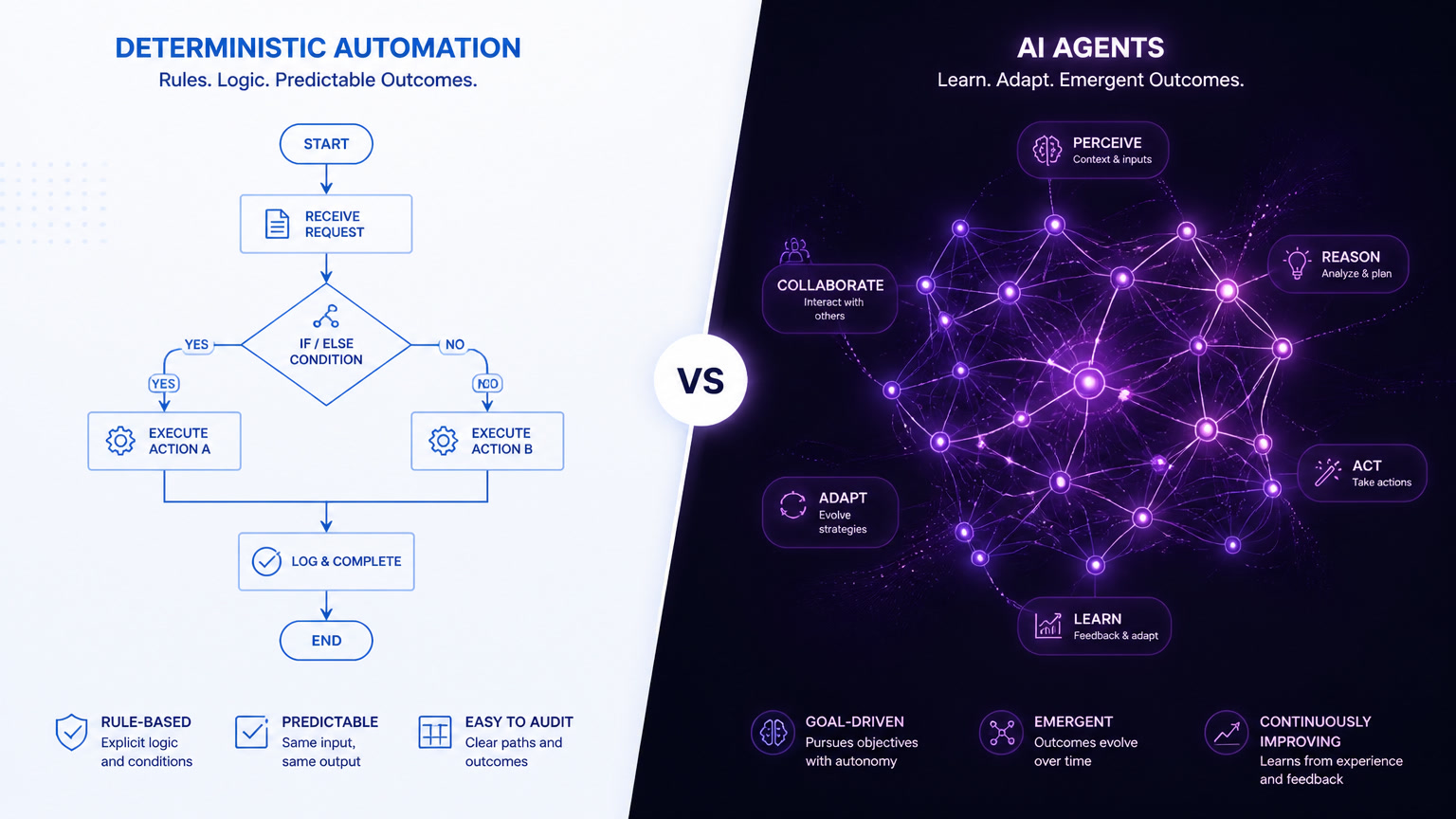
The rule is straightforward: if the decision can be expressed as a binary condition or a finite set of rules, you don't need an AI Agent. Deterministic automation is cheaper (10x-50x), faster (ms vs seconds), and fully auditable.
Where AI Agents Actually Shine (Let's Be Fair)
I'm not saying AI Agents have no value. They do — in specific, well-scoped scenarios:
Semantic understanding: when you need to grasp customer intent from an email or chat, an LLM is unbeatable. Classifying whether a message is "complaint," "inquiry," or "purchase intent" based on natural language — not keyword matching.
Summarization: generating summaries of long conversations, extracting meeting action items, synthesizing customer feedback at scale.
Contextual routing: when routing rules depend on semantic content rather than fixed criteria — directing a complex complaint to the right team based on the full context, not just which department the customer selected.
But for every one of these cases, the AI Agent should operate inside a deterministic workflow that contains it. It's not agent or deterministic. It's agent within deterministic.
The Hidden Cost of AI Agents
Here's something almost nobody talks about: the operational cost of keeping AI Agents running in production. I'm not just talking about API costs (which are significant). I'm talking about:
Model drift: LLMs change their behavior with every update. An agent that worked perfectly in January may start making different decisions in March because the underlying model was updated. That never happens with deterministic automation.
Debugging: when an AI Agent makes a wrong call, figuring out why is nearly impossible. It's a black box. In n8n or Make, every step is logged. You know exactly where and why it failed.
Unpredictable costs: deterministic automation has fixed, predictable costs. AI Agents have variable costs that can spike if volume grows or if the model starts making more API calls than expected.
In one of our projects, the client spent $2,400 in AI Agent tokens in a single month for a process that a deterministic n8n automation handled for $47. That gap matters.
The Hybrid Approach That Actually Works
The strategy that's delivered the best results for our clients is this:
Start deterministic: automate everything that's fixed rules, data movement, and notifications with n8n or Make first. This covers 70-80% of the process.
Find the semantic bottlenecks: where do you need natural language understanding? Where does a human decision slow everything down? That's where you place a scoped AI Agent.
Wrap the agent in a workflow: the AI Agent doesn't decide its own full execution path. It receives a concrete task, executes it, and returns the result to the deterministic workflow that orchestrates it.
Monitor and measure: every agent decision must be logged. Every error, recorded. If the agent's error rate exceeds the threshold — defined before implementation — the workflow escalates to a human.
This isn't theory. We've implemented it this way for clients across sectors, from professional services automation to sales-to-delivery handoff workflows.
What Actually Matters: Results, Not Technology
Across our CRM automation projects, the factor that correlates most with success isn't technological sophistication. It's process clarity. Clients who understand exactly what rules to apply, when, and why get better results regardless of whether they use n8n, Make, or plain Python scripts.
AI Agents are one more tool. Neither salvation nor enemy. But in a market where every vendor is "agent-washing" their product — rebranding if-this-then-that automation as AI Agents — someone had to say it.
For 80% of cases, deterministic automation is still the right answer. Cheaper. More reliable. Easier to maintain.
And if you do need an AI Agent for the remaining 20%, make sure it operates inside a deterministic workflow that contains it, monitors it, and keeps it in check.
That's not being old-fashioned. That's having judgment.
Frequently Asked Questions
What is the difference between an AI Agent and deterministic automation?
An AI Agent uses language models to decide its own execution path in real time. Deterministic automation follows a fixed set of if-this-then-that rules. The first is flexible but unpredictable; the second is rigid but 100% predictable. For 80% of business processes, predictability outweighs flexibility.
When should I use an AI Agent instead of n8n or Make?
Use AI Agents when the process requires semantic understanding — analyzing an email, summarizing a conversation, interpreting a lead's intent — and the cost of a mistake is low. For everything else — data movement, CRM updates, notifications, conditional approvals — deterministic automation is cheaper, faster, and easier to audit.
What does Gartner say about AI Agent adoption in 2026?
Gartner published its first dedicated Hype Cycle for Agentic AI in April 2026. Only 17% of organizations have deployed AI Agents, though 60% expect to within two years — the fastest adoption intent curve ever recorded. The firm predicts over 40% of agentic AI projects will be canceled by end of 2027 due to escalating costs, unclear business value, or inadequate risk controls.