
Four Hours of Filming per Second: What You're Buying
Levi's shot four hours of film for every second of its holiday spot. Read that ratio as a budget rule for splitting hand-made and generated video.
Levi's new holiday film took four hours of shooting for every second of animation. Most coverage treated that as a craft boast. It is a budget rule, and it is the most useful number published in advertising production this quarter.
Here is the derivation nobody printed. Four hours per second means one eight-hour day yields two seconds of finish, so a sixty-second film needs about thirty shooting days before an editor touches it. Add the set build, reported at more than 2,000 hours, and a one-minute film lands near 2,240 hours of human labour — roughly 37 hours of work per second on screen. That is a figure finance can argue with. "We shot it by hand" is a mood.
What the campaign actually published
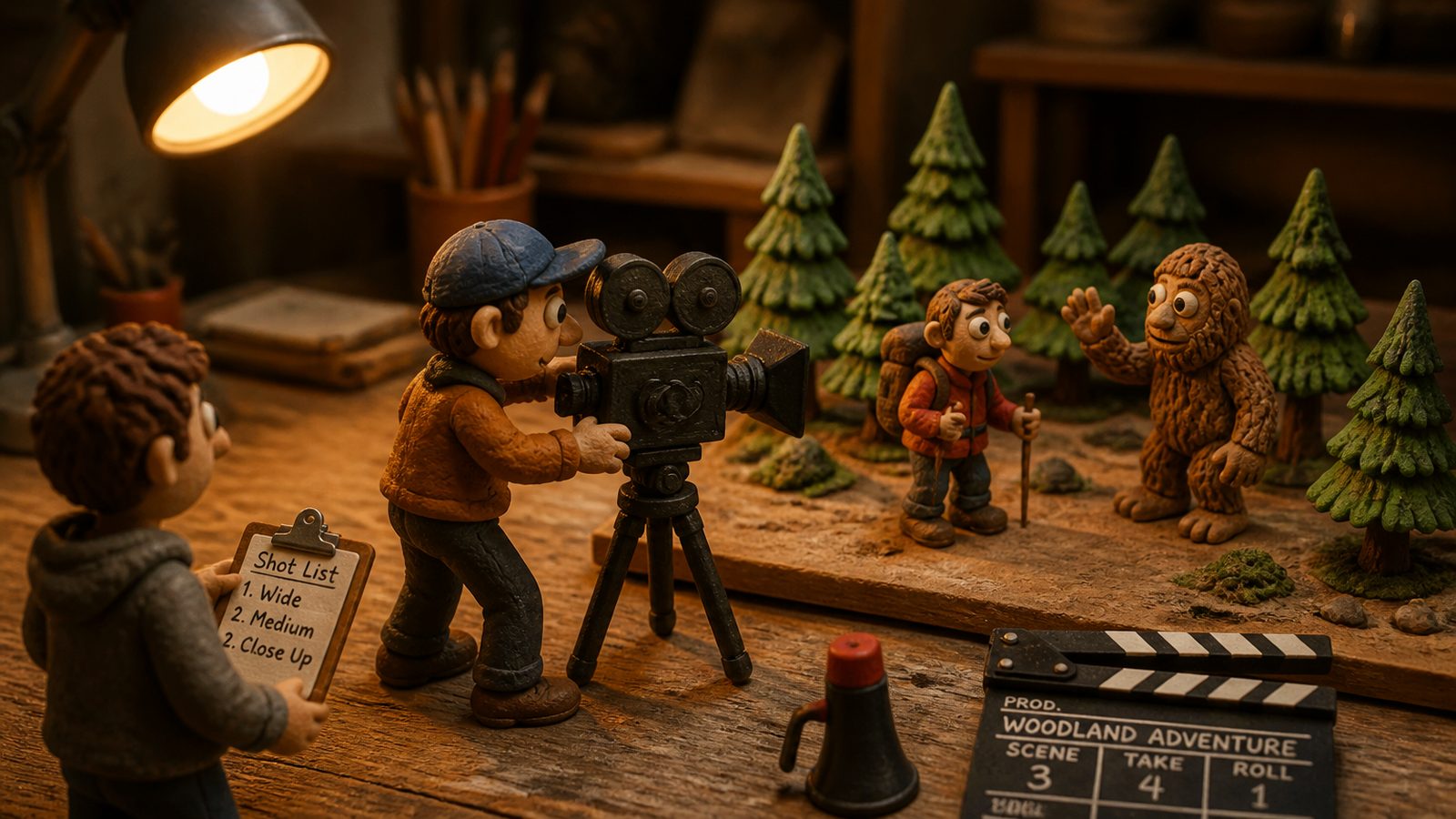
Levi Strauss & Co. announced its Holiday 2026 campaign, "Let's Get Fuzzy," on 2 November 2026. The centrepiece is a 60-second stop-motion claymation film. The brand's own release states the film "required four hours of filming for each second of animation," that the set and characters were fully crafted by hand and each character outfit reproduced by artisans, and that the claymation harks back to "Clayman," its 1995 commercial and the first full-length spot shot entirely in claymation.
Marketing Dive covered it the next day under the framing of hand-made craft amid AI bloat, and reported that no AI was used in the filming process, per the brand. That detail is doing a lot of work in the coverage. It is also, strictly, a claim about one stage of the pipeline.
Trade reporting fills in the cost the release left out. DesignRush reported a six-person team spent more than 2,000 hours building and painting sets, including 400 miniature trees, after the directors wrote 14 scripts before the yeti story was chosen. Fourteen scripts to arrive at one narrative is a revision process most budgets do not anticipate either.
Put the published figures together and the arithmetic is simple, and it is the part that transfers to any brand:
| Figure | Value | Source |
|---|---|---|
| Filming time per finished second | 4 hours | Levi's press release, 2 Nov 2026 |
| Shooting hours for a 60-second film | 240 hours (30 shooting days at 8h) | Derived from the above |
| Set construction | 2,000+ hours, six people, 400 miniature trees | DesignRush reporting |
| All-in labour per finished second | ~37 hours | Derived |
| Scripts written before selection | 14 | DesignRush reporting |
The crossover is variant count, not quality
Two production models, two cost curves, and they fail in opposite directions.
Generated video is cheap per attempt and expensive per decision. The marginal clip is close to free, so the cost migrates forward: someone has to watch forty outputs, hold brand consistency across them, and reject most of what came back. That labour is real and almost never budgeted.
Hand-made video is expensive per attempt and cheap per decision. A built set costs what it costs, and it produces exactly one thing to approve. Revisions live inside a physical object, which is why a note at second 24 can mean rebuilding rather than re-prompting.
Once you frame it that way, the decision stops being about authenticity and becomes about how many versions of a second you actually need.
Our working rule of thumb, not a law: below about three variants per second, shooting is usually cheaper per usable second, because one build amortises across a handful of decisions. Above roughly six, generated is the only version that closes, because nobody amortises a set across six hooks killed inside a week. The middle is a judgement call, and should be priced as one.
That is also why the "AI versus hand-made" framing is a bad budget conversation. It asks a culture question and then wonders why the number never arrives.
Allocate by the job of the second
The unit of decision is not the campaign. It is the second, because that is what the four-hour ratio is denominated in. Split the runtime by what each second is for, then buy each second from the model that fits it.
| Job of the second | Shoot it | Generate it | Why the line falls there |
|---|---|---|---|
| Product truth — texture, weight, how a thing actually behaves | Yes | No | Generation drifts on physical detail shot to shot; a product that changes shape between cuts is a defect, not a style |
| Hook openers for paid variants | No | Yes | You need eight or twelve of them to learn anything; at four hours a second, hand-made hooks are unaffordable experiments |
| Localised versions of the same shot | No | Yes | On-screen text, voice, and lip movement are the cheap half of localisation; the set is the expensive half |
| Human reaction in close-up | Yes | Rarely | Faces under two seconds of screen time still read as synthetic, and the failure is in the eyes, not the resolution |
| Plates, set extensions, crowd fill, backgrounds | No | Yes | These are invisible when correct. Nobody is buying craft they cannot see |
| The signature frame — the one people screenshot | Yes | No | This is the second that carries the campaign's provenance; it is the one worth 37 hours |
Read the table as a spending plan. Most brand films are 90% signature seconds by instinct, which is how a one-minute film becomes a thirty-day shoot for a message that needed nine seconds of craft and fifty-one of assembly.
Where the ratio breaks
Three failure modes show up in real production, and all three are arithmetic rather than taste.
Variant math. Twelve hook variants at 1.5 seconds each is eighteen seconds of finish. At four hours per second that is 72 hours of shooting, before you have shot the body of the film. The ratio does not survive a testing culture, and it is not supposed to.
Revision math. A note on second 24 of a hand-made film means a set rebuild or a reshoot. A note on a generated shot means a re-prompt, plus a re-review of everything downstream because seeds drift and the neighbouring shots no longer match. The second revision is cheaper. The tenth usually is not.
Review math. Generated video does not delete labour, it relocates it from building to rejecting. Teams that budget generation as a line item and review as free are consistently surprised in month two, when the same three people are watching four hundred clips a week and approving twelve.
Svedka is the counter-example, read correctly
In the same fortnight, Marketing Dive reported that Svedka is asking consumers to create its next Super Bowl ad, after backlash over a 2026 spot that used AI to bring its mascot to life. The obvious read is that the backlash worked and the brand retreated. Our read is different, and it matters more for budgets.
Svedka did not stop using AI and did not commission hand-craft. It moved authorship to the audience. That is a third production model, not a reversal, and it suggests the objection was never really about the pixels. It was about who is seen doing the work, and whether anyone is accountable for it.
If that read is right, the operational lesson is cheap to apply: when you generate, say so and say why. Disclosure is not a legal footnote bolted onto the end of a campaign, it is part of the creative proposition. Brands that hide the model and get caught pay twice — once for the work, once for the story.
The decision sequence
Three steps, in order, before a brief goes out.
- Write the second list. Runtime broken into labelled seconds with the job of each one attached. If two people disagree about what second 34 is for, the disagreement is the finding and it costs nothing to surface now.
- Price both treatments against each second. Not per campaign. Per second, using the ratio you can actually verify: hours per finished second against clips reviewed per finished second.
- Buy the ratio, not the film. Agree how many seconds are shot and how many are generated, put it in the scope, and expect pressure at the first cut to convert a cheap second into an expensive one. That pressure is normal and it is where budgets die.
Where synthetic video fails brand review is its own subject, and we have written about the review gate already: generated footage usually breaks on continuity and hands before it breaks on concept, which is why a gate beats a taste debate.
What to measure
Judge the production on two numbers, neither of which is CPM.
Cost per usable second — finished seconds that passed brand review, divided by total production spend including review labour. It is the only figure that lets you compare a 37-hour hand-made second against a generated second with forty rejected siblings.
Hook-level retention, per variant, not per campaign — the same distinction we make when a video ad's CTR looks healthy while its hooks are dying. A generated hook that holds attention for two seconds at a tenth of the cost of a shot hook is the whole argument for generating it, and you only see that if variants are tracked separately.
What we would not claim is a conversion lift from any of this. Production method changes what a viewer receives in the first two seconds; whether that becomes revenue depends on offer, audience and landing page, and attribution at the creative level is still weaker than most decks pretend.
If the hand-made-versus-generated question has stalled at the taste stage, the fix is arithmetic, not another round of references. Start with the seconds you cannot afford to fake, and build the budget outward from those. That is the shape of the work behind our AI video and audio practice, and the reason we still keep a production crew attached to it rather than treating one as a substitute for the other.
The short version
Four hours of filming per second is not a flex. It is 37 hours of human labour per second of screen time, once the set build is counted, and it only pays back on the seconds that carry proof. Everything else in the timeline should be bought from whichever model makes variants cheap — and the budget conversation is won or lost in the second list, long before anyone argues about authenticity.
If that sounds like the argument your team keeps having without a spreadsheet, book a call and bring the runtime.
Frequently Asked Questions
What does four hours of filming per second actually mean in practice?
It means one eight-hour shooting day produces about two seconds of finished animation, so a sixty-second film needs roughly thirty shooting days before editing starts. Multiply four hours by the runtime in seconds and you have the shooting schedule; add the set build and you have the real labour figure. For a one-minute stop-motion film that lands around 2,240 hours, or about 37 hours of human work per second on screen.
Should a brand choose hand-made or AI-generated video?
Neither, as a default. The decision should be made per second, not per campaign. Seconds that carry product truth, physical texture or a human reaction in close-up are usually cheaper to shoot than to iterate, because a physical build is honest about what it costs. Seconds that exist to create variants — hook openers, localised versions, aspect-ratio reframes — are cheaper to generate, because nobody can amortise a built set across twelve hooks that will be killed in a week.
How do you budget a mixed hand-made and generated production?
Write a second-by-second job list before the brief, price both treatments against each second, and contract the ratio rather than the finished film. That means agreeing how many seconds are shot and how many are generated, then holding the line when the first cut makes someone want to convert a cheap second into an expensive one.
Does using AI video hurt brand perception?
The evidence points at authorship rather than pixels. Canva's 2026 marketing and AI report, as reported by DesignRush, found 78% of consumers would rather see ads made by people even if the technology could produce higher quality. Marketing Dive cites a Harris Poll finding that most consumers are growing tired of AI-generated content, particularly in advertising. Neither number says generated video fails; both say audiences are sensitive to whether anyone is visibly doing the work.