Automated LGPD audits with n8n: run your own compliance check before the ANPD does
The ANPD opened 81 inspections in 2025 and asks for your ROPA first. Here's the n8n LGPD self-audit workflow: mapping, consent, retention, incidents.
Yes, an LGPD self-audit can be automated with the same stack you already use for sales —n8n, your CRM, and a couple of APIs— and for most Brazilian companies it's the highest-ROI compliance move available right now. The ANPD opened 81 inspection processes in 2025 alone, answered 12,701 data-subject requests, and has sanctioned at least nine cases since its first fine in July 2023. Here's the detail almost nobody knows: in that first fine against a private company, the absence of a ROPA and of a named data protection officer weighed as heavily as processing data with no legal basis.
That conclusion isn't mine, it's the regulator's: missing basic documentation is an autonomous infraction. You don't need a data leak to be non-compliant. The good news is that what the ANPD asks for first —processing records, documented legal basis, consent with evidence, retention limits, and an incident runbook— is exactly the kind of information an n8n workflow can generate, verify, and keep alive automatically.
Why 2026 is the year this stopped being theoretical
Brazil moved from theory to active enforcement in two steps. First came the inaugural fine in July 2023: Telekall Infoservice, a micro-company selling WhatsApp contact lists with no legal basis. R$14,400 in penalties —reduced because it was a micro-enterprise— plus an infraction combo that defines the pattern: processing without legal basis, no appointed data protection officer, and failure to answer the authority's requests.
Then came institutional consolidation. In March 2026 the ANPD became a full regulatory agency with management and budget autonomy, hired 213 new staff, and —per its first Integrated Management Report— opened 81 inspection processes in 2025. The sanctions map tracked by Confidata shows the trend: nine sanctioning cases since 2023, from late incident reporting (Brazil's Health Ministry, 8 months late) to the INSS being forced to publicize its infraction inside its own app for 60 days — the most expensive sanction of all: reputational.
The most instructive case for a normal company is SEEDF in 2024: the authority found an infraction for inadequately maintained ROPA and missing RIPD even without a new incident. Translation: a dead document is a live risk. It's the same enforcement pattern we mapped for WhatsApp compliance in regulated industries in Mexico and Colombia — authorities ask for paperwork first, excuses later.
What the ANPD checks first: the 5 audit fronts
| Front | What the ANPD reviews | Where companies fail |
|---|---|---|
| ROPA (art. 37) | Processing records organized by activity, not by data type; kept current | Created once and never touched; a stale ROPA reads as negligence |
| Legal basis (art. 7) | Every activity has a documented legal basis | Consent used for everything, even where contract or legal obligation applies |
| DPO (art. 41) | Named officer with a published, functional contact channel | No officer, or a generic inbox nobody reads |
| Consent | Records with timestamp, capture channel, notice version, exact text | Nothing recorded; pre-checked boxes; no separation by purpose |
| Retention & incidents (art. 48) | Per-category retention and notification within 3 business days | Data kept forever; no response runbook |
The ROPA is the first document the authority requests in an inspection, and the LGPD doesn't mandate fixed fields: the converging practice —official template and consultants alike— is to organize by processing activity, not by data category. The same CPF can sit on different legal bases in employee onboarding (legal obligation) and a loyalty program (consent). If your record is organized by data, it's organized wrong.
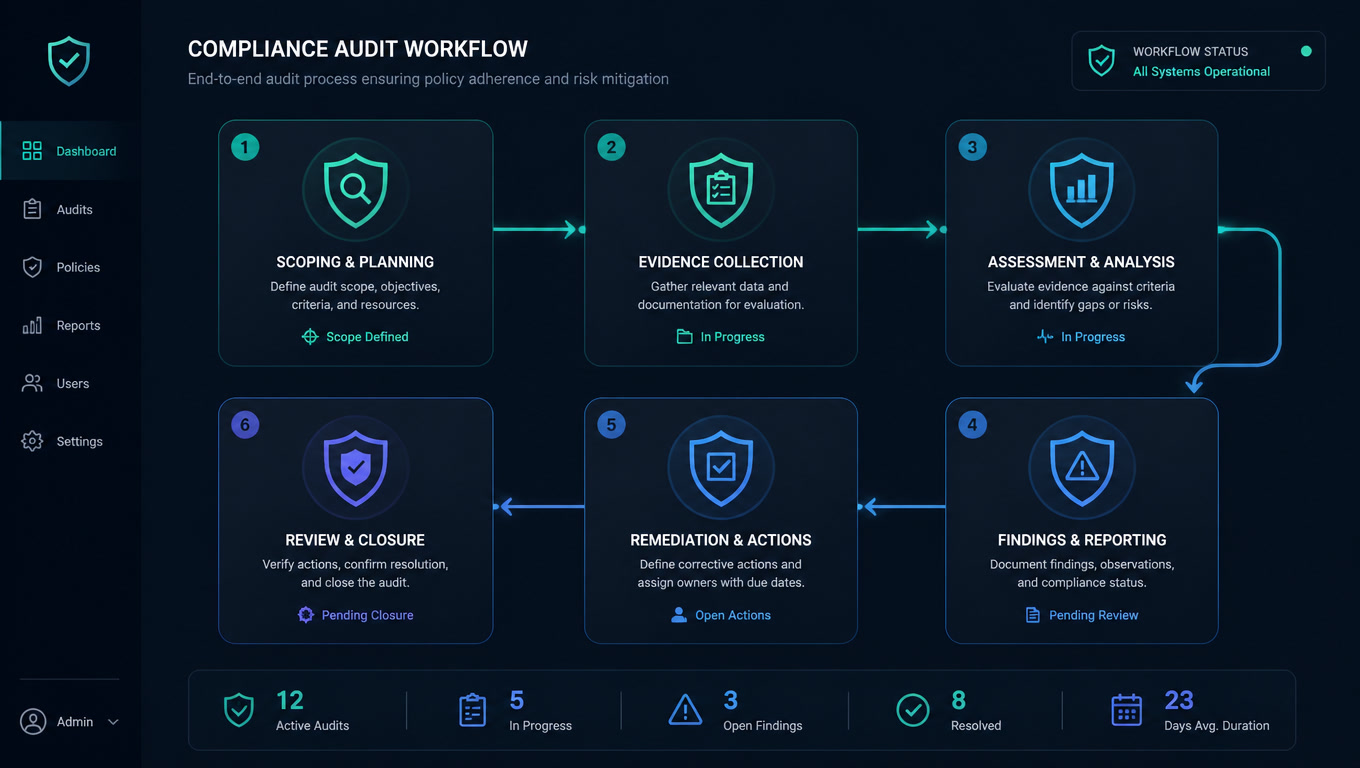
The n8n self-audit workflow: 6 nodes
This isn't theory: it's the pattern we apply when auditing a Brazilian client's CRM. The flow runs on n8n —self-hosted when sensitive data is involved, cloud when budget is tight— and pulls from the CRM, web forms, WhatsApp logs, and spreadsheets. It returns evidence instead of opinions.
| Node | What it audits | Sources it queries | Output |
|---|---|---|---|
| 1. Inventory | Which processes handle personal data, and for what purpose | CRM, forms, WhatsApp API, email | ROPA draft per activity with legal-basis flag |
| 2. Living ROPA | Whether the record still reflects the real operation | CRM schema and field comparison | Detected drift + update tasks |
| 3. Consent | Timestamp, channel, notice version, exact text of each opt-in | CRM consent fields | Report of missing or incomplete records |
| 4. Retention | Per-category data deadlines | Last-interaction dates | List of records to delete or anonymize |
| 5. Incidents | Detection and response within deadline | Security alerts, logs, phishing reports | Containment checklist + ANPD report draft with computed deadline |
| 6. Data-subject rights | 15-day responses to art. 18 requests | Request inbox | Queue with expiry dates and response evidence |
Node 1 delivers 80% of the value. In a manual audit, data mapping eats weeks: you interview every department and reconstruct from memory which system stores what. A flow that walks the CRM and the forms detects where CPFs, phones, addresses, or health data appear, groups them by activity, and produces a ROPA draft in hours. Human review then concentrates where it belongs: confirming purposes and legal bases.
Node 5 is the one that saves the company. Resolution CD/ANPD 15/2024 set the reporting deadline at three business days from when the controller learns the incident affected personal data —six for small-scale agents— with 20 business days to supplement the initial report. Three business days is not enough time to assemble a report covering the nature of the incident, categories and counts of affected subjects, measures applied, mitigation plan, and DPO contact. An n8n flow that catches the alert, fires the containment checklist, and drafts the report using the ANPD's form turns panic into a validation task. And note: even when you decide not to report, the resolution requires keeping the incident record anyway.
Spreadsheet vs compliance software vs your own n8n flow
| Spreadsheet/Drive | LGPD software | Own n8n flow | |
|---|---|---|---|
| Setup cost | $0 | R$300–3,000/mo (~$55–550) | $0 + VPS at $6–20/mo |
| Maintenance | Manual; goes stale | Included in subscription | 2–4 hours/month |
| ROPA | Static | Semi-live | Live, with change triggers |
| Consent | No verification | Manual entry | Automatic field verification |
| Incidents | No runbook | Generic templates | Runbook with computed deadline |
| Main risk | Stale ROPA = provable negligence | Monthly cost in dollars | Needs a technical owner |
Straight opinion: for a Brazilian SMB, paying for compliance software in dollars every month is expensive, and a full consultancy audit costs about as much as a light fine. The sweet spot is the DIY flow: the same process automation stack with n8n and CRM you already run for leads and sales, reused for compliance. For 500+ employee companies or regulated sectors, software or a consultant does make sense — the rule of thumb is: automate the evidence, leave the interpretation to a lawyer.
The 4 audit maturity levels
| Level | What you have | What the ANPD sees | Risk |
|---|---|---|---|
| 0 — None | Nothing documented | Autonomous infractions: no ROPA, no DPO | Maximum: fine, blocking, publicization |
| 1 — Manual | ROPA in a spreadsheet, updated once | Better than nothing; stale = negligence | Medium |
| 2 — Semi-automated | ROPA + reminders + consent in CRM | Demonstrable governance | Low |
| 3 — Continuous | Living ROPA + automated retention + incident runbook | Documented good faith → sanction mitigation (art. 52, §1°, VIII) | Minimal |
Level 3 isn't vanity: the LGPD itself provides that adopting good governance practices mitigates sanctions. The authority prioritizes whoever shows good faith —reported on time, mitigated, documented—. In practice, the same incident can end in a warning for a level-3 company and a fine for a level-0 one.
What you should not automate (even at level 3)
- Choosing the legal basis. The flow proposes one per activity; a lawyer confirms it. Automating that decision without oversight builds a brand-new risk.
- Deciding whether to notify data subjects. The resolution requires assessing significant-risk triggers —sensitive data, children, financial data, large scale—. That assessment is human.
- Defining valid anonymization. Automated deletion or anonymization works once deadlines pass, but validating that the technique isn't reversible is the DPO's job.
One recurring finding in our implementations: consent exists in the WhatsApp conversation but not in the CRM, and email consent doesn't cover other channels. That gap opens every audit we run for a Brazilian clinic or law firm — which is why we solve it inside the 5 automated compliance layers and why, before auditing, CRM data has to be clean: a ROPA generated from duplicate or incomplete records is a fake ROPA.
The 30-day plan
| Week | What you do | Deliverable |
|---|---|---|
| 1 | Run the inventory node; appoint a DPO | ROPA draft + published officer |
| 2 | Review legal bases and register consents | Validated ROPA + opt-in report |
| 3 | Define retention per category and build the incident runbook | Retention policy + notification flow |
| 4 | Activate the rights node and the closing report | Full audit + quarterly re-audit cron |
Brazilian enforcement isn't going to slow down: more staff, more budget, and a public sanctions map that rewards inspecting. The question is no longer whether you'll be audited, but whether when it happens you can show a living ROPA, consent records with evidence, and a runbook that worked. If you want to build the flow on your current stack, that's exactly the kind of automation and chatbots project Mintec implements: evidence first, compliance second.
Frequently Asked Questions
What is an LGPD self-audit and how often should you run one?
It's an internal, documented review of how your company processes personal data against LGPD requirements: processing records (ROPA), legal basis, data protection officer, consent records, and retention. Best practice is a quarterly cycle, plus triggers whenever you change a process, an integration, or a campaign.
How long do I have to report an incident to the ANPD?
Three business days from when the controller learns the incident affected personal data, per Resolution CD/ANPD 15/2024. The deadline doubles for small-scale agents, and the initial report can be supplemented with additional information within 20 business days.
Can n8n replace a lawyer or consultant for LGPD compliance?
No. Automation produces the evidence — inventory, records, deadlines, reports — but legal interpretation, like which legal basis applies or whether an incident poses relevant risk, stays human. An n8n workflow cuts the cost and time of an audit; it doesn't replace legal judgment.