WCAG 3.0 Is Here in Draft: What It Changes for Web Developers and How to Prepare Now
WCAG 3.0 introduces a completely new conformance model — Bronze, Silver, and Gold levels instead of A/AA/AAA, an Advanced Perceptual Contrast Algorithm (APCA) that breaks with the 4.5:1 ratio, and over 174 outcomes with a graduated 0-4 score instead of pass/fail. This is what it actually means for your engineering team and how to prepare without overreacting.
WCAG 3.0 Is Here in Draft: What It Changes for Web Developers and How to Prepare Now
If you work in frontend development, there's a date on your calendar you haven't marked yet — but should. WCAG 3.0 is still a draft, but the working document is evolving fast, and the changes it introduces are the deepest the web accessibility world has seen in 15 years. This isn't about updating a checklist. It's about rethinking how we measure and build accessibility.
The W3C published a refreshed Editor's Draft of WCAG 3.0 (codename Silver) in January 2026, and the document has been evolving steadily since. It now contains over 174 outcomes — the new name for what used to be called success criteria — and a conformance model that abandons binary pass/fail for graduated scoring.
At Mintec, we've been auditing websites and following accessibility standards evolution for years. Our piece on web accessibility as a competitive advantage already flagged where the industry was heading. But WCAG 3.0 is qualitatively different from anything the W3C has done before. Here's what it changes and — more importantly — what your team should be doing about it today.
WCAG 3.0 is not WCAG 2.3 — it's a complete rethink
The first thing to understand is that WCAG 3.0 isn't an incremental update. It's not "WCAG 2.2 with a few new criteria." The W3C used this revision to rethink how accessibility is measured, not just what is measured.
Conformance model: goodbye A/AA/AAA, hello Bronze/Silver/Gold
Under WCAG 2.x, every criterion is pass or fail. Miss a single AA criterion and you don't meet AA. It's binary, rigid, and — frankly — unrealistic for teams making genuine progress with isolated gaps.
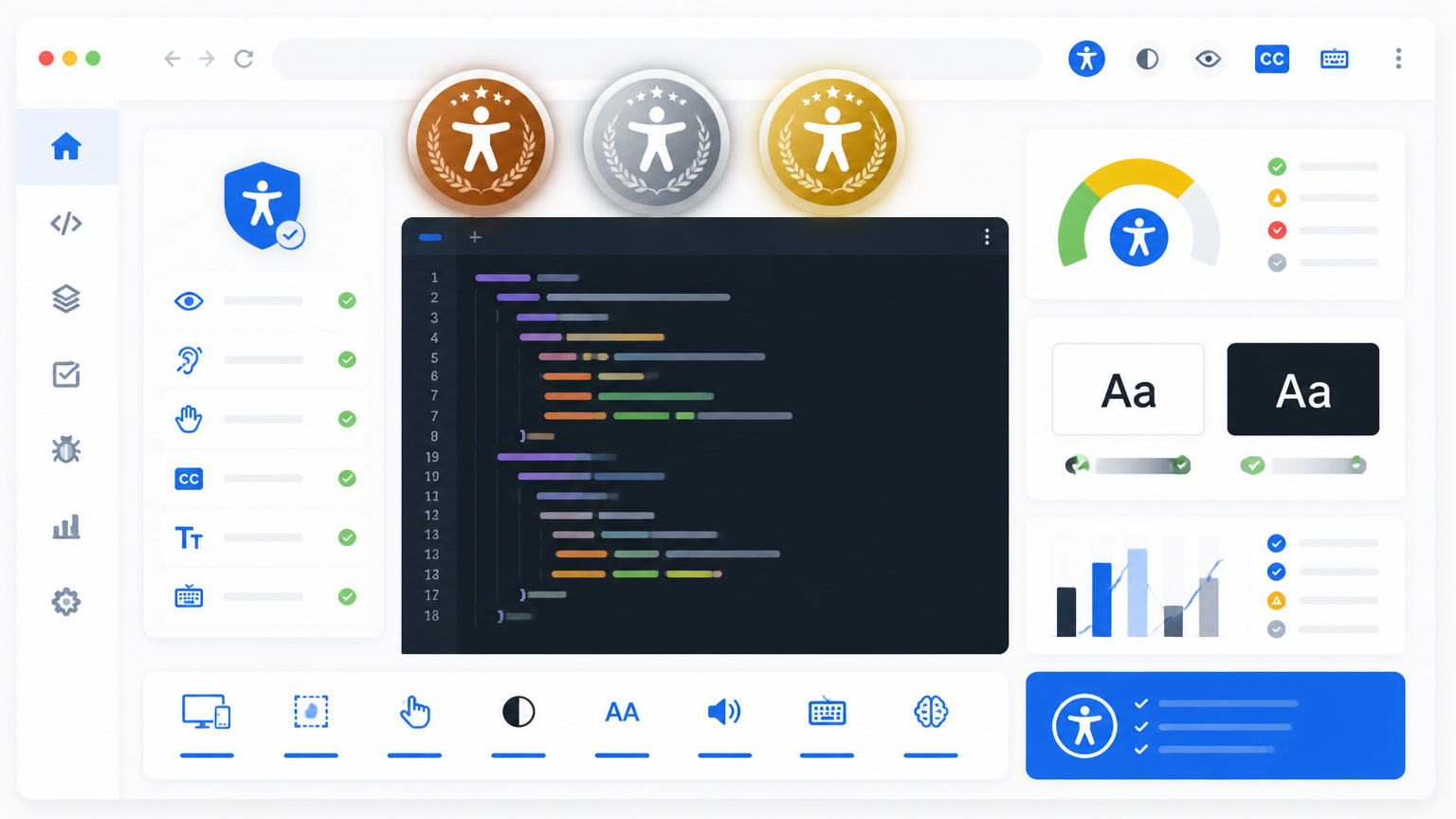
WCAG 3.0 introduces three conformance levels:
- Bronze: roughly equivalent to today's AA. This is the floor most teams should aim for.
- Silver: adds supplemental usability requirements — not just technical ones — and starts demanding inclusive design processes.
- Gold: requires accessibility innovation, direct participation of users with disabilities in the design process, and continuous improvement metrics.
Each outcome (formerly success criterion) is scored from 0 to 4. You reach Bronze when the average score across all outcomes clears a minimum threshold. That means a team can score below maximum on individual outcomes and still achieve Bronze, as long as the overall profile is solid.
APCA: the end of the 4.5:1 ratio as you know it
The change that will cause the most headaches for designers — and the most relief for users with low vision — is the adoption of APCA (Advanced Perceptual Contrast Algorithm).
The 4.5:1 ratio has been the standard for two decades. It's simple, easy to calculate, and built into every tool. But it's also known to be a poor proxy for how the human eye actually perceives contrast. A design that passes 4.5:1 can be unreadable for someone with low vision if the color has low perceptual weight, and a design that "fails" 4.5:1 can be perfectly legible.
APCA fixes this by calculating contrast based on:
- The perceptual weight of the color (not just relative luminance)
- Text size
- Font weight
- Usage context (text on solid background vs text over an image)
Preliminary reference values for Bronze conformance are:
- Lc 90: preferred for small body text (< 18px)
- Lc 75: minimum for normal body text (≥ 18px)
- Lc 60: minimum for large text (≥ 24px) or bold ≥ 18px
This isn't theoretical. Tools like the APCA Contrast Calculator already let you test color combinations with the new algorithm, and the results rarely match the traditional 4.5:1 ratio.
174+ outcomes and a broader scope
WCAG 3.0 no longer limits itself to web content. The current draft covers:
- Web applications and native mobile apps
- Reusable components (UI libraries, design systems)
- Documents (PDFs, office documents)
- Synchronized media content (video with captions, audio descriptions)
One of the most practical new outcomes for development teams is the Focus Appearance requirement: focus indicators must have a minimum thickness of 2px along the element's perimeter. Another is the Target Size outcome, which tightens minimum size requirements for interactive elements on mobile.
What to do now (and what to wait on)
Every client we work with on accessibility asks the same question: "Do we start on WCAG 3.0 now or wait?" Our answer is nuanced — and it runs in two directions.
Do now
1. Reach WCAG 2.2 Level AA as a solid baseline. The vast majority of WCAG 3.0 outcomes map directly to existing 2.x criteria. If you're solid on 2.2 AA today, your jump to Bronze under 3.0 will be much shorter. If you're not, any conversation about 3.0 is premature.
2. Start using tools that support APCA. Don't wait until it's mandatory. Familiarize yourself with perceptual contrast in your design workflow. Figma plugins like Stark and the online APCA Contrast Calculator already let you evaluate APCA combinations.
3. Prepare your design system for scoring. If you work with reusable components — and you should be in a composable web architecture — WCAG 3.0 will require you to audit each component variant not as pass/fail but with a graduated score. That means rethinking how you document and version accessibility data for every component.
4. Measure your current state. Run an accessibility audit with automated tools (axe-core, WAVE, Lighthouse) and document the results as a baseline. When WCAG 3.0 becomes a formal recommendation, knowing where you started will be the difference between an orderly migration and a scramble.
Wait on
Don't rewrite your contrast CSS today. APCA thresholds are still preliminary — the draft is explicit that they need real-user testing before finalization. Making design changes based on values that could shift is burning time and budget.
Don't migrate your accessibility documentation to the new model yet. WCAG 2.2 AA remains the legal standard (EAA, Section 508, EN 301 549) and will stay relevant for years after 3.0 ships. Any current compliance reporting must reference 2.x.
Don't panic. The realistic timeline puts WCAG 3.0 at Candidate Recommendation around late 2027 or 2028, with legal adoption taking additional years. You have time — but only if you start preparing now.
Why this matters more than it looks like
Over the last three years, web accessibility has gone from "nice to have" to a legal requirement with the European Accessibility Act, and then to a competitive differentiator. WCAG 3.0 accelerates that shift by changing the conversation from "are you compliant or not?" to "how accessible are you, really?"
The graduated scoring model rewards teams who are already on the path — it recognizes progress instead of punishing imperfection — but it also raises the bar: passing a checklist is no longer enough. WCAG 3.0 demands that you measure, improve, and demonstrate.
From our experience auditing websites and training teams, the smartest move right now is to treat WCAG 3.0 as a catalyst, not a threat. Well-implemented accessibility doesn't just reduce legal risk — it improves the experience for every user, which is good for business. As we've seen with the 2026 Core Web Vitals changes, regulators and platform owners are all pulling in the same direction: user experience quality is becoming non-negotiable.
Whether your team needs to reach WCAG 2.2 AA compliance today or wants a credible roadmap toward WCAG 3.0 readiness, the first step is an honest audit. No scaremongering, no filler checklists. Just data, priorities, and a plan.
Frequently Asked Questions
What is WCAG 3.0?
WCAG 3.0 (also known as Silver) is the next generation of the W3C's Web Content Accessibility Guidelines. It replaces the pass/fail model of WCAG 2.x with a graduated scoring system (0-4) per outcome and Bronze, Silver, and Gold conformance levels. It is currently a Working Draft, expected to reach Candidate Recommendation around 2028.
When will WCAG 3.0 become mandatory?
WCAG 3.0 remains a Working Draft as of July 2026. There is no definitive publication date, but industry consensus points to a Candidate Recommendation between late 2027 and 2028. WCAG 2.2 (and WCAG 2.1 AA for legal frameworks like the EAA) will remain the reference standards for several years after 3.0 ships.
What is APCA and why does it replace the 4.5:1 ratio?
APCA (Advanced Perceptual Contrast Algorithm) is a new W3C algorithm that calculates contrast based on actual human visual perception rather than a simple mathematical formula. Unlike the 4.5:1 ratio, APCA accounts for color perceptual weight, text size, font weight, and usage context. Some designs that pass WCAG 2.x contrast checks may fail APCA, and some that fail 2.x may pass APCA.