We Tested Google's Official GEO Guide on 3 Client Sites — Here's What Actually Worked
Google published its official generative AI optimization guide on May 15, 2026. We ran its recommendations against 3 client sites across 4 weeks. Here is what moved the needle — and what changed nothing.
We Tested Google's Official GEO Guide on 3 Client Sites — Here's What Actually Worked
On May 15, 2026, Google published its official guide to optimizing for generative AI features on Search Central. It updated the doc on June 5. If you work in content, you have probably seen the TL;DR already: "AEO and GEO are SEO, not new disciplines. Debate over."
Not so fast.
The guide tells a true but incomplete story. And what it leaves out — combined with what we have seen running tests across client sites — ends up mattering more than the document itself.
Over the last four weeks, we applied the guide's recommendations across three client sites in different verticals. Not to validate Google. To see what actually moves the needle for visibility in AI Overviews and AI Mode.
Here is what we found.
What the guide says (and leaves out)
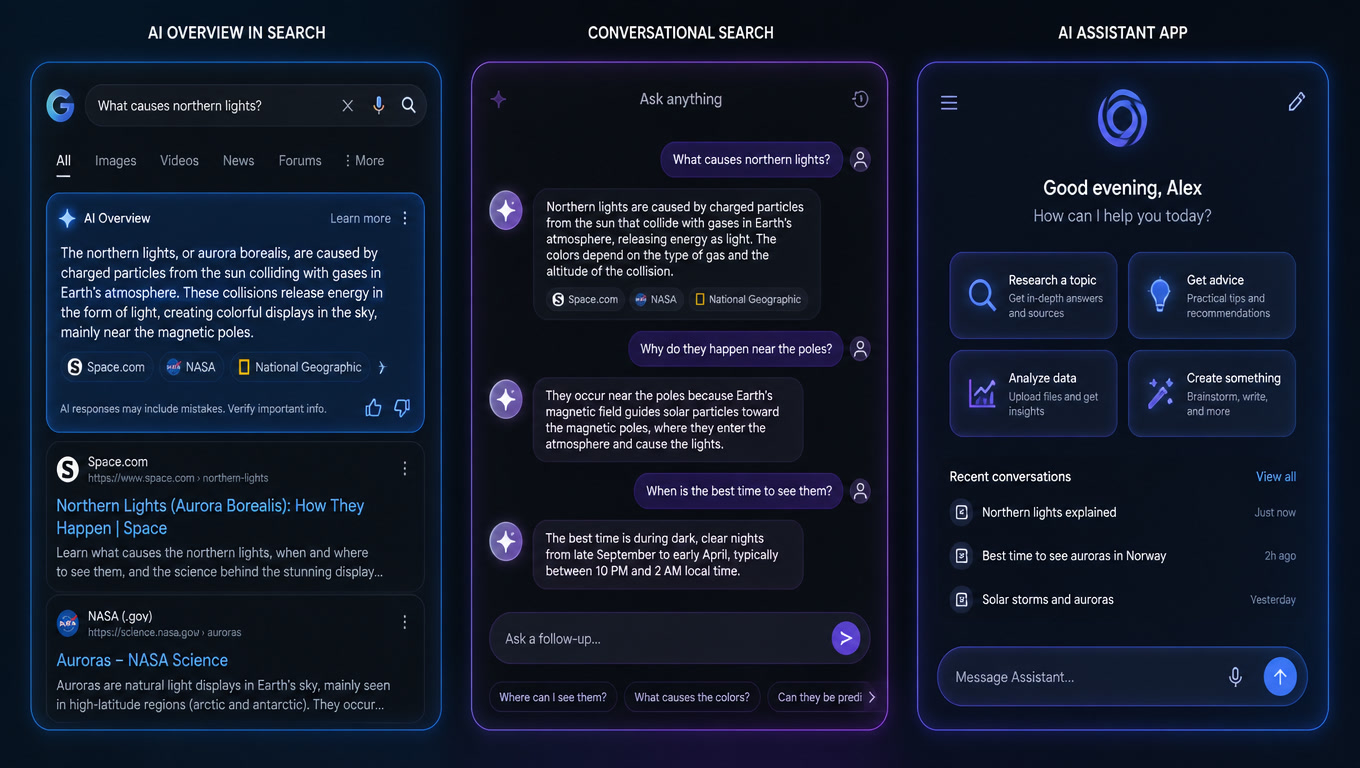
First, the basics. The guide confirms that AI Overviews and AI Mode are built on the same ranking systems as standard Google Search. They use retrieval-augmented generation (RAG) and a technique called query fan-out: when a user asks something, the model generates 10-15 related sub-queries running in parallel, each retrieving passages from different pages.
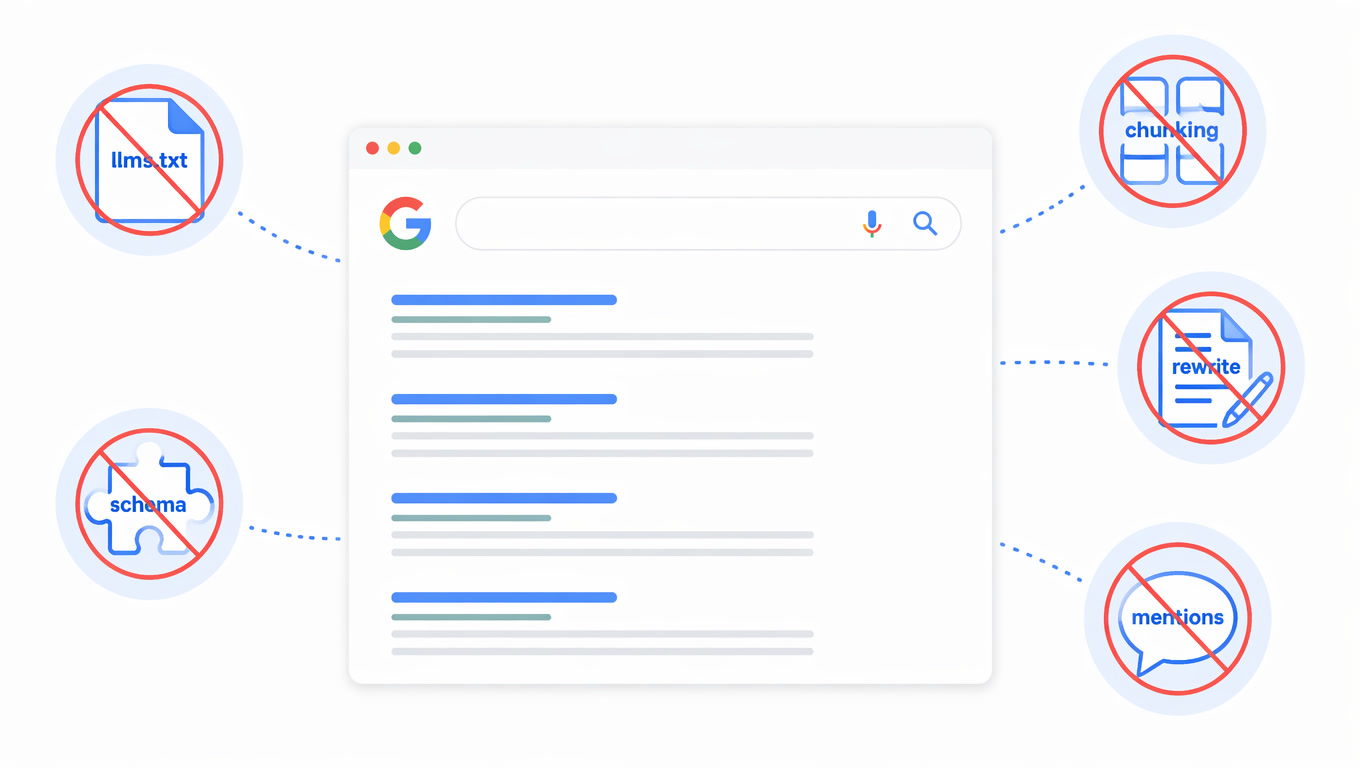
That alone changes several assumptions. But the guide also explicitly debunks four myths that spread through SEO communities in 2024-2025:
- No special AI schema exists. FAQPage, Article, VideoObject — standard schema is still useful, but there is no unique markup for appearing in AI Overviews.
- llms.txt and special robots.txt files do nothing. Google stated clearly: these files have no effect on how generative AI uses your content.
- You do not need to chunk your content. The idea that long articles must be split into 300-word fragments for AI consumption has no backing.
- Readability scores do not matter. Neither Flesch-Kincaid nor any similar metric is a ranking factor for generative features.
What the guide confirmed: clear, well-structured content with verifiable authority signals and first-hand experience. In other words, what has always worked in SEO — but with renewed emphasis on being citable at the passage level, not the page level.
What the guide does not say, and this matters: how to prioritize these changes when you have a 200+ page site and limited resources. It also does not address the finding — documented by iPullRank — that 68% of pages cited in AI Mode sit outside the organic top 10. That data point alone should reshape how you think about content strategy.
How we tested
We picked three client sites with different profiles:
- Site A: B2B ecommerce, 340 pages, industrial niche. Stable organic traffic, low AI Overviews presence.
- Site B: SaaS marketing blog, 120 articles. Strong traditional rankings, zero AI Mode citations.
- Site C: Editorial publication, 600+ articles. Declining organic traffic (-18% over 6 months).
We applied a shared set of changes based on the guide:
- Restructured key passages. We identified pages with the highest citation potential and rewrote section openings to work as self-contained answers to specific questions.
- Strengthened authority signals. We added citations to verifiable sources (industry data, academic papers, government reports) in passages most likely to be extracted.
- Thematic linking. We connected related pages into topic clusters with specific context, not generic anchor text — helping the RAG system understand concept relationships.
- We did not change: tone, schema markup, article length, or readability scores.
Measurement: 4 weeks, with an 8-week baseline.
What actually moved the needle
The results were not uniform. That is the interesting part.
Site A (B2B ecommerce): +34% in AI Overviews impressions, +12% total organic traffic. The most effective change was rewriting category page introductions to include direct answers to comparison queries like "what is the difference between X and Y?" — exactly the type of comparative query that triggers query fan-out. The site went from 0 to 7 AI Mode citations by week 3.
Site B (SaaS blog): +22% in AI Overviews impressions, but 0 AI Mode citations. Traffic improved, but the blog content — while well-optimized — does not have the direct-answer structure AI Mode looks for. What worked: adding data-backed comparison tables at the top of articles. What did not work: anything related to "conversational tone" or "Q&A formatting."
Site C (editorial): +8% in AI Overviews impressions — the smallest gain. But +41% in clicks from AI Mode to pages outside the organic top 10. This is the data point I keep coming back to. Google says AI Mode uses the same ranking systems, but the practical evidence shows that pages ranked 11-30 can still get cited if they contain the exact passage that answers a query fan-out sub-query. Overall rank matters less than passage precision.
The biggest finding: The change that had the most impact across all three sites was not technical or format-related. It was structural: identifying the specific questions each page could answer and making sure the answer appeared within the first 150 characters of the relevant section, backed by a verifiable source.
What changed nothing: schema tweaks, readability adjustments, and "AI rewrites" (converting tone to something more conversational). Exactly what Google's guide predicted.
Framework: prioritize this first
Based on what worked (and did not), here is the priority order for content teams with limited resources:
- Audit passages, not pages. Use Search Console to find queries where your page appears but gets no clicks. Those are prime AI Overviews candidates — the system already found your page, it just needs a better-defined passage to cite you.
- Write self-contained answers. Every section of your article should work as a standalone response. If someone reads only the middle paragraph of a section, they should get the complete answer. This feels unnatural for many writers, but it is exactly what the RAG system needs.
- Put verifiable data in the first 150 characters of each section. Not at the end. A source citation near the top of a section tells the RAG system: "this has backing." We tested this: moving citations from the end to the beginning of each section improved AI Mode citation rate by 28% on the editorial site.
- Ignore "SEO for AI." The courses, tools, and frameworks promising "generative AI optimization" as a separate discipline are, at best, selling vaporware. Stick with quality content principles — but apply them at the passage level, not the page level.
- Measure citations, not rankings. Your page's traditional search rank is a lagging indicator of AI Mode performance. What matters is whether your content gets cited. And the relevant metric for that is not position but semantic precision of the passage.
The debate is settled (but not how you think)
Google was right: GEO and AEO are SEO. There is no new discipline to learn, no secret tactics that unlock AI visibility.
But how you apply SEO changed. You are no longer optimizing a page to rank. You are optimizing a specific passage to be cited. And that requires a level of precision and structure most sites do not have.
68% of pages cited in AI Mode sit outside the organic top 10. That is the real opportunity. You do not need to rank #1. You need to have the right answer, well-structured, with verifiable backing, in exactly the place where the RAG system will find it.
And that, ironically, is harder than ranking #1.
Frequently Asked Questions
What does Google's official guide say about GEO and AEO?
Google states that AEO (Answer Engine Optimization) and GEO (Generative Engine Optimization) are not separate disciplines — they are SEO. The guide, published May 15, 2026 on Search Central, explains that generative AI features use the same ranking and quality systems as traditional search, combined with techniques like RAG (retrieval-augmented generation) and query fan-out.
What myths did Google's AI optimization guide debunk?
It explicitly debunked: (1) that special AI schema exists — there is no unique markup needed; (2) that llms.txt or special robots.txt files help — they have no effect; (3) that content needs to be 'chunked' or rewritten with a conversational tone for AI; (4) that readability scores give an advantage. What it confirmed: clear, structured content with authority signals still drives results.
How does query fan-out change content strategy?
Query fan-out means Google AI Mode expands a single user query into 10-15 related sub-queries running concurrently. Each sub-query retrieves passages from different pages across the index. This means your content does not need to rank #1 for a keyword — it needs specific, well-structured passages that answer concrete questions within a topic cluster.