Google Just Killed 5 'GEO' Tactics. Here's What Survived.
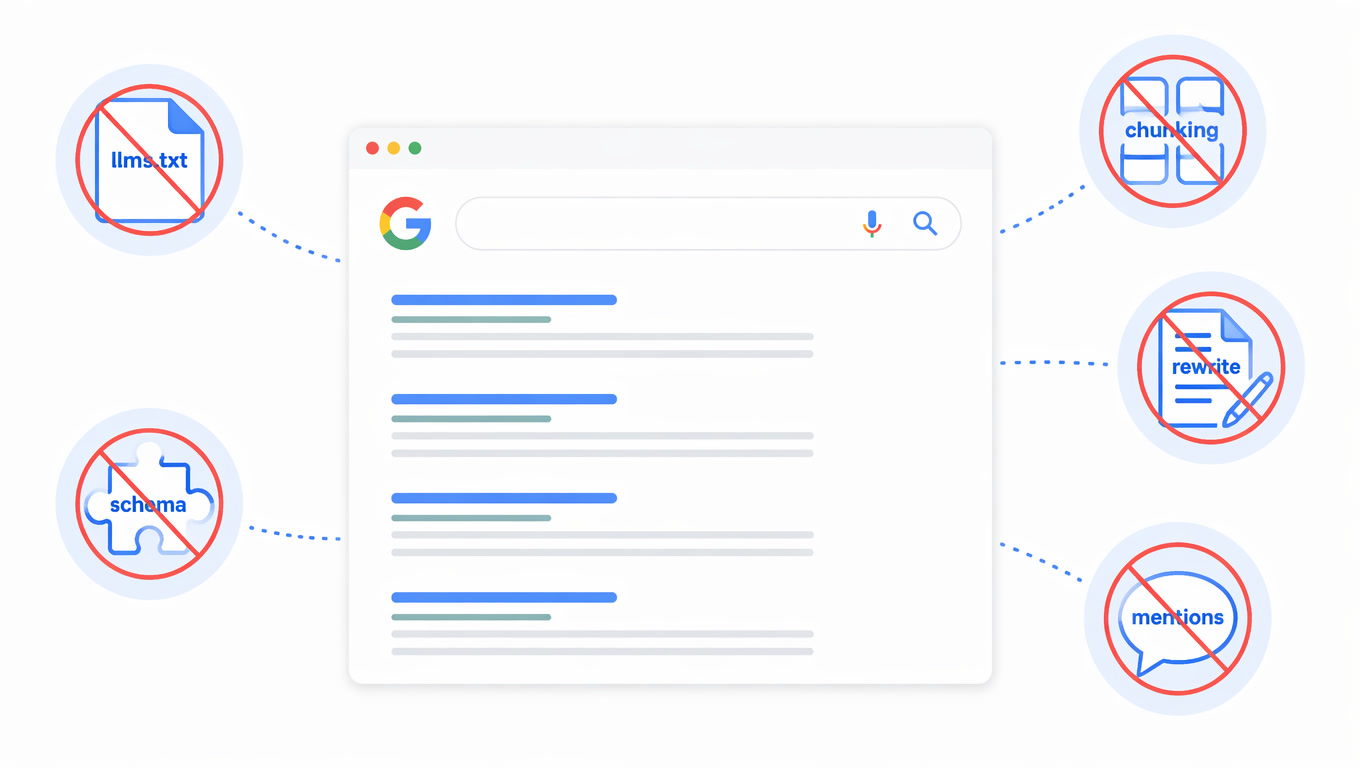
Google's official generative AI optimization guide, published May 2026, did something rare: it explicitly named five 'GEO' tactics you can ignore. llms.txt, content chunking, AI-specific rewrites, inauthentic mentions, structured data obsession — none of them move the needle. Here's what actually works.
Google Just Killed 5 'GEO' Tactics. Here's What Survived.
In May 2026, Google published its first official guide to optimizing for generative AI search features. The document is useful. But not for the reasons most people think.
The most interesting part isn't what Google says you should do. It's what Google says you can ignore.
Because while Google was writing that guide, an entire ecosystem of LinkedIn gurus, course sellers, and self-proclaimed GEO experts were pushing a very specific set of tactics as "essential for AI visibility." llms.txt files. Content chunking. Rewriting articles so AI models can "understand them better." Aggressive structured data. Fake brand mentions.
Google's guide addresses them directly in a myth-busting section. The verdict: none of it is necessary.
We've been doing SEO for 15 years. This is not the first time the industry invented shortcuts that Google later disproved. But the speed at which these tactics were sold as indispensable — before anyone bothered to validate them — was something else.
Here they are.
The 5 tactics Google killed
Google phrases these as "tactics you can ignore." The wording is more diplomatic than mine. The conclusion is the same.
1. llms.txt files
The idea: create a file similar to robots.txt but designed to tell language models how to use your content. Dozens of articles, tools, and even WordPress plugins appeared to generate them.
Google says: you don't need them. Search already finds and processes your content without this file. If your goal is getting cited by AI, the problem isn't access — it's relevance and authority.
2. Content chunking
The theory: break your articles into ultra-short fragments so AI processes them better. Some consultants recommended paragraphs of no more than 2-3 sentences and sections capped at 100 words.
Google directly debunks this. Aggressive chunking doesn't improve AI Overviews visibility. What matters is thematic structure, not artificial length constraints.
3. AI-specific content rewriting
The notion that you should rewrite content specifically for language model comprehension. As if human-readable content isn't enough.
Google: write for humans. Language models process natural language — they don't need a special "LLM-optimized" version of your content. Rewriting for AI usually makes the text less readable for the actual audience.
4. Inauthentic brand mentions
The practice: strategically place brand mentions on external sites — forums, comments, directories — specifically so AI crawlers capture them as authority signals.
Google calls these "inauthentic mentions" and tells you to skip them. Genuine, organic mentions that result from actual quality work are what matter. Fabricating them is a waste of time.
5. Structured data obsession
I'm not saying schema markup is useless. It's not. But Google clarifies that obsessing over structured data — marking up every element of a page in hopes it boosts AI visibility — is unfounded.
What matters is well-organized, clear content. Schema is a supplement. Not a magic bullet.
So what actually works?
Google's guide doesn't leave much room for speculation. What works:
Demonstrable E-E-A-T. Experience, expertise, authoritativeness, and trust. Not as keywords on a page, but as verifiable signals: real authors with biographies, cited sources, original data, links to authoritative references.
Clear structure. Descriptive headings that work as a table of contents. Direct answers at the start of each section. Thematic organization that lets both AI and readers find what they need without friction.
Original content. Proprietary data. Analysis you can't find anywhere else. Perspectives only you can provide. If your content is a remix of what ten other sites already published, AI has no reason to cite you.
Speed and accessibility. Google has been saying this since 2010: fast, accessible, mobile-friendly pages have an advantage. Generative AI search is no different.
Does this mean GEO isn't real?
No. It means GEO isn't a separate discipline from SEO. It's SEO with an emphasis on what always worked: content that answers questions better than anyone else.
Google said it plainly: "Optimizing for generative AI search is optimizing for the search experience, and thus still SEO."
Course sellers are going to hate this conclusion. Because it's easier to sell "5 GEO tricks nobody is telling you" than "do the fundamentals well and publish original content." The first sells for $997. The second is the work of showing up every day.
We tested the official guide on 3 client sites over four weeks. The results confirmed exactly this: what moved the needle was better-structured content, not new tricks. The sites that implemented llms.txt and chunking saw zero change.
What nobody is saying
There's a reason these 5 tactics sold so fast. The SEO industry — especially on LinkedIn — runs on cycles of panic and hope. A new technology appears, someone declares "SEO is dead," and a dozen gurus materialize with a miracle cure.
Google just did something it almost never does: intervene directly to debunk the cycle.
Might be worth asking yourself why you trusted tactics Google never validated.
If the answer includes "because a course said so" or "because I saw it on LinkedIn," it's worth rethinking how you filter information in this industry.
What I'd do today
If you want to be ready for AI-driven search:
- Audit your E-E-A-T. Does your site have real authors with verifiable bios? Are sources properly cited? Is your data original or recycled?
- Structure content for direct answers. Each section should be readable independently and answer a specific question. FAQ sections help, but they're not required.
- Publish content nobody else can publish. The biggest differentiator in generative AI isn't technical optimization. It's having something unique to say.
- Stop chasing shortcuts. If a tactic wasn't validated before May 2026 and doesn't appear in Google's official guide, it's speculation.
Google's AI optimization guide is on Search Central. It has three sections and takes about 15 minutes to read. The most valuable part is what it tells you not to do.
Frequently Asked Questions
What GEO tactics did Google debunk in its 2026 official AI optimization guide?
Google named five tactics that site owners can ignore: llms.txt files, content chunking, AI-specific content rewriting, inauthentic brand mentions, and structured data obsession. The guide states clearly that none of these improve visibility in AI Overviews or AI Mode.
Does llms.txt help with AI Overviews visibility?
Google explicitly says llms.txt files are not needed for AI Overviews or AI Mode. What matters instead is well-structured content, demonstrable topical authority, and direct answers to user questions.
What actually works for optimizing content for AI search?
Google recommends the same fundamentals that have always worked: original content with demonstrable E-E-A-T, clear structure with descriptive headings, question-and-answer sections, verifiable sources and data, and fast page speeds. There are no shortcuts or AI-specific tricks.