Google Preferred Sources Just Hit AI Mode. This Changes How Brands Get Cited.
On May 27, 2026, Google brought Preferred Sources and Highly Cited labels to AI Mode and AI Overviews. This isn't a routine feature update. It's a structural shift in how brands earn visibility in AI search — and most companies don't even know it exists yet.
Google Preferred Sources Just Hit AI Mode. This Changes How Brands Get Cited.
On May 27, 2026, Google brought Preferred Sources and Highly Cited labels to AI Mode and AI Overviews. If you've only been thinking about algorithms and structured data, you're missing half the equation.
Google teased this at I/O — Preferred Sources, the feature that lets users pick specific sites to prioritize, was coming to AI search. On May 27 it landed. Alongside it came Highly Cited labels and a new Perspectives carousel.
This isn't a routine feature update. It's Google quietly saying that visibility in AI search isn't decided by technical signals alone anymore. User preference now matters as much as algorithmic authority.
That changes how you should think about content strategy.
What Preferred Sources Actually Is
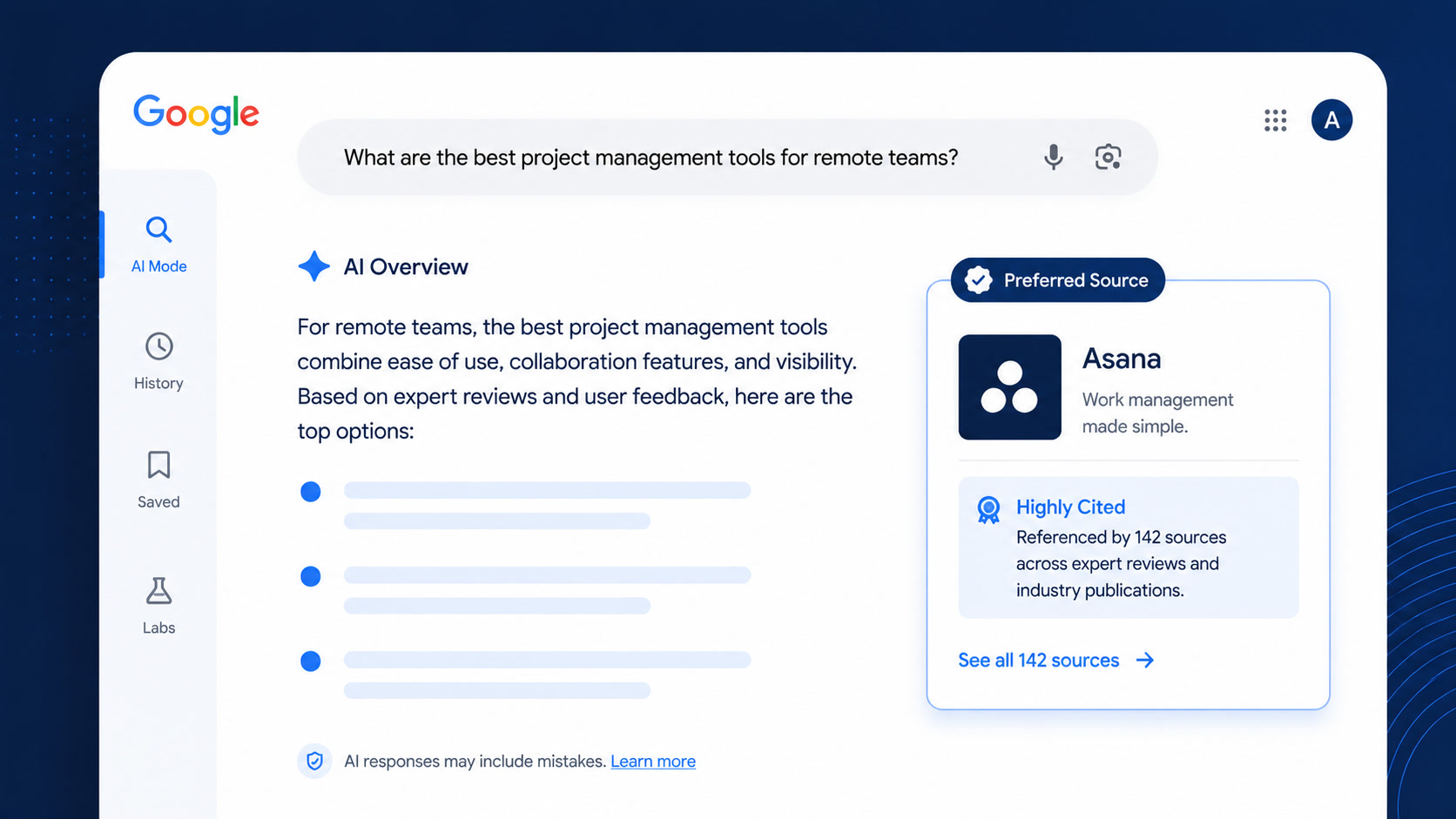
Start with the basics. Preferred Sources is a Google Search feature that originally launched for traditional results. Here's how it works: a user goes to Search Settings > Preferences > Preferred Sources, picks up to 20 websites, and from then on those sites get a "Preferred Source" label with priority ranking.
Until May 27, this only applied to traditional blue-link search. Now it works inside AI Overviews and AI Mode too.
In practice, this means: if a user has Mintec marked as a preferred source and asks AI Mode about marketing automation, Google prioritizes Mintec's content when generating its AI answer. It's essentially a direct line to citation.
By June 2026, over 345,000 unique sources had been selected by users according to Google. That number will climb fast as the feature becomes more visible.
Highly Cited: The Signal Google Just Validated
Alongside Preferred Sources, Google launched Highly Cited labels in AI Mode. These are different. Where Preferred Sources reflects user choice, Highly Cited is algorithmic.
Google labels a source as "Highly Cited" when it's consistently referenced by multiple independent sources across the web. Not traditional links — a citation pattern between entities.
The research firm Machine Relations published a breakdown of this signal, and their conclusion is worth sitting with: Highly Cited labels are product-level validation that entity chain architecture determines which brands win visibility in AI Mode. This isn't theory. Google built a UI around it.
The implication is direct: if your brand appears across diverse contexts and gets referenced by independent sources within a topic area, your odds of earning the Highly Cited label — and better AI Mode visibility — go up significantly.
The Hybrid Model Nobody's Talking About
What's interesting here is that Google just created a hybrid visibility model for AI search:
| Signal | Source | How you earn it |
|---|---|---|
| Preferred Sources | User | User manually adds you to their list |
| Highly Cited | Algorithm | Multiple independent sources reference you |
| E-E-A-T | Algorithm | Original content, demonstrable authority |
| Entity structure | Algorithm + content | Clear passages, structured data, descriptive headings |
Before May 2026, algorithmic signals were everything. Now you have a channel you can't directly control: user preference. And one you can actively cultivate: cross-domain citations.
This changes the answer to a question we hear constantly at Mintec: "How do I get AI to cite me?" The old answer was technical (schema, structure, E-E-A-T). The new answer also includes "get enough independent sources to reference you" and "give users a reason to prioritize you."
What This Means for Your Content Strategy
I've seen too many 2026 content strategies follow the same script: "optimize for AI Mode with FAQs, structured data, and conversational keywords." All of that is still true. Since May 27, it's also insufficient.
First, your users can become your distribution channel into AI search. If a client adds you as a Preferred Source, your content gets prioritized in AI Mode for every query they make about your industry. This turns customer experience and brand trust into AI visibility signals. Not theoretical. It's a live product feature.
Second, cross-domain citations matter more than ever. The Highly Cited label validates what many SEOs suspected since 2025: Google tracks citation patterns across independent sources as an authority signal. If your content gets referenced by industry blogs, specialized media, or academic papers, your odds of earning the label increase. This rewards brands that have been building topical authority for years, not ones that optimize quickly.
Third, PR is now a GEO tactic. If media mentions used to be a "nice to have" for branding, they're now a direct citation signal for AI Mode. You don't need The New York Times. Mentions in specialized industry outlets — blogs, newsletters, podcasts — feed the entity chain pattern Google validates with Highly Cited.
What to Do Right Now
If your site already has AI Mode-optimized content (FAQs, structured data, descriptive headings, direct answers), your next step isn't technical. It's positioning.
Audit your citation ecosystem. What independent sources reference your content? Use Google Search Console and mention-tracking tools to map who cites you and in what context. If the number is low, that's your bottleneck.
Make yourself easy to cite. Publish original data, proprietary frameworks, clear definitions. The content AI cites most often has reference structure: tables, lists, concrete data with sources. Don't write to be read. Write to be cited.
Give users a reason to prefer you. Preferred Sources isn't won with SEO. It's won with consistency, authority, and trust. Does your content reliably solve real problems? Is your brand recognized in your industry? Those are the signals that make someone add you as a preferred source.
AI search just got more complex. But also more interesting — because for the first time in years, visibility doesn't depend only on what Google thinks of you. It depends on what your users and your industry think of you too.
And honestly, that's good news for brands that have been doing the work all along.
Frequently Asked Questions
What are Google Preferred Sources and how do they work in AI Mode?
Preferred Sources is a Google Search feature that lets users select specific websites they want prioritized in results. As of May 27, 2026, this preference also applies within AI Mode and AI Overviews, meaning URLs from selected sources appear more frequently and with higher visibility in AI-generated answers. Users can select up to 20 sites.
What's the difference between Preferred Sources and Highly Cited?
Preferred Sources reflects an active user choice — sites that specific person marked as favorites. Highly Cited is an algorithmic label Google assigns to sources that multiple independent sites consistently reference, validating an entity chain architecture pattern. One is explicit user preference; the other is algorithmically validated authority.
How does Preferred Sources change my content strategy for AI search?
Preferred Sources introduces a new visibility lever: user preference. You're no longer competing only on algorithmic signals (E-E-A-T, structured data, entities). You also need users to actively add you as a preferred source. This shifts the focus from 'optimize for the algorithm' to 'generate enough trust and consistency that users want to prioritize you' — a higher bar than traditional SEO.