Meta Customer Lifecycle Strategy: How to Use Pure Acquisition in Your Campaigns (And Why It's Not Magic)
Meta's new Customer Lifecycle Strategy setting lets you exclude existing buyers at the ad set level and force net-new customer acquisition. We tested CLS with client accounts in LATAM — here's what it actually does, how to set it up, and why some media buyers say it's overhyped.
Meta Customer Lifecycle Strategy: How to Use Pure Acquisition in Your Campaigns (And Why It's Not Magic)
In early 2026, Meta quietly rolled out a feature advertisers had been asking for for years: an ad-set-level toggle that tells the algorithm "spend my entire budget on people who have never bought from me." No manual exclusions. No audience lists to maintain. No Meta taking the retargeting shortcut to hit a fake ROAS number.
The reality, after testing this across client accounts, is more nuanced. Customer Lifecycle Strategy (CLS) isn't magic — but used correctly, it solves a real problem that manual workarounds never fully addressed.
The problem nobody talked about
If you run Sales campaigns on Meta, you know the loop. You launch an ad set designed to prospect. The dashboard looks solid for the first two weeks. Healthy ROAS, acceptable CPA. But when you break down the delivery by audience segment, you realize 30-40% of the spend went to people who've visited your site or purchased before.
Meta is doing exactly what it's optimized to do — get the cheapest conversion possible. And the cheapest path always runs through warm audiences. The dashboard is lying to you because that ROAS includes those easy sales, but your actual growth stalls because you're not feeding the top of the funnel.
Before CLS, you had two options:
Manual exclusions: Build custom audiences of past purchasers, visitors, and email subscribers, then exclude them ad set by ad set. Works but is brittle — if the audience doesn't update in time, the algorithm goes back to retargeting.
ASC Lifetime Budget Cap: Only available in Advantage+ Shopping Campaigns. The closest native option, but locked inside the ASC ecosystem.
Customer Lifecycle Strategy arrives as a third path: a native ad-set-level control for manual Sales campaigns.
What actually changed (and what didn't)
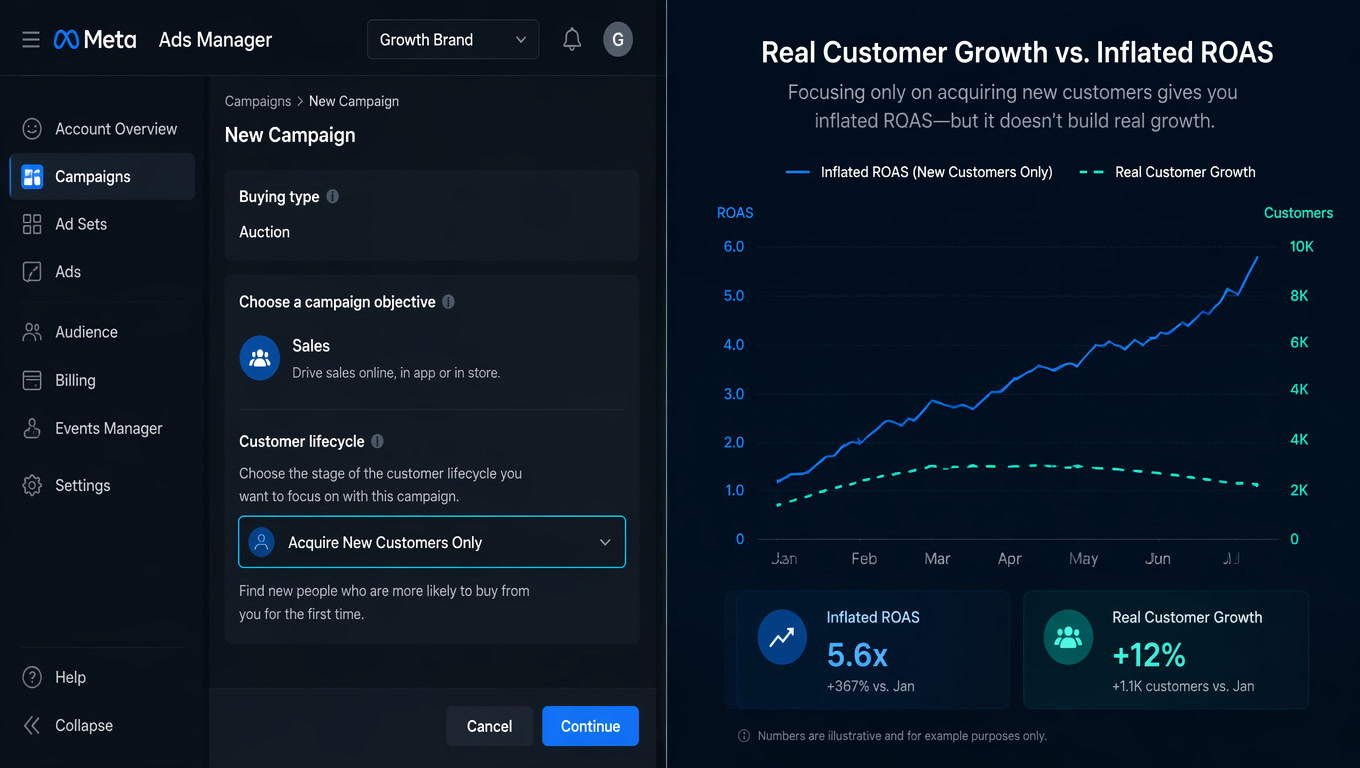
CLS appears as a new section called "Customer lifecycle" inside ad set configuration for manual Sales campaigns. It offers three paths:
| Option | Behavior | Best Use Case |
|---|---|---|
| Get conversions from all audiences | Works as before — Meta optimizes across everyone | General scaling, when prospecting + retargeting mix is part of your strategy |
| Acquire new customers only | Automatically excludes past buyers defined at the account level | Pure prospecting, market expansion, aggressive growth phases |
| Acquire new and engaged customers | Excludes buyers only, but reaches people who engaged without purchasing | Middle-of-funnel, nurturing without paying for fully cold traffic |
The mechanism depends entirely on how well you've populated your "existing customers" definition in your Meta account's advertising settings. If that list is incomplete — because your pixel misses some purchases, you're not using Conversions API, or your CRM isn't synced — CLS won't have enough data to exclude correctly.
This is the asterisk that media buyers like Naman Bansal and Jon Loomer have pointed out: it's not AI-powered new customer detection. It's a centralized exclusion layer with a better name.
How we set it up for clients in LATAM
Here's the exact process we follow at Mintec to activate CLS for ecommerce and professional service accounts:
Step 1: Audit your "existing customer" definition
Before touching any setting, we audit what Meta knows about the account's buyers. Go to Ad Settings > Audiences > Existing Customers and verify:
- The pixel fires Purchase events correctly
- Conversions API sends offline purchases and backend transactions
- A synced customer list (with LTV data if possible) updates at least weekly
Without this foundation, CLS won't work. Period.
Step 2: Create a dedicated prospecting ad set
In existing or new manual Sales campaigns, duplicate an ad set and toggle "Acquire new customers only" in the Customer lifecycle section.
This forces Meta to ignore anyone on your existing customer list and hunt for conversions outside that pool.
Step 3: Align creative for cold audiences
This step gets skipped most often. If you're telling Meta to spend only on people who've never heard of you, your creative can't talk like they already know you.
For clients with CLS active, we swap creatives to:
- Educational hooks explaining the problem, not the product
- Founder stories or use cases with full context
- Entry offers (free samples, trials, first-purchase discounts) instead of loyalty discounts
- Native formats: selfie video, UGC, quick demos
We migrated a beauty subscription brand in Mexico through this process. The prospecting CPA jumped 22% in the first two weeks — expected, since we stripped out the easy retargeting conversions. But 60-day retention for those new customers was 34% higher than customers acquired through mixed campaigns. Campaign ROAS dropped. The business grew.
Step 4: Measure what matters (stop staring at in-platform ROAS)
The hardest adjustment isn't technical — it's mental. When you toggle CLS on an ad set, the ROAS you see in Ads Manager will drop. That's not a failure signal. It means you stopped counting easy retargeting sales as if they were new.
The metrics that actually matter with pure acquisition:
- MER (Marketing Efficiency Ratio): Total revenue / Total ad spend. Tells you if the business is growing, not just the campaign.
- nCAC (New Customer Acquisition Cost): What it really costs to acquire a first-time buyer.
- 30- and 60-day retention rates: Pure-prospecting new customers tend to retain better than retargeting discount buyers.
- Incrementality: How many of those sales wouldn't have happened without the ad.
Real results from managed accounts
Across accounts where we activated CLS with proper setup, the pattern is consistent:
Weeks 1-2: CPA climbs 15-30%. The algorithm learns to find cold buyers without leaning on warm audiences. This is the most uncomfortable phase.
Weeks 3-4: CPA starts stabilizing. Meta discovers high-intent clusters within cold traffic that it never explored before because easier paths always existed.
Week 5+: nCAC stabilizes into a predictable range. New customer quality — measured by retention and lifetime value — typically outperforms mixed campaigns because you're not buying people who were already convinced.
Concrete case: a DTC personal care brand in Colombia went from a blended CAC of $18.50 to an nCAC of $24.20 after activating CLS. In-platform ROAS dropped from 3.2x to 2.1x. But average order value from new customers was 27% higher than retargeted customers, and the second-purchase rate jumped 18 percentage points.
When NOT to use it
CLS isn't for every account. We recommend skipping it when:
- The account has fewer than 200-300 monthly conversions. The algorithm needs signal density to learn cold prospecting. Without enough volume, pure acquisition campaigns may never exit learning phase.
- The business depends on frequent repeat purchases (e.g., low-ticket consumables). In those cases, "new" vs. "existing" is a less useful distinction.
- You don't have a reliable existing-customer definition. If your conversion tracking has gaps, CLS will make incorrect exclusions and you'll limit reach unnecessarily.
For those scenarios, we still use manual exclusions + ASC budget caps.
What's next
CLS is still rolling out gradually. Not all accounts have it yet, and Meta hasn't announced a full launch date. But the direction is clear: Meta wants advertisers to have sharper budget-direction controls without complex technical configurations.
If your account already has the setting visible, the best time to test is now — with one isolated ad set, cold-optimized creative, and business-level metrics (not platform metrics) as your success criteria.
We're testing CLS combined with lifetime value segmentation to create prospecting layers that hunt not just "new customers," but "new customers with high-LTV profiles." When Meta lets you pass projected LTV signals into Customer Lifecycle Strategy, that will be a real game-changer. Until then, the current setting is already a solid tool — as long as you know it's not magic.
Need help setting up pure acquisition campaigns? We structure, test, and optimize Meta ad strategies for brands across LATAM and the US. Reach out — we'll show you what actually works in 2026.
Frequently Asked Questions
What is Customer Lifecycle Strategy in Meta Ads?
It's an ad-set-level setting for manual Sales campaigns that lets advertisers tell Meta whether to target only new customers, engaged non-buyers, or all audiences. It replaces manual audience exclusions to prevent the algorithm from spending prospecting budget on retargeting past buyers.
Does Customer Lifecycle Strategy automatically detect new customers?
Not as advertised. While early coverage framed it as AI-powered new-customer detection, the reality is closer to a centralized exclusion section with a friendlier name. It depends entirely on how well you've defined your existing customers at the account level through pixel events, Conversions API, and uploaded lists. If your definition is incomplete, the setting won't exclude accurately.
Should I use Customer Lifecycle Strategy or stick with manual exclusions?
CLS is worth using if your account has 500+ monthly conversions and solid conversion tracking. The main advantage is centralization: define existing customers once at the account level, and the setting applies across all ad sets where you toggle it. For smaller accounts or those with tracking gaps, manual exclusions may still be more predictable.