
Meta Is Dumping 90% of Your Budget Into One Ad — How Andromeda Actually Decides and How to Fix It
If you check Meta Ads Manager and see a single image ad eating 80-90% of your daily spend while your new videos get zero traction, it's not a bug — it's Andromeda working exactly as designed. Here's why budget concentration happens under Meta's 2026 ad delivery system and how to force fairer distribution.
If you've opened Meta Ads Manager recently and found one ad — usually a static image — consuming 80-90% of your daily budget while newer video creatives struggle to reach 500 impressions, you're experiencing the most discussed pain point in Facebook advertising in 2026. A recent r/PPC post titled "Meta is dumping ~90% of my budget into one image ad. How do I actually give my videos a fair test?" captured exactly what dozens of advertisers ask us every week.
The answer is uncomfortable: this isn't a bug or a configuration error. It's Meta's Project Andromeda working exactly as intended.
Since Andromeda's full rollout in early 2026, we've observed the same pattern across multiple client accounts. The algorithm finds a winning creative and funnels every available dollar toward it. Advertisers who used to launch 5-10 variants of the same concept and "let the market decide" now discover the market decided — and picked one option on day one.
This article explains why Andromeda concentrates budget, what metrics to watch, and how to restructure campaigns for fairer distribution.
How Andromeda decides where your money goes
Before Andromeda, ad delivery worked roughly like this: you defined an audience, uploaded several creatives, and Meta spread the budget among them while learning which performed best. Distribution was imperfect, but spend rarely exceeded 40-50% on a single ad.
Andromeda replaced that logic with a three-layer system:
Individual retrieval. Instead of segmenting by audience, Andromeda evaluates every impression as a match between a specific user and a specific creative. It doesn't think "women 25-40 in New York interested in fashion." It thinks "Sarah, 34, just watched three makeup tutorials, predicted response to this ad: high."
Creative Similarity Score. Andromeda classifies every creative by visual, textual, and format similarity. Upload five versions of the same ad with different background colors? The system groups them as a single Entity ID. All five compete for the same auction space as if they were one — and once the algorithm picks a winner, the other four effectively disappear.
Accelerated fatigue. Because Andromeda delivers the winning creative to more people faster, fatigue hits in days instead of weeks. CPM rises, CTR drops — but the system intensifies delivery of the same creative because its historical conversion signals remain the strongest in your account.
The result: a single ad consuming 90% of your budget while a dozen creatives never leave the learning phase.
The Andromeda paradox is brutal: the system is optimized for immediate results, but that optimization cannibalizes your ability to find the next winner.
The three budget traps
Trap 1: Similarity blindness
The most common mistake we see when auditing new accounts: the advertiser uploads 8-10 variants of the same concept. Same image, different copy. Same video, different CTA. Same offer, different button color.
To Andromeda, those aren't 10 creatives — they're one creative with 10 disguises. The system groups them, picks the variant with the best early performance, and buries the rest.
Check your Creative Similarity Score in Ads Manager (available since June 2026 in custom columns). Scores above 0.7 between active creatives mean you're in this trap.
Trap 2: The premature winner
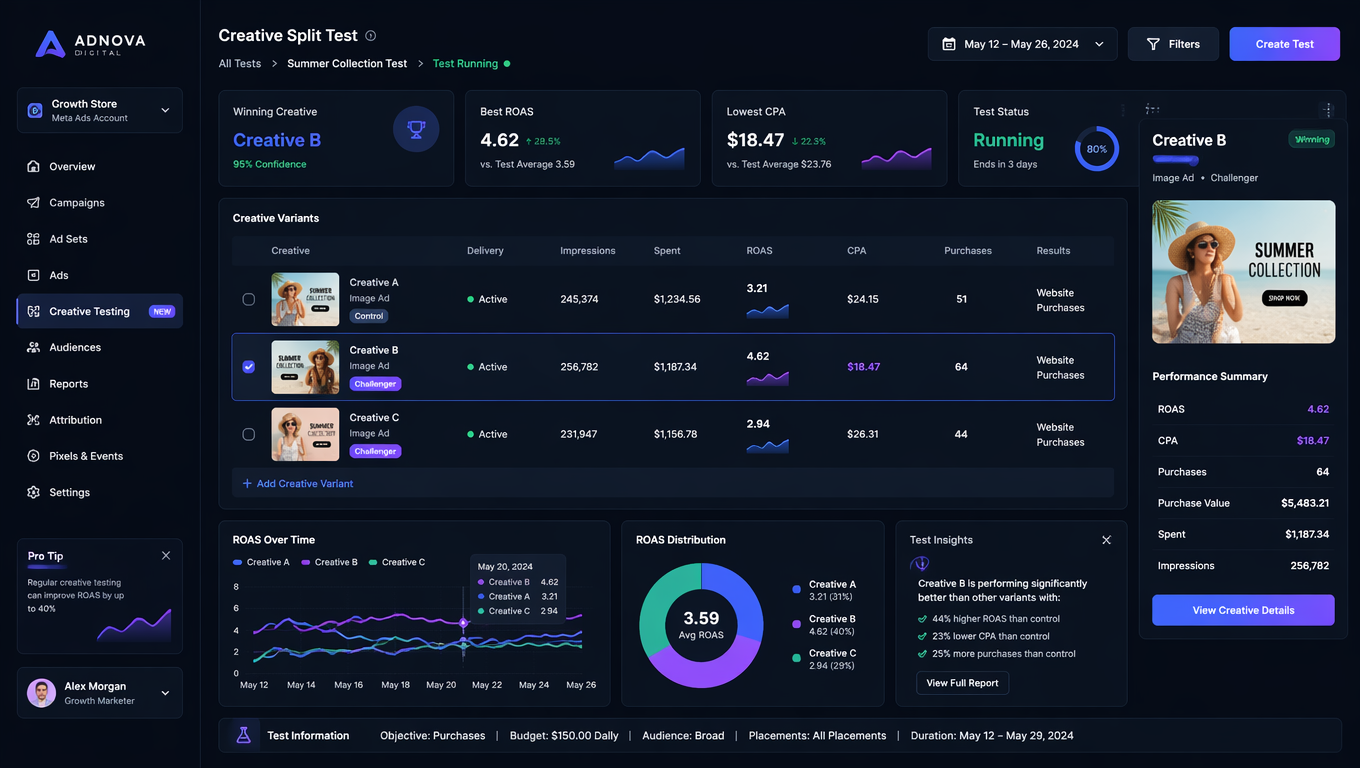
Andromeda needs 50-100 conversions per Entity ID to exit the learning phase. Run 20 creatives on a $500 weekly budget? The first one to get 3-4 conversions gets a positive signal and the algorithm pours more money into it. The others never reach the learning minimum.
Self-fulfilling prophecy: the creative that won early gets all the spend, and the rest never get enough data to prove they could outperform it.
Trap 3: Single-format limitations
We've measured this across client campaigns: when all creatives share the same format (all static images, all 15-second videos), Andromeda has fewer signals to diversify delivery. Campaigns that combine radically different formats — 30-second testimonials, 15-second demos, minimal-copy image ads, educational carousels — consistently show 30-50% less budget concentration.
How to force fairer budget distribution
You can't disable Andromeda or ask Meta to spend your money less efficiently. But you can restructure campaigns so the algorithm has structural incentives to distribute better.
Tactic 1: Separate Entity IDs, not variants
Instead of stacking 10 variants in one Advantage+ Shopping Campaign or ad set, split your creatives into independent Entity IDs. Each Entity ID needs its own budget and concept.
The rule of thumb: if two creatives can't be described in meaningfully different one-liners — "customer testimonial with hard numbers" vs "product demo showing the interface" — they're too similar. Andromeda will group them.
Each Entity ID needs $50-100 weekly minimum to exit learning. If your total budget is tight, launch 3 strong Entity IDs instead of 10 weak ones.
Tactic 2: Radical format diversity
The evidence from our managed accounts is consistent: campaigns running 3-4 distinct formats (static image, short video, long-form video, carousel) show 30-50% less budget concentration than single-format campaigns.
The mechanism: Andromeda doesn't compare a 30-second testimonial to a static image the same way it compares two 1080x1080 images. Different formats occupy different auction positions and trigger different user signals. The system can allocate spend across them without "cannibalizing" the comparison.
For mid-budget clients ($2,000-5,000/month on Meta):
- 3 testimonial videos (20-30 seconds)
- 3 minimal-copy image ads with clear offers
- 2 educational carousels (3-5 cards each)
- 2 quick demo videos (10-15 seconds)
This combination distributes spend significantly better than 10 static images.
Tactic 3: Active fatigue monitoring with forced rotation
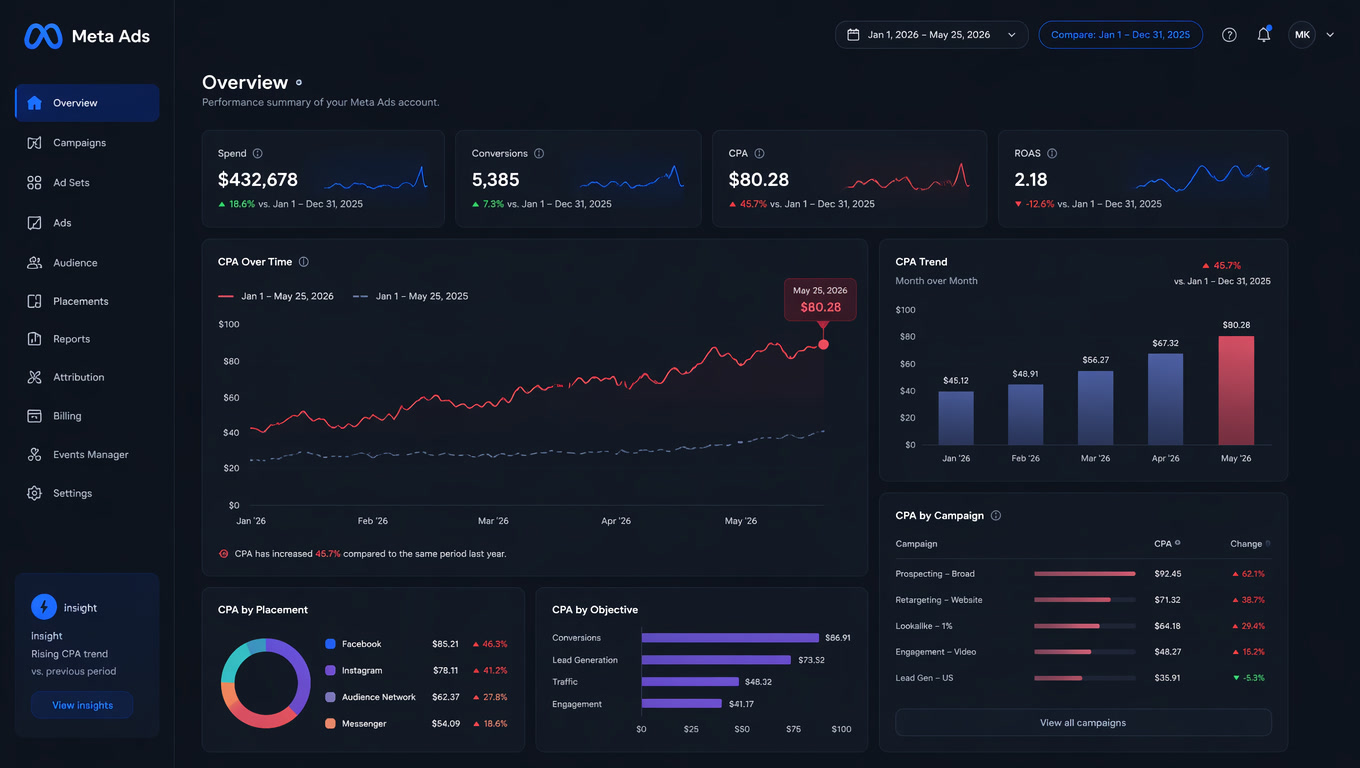
Creative fatigue is the hidden engine of budget concentration. When an ad shows fatigue signals (CPM +20%, CTR -30% from its 7-day average), the algorithm should redistribute — but it won't if that creative still has the best historical conversion data.
The rotation workflow we use at Mintec:
- Tag every creative with launch date at upload
- Weekly check: CPM, CTR, frequency, Creative Similarity Score
- When a creative hits 7+ days or frequency 4.0, pause it manually
- Activate a new or "sleeping" creative with a genuinely different concept
- If the new creative doesn't reach 80% of the original's CPA within 48 hours, reactivate the original
This 7-10 day cycle prevents any single creative from accumulating enough historical signal to monopolize the budget.
What doesn't work (we tested it)
Some tactics that seem logical but backfired:
- Lowering daily budget. Meta interprets small budgets as "maximize efficiency" and concentrates spend even more on the proven creative. Counterproductive.
- Duplicating ad sets with the same creatives. Andromeda detects duplicates and treats them as the same Entity ID, cannibalizing your own inventory.
- Switching optimization objectives. Moving from "conversions" to "clicks" or "reach" changes the audience but doesn't solve concentration. Andromeda still prioritizes the winning creative within each objective.
The 70-20-10 framework for Andromeda-era campaigns
The structure that has worked best across our client portfolio:
- 70% of budget: Established Advantage+ campaigns with proven creatives (3-5 Entity IDs).
- 20% of budget: Testing new creative concepts with independent Entity IDs and dedicated budgets.
- 10% of budget: Radical experimentation (new formats, creative audiences, risky propositions).
We cover this framework in more depth in our guide on Advantage+ Campaign Structure for 2026, including setup details for each layer.
What's coming: will Meta fix this?
Meta has acknowledged the budget concentration problem publicly and confirmed work on Creative Similarity Score adjustments to introduce "mandatory periodic exploration" within Advantage+ campaigns. Industry sources point to a Q4 2026 release.
Until then, the responsibility for distribution is yours. Andromeda won't rebalance for fairness — it will allocate for efficiency. Your job is to give the system enough genuinely different creatives, with enough individual budget, and active rotation so the algorithm doesn't fall asleep on a single winner.
For a quick audit of where your budget is concentrating, check our practical checklist in the Meta Ads AI Connectors & MCP guide. For context on the broader market shift, read Meta Overtakes Google in Ad Revenue. And if you're concerned about how off-platform retargeting changes affect your campaigns, we cover that in Meta Off-Meta Retargeting Impact.
Sources: Campaign data from Mintec-managed accounts, July 2026. Spend distribution analysis across 12 active Meta Ads accounts with combined monthly budgets of $45,000+. External references: Segwise.ai — "Meta Andromeda Update 2026: Creative Strategy Playbook" (June 2026) for Creative Similarity Score metrics and recommended creative volume benchmarks. Billo.app — "Meta Andromeda Update Explained" (June 2026) for individual retrieval vs audience targeting analysis. AdManage.ai — "Meta Advantage+ Shopping Campaigns 2026 Guide" for spend concentration benchmarks in ASC campaigns.
Frequently Asked Questions
Why is Meta spending all my budget on a single ad?
Meta's Andromeda system prioritizes the creative driving the most conversions at the lowest cost. Once a single ad outperforms others, the algorithm funnels more budget to it to maximize immediate results. The problem compounds when creatives are too similar — Andromeda groups them as a single Entity ID, so five similar variants compete for the same auction space as if they were one.
How many creatives do I need for fair budget distribution under Andromeda?
Meta recommends 15-50 active creatives per account in 2026 — roughly double the pre-Andromeda baseline. But quantity isn't enough: each creative needs to be genuinely different in concept, format, or offer for Andromeda to treat it as an independent Entity ID. With limited budgets, prioritize 5-10 unique concepts with at least $50-100 weekly spend each so they exit the learning phase.
What actually works to stop budget concentration?
Three tactics: (1) separate Entity IDs with individual daily budgets instead of variants inside one ad set, (2) radically different formats and concepts (video testimonials, static image offers, educational carousels) so Andromeda places them in different auction slots, and (3) active creative rotation with forced pauses at 7 days or frequency 4.0 to prevent any single ad from accumulating too much historical signal.