

AI Mode Doesn't Care About Your Keywords: Optimizing for Planning Queries in 2026
Users in Google AI Mode type 3x longer queries with planning and comparison intent. Content optimized for 2-word keywords gets ignored. Here's Mintec's framework for targeting conversational planning queries — with real examples and a 4-step process.
AI Mode Doesn't Care About Your Keywords: Optimizing for Planning Queries in 2026
Most SEO advice for AI Mode is wrong. Not bad, not incomplete — structurally wrong.
It tells you to add FAQ schema, write longer posts, and target long-tail keywords. That is the same advice from 2023, repackaged with "GEO" stamped on it. Meanwhile, AI Mode users are doing something keyword targeting cannot reach.
They are typing planning queries.
Not "best CRM" — three words with the same intent as every other searcher. Full sentences with constraints, preferences, and sub-questions baked in:
"I need a CRM for my 12-person B2B team that integrates with HubSpot and costs under $50/user/month — what should I look at?"
Traditional SEO cannot answer that. A page ranking for "best CRM small business 2026" gets ignored because the AI is looking for something different: complete, structured knowledge it can reassemble into a planning response.
I wrote about the citation gap last week — why top Google rankings and AI citations are decoupling. This is the tactical follow-up. If you want AI Mode to cite you, stop optimizing for keywords and start optimizing for planning queries.
What Changed
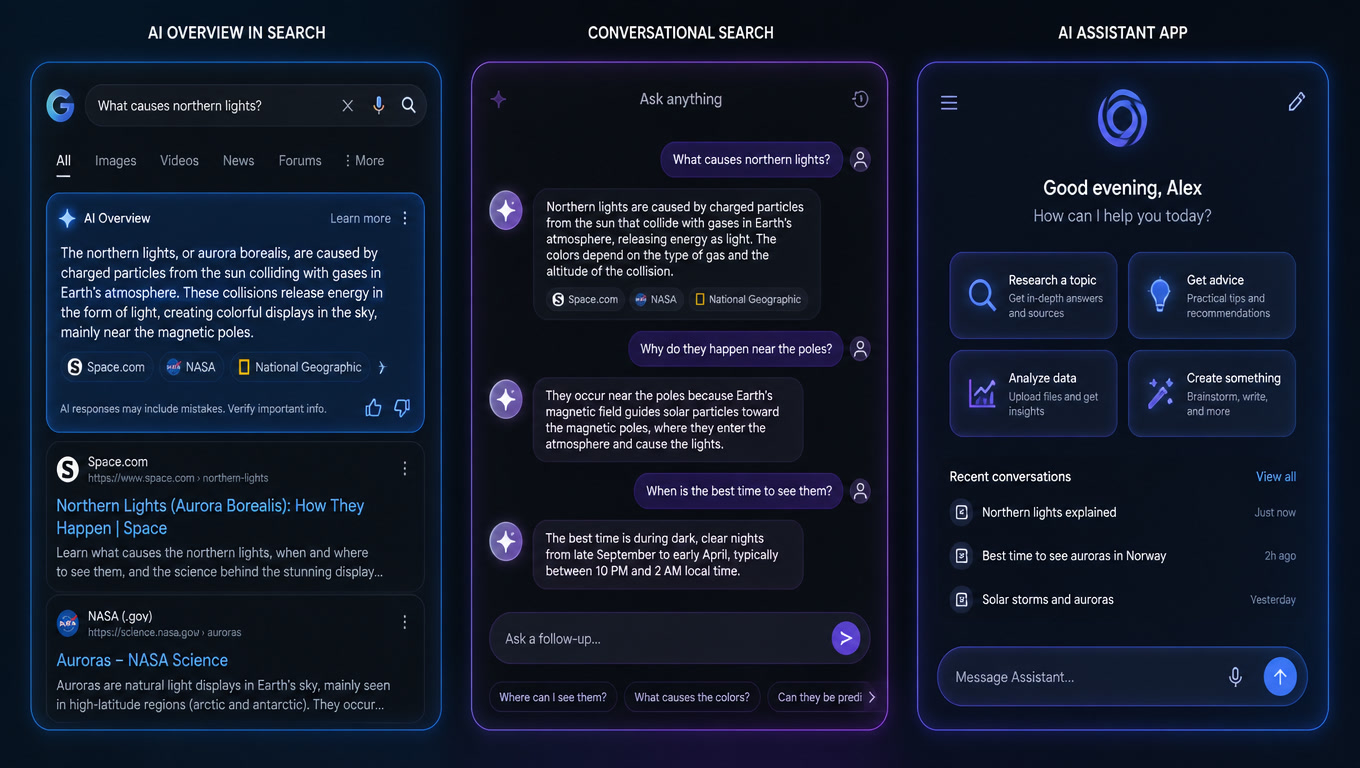
AI Mode queries average 3x longer than traditional search queries. Not a small shift — people are typing full questions, not keyword fragments. Google's own data shows follow-up queries rose 40% month over month through 2026. Users are having conversations with search, not one-shot lookups.
AI Mode passed 1 billion monthly users at Google I/O. That is one billion people doing planning queries, comparison queries, and multi-turn research. The share of search traffic coming from three-word keywords is shrinking. The share from conversational planning queries is growing.
If your content strategy still measures success by "position 1 for 'best CRM,'" you are optimizing for a shrinking pool.
What Planning Queries Actually Look Like
I have been collecting AI Mode query patterns since February — from client analytics, internal tests, and my own search behavior. Here is what keeps showing up:
Comparison queries with real constraints. Not "Salesforce vs HubSpot." "I run a 50-person remote sales team and we need mobile workflow approvals — which platform actually supports that without a $10k add-on?" The AI needs to compare specific features against stated constraints. Most vs pages are too generic.
Planning queries. "Plan a 3-day marketing conference in Austin with $50k and 200 attendees, AI tools focus." The AI does not retrieve a single page. It assembles an answer from venue options, budgeting guides, speaker recommendations, and timeline templates. If your content covers one piece of that puzzle well, it might get cited. If it covers all of it, it gets cited first.
Problem-solving queries. "Our email open rates dropped from 25% to 12% after switching ESPs — what could cause this?" The AI needs to reason through causes (deliverability, list hygiene, content changes), cross-reference your situation against known patterns, and suggest diagnostics. A single "email deliverability checklist" page does not cut it.
Validation queries. "I think we should switch from Zapier to n8n — am I missing any downsides?" The user already has a hypothesis. They want the AI to pressure-test it. Your content needs to acknowledge the downsides of the choice they are leaning toward, not just promote what you sell.
None of these look like keyword searches. None of them will be captured by a page ranking for "n8n vs Zapier 2026."
Why Most Content Fails
I have been testing how AI Mode responds to different content structures. The pages that rank well in traditional search but get ignored by AI Mode share a pattern:
Narrow scope. A page about CRM pricing that never mentions features, integrations, or migration effort. The AI needs to pull from multiple pages to answer a planning query. It prefers single sources that cover the full surface.
Shallow structure. Walls of text without subheadings, tables, or data summaries. AI Mode extracts structured information. If your page reads like a brochure, the AI cannot parse it into answer components.
No constraint handling. Planning queries always include constraints: budget, team size, timeline. If your content only answers "what is X" but never "what should I choose given Y constraints," it does not satisfy the query.
Data-free claims. "Our platform is the most popular choice for growing businesses" is useless to an AI that needs to cite specific adoption rates, retention numbers, or cost comparisons.
What We Have Been Doing with Clients (and It Works)
I am not going to pretend we figured this out months ago and have all the answers. We started testing in February, broke some things, and iterated. Here is what stuck:
Mine real conversations, not keyword tools. Pull from sales call transcripts, support tickets, CRM notes. Extract the actual sentences prospects use. Build a list of 20-30 real planning queries. Keyword research tools cannot capture conversational intent. Real conversations can.
Map the decision surface. For each planning query, list every sub-question the user needs answered before they can decide. For "which CRM:" pricing models, integrations, mobile support, migration difficulty, training requirements, scalability. Cover every sub-question in the same topical cluster. Do not spread them across three pages.
Write in modular answer blocks. Each section should work extracted in isolation. Lead with the answer, add context after. Put comparison tables at the top of comparison sections, not buried at the bottom. Make cost and effort explicit near the section header. End each section with a short verdict: "For teams under 20 on a tight budget, X is the better choice."
Verify with real AI Mode searches. This is the step everyone skips. After publishing, run your planning queries through AI Mode and check citation. If you are not cited, figure out why. Did the AI find your page but extract the wrong information? Or did it not find your page at all? The first problem is structure. The second is authority and depth.
The Part I Disagree With
A lot of GEO advice says "write for AI, not for humans." I think that is backwards.
AI Mode runs on Gemini 3.5 Flash with agentic reasoning. It evaluates whether your content is authoritative, specific, and complete — the same things a human expert checks. You are not tricking an algorithm. You are proving your content deserves citation.
The single best optimization for AI Mode is the same as winning a client's trust: be the most specific, most structured, most opinionated source on the topic. The AI does the rest.
What This Means
If your content strategy still revolves around keyword research, you are going to feel this shift before the end of 2026. AI Mode traffic does not reward keyword density, meta descriptions, or pages that answer one narrow question.
It rewards depth, structure, and taking a position. Planning queries do not want a list of options. They want a recommendation with tradeoffs, backed by specific data.
That is harder to produce than another "X vs Y" listicle. But it is the only kind of content that survives when the AI is doing the browsing for the user.
Frequently Asked Questions
What are planning queries in AI Mode?
Planning queries are multi-step, conversational searches where users ask AI Mode to complete a task or make a decision — for example, 'plan a 3-day marketing conference in Austin with a $50k budget.' Unlike traditional keyword searches, planning queries have constraints, preferences, and multiple sub-questions embedded in a single query.
How is optimizing for AI Mode different from traditional SEO?
Traditional SEO targets short keywords (2-4 words) and aims for position 1 on a SERP. AI Mode optimization targets full conversational queries (10-30+ words) and aims to be the source the AI cites when answering a planning task. The content structure changes from keyword-dense pages to modular answer blocks that AI Mode can reassemble into planning responses.
Do keywords still matter for AI Mode?
Individual keywords matter less than topical clusters and entity relationships. AI Mode's agentic reasoning (powered by Gemini 3.5 Flash) evaluates whether your content comprehensively answers the user's goal — not whether you used the right keyword density. Short keyword-focused pages are effectively invisible to AI Mode traffic.